eBook - ePub
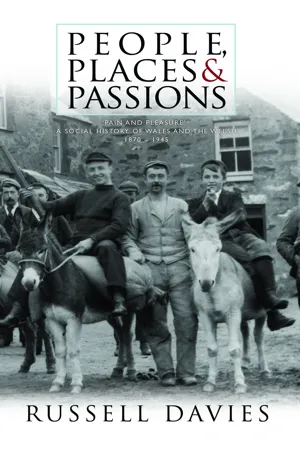
People, Places and Passions
A Social History of Wales and the Welsh 1870–1948 Volume 1
- 448 pages
- English
- ePUB (mobile friendly)
- Available on iOS & Android
eBook - ePub
People, Places and Passions
A Social History of Wales and the Welsh 1870–1948 Volume 1
About this book
The first of two volumes on the social history of Wales in the period 1870–1948, People, Places and Passions concentrates on the social events and changes which created and forged Wales into the mid-twentieth century. This volume considers a range of social changes little considered elsewhere by studies in Welsh history, accounting for the role played by the people of Wales in times of war and the age of the British Empire, and in technological change and innovation, as they travelled the developing capitalist and consumerist world in search of fame and fortune.
Information
1
The Structures of Everyday Life: Endurance and Endeavour
O wynfa goll! O wynfa goll!
Ai dim ond breuddwyd oeddet oll?
(O paradise lost! O paradise lost!
Were you just a dream?)
Cynan (Albert Evans-Jones), ‘Mab y Bwthyn’ quoted in Alan Llwyd,
Rhyfel a Gwrthryfel
(Llandybïe, 2003), p. 179
Rhyfel a Gwrthryfel
(Llandybïe, 2003), p. 179
People and places: vital statistics
Hapus dyrfa
Sydd â’u trigfan yno mwy.
Sydd â’u trigfan yno mwy.
(Happy throng
Have their dwelling there evermore.)
Have their dwelling there evermore.)
Islwyn (William Thomas: 1838–78),
in O. M. Edwards (ed.), Gwaith Islwyn (1903)
in O. M. Edwards (ed.), Gwaith Islwyn (1903)
The population of Wales rose throughout the period 1870–1931. Within the legally defined geographical boundaries of the country, in 1871, there lived 1,412,583 people. Their number increased to 1,571,780 in 1881 and rose again to 2,420,921 in 1911. In 1921, despite death’s diligent harvesting in the First World War and the 1918 influenza pandemic, 2,656,474 people lived in Wales. During the late 1920s and the 1930s, the corrosive and erosive experience of economic decline and depression dislocated population growth so that in 1939, on the eve of the Second World War, the number of people living in Wales had declined to 2,487,000.1 Despite war, austerity and rationing, by 1951 the population had increased slightly to 2,598,675. The increase was far from uniform over the country. There were zones of stagnation and even of regression, in sharp contrast to zones of dynamic expansion and, from area to area, the chronological patterns varied. The population, as we shall see, was not just increasing, but moving.
The national figures conceal as much as they reveal about the markedly different demographic experience of each county. Angle-sey, Breconshire, Cardiganshire, Merioneth, Montgomeryshire, Pembrokeshire and Radnorshire experienced continuous decline in population. A few examples are indicative, if not wholly representative, of the general trend. The western, coastal county of Cardigan-shire had its peak of population in 1871 when 73,441 people lived within its borders. Thereafter, each successive census recorded a decrease until 1951, when only 53,278 people lived in Cardigan-shire.2 In remote and rural Radnorshire, time seemed to have been at anchor since the days of George Herbert and the metaphysical poets, for the number of people gently dwindled, from 25,430 in 1871 to 19,993 in 1951. Far from the madding crowd, this part of the ‘green desert’ of mid Wales had more sheep than people.3 The chief ambition of many young people in rural Wales was simply to leave. They yearned to escape from the morose countryside, on foot and by donkey-cart, to avoid poverty, stilted ambition and strangled aspirations. In marked contrast to these counties was the general experience of Carmarthenshire, Caernarfonshire, Denbigh-shire, Flintshire, Glamorgan and Monmouthshire, in which population grew significantly. Glamorgan, in particular, witnessed spectacular growth. In 1871, some 397,859 people lived within the county’s boundaries. By 1901 the population had more than doubled to 859,931 and rose again to 1,252,481 in 1921. Thereafter, the county’s population entered a period of decline, so that by 1951 around 1,202,581 people lived in Glamorgan.4
It is important to emphasise that the rates of growth or decline were neither uniform across each Welsh county, nor consistent down the decades. In the eastern and northern parishes of Cardigan-shire, for example, where lead mining had declined to a ghostly echo of a hammer, the population was in serious decline. In contrast, the western coastal town of Aberystwyth, thanks to tourism and the fledgling university, experienced gradual growth from 6,899 people in 1871 to 9,315 in 1951.5 Glamorgan’s predominantly rural and agricultural parishes experienced a slow, mouldering population decline. In contrast, especially in the years down to 1921, population growth in other parts of Glamorgan was breakneck. Neath grew from 9,319 people in 1871 to 32,284 in 1951; Maesteg from 7,667 to 28,917; Mountain Ash from 17,826 to 43,287. Within the old town boundaries of Cardiff there lived 39,536 people in 1871. Ten years later, 82,761 people existed within the new boundaries of the municipal borough. Thereafter the population grew and grew again, until by 1951 there were 243,632 citizens in the city of Cardiff. The Rhondda urban district, in 1871, was still a relatively bucolic area where ‘an agile squirrel could make its way up the valley without placing a paw on the ground’. By 1921, an estimated 162,717 people had packed along the valley floor and the slopes above.6 As the historian studies the census across the decades, new towns suddenly emerge with the arbitrariness of the creative process of Genesis. In 1861, the census had no entry for Briton Ferry. In 1871, 26,112 people lived hugger-mugger in the ‘Giant’s Grave’ there. Barry was a small, gull-infested hamlet of 484 people in 1881. By 1921, thanks largely to David Davies’s decision to construct his own docks there to circumvent the Bute monopoly at Cardiff, 38,945 people had been attracted to the town.7 Ten years, or even three or four years, were time and tide enough for some communities, such as Croesderw in the Afan valley, to grow, flourish and vanish, so that they never appeared in the census enumerator’s records. In 1902 the hell-roaring mining camp boomed; by 1910 it was a ghost town.8
The census statistics reveal patterns of real human interest. The distribution of men and women across the counties of Wales reflected the patterns of population increase and decrease. Those counties which had experienced demographic decline tended to have higher numbers of women than they did of men.9 Anglesey, Breconshire, Caernarfonshire, Cardiganshire, Merioneth, Pembroke-shire, Radnorshire, even Carmarthenshire, were effectively matriarchal societies. In Cardiganshire in 1871, 33,396 men lived alongside 40,045 women. In contrast in Glamorgan, as the 1871 census revealed, men outnumbered women by 205,660 to 192,199. Marriage prospects and, presumably, choice, for men were usually better in the rural and western counties. In contrast, women in want of a partner, were advised to ‘go east young girl’ to Glamorgan, Flintshire, Denbighshire or Monmouthshire.10 Economic forces must have created profound emotional frustration.
The age profile of different counties also differed significantly. Those counties which grew in population had high percentages of young, unmarried men. In contrast, those areas of Wales which experienced population decline tended to be principally comprised of middle-aged and of elderly women. Indeed, the census statistics reveal that, between 1871 and 1951, the number of Welsh people who survived into old age increased markedly. In 1871, only 21 people in Wales lived to be over 100 years of age. In 1951, there were 397 centenarians. Again, the disparity between the survival of the sexes was apparent. Only 5 men in 1871, and 63 men in 1951 managed to survive to receive birthday greetings from their sovereign. Above 50 years of age, women outnumbered men. Wales was a land of widows - there were always more widows than widowers. In 1891, to take just one date at random, 33,060 widowers outlived their wives, whereas 76,891 widows outlasted their husbands.11
Historians have expended considerable industry in explaining the growth of population. From the multitude of variations it is clear that all sorts of factors are involved in population ebb and flow – details of local circumstances, of weather and crops, the ups and downs of manufacturing and trading, local pressures concerning the age of marriage and sexual conduct, opportunities for social and geographical mobility and, more mysteriously, the changes in the virulent force of particular epidemics. Yet a satisfactory answer is elusive, for the reasons are lost in the mysterious interface between biology and behaviour. To simplify the complexity, it can be stated that, in its essence, a population can grow for one of two reasons. Firstly, more people need to be cradled by the midwife than are carried away by the undertaker. Births need to outnumber deaths. Therefore, it was significant that, for a host of reasons, death’s sting was softened in the period 1871–1951. Secondly, more people need to live in and move into an area than leave it.12 Between 1871 and 1921, the population increased because Wales was able to retain a significant portion of her natural increase in population, but it was only that ‘Black Gold Rush’ decade of 1901–11 that witnessed an absolute increase in population. Thus, the 1911 census revealed that significant numbers of foreign born people had moved into Wales. Cardiff, with 4,786 ‘foreigners’ was second only to London as a centre for immigration, whilst Swansea was in fourth position and Newport in eighth place with regard to the number of foreign-born people who had recently moved in. There were also, on occasion, communities of immigrants in remote places, such as the large numbers of Irish people settled along the coast in Anglesey and Pembrokeshire, and a group of over 200 Italians drawn to north Cardiganshire in an ill-fated attempt to reopen the Frongoch leadmine.13
Despite the ability of Wales to draw in immigrants, the emigrant’s experience of heartbreak and hiraeth was a significant aspect of the Welsh experience. The emigrants created an absence, a sense of communities hollowed out and deprived of men and women. As T. Rowland Hughes lamented in his poem to the deserted homestead, ‘Y tyddyn’: ‘Mae “nhw” wedi mynd i gyd: ’Does ’na ddim o’u hôl, dim byd.’ (They have all gone. There is no trace of them, nothing).14 In 1891, the American census revealed that 100,079 Welsh-born people resided in the United States, the majority of whom, 17,767, had gone off to Pennsylvania in the morning.15 Others departed Welsh borders and shores to London, Liverpool, Australia, South America, India or South Africa. In the 1880s, W. O. Thomas travelled around the world twice, recounting his adventures in print in Dwywaith o amgylch y byd (Utica, 1882). Wherever he went, he sought out local Welsh people. Shamelessly, he played and preyed upon their homesickness and conned them into providing him with free board and lodging. His book is a remarkable testimony to native generosity and gullibility but also to the global spread of the Welsh diaspora.16
Her ability to retain most of her own people had profound implications for the linguistic character and composition of Wales.17 In 1891, the census enumerators, for the first time, included a question in the census as to the linguistic preferences and practices of the Welsh. The results, despite reservations about the reliability of the statistics, indicate that roughly 54.4 per cent of the people of Wales spoke Welsh. This percentage declined gradually as the combined effects of Anglicisation, education, globalisation, commercialism, emigration and migration generally worked to the detriment of the Welsh language. From 1901, when 49.9 per cent of the people could speak it, the situation of Welsh became parlous. By 1951, the percentage had decreased further to 28.9 per cent. As with all statistics, the levels vary markedly across Wales, but speaking generally and compressing the experiences of particular communities into averages, the percentage of people who spoke Welsh was at its highest the further west one travelled. In Anglesey, Caernarfonshire, Carmarthenshire and Merioneth in 1951, over 70 per cent of the people still spoke Welsh. In 1931, despite the detrimental impacts of education, the First World War and the ravages of economics, a significant number of the people of Anglesey (23.9 per cent), Caernarfonshire (21.4 per cent), Cardiganshire (20 per cent) and Merioneth (29.7 per cent) were monoglots whose sole language was Welsh.18
In eastern border counties, where the integration with England was stronger and longer, the percentage who spoke Welsh was substantially lower. Only 4.5 per cent of the people scattered around Radnorshire could speak Welsh. The percentages of Welsh speakers in Flintshire (21.1 per cent), Glamorgan (20.3 per cent) and Monmouth (4.5 per cent) were a cause of serious concern for lovers of the language. This situation led some to argue that the process of industrialisation killed the Welsh language. But others have countered, arguing that even if the percentage of, for example, the total population of Glamorgan who spoke Welsh was comparatively low, the actual total number of speakers was significant. The number of people in Glamorgan who could speak Welsh rose from 320,072 in 1871, to 368,692 in 1921. This figure was far higher than the combined total of people who could speak Welsh in the four counties where the percentage of Welsh speakers was highest. Such facts led the economist Brinley Thomas to argue that industrialisation did not slay, but rather saved, the Welsh language. Carmarthenshire’s Aman and Gwendraeth valleys, Glamorgan’s Tawe and Neath valleys and Caernarfonshire’s slate-quarrying and Flintshire’s coal-mining regions, were significant industrial areas in which Welsh was the community’s chosen language.19
‘Ill fares the land’: the failures and fortunes of Welsh agriculture
Lle dôi gwenith gwyn Llanrhiain
Derfyn haf yn llwythi cras,
Ni cheir mwy ond tres o wymon
Gydag ambell frwynen las.
Ni cheir mwy ond tres o wymon
Gydag ambell frwynen las.
(Where once came Llanrhiain’s white corn,
At summer’s close in loaded carts,
Now there is just a trace of seaweed
And a few brambles).
Now there is just a trace of seaweed
And a few brambles).
Crwys (William Williams), ‘Melin Trefin’,
Cerddi Crwys (Wrexham, 1935)
Cerddi Crwys (Wrexham, 1935)
Crwys wrote his sad lines of lament for Melin Trefin after a visit to the derelict mill on the north Pembrokeshire coast. This miller’s tale is an eloquent reminder that the history of rural Wales is often told as a saga of decline, despair and doom, where two thing are certain; firstly, it rains, and secondly, with the persistence of rain on the rolling badlands of Pumlumon, farmers complain that times are dire. Yet pessimistic tales of half-empty barns obscure the fact that the period 1870–1945 saw a profound transformation in the functions and fortunes of Welsh agriculture.
By the 1870s Wales had already witnessed remarkable change in the nature and extent of the agriculture practiced. A significant...
Table of contents
- Cover
- Half Title
- Title
- Copyright
- Contents
- List of Illustrations
- Prologue: Sources for a ‘Sullen Art’
- Introduction: Private Lives, the Individual and Society
- 1 The Structures of Everyday Life: Endurance and Endeavour
- 2 ‘Lead us into Temptation’: Consumerism, Creativity and Change
- 3 ‘Bonfire of the Vanities’: Ambitions, Aspirations and Education
- 4 ‘Ffair Wagedd’ – Vanity Fair: People, Class and Hierarchy
- 5 Hiraeth and Heartbreak – Wales and the World: Curiosity, Boldness and Zest
- 6 ‘The Blood never Dried’ – the Welsh in Empire: Envy, Greed and Zeal
- 7 ‘Ha! Ha! among the Trumpets’ – a Century of Warfare: Cowardice, Courage and Hatred
- 8 ‘Once more unto the breach’ – Wales and the Welsh go to War, Again: Fear, Terror and Tragedy
- L’Heure Bleue (The Blue Hour): a brief conclusion
- Notes
Trusted by 375,005 students
Access to over 1.5 million titles for a fair monthly price.
Study more efficiently using our study tools.
Frequently asked questions
Yes, you can cancel anytime from the Subscription tab in your account settings on the Perlego website. Your subscription will stay active until the end of your current billing period. Learn how to cancel your subscription
No, books cannot be downloaded as external files, such as PDFs, for use outside of Perlego. However, you can download books within the Perlego app for offline reading on mobile or tablet. Learn how to download books offline
Perlego offers two plans: Essential and Complete
- Essential is ideal for learners and professionals who enjoy exploring a wide range of subjects. Access the Essential Library with 800,000+ trusted titles and best-sellers across business, personal growth, and the humanities. Includes unlimited reading time and Standard Read Aloud voice.
- Complete: Perfect for advanced learners and researchers needing full, unrestricted access. Unlock 1.5M+ books across hundreds of subjects, including academic and specialized titles. The Complete Plan also includes advanced features like Premium Read Aloud and Research Assistant.
We are an online textbook subscription service, where you can get access to an entire online library for less than the price of a single book per month. With over 1.5 million books across 990+ topics, we’ve got you covered! Learn about our mission
Look out for the read-aloud symbol on your next book to see if you can listen to it. The read-aloud tool reads text aloud for you, highlighting the text as it is being read. You can pause it, speed it up and slow it down. Learn more about Read Aloud
Yes! You can use the Perlego app on both iOS and Android devices to read anytime, anywhere — even offline. Perfect for commutes or when you’re on the go.
Please note we cannot support devices running on iOS 13 and Android 7 or earlier. Learn more about using the app
Please note we cannot support devices running on iOS 13 and Android 7 or earlier. Learn more about using the app
Yes, you can access People, Places and Passions by Russell Davies in PDF and/or ePUB format, as well as other popular books in History & 19th Century History. We have over 1.5 million books available in our catalogue for you to explore.