- English
- ePUB (mobile friendly)
- Available on iOS & Android
eBook - ePub
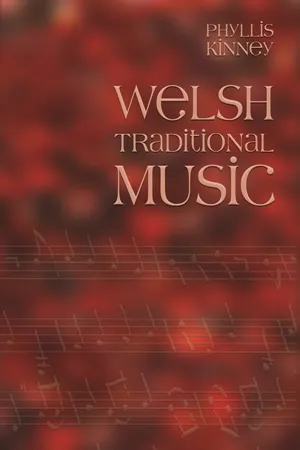
Welsh Traditional Music
About this book
Now available in paperback, this fully illustrated volume traces the emergence of Welsh traditional music through the ages and is complemented throughout with more than 200 musical examples. Phyllis Kinney's Welsh Traditional Music covers the traditional music of Wales from its beginnings through to the present day, providing musical analysis and placing its material firmly into a social and historical context. Among the many different forms of Welsh traditional music discussed are seasonal music (including wassail songs, Christmas and May carols and Plygain carols), folk drama, ballad-singing, the relevance of the eisteddfod and the musical journals of the nineteenth century. Additionally, the book includes a history of song collecting from the eighteenth century to the establishment and ongoing activities of the Welsh Folk-Song Society in the twentieth; both the instrumental and the vocal traditions are examined, as well as the uniquely Welsh tradition of 'cerdd dant'. This is a work of pioneering scholarship that accounts for Welsh traditional music within the context of a greater Welsh musical tradition.
Information
1
The Oral Tradition
NO MANUSCRIPTS of secular music have survived from Wales, if indeed there were any, before the end of the sixteenth century. Although music was an important part of Welsh life, the secular tradition was an oral one. The music of ordinary people, the songs and dances of ploughmen, nursemaids, blacksmiths and itinerant fiddlers were not noted down before the eighteenth century, whereas music favoured by cultivated Welsh gentry from later medieval times until the seventeenth century was sophisticated, complex, bound by strict rules and passed on orally from teacher to pupil. Knowledge of music from an earlier period depends upon literary references, passages from the Welsh Laws and comparison with other Celtic societies such as Ireland.
One of the earliest references to music in Wales was made by the sixth-century monk Gildas in De Excidio et Conquestu Britanniae where his caustic indictment of Maelgwn Gwynedd, lord of Anglesey and Gwynedd, gives a picture of praisesinging in early Welsh courts. The monk berates the ruler for not listening to the ‘tuneful voice’ of Christians singing the praises of God with sweet rhythm and melodious church song, instead of his own bards, a rascally crew who yell forth his praises like Bacchanalian revellers. This earliest reference to bards in Wales gives an interesting picture of two styles of singing: the ecclesiastical style, pleasing and harmonious; and the bardic style, strongly declamatory. Some half-century later the churchman Venantius Fortunatus mentions the instruments used:
Romanusque lyra, plaudat tibi barbarus harpa,
Graecus Achilliaca, crotta Brittanna canat.
[Let the Roman praise you with the lyra, the barbarian with the harpa,
the Greek with the lyre of Achilles, the Briton with the crotta]1
Graecus Achilliaca, crotta Brittanna canat.
[Let the Roman praise you with the lyra, the barbarian with the harpa,
the Greek with the lyre of Achilles, the Briton with the crotta]1
Although Venantius calls these instruments by different names, lyra, harpa, crotta, it appears that they were all species of lyre, the ‘crotta’ of the Britons being the vernacular name for an early unbowed ancestor of the crwth (crowd).
The close connection of music and poetry in this period, and for many centuries to follow, is evident in Welsh terminology: a cerdd can be either a song or poem and caniad can mean poetry or music. However, information about music and poetry in early Wales is extremely scarce. The Roman occupation, which lasted some four hundred years until the end of the fourth century, affected the nature of Celtic society in the conquered areas; for clues to bardic tradition in this period it is necessary to turn to Ireland, which the Romans never conquered.
When St Patrick arrived there in the fifth century, Celtic culture was still similar to that described by Caesar in Gaul. Poets held an important position at Celtic courts and their influence was powerful; in addition to singing praises, elegies and satires, they were prophets, story-tellers, genealogists and historians. In time, court poets formed a professional hierarchy in which each class had its own rank and dignity. The chief poet had a special chair in the court and his status was equal to that of the king. Bardic training was long and demanding; it took twelve years for the chief poet to complete his education and seven for an ordinary bard. Because the appeal of the poetry was first and foremost to the ear, music was an essential part of the bardic performance, sustaining the rhythm of the words.
The Marquis of Clanricarde, in describing the performance of a poem in the presence of a wealthy patron in early seventeenth-century Ireland noted that it was accomplished:
with a great deal of Ceremony, in a Consort of Vocal and Instrumental Musick. The Poet himself said nothing, but directed and took care, that everybody else did his Part right. The Bards having first had the Composition from him, got it well by Heart, and now pronounc’d it orderly, keeping even Pace with a Harp2
Sometimes the harp was joined by the tiompán, a kind of lyre, and at a later period the poet sang to his own accompaniment. Although the Marquis was writing in the eighteenth century, the tradition was a conservative one and his description represents a very much older custom.
Welsh society in the period after the Romans left seems to have been much like that of Ireland in terms of bardic duties and status, but references to musicians in early Welsh poetry are vague. Interpretation of the place of music in Wales before the English conquest in 1282 depends upon literary and legal references and the writings of the ecclesiastic, Giraldus Cambrensis (Gerald of Wales). The Laws of Hywel Dda (Hywel the Good) derived their name from the tenth-century king Hywel and represent a native legal tradition which was predominantly oral and which had evolved over a long period, though the earliest extant written manuscripts come from the thirteenth century. Because of this, the Laws incorporate much material which refers to earlier times and many references that suggest the warrior aristocracy of a heroic age.
These Laws describe three kinds of poet. Lowest in stature was the cerddor, a bardic apprentice being trained in the craft of poetry and whose status was defined by the fact that no serf or villein’s son could practise the bardic craft without the king’s permission. Above him came the bardd teulu, a court officer and bard of the war-band. At the top was the pencerdd, a master-poet who had the privilege of sitting at court in a chair which symbolised his authority and had to be won in poetic competition. In the heroic age, court poets would be expected to perform their songs before battle and at the victory feast after a successful battle where they would sing the praises of the king and his war-band. Although the word ‘sing’ is used, it would probably be a mistake to think in modern terms since the style was almost certainly declamatory rather than melodic.
By the time the Laws were written down the harp was the supreme instrument of the Welsh; in addition to the performances of professional harpers, harp-playing was part of the education of a noble. However, according to one version of the Laws, two other instruments, the crwth and the pipes, had high if not equal status. At a twelfth-century feast held by the Lord Rhys in Cardigan Castle, a chair was awarded to the winner of a competition between harpers, crouthers and pipers.3
The inherent conservatism of the bardic order meant that, even after the passing of the heroic age with its warrior aristocracy, poets retained much of their status and influence. Apprentices had to pass through various stages of instruction, which might take as many as nine years before attaining the rank of pencerdd, and only a pencerdd could assume the right to be a bardic teacher, demanding many years of study through predominantly oral instruction. Although the poetry created was essentially aristocratic and had little or no place in the lives of ordinary members of the community, the bardic order continued to train poets in this style and to hold degree examinations to the end of the sixteenth century.
There is no detailed description of musical styles until the end of the twelfth century when the Norman-Welsh ecclesiastic, Giraldus de Barri, known as Giraldus Cambrensis, accompanied Archbishop Baldwin on a tour through Wales to preach the Third Crusade. The Archbishop, impressed by Topographica Hibernica (The Topography of Ireland), an early work by Giraldus, suggested that he should write the history of the tour and it is from his copious notes on the places they visited and the customs of the people, published in his Itinerarium Kambriae (The Journey through Wales) and Descriptio Kambriae (The Description of Wales), that we have our first significant description of music in Wales. These reports include the musicmaking of ordinary people for the first time.
The second chapter of the Itinerarium Kambriae contains a description of the feast-day of St Eluned in Breconshire, where sick people would come together from far and wide in the hope of being cured. Giraldus describes men and women, in the church or the churchyard, sometimes dancing, sometimes as if in a peaceful trance, then suddenly jumping up in a frenzy and indicating with gestures the work they had been doing unlawfully on holy days. One would appear to put his hand to the plough, another seemed to urge on the oxen with a goad, both singing crude rustic songs as if to ease their work. This first report to give any detail of folk singing in Wales is significant in that the writer mentions oxen songs, a type which continued in use in Glamorganshire until the end of the nineteenth century, some eight hundred years later.4
The tenth chapter of the Descriptio Kambriae confirms the importance of the harp, with Giraldus remarking that Welsh courtiers consider the ability to play the harp greater than all other accomplishments, while in every house there would be harps and, if guests should arrive early in the day, the young women of the household would play for them on the harp. In the twelfth chapter, Giraldus corroborates the references in the Laws that the Welsh play three instruments – harp, pipes and crwth.
It also contains what he said about Irish instrumental performers in the Topographica Hibernica, showing how close the two cultures were in his day. He describes them as playing with fingers moving so swiftly that they seem to be disputing with each other, yet preserving harmonic consistency while performing with unfailing artistry a variety of music on diverse instruments with sweet rapidity, unequal equality and discordant concord finishing in tonal unity. Whether the strings sound in fourths or in fifths, the performers always begin with B flat and return to it at the end so as to finish with a pleasing sound. The treble strings are played rapidly above the deeper tones of the lower strings giving particular enjoyment to the listener while concealing their artistry. Those who have studied and who understand the mysteries of this art would get great pleasure from it, but for those who listen without comprehension it would be like a disorderly tumult, producing exhaustion and boredom in unwilling listeners.
Here it is obvious that Giraldus is not discussing the songs of ordinary people but professional instrumentalists performing elaborate music for an aristocratic audience. He seems to be describing music that differs from the general trend of European music of that period but his words are open to more than one interpretation. ...
Table of contents
- Half Title
- Title Page
- Copyright
- Foreword
- Acknowledgements
- Contents
- List of illustrations
- Abbreviations
- A note on the translation of Welsh terms and transcription of the musical examples
- Introduction: What is Traditional Music?
- 1: The Oral Tradition
- 2: The Watershed
- 3: Manuscript to Print
- 4: Edward Jones and Traditional Airs
- 5: Seasonal Festivities
- 6: Carols, Ballads and the Anterliwt
- 7: The Early Collectors: Iolo Morganwg and Ifor Ceri
- 8: The Great Change
- 9: The Momentum Continues
- 10: J. Lloyd Williams and the Welsh Folk-Song Society
- Notes
- Appendix 1: Cerdd Dant
- Appendix 2: Printed Music Collections referred to (including facsimiles) by date of publication
- Bibliography
- Index of Music
Trusted by 375,005 students
Access to over 1.5 million titles for a fair monthly price.
Study more efficiently using our study tools.
Frequently asked questions
Yes, you can cancel anytime from the Subscription tab in your account settings on the Perlego website. Your subscription will stay active until the end of your current billing period. Learn how to cancel your subscription
No, books cannot be downloaded as external files, such as PDFs, for use outside of Perlego. However, you can download books within the Perlego app for offline reading on mobile or tablet. Learn how to download books offline
Perlego offers two plans: Essential and Complete
- Essential is ideal for learners and professionals who enjoy exploring a wide range of subjects. Access the Essential Library with 800,000+ trusted titles and best-sellers across business, personal growth, and the humanities. Includes unlimited reading time and Standard Read Aloud voice.
- Complete: Perfect for advanced learners and researchers needing full, unrestricted access. Unlock 1.5M+ books across hundreds of subjects, including academic and specialized titles. The Complete Plan also includes advanced features like Premium Read Aloud and Research Assistant.
We are an online textbook subscription service, where you can get access to an entire online library for less than the price of a single book per month. With over 1.5 million books across 990+ topics, we’ve got you covered! Learn about our mission
Look out for the read-aloud symbol on your next book to see if you can listen to it. The read-aloud tool reads text aloud for you, highlighting the text as it is being read. You can pause it, speed it up and slow it down. Learn more about Read Aloud
Yes! You can use the Perlego app on both iOS and Android devices to read anytime, anywhere — even offline. Perfect for commutes or when you’re on the go.
Please note we cannot support devices running on iOS 13 and Android 7 or earlier. Learn more about using the app
Please note we cannot support devices running on iOS 13 and Android 7 or earlier. Learn more about using the app
Yes, you can access Welsh Traditional Music by Phyllis Kinney in PDF and/or ePUB format, as well as other popular books in Media & Performing Arts & Folk Music. We have over 1.5 million books available in our catalogue for you to explore.