eBook - ePub
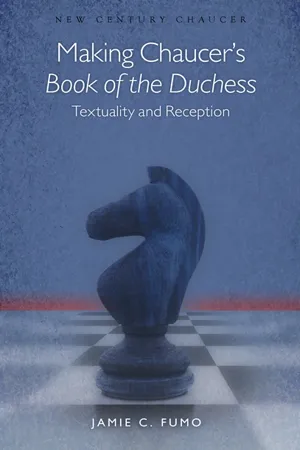
Making Chaucer's Book of the Duchess
Textuality and Reception
- 272 pages
- English
- ePUB (mobile friendly)
- Available on iOS & Android
eBook - ePub
About this book
Making Chaucer's Book of the Duchess: Textuality and Reception is the first comprehensive, book-length study of Chaucer's earliest major narrative poem, its critical contexts and its literary reception.
Information
1
READING THE BOOK (I)
Critical History – An Overview
On the face of it, Chaucer’s Book of the Duchess is an unprepossessing, even simple poem. Its central matter consists of a largely one-sided conversation between two strangers, leading to a wholly predictable revelation expressed in three short monosyllables: ‘She ys ded!’ (1309). There occurs no real action to speak of, unless one counts the forest hunt that is kept offstage for most of the narrative. Human drama hangs on the awkward structure of the poem like an ill-fitting mantle: the poem’s only genuinely endearing character is a lost puppy, and he vanishes after ten brief lines. BD ends quaintly – one might even say naïvely – with the Chaucer-persona placing the completed poem, as if tied with a shiny ribbon, in our hands to enjoy and be done with. ‘Thin prettiness’, sniffed the great early Chaucer critic and editor J. M. Manly regarding BD in his 1929 Warton Lecture, Chaucer and the Rhetoricians. The stiff artificiality Manly detected in Chaucer’s use of rhetorical convention in the early BD led him, rather astonishingly, to express relief that we have a limited stock of Chaucer’s juvenilia over which to spill ink: ‘Unfortunately – or perhaps fortunately – most of his early writings have perished.’1
Manly was not alone among distinguished early Chaucer scholars in disdaining BD as a meagre, amateurish, imitative or at best rough-hewn work whose chief relevance is its demarcation of how far Chaucer’s genius had yet to evolve. Writing in 1871, the indefatigable Victorian scholar Frederick James Furnivall, whose seminal contributions to Chaucer studies include his establishment of the Chaucer Society and coordination of the Six-Text Edition of the Canterbury Tales, regarded BD as a patchy experiment. Furnivall endorsed William Godwin’s view, advanced in his 1803 biography of Chaucer, that BD jumbled stylistic promise with more than occasional ‘trite, vulgar and impotent’ passages which attest to ‘the crudeness of taste of the times in which Chaucer wrote’.2 Particularly offended by the oddly paced ending, Furnivall conveyed his hope that ‘Chaucer felt ashamed of himself for this most lame and impotent conclusion … every time he read it: he ought to have been caned for it.’3 Similarly, C. S. Lewis in his Allegory of Love (1936) found the overall effectiveness of BD as an elegy marred by rhetorical indulgence in ‘the old, bad manner’ which Chaucer, unlike his early poetic followers, would eventually outgrow.4 For Robert Kilburn Root, writing in 1922, BD’s artistic potential crumbled into ‘mediocrity’ and ‘weary reading’, especially when weighed against Chaucer’s later poetry (rather irrelevantly, Root noted that John Keats evinced much greater poetic maturity at a young age than did Chaucer).5 Even Charles Muscatine, one of the most sensitive students of Chaucer’s creative imitation of French source materials, offered faint praise for this narrative poem of Chaucer’s most fully steeped in the French tradition, referring to it politely as a ‘competent courtly elegy’ diminished by ‘conventionalism’.6
That such negative opinions did not finally dominate the scholarly history of BD owes much to George Lyman Kittredge, who defended the poem as ‘charming and generally underrated’ and a ‘lovely and pathetic elegy’.7 Kittredge’s foundational work on BD, in articles minutely tracing the poem’s sources in various dits of Guillaume de Machaut, and in the interpretative analysis developed in Chaucer and His Poetry (1915), set the terms of investigation and debate for the remainder of the twentieth century. The lines of critical discussion opened by Kittredge, centred especially upon the motivation and consistency of the narrator and the thematic coherence of the poem, engendered over time a dazzling array of interpretative perspectives on key issues of genre, characterization, literary relationships and the poetics of consolation, among others. The diverse (and sometimes divisive) history of scholarship on BD attests to the richness and elusiveness of a poem once thought wholly without guile, debunking Muscatine’s claim that among Chaucer’s early poems, BD is ‘the most homogeneous in style and the clearest in meaning’.8 In point of fact, this ‘happily depressing’, restively eclectic poem about death, literature, featherbeds, hunting and feminine beauty raises enduring problems of interpretation that cast into relief both the formative narratives of Chaucer scholarship and its patterns of development to the present day.9
Twenty-first-century scholars occupy a very different conceptual space from the earlier critics whose views have just been rehearsed. Those literary historians, philologists, editors and textual scholars were the learned architects of Chaucer studies as an academic discipline; theirs was the fundamental work of standardizing, contextualizing and disseminating Chaucer’s works for an increasingly professionalized academy, one for which Chaucer carried the authority (for English literature) of a founding father. Today’s more diverse and decentred academy, by comparison, is sceptical of canonical imperatives and irreverent towards its ‘father figures’. Simultaneously, it is critically contemplative of its own institutional history – a trend, for Chaucer studies, well represented by the interrogations of Chaucer’s critical and popular reception by Steve Ellis (2000), Stephanie Trigg (2002), Kathy Cawsey (2011) and others. From this vantage point, the momentousness of Chaucer’s first major narrative poem is enfolded, as Elizabeth Scala has observed, in an ‘overdetermined sense of origins’. For Scala, BD is a kind of authorial Bildungsroman centred upon Chaucerian self-invention: as the narrator transforms from reader to writer over the course of the narrative, he emerges as ‘what we now recognize as Chaucerian’ (Scala’s italics).10 When the passive and anonymous persona who struggled to sleep and dream recounts his resolution, at the end of the poem, to ‘put this sweven in ryme’ (1332), he enunciates the ‘author-function’ known ever after as ‘Chaucer’, creator of the Book of the Duchess. In Steven Davis’s view, what emerges from BD is not only the idea of Chaucer as an author (a fresh ‘brand’, in late-capitalist terms) but of a newly identified Chaucerian audience of which we are inscribed as members – a market, so to speak. In Chaucer’s attempt, in BD, to ‘create and embrace a new reader’, he thus inaugurates and models a critical tradition for his poetry, collapsing his own acts of reading and interpretation within the poem (i.e. the book the narrator reads in bed, which prompts his dream) into our own, future efforts to parse Chaucer.11
The originary status of BD pertains not only to Chaucer’s corpus and his expressions of authorship but also to English literature itself, insofar as it is the first poem written in English substantially to appropriate French courtly tradition,12 thus contributing to the growing empowerment of English as a language of cultural respectability in the second half of the fourteenth century, when ongoing war with France made this on one level a nationalist gesture. The consciousness and canniness of BD’s English intervention in French registers of language, style and subject matter have led some critics to regard BD as, far from a servile or derivative practice run for Chaucer’s more ‘original’ later poetry, no less than a linguistic ‘manifesto’ in which Chaucer is ‘highly conscious of the linguistic, poetic, and political implications of his project’.13 In this view, English literature, reflective on itself as such, first takes shape when BD ends by announcing its own composition.
Much institutional, canonical, and cultural weight thus comes to rest on what once seemed an unassuming early poem innocent of grand designs. As twentieth-century criticism on BD flourished, lines of continuity from this first substantial poem to Chaucer’s mature poetry were frequently emphasized, marking a shift from the earlier marginalization of BD towards its assimilation into a steadily realized artistic vision. The assumption of consistency between BD and Chaucer’s later poetry – its evidencing of the same Chaucerian ‘author-function’ that certifies Troilus and Criseyde and the Canterbury Tales as masterworks – expresses in different terms the assertion, discussed above, that BD is a poem very much within the control of a recognizably Chaucerian Chaucer, even if this perspective only comes full circle at the end.
Argumentative circularity has marked much scholarship on BD as a result of the premise that Chaucer’s later poetic practices can guide our interpretation of puzzles presented by his first major poem. It is telling, for example, that John Livingston Lowes should begin his appreciative analysis of BD not by confronting the poem on its own terms but by invoking the framework of Chaucer’s mature genius: ‘It was no less inevitable – Chaucer being Chaucer – that from the first his work should bear his individual stamp.’14 Similarly, Nevill Coghill finds in BD confirmation of poetic features – the matter of love, the art of storytelling – for which Chaucer’s later works are justly famous.15 Even less favourable assessments, such as that of J. S. P. Tatlock, reflexively deploy later evidence to evaluate this early poem: so, the central characters of BD are flat ‘patrician ideals’ rather than dramatically fleshed-out portraits, and the dreamer’s inconsistencies are clumsily sketched in contrast with the subtle complexities through which the mature Chaucer reveals character.16 Especially riskily, Chaucer’s mature poetry has been invoked to adjudicate cruxes in BD, for example the problem of the dreamer’s overhearing, yet appearing unaware of, the Man in Black’s early reference to his beloved’s death. According to W. H. French (who draws on Troilus, the Canterbury Tales and the Legend of Good Women for evidence), Chaucer elsewhere values clarity of motivation, and so must not intend ambiguity here; furthermore, critical confusion over the Man in Black’s later chess analogy is belied by the fact that ‘Chaucer usually kept his imagery clear and sharp.’17
More recent critics have made, if anything, more sweeping claims for BD’s affinity with Chaucer’s later poetics, endorsing by implication the relevance of the mature writings as a measure of artistic design in BD. Louise O. Fradenburg represents this trend in arguing that BD’s ‘elegiac poetics’ are foundational for the rest of Chaucer’s poetic career, which in her view is absorbed with problems of loss and remembrance.18 Charles W. Owen, similarly, discerns in BD Chaucer’s trademark ‘confidence … in implicit relationships’ and polyvalence, claiming that the poem ‘foreshadows his mature triumphs’.19
No doubt it is critically healthy, and has often been productive, to integrate BD within the totality of Chaucer’s poetic achievement (as chapter 3 of the present study will further attempt), and to see its enduring relevance to Chaucer’s expression of authorship rather than presuming its immaturity or unworthiness of Chaucer as we wish to define him. It is important, however, to be conscious of the danger of freighting BD – for better or worse – with foregone conclusions regarding Chaucer’s ‘usual practices’ based on later works produced under different cultural and personal circumstances. Although the point may seem academic, it is not quite right to read BD as a poem written by the author of Troilus and Criseyde, the Canterbury Tales, and so on, because the author of BD is not yet that author, not yet an inhabitant of those (still non-existent, or at least inchoate) imaginative worlds. He certainly is not yet the author publicly identified with a renowned and influential corpus, or with the valorization of English letters, or with the discipline upon which we receive degrees or draw a pay cheque. The fact that the Chaucer of BD writes from a historical moment that is in important ways unimaginable to us releases an air of open possibility and disorientation in the poem that we would do well to weigh against the historical pressures of overdetermination that condition our experience of BD and its interpretation. To adapt a remark by Jacques Lacan, from a consideration of language and temporality, we must negotiate in BD ‘the future anterior of what [Chaucer] shall have been for what [he is] in the process of becoming’.20
This and the following chapter identify various ‘nodes’ of interpretative discussion that have occupied BD scholarship over the twentieth century and into the twenty-first while proving especially provocative of continuing debate. It is neither possible to be comprehensive in the selection of topics and representation of criticism (limitations of space preclude this) nor to offer a linear interpretative guide to the poem (readily available in several excellent handbooks and editions21). In consideration of the great quantity of scholarship that exists on BD, and its exponential increase in the last twenty years (from which period roughly as many articles and book chapters were published on BD as had been in the period from 1900–90) – making it all but impossible for a critic publishing on BD today to familiarize herself with all criticism on the poem – it is hoped that the following will serve as a vade mecum for students, instructors and researchers seeking an up-to-date interpretative digest of scholarly opinion on key critical issues in BD studies.
BD Scholarship: A Historical Overview
A diachronic itinerary of broad patterns of development ‘be processe of tyme’ (BD 1331) will be of practical use before proceeding to the synchronic, topic-based perspective offered in chapter 2. In general, scholarship from the beginning of the twentieth century up to around 1950 approached BD through the lenses of biography and source study. Debate revolved around possible historical bases of the narrator’s lovesickness (as the eight-year sickness, cryptically mentioned at BD 36–7, was typically interpreted), the most extravagant of these being Margaret Galway’s proposal that Chaucer, identified autobiographically with the narrator, suffered unrequited love for Joan of Kent, wife of the Black Prince.22 Of more lasting relevance was the foundational work on the French and Latin literary sources of BD accomplished in the first half of the century by Kittredge, W. Owen Sypherd, Constance L. Rosenthal, Edgar Finley Shannon, Haldeen Braddy and others; intellectual and cultural materials informing the poem (apart from specific source relationships) were also mapped, e.g. medieval travel lore and hunting practices.23 When literary-critical (as opposed to philological) interpretations of BD were executed in this period, as touched on above, they tended to regard the poem as jejune, uni...
Table of contents
- Cover
- Title
- Copyright
- Dedication
- Contents
- Acknowledgements
- List of Abbreviations
- Introduction
- 1 Reading the Book (I): Critical History – An Overview
- 2 Reading the Book (II): Themes, Problems, Interpretations
- 3 All This Black: Reading and Making
- 4 Rereading the Book (I): The Materials of Transmission
- 5 Rereading the Book (II): Literary Reception up to the Sixteenth Century
- ‘Now hit ys doon’: Conclusion
- Notes
- Bibliography
Trusted by 375,005 students
Access to over 1.5 million titles for a fair monthly price.
Study more efficiently using our study tools.
Frequently asked questions
Yes, you can cancel anytime from the Subscription tab in your account settings on the Perlego website. Your subscription will stay active until the end of your current billing period. Learn how to cancel your subscription
No, books cannot be downloaded as external files, such as PDFs, for use outside of Perlego. However, you can download books within the Perlego app for offline reading on mobile or tablet. Learn how to download books offline
Perlego offers two plans: Essential and Complete
- Essential is ideal for learners and professionals who enjoy exploring a wide range of subjects. Access the Essential Library with 800,000+ trusted titles and best-sellers across business, personal growth, and the humanities. Includes unlimited reading time and Standard Read Aloud voice.
- Complete: Perfect for advanced learners and researchers needing full, unrestricted access. Unlock 1.5M+ books across hundreds of subjects, including academic and specialized titles. The Complete Plan also includes advanced features like Premium Read Aloud and Research Assistant.
We are an online textbook subscription service, where you can get access to an entire online library for less than the price of a single book per month. With over 1.5 million books across 990+ topics, we’ve got you covered! Learn about our mission
Look out for the read-aloud symbol on your next book to see if you can listen to it. The read-aloud tool reads text aloud for you, highlighting the text as it is being read. You can pause it, speed it up and slow it down. Learn more about Read Aloud
Yes! You can use the Perlego app on both iOS and Android devices to read anytime, anywhere — even offline. Perfect for commutes or when you’re on the go.
Please note we cannot support devices running on iOS 13 and Android 7 or earlier. Learn more about using the app
Please note we cannot support devices running on iOS 13 and Android 7 or earlier. Learn more about using the app
Yes, you can access Making Chaucer's Book of the Duchess by Jamie C. Fumo, Regula Meyer Evitt in PDF and/or ePUB format, as well as other popular books in Literature & European Medieval History. We have over 1.5 million books available in our catalogue for you to explore.