- 384 pages
- English
- ePUB (mobile friendly)
- Available on iOS & Android
eBook - ePub
About this book
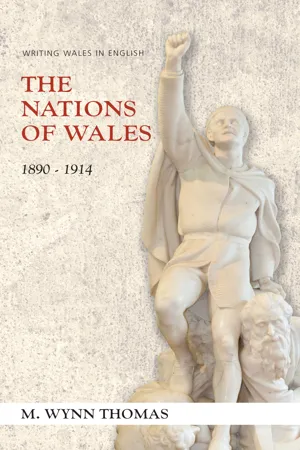
Certain simple and stereotypical images of Wales strike an immediate chord with the public, both in Wales itself and beyond its borders. For much of the twentieth century, the country was thought of as 'The Valleys', a land of miners and choirs and rugby clubs. This image of a 'Proletarian Wales' (with its attendant Socialist politics) dominated popular imagination, just as the image of 'Nonconformist Wales' – a Wales of chapels and of a grimly puritan society – had gripped the imagination of the High Victorian era. But what of the Wales of the late Victorian and Edwardian decades? What image of Wales prevailed at that time of revolutionary social, economic, cultural, religious and political change? This book argues that several competing images of Welshness were put in circulation during that time, and proceeds to examine several of the most influential of these as they took the form of literary texts.
Information
Publisher
University of Wales PressYear
2016Print ISBN
9781783168385
9781783168378
eBook ISBN
9781783168408
Table of contents
- Cover
- Title
- Copyright
- Dedication
- Contents
- Series Editor’s Preface
- Preface
- 1 Emblematising the nation
- 2 Performing political identity
- 3 O. M. Edwards: Keeping track of the gwerin
- 4 Literature and the political nation
- 5 The Celtic option
- 6 T. Gwynn Jones: The once and future Wales
- 7 Evan Roberts: The ghost dance of Welsh Nonconformity
- 8 Arthur Machen: Border disputes
- Notes
Trusted by 375,005 students
Access to over 1.5 million titles for a fair monthly price.
Study more efficiently using our study tools.
Frequently asked questions
Yes, you can cancel anytime from the Subscription tab in your account settings on the Perlego website. Your subscription will stay active until the end of your current billing period. Learn how to cancel your subscription
No, books cannot be downloaded as external files, such as PDFs, for use outside of Perlego. However, you can download books within the Perlego app for offline reading on mobile or tablet. Learn how to download books offline
Perlego offers two plans: Essential and Complete
- Essential is ideal for learners and professionals who enjoy exploring a wide range of subjects. Access the Essential Library with 800,000+ trusted titles and best-sellers across business, personal growth, and the humanities. Includes unlimited reading time and Standard Read Aloud voice.
- Complete: Perfect for advanced learners and researchers needing full, unrestricted access. Unlock 1.5M+ books across hundreds of subjects, including academic and specialized titles. The Complete Plan also includes advanced features like Premium Read Aloud and Research Assistant.
We are an online textbook subscription service, where you can get access to an entire online library for less than the price of a single book per month. With over 1.5 million books across 990+ topics, we’ve got you covered! Learn about our mission
Look out for the read-aloud symbol on your next book to see if you can listen to it. The read-aloud tool reads text aloud for you, highlighting the text as it is being read. You can pause it, speed it up and slow it down. Learn more about Read Aloud
Yes! You can use the Perlego app on both iOS and Android devices to read anytime, anywhere — even offline. Perfect for commutes or when you’re on the go.
Please note we cannot support devices running on iOS 13 and Android 7 or earlier. Learn more about using the app
Please note we cannot support devices running on iOS 13 and Android 7 or earlier. Learn more about using the app
Yes, you can access The Nations of Wales by M. Wynn Thomas in PDF and/or ePUB format, as well as other popular books in Literature & English Literary Criticism. We have over 1.5 million books available in our catalogue for you to explore.