- 368 pages
- English
- ePUB (mobile friendly)
- Available on iOS & Android
eBook - ePub
Americanism, Media, and the Politics of Culture in 1930s France
About this book
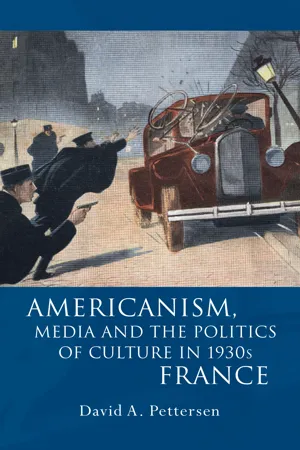
Gangsters, aviators, hard-boiled detectives, gunslingers, jazz and images of the American metropolis were all an inextricable part of the cultural landscape of interwar France. While the French 1930s have long been understood as profoundly anti-American, this book shows how a young, up-and-coming generation of 1930s French writers and filmmakers approached American culture with admiration as well as criticism. For some, the imaginary America that circulated through Hollywood films, newspaper reports, radio programming and translated fiction represented the society of the future, while for others it embodied a dire threat to French identity. This book brings an innovative transatlantic perspective to 1930s French culture, focusing on several of the most famous figures from the 1930s - including Marcel Carne, Louis-Ferdinand Celine, Pierre Drieu la Rochelle, Julien Duvivier, Andre Malraux, Jean Renoir and Jean-Paul Sartre - to track the ways in which they sought to reinterpret the political and social dimensions of modernism for mass audiences via an imaginary America.
Information
Chapter 1
Mass Culture and Leftist Politics in Jean Renoir
This airplane generation is also one of cinema; the same passion that threw it before the first screen cowboys with their mad chases on dusty roads, their flying lassos, their beautiful hats with wide-brimmed wings also made it tremble at Blériot’s first exploits, Farman’s audacious flights and Védrine’s aerial loops. Aeroplane, areo like we used to say as children, and the Wild West …
– Georges Altman, ‘Appel d’air : cinéma et aviation’ (1934)1
Film history remembers Jean Renoir as a cinematic auteur par excellence, though, as Keith Reader observed in 1990, he has been lionized as a ‘jovially unthreatening humanist’ rather than as the radically leftist political filmmaker he was during the late 1930s.2 Through both his films and his public interventions, Renoir consciously positioned himself as a leftist during the Popular Front era before becoming disenchanted with politics altogether following its collapse. The series of films between Le Crime de Monsieur Lange [The Crime of Mr Lange] (1936) and La Règle du jeu [Rules of the Game] (1939) tracks both the rise and fall of Renoir’s engagement with the French left and the volatility of the politics of culture in the Popular Front era. Though Renoir’s preceding and subsequent films also contain trenchant social commentary, the films from the late 1930s are of particular interest for this study because they explore the revolutionary potential of mass culture originating both inside and outside France.
Of Renoir’s late 1930s corpus, Le Crime de Monsieur Lange and La Règle du jeu share the most evident fascination with mass culture and media technology. Indeed, the narratives of both films dramatize the workings of media such as radio, popular serials and newsreels. The films also borrow from popular American genres: the Western in Lange and the aviator film in La Règle du jeu. However, these films’ approach to their American intertexts is quite different. In Lange, the Western popular serial Arizona Jim unites people across class boundaries and justifies a class-motivated crime, the murder of the bourgeois businessman who threatens the workers’ collective. In La Règle du jeu, the aviator André Jurieux, just back from a record-setting transatlantic flight, infuses the film with an American-inspired disruptive energy that slowly dissipates in the closed, backwards-looking world of the French bourgeoisie. Lange insists on mass culture's revolutionary possibilities and its relevance for the working class, while La Règle du jeu closes off all avenues of mobility or escape. Interestingly, both films rely on murder to articulate their contrasting politics. In each case, the meaning of the murder depends on the interaction between the film’s favoured American genre and the French fait divers crime tradition. In Lange, the murder of Batala might have been just another instance of sensationalistic and inexplicable violence if not for the language of the Western, which allows audiences both inside and outside the film to understand it as a revolutionary act. La Règle du jeu, in contrast, kills its heroic aviator in a way that denies him status as a martyr. Jurieux’s death is accidental, a fait divers-like casualty of the status games of a bored and entrenched privileged class.
The relationship of Renoir’s films to the American genres they reference develops along opposite trajectories, aligning with the vastly different political and social contexts surrounding the two films. Lange taps into the heady optimism of the Popular Front’s early days, in which a leftist coalition was remaking the world of work and public life. By contrast, La Règle du jeu evinces bitter disillusionment about the bourgeoisie’s ineptitude and an increasingly inescapable Second World War. By 1939, the vital possibilities of mass culture that Renoir had explored in Lange had revealed themselves to be mere illusion. Yet in both these politically engaged films, mass culture, and particularly American mass culture, plays an important role in Renoir’s exploration of what it meant to be a leftist filmmaker and how to imagine social change. Furthermore, the stark contrast between the politics of Lange and La Règle du jeu exemplifies the movement from reverence to irony that characterizes the relationship of 1930s writers and filmmakers to America and American mass culture.
Le Crime de Monsieur Lange
Le Crime de Monsieur Lange (1936) offers a whimsical tale about economic reorganization through a blend of crime melodrama and the American western. The film’s levity and uneven tone have posed significant difficulties for understanding its politics. At the time of its release, the fascist film critic Lucien Rebatet found Lange rather innocuous.3 Contemporary scholarly interpretations of the film’s politics vary widely, testifying to the film’s ideological slipperiness.4 The film’s narrative, ideological and political uncertainties have often been discussed in connection to the famous 270-degree pan shot of the courtyard.5 Lange’s generic ambiguities, by contrast, have generated less attention. The justification of Batala’s murder as a revolutionary act depends on the convergence of two popular genres, one American and one French: the American Western and the French true-crime fait divers. The interactions between the Western and the crime narrative throughout the film represent the struggle to control how the audience will understand and judge Lange’s act.
Lange’s play of genres does more than articulate a political justification of murder: it aligns mass culture with collective political action. Despite the film’s playfulness, Le Crime de Monsieur Lange marked Renoir as leftist for 1930s audiences and suggested him as the appropriate person to coordinate the production of the activist documentary La Vie est à nous [Life Belongs to Us] (1936).6 Martin O’Shaughnessy argues, like Christopher Faulkner, that despite Lange’s apparent levity, its radical vision cannot be underestimated given the fact that Lange, and by extension the cooperative, murder the capitalist publisher Batala.7 The film was released on the cusp of the election of the Popular Front, which achieved a fragile union of leftist parties in France. At a time when the left was rethinking how to unite people, mass culture offered ways to imagine new forms of community. Instead of the traditional tools of leftist political cinema (agitprop, activist documentary or self-consciously experimental filmmaking), Le Crime de Monsieur Lange opts for the fait divers and the Western. While Lange’s use of popular fiction has often been noted, the ways in which it constructs the film’s politics has not received adequate attention.8
Lange structures itself as an appeal to its audience. The film is told in flashback, and a group of intradiegetic interlocutors models the interpretive role of the public. Renoir opens with point-of-view shots from a car careering down country roads at high speed, carrying Lange and his washerwoman girlfriend, Valentine, to the Belgian border. As the two spend the night in a small bar-hotel, Valentine recounts Lange’s story in order to convince the working-class locals not to denounce them to the police. Valentine’s plea frames the film, which ends with these listeners ‘acquitting’ Lange and leading the two fugitives safely to the border. Along with the bar patrons, the audience becomes a popular jury for Lange, tasked with deciding whether the death of Batala was a crime or an exemplary act.9 In order for the film to be considered radical from a leftist perspective, Lange’s ‘crime’ has to be interpreted as revolutionary and just. Yet the crime risks being taken as just another fait divers, an aberrant yet fascinating act of violence whose ultimate meaning is uncertain. Renoir wanted the audiences, both inside and outside the film, to interpret the killing of Batala as a heroic gesture that founds a new economic and social order, a subject that, in Jim Kitses’s estimation, the Western genre often deals with explicitly.10 In the Western, heroes and villains battle with guns, and order can best be restored through a violent settling of scores. Arizona Jim, then, is more than just a convenient way for the cooperative to make money: it exists to suggest a context in which a murder can be considered as the triumph of good over evil. Yet at the end of the film, Renoir does not declare the Western’s victory over the crime narrative. The doubt of the fait divers cannot be resolved, gesturing to the intractable moral difficulty of using violence to effect social change.
The Western and the fait divers in interwar France
The two genres Renoir cites in Le Crime de Monsieur Lange were a highly visible part of the cultural world of interwar France, and the film’s political intervention via mass culture depended on viewers’ familiarity with genre conventions. Faits divers and detective fiction, which grew from both French and international roots, were pervasive during the interwar period due to changes in publishing technology. For the purposes of this chapter, the term fait divers refers to the sensationalistic short-format crime reports that often appeared in French periodicals of the early twentieth century. David Walker has shown how the consumption of these true-crime stories reached new heights in the 1930s as innovative photoengraving techniques launched a printing revolution that enabled photographs to be cheaply printed on a large scale.11 These new techniques remade interwar magazines and allowed them to reproduce images of crime with an unprecedented realism. Gallimard’s true-crime weekly, Détective, first published in 1928, reputedly reached circulation numbers as high as 800,000.12 In this genre, crime, particularly murder, marks the limits of social propriety and understanding. Sarah Maza writes that the fragmentary and incomplete form of the French fait divers explicitly undermines journalistic and fictional attempts to explain events.13 Ultimately, their otherness cannot be fully assimilated back into the social order. Explanations may attenuate the incomprehensibility of crime, but the fundamental strangeness of deviance from society’s rules remains. According to Walker, what fascinates readers is the act of transgression itself, in all its hideous detail.14
One of the most sensational events of the 1930s, and a fait divers par excellence, was a double murder committed by two sisters.15 The Papins worked as maids for Madame Lancelin and her daughter, whom they slaughtered according to the method advocated by a 1900 cook’s manual for preparing rabbit. Hoping to provoke outrage, the surrealists argued that the murder was revolutionary; according to them, the Papin sisters were revolting against the bourgeoisie with verses of Lautréamont in their heads.16 The surrealists’ reframing of the murder indicates that the revolutionary potential of a crime is not so much in the details of the crime itself, but in its interpretation. Lange’s crime in the film is, I would argue, a fait divers that has the potential to acquire a revolutionary interpretation. Just as the surrealists attempted to appropriate the Papin sisters for their revolution, Renoir in Le Crime de Monsieur Lange uses the language and imaginary of the American Western to encourage the audience to interpret the murder in a way that would support the Popular Front’s ideals.
Renoir associates Batala the capitalist with faits divers and crime fiction through his publications. During the early part of the film, Batala’s company promotes a new ‘literary and crime weekly’ entitled Javert. Viewers learn later that Éditions Batala has been advertising this publication for weeks, yet the actual magazine has never appeared. The title makes reference to the policeman antagonist in Victor Hugo’s Les Misérables (1862) and associates Batala with the law, albeit a side of the law that preys on the innocent. Additionally, the publication’s title asserts French sources for the crime narrative as represented in Lange; while crime genres also come from America, in this case, the French tradition as a descendant of nineteenth-century popular literature is in focus. Furthermore, it gestures to French crime fiction and journalism’s connections to nineteenth-century popular fiction, which Jacques Dubois has explored in his history of the crime novel.17 The highly successful Détective was hybrid by nature, as its title, a loan word from English that had become part of French vocabulary, indicates. Détective, moreover, included reports of gangster activity in the United States along with domestic and other international crime; it is uncertain what the content of Javert would have been if Batala had actually begun to produce it.
Crime, however, is not Batala’s only popular genre. The advertisement for Javert sits just below a sign that reads: ‘Batala Publishing | Paul Batala Director | The Thigh of Paris (Cuisse de Paris) | Legs in the Air (Jambes en l’Air) | Mischief (Fredaines) | Police, Emotions, etc., etc.’ These phrases suggest that Batala’s publications deal in soft pornography and other unsavoury genres. The mention of emotion in connection with the police links Batala’s magazines to weeklies like Détective. Fredaines is familiar slang for deviant behaviour, and faits divers and detective fiction were possible formats for writing about them. 1930s crime magazines sought to titillate their readers, giving them the shivers (frissons) that resulted from the voyeuristic pleasure of reading about violent acts. Walker notes that post-war critics of this kind of magazine linked them to pornography and denounced both in the same breath.18 The ‘etc., etc.’ suggests that this kind of sensationalist publishing is both inherently miscellaneous and so recognizable that it does not need a complete description. It also denotes a certain casualness on the part of Batala with regard to what he publishes and reflects the seedy Batala himself, suggesting that profit is more important to him than moral or artistic quality.
The ideological risk of the film is that viewers could interpret Lange’s murderous act as just another eruption of inexplicable violence. The events make it easy to imagine what the fait divers-style coverage might look like. The fact that Batala was disguised as a priest when Lange killed him would delight the reader interested in transgressions of every sort. The front page might feature the film’s image of Batala dying in his courtyard. Journalists for a publication like Détective would unravel the story, and it would become more and more outrageous as they reconstructed what happened. Lange’s illusionist construction makes it is easy to forget that viewers have access to a retelling of the events, not the events themselves. Valentine seems to offer eyewitness testimony, but the film recounts events she did not witness. As a narrator, Valentine resembles the journalist, reconstructing cause and effect after the fact.
While Lange himself never tells the viewer why he killed Batala, Renoir’s framing of the moment of Batala’s death favours Valentine’s collectivist interpretation over a psychological interpretation or the nihilism of the fait divers. Lange has many selfish reasons for which to kill Batala, but the film does not focus on his individual psychology. Batala himself provides the framing necessary to bring the crime out of the territory of meaningless, morally bankrupt faits divers. When Batala returns to his office disguised as a priest, he launches into a tirade about how the very idea of a cooperative is ludicrous because workers need a strong leader. He pulls his gun from the desk drawer, lays it in front of Lange, and later tells him ‘you should kill me’.19 Batala’s gesture cites the melodramatic trope of offering a gun to an injured party with the hope of defusing the situation. Unfortunately for his own survival, Batala speaks the truth: in order for the cooperative to continue, or for Lange to retain the rights to his Western serial Arizona Jim, Batala must die. I would argue that this scene represents a meta-narrative moment in which Renoir exposes the knot of ideological contradictions inherent in the political use of violence. Lange might have killed Batala for many reasons. Did he do it for himself? Did he do it for the collective? Did he do it to avenge Estelle, whom Batala raped? Did Lange, Batala’s personal secretary, do it in retribution for all the horrible deeds he has seen his employer commit? Did he do it because this is what one does in a crime melodrama? The character Lange offers no explanation, and in fact the murder is his last real act in the ...
Table of contents
- Cover
- Title
- Copyright
- Contents
- Acknowledgements
- List of Illustrations
- Notes to the Reader
- Introduction
- Chapter 1: Mass Culture and Leftist Politics in Jean Renoir
- Chapter 2: The American Gangster in French Poetic Realism
- Chapter 3: The Rise and Fall of the Gangster in André Malraux’s Revolutionary Novels
- Chapter 4: White Primitivism in Pierre Drieu la Rochelle
- Chapter 5: Whitewashing the Transatlantic in Louis-Ferdinand Céline
- Chapter 6: The Americanist Anti-Americanism of Jean-Paul Sartre’s Les Chemins de la liberté
- Conclution
- Notes
- Bibliography
Trusted by 375,005 students
Access to over 1.5 million titles for a fair monthly price.
Study more efficiently using our study tools.
Frequently asked questions
Yes, you can cancel anytime from the Subscription tab in your account settings on the Perlego website. Your subscription will stay active until the end of your current billing period. Learn how to cancel your subscription
No, books cannot be downloaded as external files, such as PDFs, for use outside of Perlego. However, you can download books within the Perlego app for offline reading on mobile or tablet. Learn how to download books offline
Perlego offers two plans: Essential and Complete
- Essential is ideal for learners and professionals who enjoy exploring a wide range of subjects. Access the Essential Library with 800,000+ trusted titles and best-sellers across business, personal growth, and the humanities. Includes unlimited reading time and Standard Read Aloud voice.
- Complete: Perfect for advanced learners and researchers needing full, unrestricted access. Unlock 1.5M+ books across hundreds of subjects, including academic and specialized titles. The Complete Plan also includes advanced features like Premium Read Aloud and Research Assistant.
We are an online textbook subscription service, where you can get access to an entire online library for less than the price of a single book per month. With over 1.5 million books across 990+ topics, we’ve got you covered! Learn about our mission
Look out for the read-aloud symbol on your next book to see if you can listen to it. The read-aloud tool reads text aloud for you, highlighting the text as it is being read. You can pause it, speed it up and slow it down. Learn more about Read Aloud
Yes! You can use the Perlego app on both iOS and Android devices to read anytime, anywhere — even offline. Perfect for commutes or when you’re on the go.
Please note we cannot support devices running on iOS 13 and Android 7 or earlier. Learn more about using the app
Please note we cannot support devices running on iOS 13 and Android 7 or earlier. Learn more about using the app
Yes, you can access Americanism, Media, and the Politics of Culture in 1930s France by David A. Pettersen in PDF and/or ePUB format, as well as other popular books in History & French History. We have over 1.5 million books available in our catalogue for you to explore.