- 352 pages
- English
- ePUB (mobile friendly)
- Available on iOS & Android
eBook - ePub
About this book
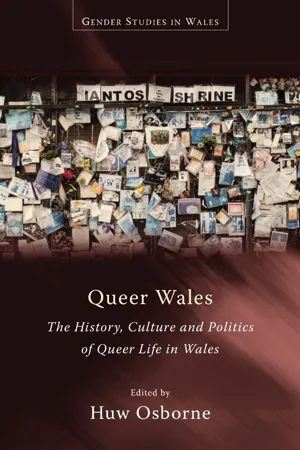
This book provides varied perspectives on queer history, culture, politics and life in Wales. It addresses the queering of the Welsh language in examples from the nineteenth and twenty-first centuries, acquainting readers with such figures as Felicia Hemans, George Powell, and Edward Thomas; and it explores forms of lesbian belonging, the possibilities of transgender Wales, the communities of queer Welsh television and film, and the many places of the queer Welsh `home'. This book for the first time brings together work by a wide variety of authors working in varied areas of queer Welsh culture; its chapters mark the beginning of what will be an ongoing discussion of sexual and national life in Wales with essays that launch an important discussion of queer life and suggesting that perhaps Wales has always been a bit of a queer place to live.
Information
Notes
Notes to the Introduction
1 Santiago Fouz-Hernández, ‘School Is Out: The British “Coming Out” Films of the 1990s’, in Robin Griffiths (ed.), Queer Cinema in Europe (Bristol and Chicago: Intellect, 2008), pp. 145–164, 145.
2 Judith Halberstam, In a Queer Time and Place: Transgender Bodies, Subcultural Lives (New York and London: New York University Press, 2005), pp. 36–7.
3 Richard Phillips and Diane Watt, ‘Introduction’, in Richard Phillips, Diane Watt and David Shuttleton (eds), Decentering Sexualities: Politics and Representations Beyond the Metropolis (London and New York: Routledge, 2000), p. 1.
4 Phillips and Watt, ‘Introduction’, p. 1.
5 Lee Edelman, No Future: Queer Theory and the Death Drive (Durham, NC and London: Duke University Press, 2004), p. 17.
6 Homonormativity refers to the normalization of queer lives through domesticity and consumption. The progress of LGBTQ rights and the increased representation of LGBTQ people (and really only the select, generally white middle-class few) in media is a form of acceptance through rendering queers institutionally invisible. See, for instance, Jasbir K. Puar, Terrorist Assemblages: Homonationalism in Queer Times (Durham, NC and London: Duke University Press, 2007), pp. 38–9; Heather Love, Feeling Backward: Loss and the Politics of Queer History (Cambridge: Harvard University Press, 2007), p. 10.
7 Love, Feeling Backward, p. 32.
8 Love, Feeling Backward, p. 17.
9 Stevie Davies, Impassioned Clay (London: The Women’s Press, 1999), p. 32.
10 A similar relation to the past may be found in Margiad Evans, as discussed in Katie Gramich’s ‘Gothic Borderlands: The Hauntology of Place in the Fiction of Margiad Evans’ and Kirsti Bohata’s ‘The Apparitional Lover: Homoerotic Lesbian Imagery in the Writing of Margiad Evans’, both of which appear in Kirsti Bohata and Katie Gramich (eds), Rediscovering Margiad Evans: Marginality, Gender and Illness (Cardiff: University of Wales Press, 2013), pp. 513–68 and pp. 107–28, respectively. See also Carla Freccero, Queer/Early Modern (Durham, NC and London: Duke University Press, 2006), p. 71.
11 In their oft-cited introduction, Andrew Parker et al. tell us that nations ‘are forever haunted by their various definitional others. Hence, on the one hand, the nation’s insatiable need to administer difference through violent acts of segregation, censorship, economic coercion, physical torture, police brutality. And hence, on the other hand, the nation’s insatiable need for representational labour to supplement its founding ambivalence, the lack of self-presence at its origin or in its essence.’ See Andrew Parker, Mary Russo, Doris Sommer and Patricia Yaeger (eds), Nationalisms and Sexualities (New York and London: Routledge, 1992), p. 5.
12 Roni Crwydren, ‘Welsh Lesbian Feminist: A Contradiction in Terms?’, in Jane Aaron, Teresa Rees, Sandra Betts and Moira Vincentelli (eds), Our Sister’s Land: The Changing Identities of Women in Wales (Cardiff: University of Wales Press, 1994), pp. 294–300. While Crwydren problematically refers to ‘choosing to become a lesbian’ (p. 20), the essay as a whole is sensitive to the incommensurable hybridities across gendered, national, linguistic and sexual affiliations that de-constitute the national body.
13 Crwydren, ‘Welsh Lesbian Feminist’, p. 294.
14 Crwydren, ‘Welsh Lesbian Feminist’, p. 295.
15 See, for instance, Katie Gramich, ‘“Those Blue Remembered Hills”: Gender in Twentieth-century Welsh Border Writing by Men’, in Jane Aaron, Henrice Altink and Chris Weedon (eds), Gendering Border Studies (Cardiff: University of Wales Press, 2010), pp. 142–62.
16 Crwydren, ‘Welsh Lesbian Feminist’, p. 297.
17 Elizabeth Freeman, Time Binds: Queer Temporalities, Queer Histories (Durham, NC and London: Duke University Press, 2010), p. 16.
18 José Estaban Muñoz, Cruising Utopia: The Then and There of Queer Futurity (New York: New York University Press, 2009), p. 11.
19 Muñoz, Cruising Utopia, p. 1.
20 Carolyn Dinshaw, Getting Medieval: Sexualities and Communities, Pre- and Postmodern (Durham, NC and London: Duke University Press, 1999), p. 3.
21 See Matt Cook, A Gay History of Britain: Love and Sex between Men since the Middle Ages (Oxford and Westport, CT: Greenwood World Publishing, 2007), p. 3. Rebecca Jennings calls for a practice that instead analyses ‘systems of knowledge about sexuality, exploring different ways in which sexuality has been thought and described’, A Lesbian History of Britain (Oxford and Westport, CT: Greenwood World Publishing, 2007), p. xvi. Brian Lewis challenges chronological approaches to queer histories: ‘Deep burrowing in archives and a theoretical mindset conducive to a bonfire of taxonomies have expanded our localised knowledge of the multiplicity of sexual practices and beliefs but rendered “our queer ancestors” less knowable.’ Brian Lewis, British Queer History: New Approaches and Perspectives (Manchest...
Table of contents
- Cover
- Title
- Copyright
- Contents
- Acknowledgements
- List of Illustrations and Figures
- Notes on Contributors
- Introduction
- I. The Queer Past Before 1900
- II. PLacing Queer Wales After 1900
- III. Building Queer Wales Post-Devolution
- IV. Performing Contemporary Queer Wales
- Notes
- Select Bibliography
Trusted by 375,005 students
Access to over 1.5 million titles for a fair monthly price.
Study more efficiently using our study tools.
Frequently asked questions
Yes, you can cancel anytime from the Subscription tab in your account settings on the Perlego website. Your subscription will stay active until the end of your current billing period. Learn how to cancel your subscription
No, books cannot be downloaded as external files, such as PDFs, for use outside of Perlego. However, you can download books within the Perlego app for offline reading on mobile or tablet. Learn how to download books offline
Perlego offers two plans: Essential and Complete
- Essential is ideal for learners and professionals who enjoy exploring a wide range of subjects. Access the Essential Library with 800,000+ trusted titles and best-sellers across business, personal growth, and the humanities. Includes unlimited reading time and Standard Read Aloud voice.
- Complete: Perfect for advanced learners and researchers needing full, unrestricted access. Unlock 1.5M+ books across hundreds of subjects, including academic and specialized titles. The Complete Plan also includes advanced features like Premium Read Aloud and Research Assistant.
We are an online textbook subscription service, where you can get access to an entire online library for less than the price of a single book per month. With over 1.5 million books across 990+ topics, we’ve got you covered! Learn about our mission
Look out for the read-aloud symbol on your next book to see if you can listen to it. The read-aloud tool reads text aloud for you, highlighting the text as it is being read. You can pause it, speed it up and slow it down. Learn more about Read Aloud
Yes! You can use the Perlego app on both iOS and Android devices to read anytime, anywhere — even offline. Perfect for commutes or when you’re on the go.
Please note we cannot support devices running on iOS 13 and Android 7 or earlier. Learn more about using the app
Please note we cannot support devices running on iOS 13 and Android 7 or earlier. Learn more about using the app
Yes, you can access Queer Wales by Huw Osborne in PDF and/or ePUB format, as well as other popular books in Social Sciences & Gender Studies. We have over 1.5 million books available in our catalogue for you to explore.