- 210 pages
- English
- ePUB (mobile friendly)
- Available on iOS & Android
eBook - ePub
The Literature of Wales
About this book
A concise and authoritative survey of both the Welsh- and English-language literatures of Wales from the earliest period up to the present day. This illustrated guide, containing extracts from original texts with English translations, is a revised version of Professor Dafydd Johnston's volume in the University of Wales's Pocket Guide series, and includes a new chapter on contemporary writing.
Information
1
Heroic Poetry
The poetic tradition
Two essential features of the Welsh poetic tradition are its antiquity and the continuity of its central theme of praise. By virtue of the works which have survived by two poets of the late sixth century, Taliesin and Aneirin, Welsh can claim to be the oldest attested vernacular literature in Europe. Welsh poets of the Middle Ages venerated Taliesin in particular as the founding father of the praise tradition, and deliberately wove echoes of the hengerdd (literally ‘old song’) into their own compositions. The elaborate patterning of sound which is a characteristic feature of the Welsh poetic craft is present in embryo in the earliest poetry. However, Taliesin and Aneirin should not in fact be seen as originators, but rather as inheritors of an already ancient and sophisticated bardic tradition common to the Celtic peoples and incorporating Indo-European social ideals. They stand at the very end of the Brythonic period of British history, nearly two hundred years after the end of the Roman occupation, and their work bears witness to the crucial conflict between the Brythonic tribes of northern Britain and the Germanic invaders.
The Old North
The earliest Welsh poetry is Welsh in a linguistic sense rather than a geographical one. In the late sixth century an early form of Welsh was spoken in the western half of Britain from southern Scotland down to Cornwall. Invading Germanic tribes occupied the eastern half of the island, and were gradually extending their territories westwards. Only one of Taliesin’s surviving poems relates to the area now known as Wales. The rest of his work and all that of Aneirin belongs to the Brythonic kingdoms of what is now northern England and southern Scotland. The three independent kingdoms of that region were Rheged around the Solway estuary, Strathclyde further to the north around the estuary of the Clyde, and Gododdin to the east with its centre at Edinburgh. After the collapse of the kingdoms of Rheged and Gododdin in the seventh century, and the subsequent political isolation of Wales, the traditions and stories of the North may have been preserved in Strathclyde before being transmitted to Wales, where they came to represent the legendary heroic age of the Brythonic people, providing source material which Welsh poets and story-tellers were to draw on during the following centuries. There has been a good deal of scholarly debate over the authenticity of this early poetry, since the manuscript copies are of a much later date, and textual corruption no doubt occurred during the process of both oral and written transmission, but the general consensus is that a nucleus of genuine sixth-century material has survived in something close to its original form.
Taliesin
The work of Taliesin is preserved in a manuscript of the early fourteenth century known as the Book of Taliesin. Amongst that compendium of early and medieval poetry attributed to the legendary bard (see chapter 2), twelve poems have been distinguished as belonging to the late sixth century. Of these twelve, one is a panegyric addressed to Cynan Garwyn, a king of Powys in north-east Wales who flourished about the year 580, two are addressed to Gwallawg, the ruler of the small kingdom of Elmet (in the area around what is now Leeds), and the other nine all concern Urien, king of Rheged, and his son Owain. If all these poems are accepted as the genuine work of Taliesin, then it might be speculated that the poet was a native of Powys who migrated to the North, perhaps drawn by Urien’s fame as a warlord. The existence of a poem of reconciliation (dadolwch) by Taliesin begging Urien’s forgiveness may be connected to the two poems which he sang in praise of Urien’s rival Gwallawg. However, it is equally possible that Taliesin was in fact a native of Rheged and Urien’s court bard, and that the three poems to other lords were falsely attributed to him because of his legendary fame in a later period.
The essence of Taliesin’s poetry is the depiction of the ideal ruler in the person of Urien Rheged, which can be seen to provide a model for the praise poetry of the next thousand years. The ideal is twofold, consisting of a balance between ferocity in leading his warriors to victory on the battlefield and magnanimous largesse towards his retainers in his court. The king is portrayed as personally responsible for the well-being of his people in war and in peace. Behind this ideal lies the primitive belief that the prosperity of a land depended on the kingly attributes of its ruler. The role of the poet’s panegyric was to reassure the tribe that its ruler was indeed fit to be their king, proclaiming the righteousness of the established political order, whilst also serving to remind the king of his responsibilities towards his people.
Taliesin
from ‘In Praise of Urien Rheged’
from ‘In Praise of Urien Rheged’
Urien of Yrechwydd most generous of Christian men,
much do you give to the people of your land;
as you gather so also you scatter,
the poets of Christendom rejoice while you stand.
More is the gaiety and more is the glory
that Urien and his heirs are for riches renowned,
and he is the chieftain, the paramount ruler,
the far-flung refuge, first of fighters found.
The Lloegrians know it when they count their numbers,
death have they suffered and many a shame,
their homesteads a-burning, stripped their bedding,
and many a loss and many a blame,
and never a respite from Urien of Rheged.
Rheged’s defender, famed lord, your land’s anchor,
all that is told of you has my acclaim.
(Translation by Saunders Lewis, Presenting Saunders Lewis)
Taliesin’s poems are mostly short, averaging about thirty lines. His style is notable for its concision, achieved by taut phraseology and suggestive images. Even in his three poems celebrating Urien’s martial exploits he does not provide any narrative account, but rather seeks to create a vivid impression of the events by striking visual details (such as dead warriors with light in their eyes, or the waters of a river like red wine with the blood of battle) and by dramatization. In ‘The Battle of Argoed Llwyfain’ we are given the very words of the enemy demanding hostages and the defiant replies of Owain and his father Urien. The ensuing slaughter is conveyed only by the image of ravens feeding on the corpses. The compressed intensity of the style is heightened by complex patterns of alliteration and internal rhyme, a feature which was later to develop into the formal system of cynghanedd. Key words can be effectively linked by consonantal correspondence, as in this laconic description of the aftermath of battle: ‘A gwedy boregat briwgic’ (And after morning battle hacked flesh).
Taliesin
‘Death Song for Owain ab Urien’
‘Death Song for Owain ab Urien’
God, consider the soul’s need
Of Owain son of Urien!
Rheged’s prince, secret in loam:
No shallow work, to praise him!
A strait grave, a man much praised,
His whetted spear the wings of dawn:
That lord of bright Llwyfenydd,
Where is his peer?
Reaper of enemies; strong of grip;
One kind with his fathers;
Owain, to slay Fflamddwyn,
Thought it no more than sleep.
Sleepeth the wide host of England
With light in their eyes,
And those that had not fled
Were braver than were wise.
Owain dealt them doom
As the wolves devour sheep;
That warrior, bright of harness,
Gave stallions for the bard.
Though he hoarded wealth like a miser,
For his soul’s sake he gave it.
God, consider the soul’s need
Of Owain son of Urien.
(Translation by Tony Conran, Welsh Verse)
One of the court poet’s principal functions was the composition of an elegy (marwnad) on the death of his lord. Taliesin’s elegy for Urien’s son Owain is the earliest example of this important genre of Welsh poetry. It is more a celebration of his life than a lament on his death, declaring his superiority over his enemies with ferocious relish. The prayer for the soul at the beginning and end of the poem shows that the poet was a Christian, but in proclaiming the undying fame of the warrior he was subscribing to a heroic ethic which was fundamentally pagan.
Aneirin
Roughly contemporary with Taliesin in the late sixth century, Aneirin was the author of a long poem known as the Gododdin, commemorating the heroic deeds of a war-band from the Gododdin tribe and their allies which was defeated by a much larger force from the Anglian kingdoms of Deira and Bernicia at the battle of Catraeth (probably Catterick in North Yorkshire) about the year 600. The battle is not attested in any other source, and the poem provides no narrative account, but the bare outlines of the event can be deduced. It seems that Mynyddawg Mwynfawr, lord of the Gododdin tribe, gathered together a select band of three hundred horsemen from all parts of the Brythonic world, who were feasted and trained for a year at his court of Dineidyn (Edinburgh) in preparation for an expedition against Catraeth, some one hundred and fifty miles to the south (probably accompanied by foot-soldiers). All except one were killed, but not before they had slain many times their own number of the enemy. The raid no doubt had some strategic purpose, but for Aneirin the most important thing was the warriors’ loyalty to their lord. The heroic ethic demanded that in return for their lord’s hospitality, symbolized by the mead which they drank in his hall, the warriors must be prepared to fight to the death for him on the battlefield. Honourable death in battle was the ultimate glory for the warriors, and the poet had a vital role to play in ensuring their everlasting fame.
The Gododdin is preserved in the Book of Aneirin, written in about 1265. The text consists of two independent versions, known as A and B, of which B has the more archaic orthography, probably deriving from an exemplar written in the ninth or tenth century. The substantial differences between the two texts suggest that the poem was transmitted orally before that. It is quite loose in form, consisting of about a thousand separate lines arranged in short rhyming stanzas. Each stanza is a separate unit, devoted either to one or several warriors, or to the war-band as a whole. Each encapsulates the whole sequence of events, involving a constantly shifting perspective, from the feasting beforehand, through the journey to Catraeth and the battle itself, to its aftermath of silence. Thus the poem as a whole is constantly circling around the central event of the battle, having no linear development, no beginning or end.
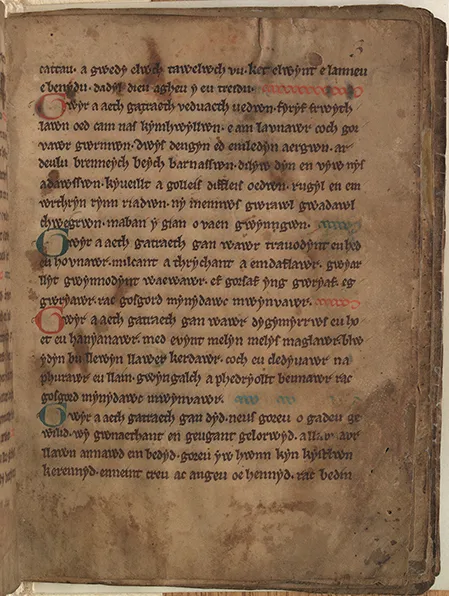
1. A page from the Book of Aneirin.
Like Taliesin, Aneirin had a remarkable ability to epitomize the tragedy in one stark phrase, such as the second line of the first quotation given here, where the bitter irony is underlined by the rhyme between the words meaning feast and poison (ancwyn / gwenwyn). His awareness of the grief caused by his hero’s action in the second quotation should not lead us to think that he felt pity for the bereaved mothers of his enemies. But, nevertheless, his clear-sighted recognition of the consequences of adherence to the heroic code meant that his exuberant praise of the ...
Table of contents
- Cover
- Title Page
- Copyright Page
- Contents
- Acknowledgements
- List of illustrations
- Preface to the First Edition
- Preface to the Second Edition
- Chapter 1: Heroic Poetry
- Chapter 2: Early Medieval Poetry
- Chapter 3: Medieval Prose
- Chapter 4: Medieval Poetry
- Chapter 5: The Renaissance
- Chapter 6: The Eighteenth Century
- Chapter 7: The Victorian Age
- Chapter 8: The Literary Revival of the Early Twentieth Century
- Chapter 9: The Inter-War Years
- Chapter 10: Post-War Literature
- Chapter 11: The Later Twentieth Century
- Chapter 12: Contemporary Literature
- Further Reading
Trusted by 375,005 students
Access to over 1.5 million titles for a fair monthly price.
Study more efficiently using our study tools.
Frequently asked questions
Yes, you can cancel anytime from the Subscription tab in your account settings on the Perlego website. Your subscription will stay active until the end of your current billing period. Learn how to cancel your subscription
No, books cannot be downloaded as external files, such as PDFs, for use outside of Perlego. However, you can download books within the Perlego app for offline reading on mobile or tablet. Learn how to download books offline
Perlego offers two plans: Essential and Complete
- Essential is ideal for learners and professionals who enjoy exploring a wide range of subjects. Access the Essential Library with 800,000+ trusted titles and best-sellers across business, personal growth, and the humanities. Includes unlimited reading time and Standard Read Aloud voice.
- Complete: Perfect for advanced learners and researchers needing full, unrestricted access. Unlock 1.5M+ books across hundreds of subjects, including academic and specialized titles. The Complete Plan also includes advanced features like Premium Read Aloud and Research Assistant.
We are an online textbook subscription service, where you can get access to an entire online library for less than the price of a single book per month. With over 1.5 million books across 990+ topics, we’ve got you covered! Learn about our mission
Look out for the read-aloud symbol on your next book to see if you can listen to it. The read-aloud tool reads text aloud for you, highlighting the text as it is being read. You can pause it, speed it up and slow it down. Learn more about Read Aloud
Yes! You can use the Perlego app on both iOS and Android devices to read anytime, anywhere — even offline. Perfect for commutes or when you’re on the go.
Please note we cannot support devices running on iOS 13 and Android 7 or earlier. Learn more about using the app
Please note we cannot support devices running on iOS 13 and Android 7 or earlier. Learn more about using the app
Yes, you can access The Literature of Wales by Dafydd Johnston in PDF and/or ePUB format, as well as other popular books in Literature & Ancient & Classical Literary Criticism. We have over 1.5 million books available in our catalogue for you to explore.