- 288 pages
- English
- ePUB (mobile friendly)
- Available on iOS & Android
eBook - ePub
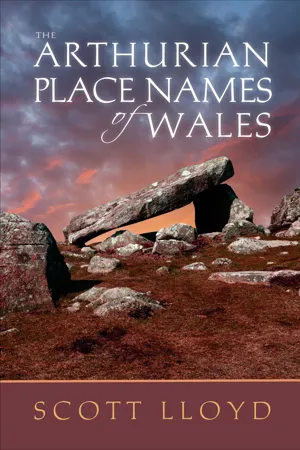
The Arthurian Place Names of Wales
About this book
This new book examines all of the available source materials, dating from the ninth century to the present, that have associated Arthur with sites in Wales. The material ranges from Medieval Latin chronicles, French romances and Welsh poetry through to the earliest printed works, antiquarian notebooks, periodicals, academic publications and finally books, written by both amateur and professional historians alike, in the modern period that have made various claims about the identity of Arthur and his kingdom. All of these sources are here placed in context, with the issues of dating and authorship discussed, and their impact and influence assessed. This book also contains a gazetteer of all the sites mentioned, including those yet to be identified, and traces their Arthurian associations back to their original source.
Information
ONE
THE LATIN TEXTS
THE POSSIBILITY that the Arthur of legend was a real historical figure has been a topic of debate for over 800 years, and various candidates have been suggested: these include the Roman general Lucius Artorius Castus, Artuir the son of the Áedán, a sixth-century king of Dalriata in Scotland, and Arthur map Petr, a member of the Dyfed dynasty, from the same period.1 None of these candidates has found wide acceptance and a definitive answer to the question of the historicity of Arthur remains unlikely. This chapter will examine the place names from the earliest sources for the Arthurian legend, from the ninth-century battle list of the Historia Brittonum (HB), through the vitae of the Welsh saints, to the influential Historia regum Britanniae (HRB) of Geoffrey of Monmouth (c.1138). This last work was largely responsible for the huge popularity of the Arthurian legend in the twelfth and thirteenth centuries, and later chroniclers and romance writers used it frequently, but the earliest source for the figure of Arthur is the battle-list in the Historia Brittonum.
Historia Brittonum
The complex of manuscripts known to scholars as the Historia Brittonum (a title given in early printed editions, but rarely in the manuscripts themselves) is fundamental to our understanding of the development of the Arthurian legend, not just in Wales, but also the rest of Europe.2 A dating clause to the fourth year of the reign of Merfyn Frych, the king of Gwynedd, is found in most manuscripts:
A primo anno quo Saxones uenerunt in Brittanniam usque ad annum quartum Mermini Regis supputantur anni quadringenti uiginti nouem.3From the first year in which the Saxons came to Britain to the fourth year of King Merfyn are computed four hundred and twenty-nine years.4
This clause is widely accepted as denoting the year in which the text was first compiled; Merfyn came to power in Gwynedd following the death of Hywel ap Caradog in the year 825, making the fourth year of his reign 829/30.5 A Gwynedd origin for the text has been widely accepted by most commentators, and the kingdom was a renowned place of intellectual activity in the ninth century.6 In 2002, Higham put forward the argument that the text had been commissioned by Merfyn as a work of propaganda against the neighbouring dynasties of Powys and Mercia, to bolster his weak claim to the throne of Gwynedd.7
Following its first appearance, HB was adapted, abbreviated and combined with other texts on a regular basis over the following 350 years, and the forty or so surviving manuscripts have been classified into nine different Latin recensions and a Middle Irish translation.8 The most detailed study of the complex textual transmission of HB remains Dumville’s 1975 thesis and a series of accompanying articles.9 Seventy-six different sections can be identified across the recensions, but only the Harleian, in British Library, Harley 3859, includes them all.
1–18 | The six ages of the world in which are described the Trojan origins of the Britons and the alternative biblical origins. The arrival of the Picts and Scots in Britain. |
19–30 | A brief history of Roman Britain concerning the reign of nine emperors from Julius Caesar to Constantinus with particular attention given to Maximus and his removal of British soldiers to the continent. 31–49 The story of Vortigern, the coming of the Saxons to Britain, Ambrosius and the dragons beneath Dinas Emrys. |
50–55 | Abbreviated story of the life of St Patrick. |
56 | Arthurian battle list. |
57–61 | Anglian genealogies. |
62–65 | Wars between the Britons and the Angles, known as the ‘Northern History’. 66 Calculi and 28 cities of Britain. |
67–76 | Mirabilia. |
The first discussions and extracts in print date to the early sixteenth century, but it was not until 1691 that Thomas Gale published a version of the text.10 The Vatican recension was printed by Gunn in 1819, the Harleian by Stevenson in 1838 and a confusing multi-recension version was edited by Theodore Mommsen in 1898.11 A useful English translation of the Harleian text was published by Wade-Evans in 1938, and another by John Morris in 1980 is widely quoted despite its inadequacies.12 Dumville proposed a ten-volume edition covering all recensions and variants, but to date only the Vatican recension volume has appeared and his 1975 thesis remains the most detailed discussion of the work.
The Harleian recension is considered to be closest to the original form of the text and is found amongst the 365 folios that make up London, British Library, Harleian MS 3859, dated to c.1100.13 This manuscript also preserves the earliest copy of the Mirabilia, often considered to be an integral part of HB and containing material of Arthurian interest, the Annales Cambriae (both discussed below) and a series of Welsh genealogies. The other manuscript that provides early evidence for the importance of HB is that of the Vatican recension: Rome, Bibliotheca Apostolica Vaticana, MS Reginensis Lat. 1964, dates from the second half of the eleventh century and originated at the church of Saint Médard in Soissons, sixty miles north-east of Paris.14 It is the earliest securely datable manuscript to mention Arthur. It is a shorter text compared to the Harleian recension, as it omits the ‘Northern History’ and the Mirabilia.15 For the purposes of studying the Arthurian material relating to Wales these two recensions are sufficient to establish its date and development; however, the other recensions provide material relevant to the reception of the Arthurian legend in Scotland and are important for the development of HB as a source for the history of Britain.16
The Battle List
The battle list from the Harleian recension is given below with the place names left in their original form and variant spellings from the Vatican recension given in parenthesis.
Then it was that Arthur was wont to fight against them [the Saxons] in those days along with the kings of Britannia, but he himself was Dux Bellorum. The first battle was at the mouth of the river, which is called Glein. The second, third, fourth and fifth on another river, which is called Dubglas (Duglas) and is in the region of Linnius (Linnuis). The sixth battle on a river, which is called Bassas. The seventh was a battle in the wood of Celidon, that is Cat Coit Celidon. The eighth was the battle at Castellum Guinnion, in which Arthur carried the image of Saint Mary, the perpetual virgin on his shoulders, and the pagans were put to flight on that day and a great slaughter was upon them through the power of our Lord Jesus Christ and through the power of Saint Mary his holy virgin mother. The ninth battle was fought at Urbes Legionis (urbe Leogis that in British is called Cair Lion). The tenth battle was fought on the shore of the river, which is called Tribruit (Treuroit). The eleventh battle occurred on the mountain, which is called Agned (Bregion). The twelfth was the battle on the mountain of Badon, in which there fell in one day nine hundred and sixty men from one charge [of] Arthur; and no-one slew them except he alone, and in all battles he remained the victor.17
In this text Arthur is referred to as dux bellorum (leader in battles), not rex (king) as he became in later sources. The phrase dux bellorum occurs in earlier sources, primarily the Latin Vulgate of the Old Testament in the opening lines of the Book of Judges where Joshua is referred to as dux belli (leader in battle), and Bede later used the phrase in his ‘Greater Chronicle’, written in 725, to describe Germanus.18 Higham has suggested that the apostolic number twelve may have influenced the number of battles described, despite four of them taking place at the same location.19
Is it possible to identify any of the battle sites? One of the first independent witnesses to the battle list is William of Malmesbury’s Gesta regum Anglorum (1125), in which he mentions Arthur’s victory at the siege of Mount Badon, where he wore the image of the Virgin on his armour, a fact associated with the battle of Castello Guinnion in all surviving manuscripts of HB.20 The next earliest reference is by Henry of Huntingdon in his Historia Anglorum (1129), who notes that ‘none of the places can be identified now’.21 The fact that by the early twelfth century none of the battle sites could be located made Arthur into a mysterious heroic figure and, perhaps more importantly, a blank canvas on which a new view of the early history of Britain could be portrayed. Geoffrey of Monmouth grasped this potential and was the first author to place the battles into a recognisable geographical framework in his Historia regum Brittaniae (c.1138). He located the battles in areas across Britain, from Scotland to Cornwall, and his identifications gave rise to the idea that Arthur was a figure to be associated with the whole of the British Isles, not something obviously claimed in HB. Only two of the battle names can definitively be shown to derive from earlier sources, Monte Badonis from De excidio Britanniae by Gildas (c.540) and Urbes legionis from Bede’s Historia ecclesiastica gentis Anglorum (731).22 Another early attempt to identify one of Arthur’s battles with a geographical site was by Ranulf Higden in his Polychronicon (c.1325) where he associates the battles at Dubglas with the river Douglas, near Wigan in Lancashire.23
A bibliography of discussions about the Arthurian battle list, published by Tolstoy in 1960, lists some eighty articles published after 1845.24 These articles argue for identifications in one particular area of Britain, usually founded upon the idea that the sites must be located in an area where a British army would most likely encounter a Saxon army. Hence Skene identified all of the sites in Scotland, Collingwood located them all in the south-east of England and Anscombe placed them all in the Midlands.25 Attempting to identify the exact location of all the battles and prove the involvement of Arthur is unlikely to produce a satisfactory answer. How do you identify such obscure names as Glein, Tribruit, Bassas, Agned and Breguion without further context and additional references from other sources? Attempts to locate the battle sites of Arthur continue to be made however, and armed with a better understanding of the complex origins of HB, some progress might be possible.26 Exactly where the author of HB found the name Arthur and why he chose to use him in such a way, remains a major obstacle to our understanding of the origins of the Arthurian legend. We can only assume that it must have had, for whatever reason, some resonance in north Wales in the first half of the ninth century.
Mirabilia
The earliest copy of the Mirabilia (Marvels) is also found in Harleian 3859, separated from the main text of HB by the Annales Cambriae and a collection of Welsh genealogies.27 Eighteen marvels are listed and eight of them can be securely located in south-east Wales and the Engli...
Table of contents
- Cover
- Title Page
- Copyright Page
- Dedication Page
- Contents
- Acknowledgements
- List of Figures and Maps
- Introduction
- Chapter 1. The Latin Texts
- Chapter 2. The French Arthurian Romances
- Chapter 3. The Welsh Texts
- Chapter 4. Humanists and Antiquarians
- Chapter 5. From Tourists to the Internet
- Conclusion
- Appendix 1 A Chronological List of the First Attestations of Arthurian Names in Wales
- Appendix 2 A Gazetteer of Arthurian Sites in Wales
- Bibliography
- Notes
Trusted by 375,005 students
Access to over 1.5 million titles for a fair monthly price.
Study more efficiently using our study tools.
Frequently asked questions
Yes, you can cancel anytime from the Subscription tab in your account settings on the Perlego website. Your subscription will stay active until the end of your current billing period. Learn how to cancel your subscription
No, books cannot be downloaded as external files, such as PDFs, for use outside of Perlego. However, you can download books within the Perlego app for offline reading on mobile or tablet. Learn how to download books offline
Perlego offers two plans: Essential and Complete
- Essential is ideal for learners and professionals who enjoy exploring a wide range of subjects. Access the Essential Library with 800,000+ trusted titles and best-sellers across business, personal growth, and the humanities. Includes unlimited reading time and Standard Read Aloud voice.
- Complete: Perfect for advanced learners and researchers needing full, unrestricted access. Unlock 1.5M+ books across hundreds of subjects, including academic and specialized titles. The Complete Plan also includes advanced features like Premium Read Aloud and Research Assistant.
We are an online textbook subscription service, where you can get access to an entire online library for less than the price of a single book per month. With over 1.5 million books across 990+ topics, we’ve got you covered! Learn about our mission
Look out for the read-aloud symbol on your next book to see if you can listen to it. The read-aloud tool reads text aloud for you, highlighting the text as it is being read. You can pause it, speed it up and slow it down. Learn more about Read Aloud
Yes! You can use the Perlego app on both iOS and Android devices to read anytime, anywhere — even offline. Perfect for commutes or when you’re on the go.
Please note we cannot support devices running on iOS 13 and Android 7 or earlier. Learn more about using the app
Please note we cannot support devices running on iOS 13 and Android 7 or earlier. Learn more about using the app
Yes, you can access The Arthurian Place Names of Wales by Scott Lloyd in PDF and/or ePUB format, as well as other popular books in History & British History. We have over 1.5 million books available in our catalogue for you to explore.