- 448 pages
- English
- ePUB (mobile friendly)
- Available on iOS & Android
eBook - ePub
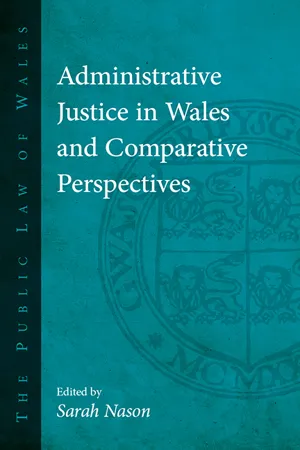
Administrative Justice in Wales and Comparative Perspectives
About this book
This book offers a unique understanding of what administrative justice means in Wales and for Wales, whilst also providing an expert and timely analysis of comparative developments in law and administration. It includes critical analysis of distinctly Welsh administrative laws and redress measures, whilst examining contemporary administrative justice issues across a range of common and civil law, European and international jurisdictions. Key issues include the roles of commissioners, administrative courts, tribunals and ombudsmen in devolved and federal nations, and evolving relationships between citizens and the state – especially in the context of localisation and austerity – and will be of interest to legal and public administration professionals at home and internationally.
Information
Chapter 1
Implications for Administrative Justice of Wales’s Unique Child Rights Laws*
INTRODUCTION
Wales’s unique laws on children’s human rights sit squarely within the domain of administrative justice. The principal enactment, the Rights of Children and Young Persons (Wales) Measure 2011 (the Measure), echoes in its long title the Human Rights Act 1998 when describing the Measure’s purpose as ‘to give further effect’ to specified international human rights obligations. The principal mechanism deployed by the Measure is, however, much confined in comparison to the principal mechanisms of the Human Rights Act 1998. The Measure is concerned with ensuring that selected human rights obligations in the United Nations Convention on the Rights of the Child (UNCRC) and its Optional Protocol are imported into the Welsh Government decision-making process. A second enactment, the Social Services and Well-being (Wales) Act 2014, injects a similar requirement into decision-making by persons exercising functions under that Act in relation to children: for example, functions relating to local assessment of children in need, provision of services and child protection. These statutory provisions belong in a consideration of administrative justice in Wales, when adopting Michael Adler’s understanding of administrative justice as ‘the principles that can be used to evaluate the justice inherent in administrative decision-taking’.1 Crafted within a particular political space at a particular time, the Welsh due regard duties on the rights of the child have introduced significant new factors to be considered in the exercise of a wide range of administrative decision-making by Welsh Ministers and Welsh statutory bodies.
As a result of these two Wales-only, made-in-Wales laws, the UNCRC has effects in Wales that it does not have under the law applicable to other parts of the United Kingdom. This has interesting consequences in terms of the accountability of the United Kingdom as State Party under the UN treaty monitoring and reporting mechanism that takes a ‘top-down’ view of the State Party’s general obligation to implement conventions, predicated on an assumption that government at the State Party level will control and coordinate implementation.2 While such consequences are played out in the international administrative justice machinery of the United Nations, these unique children’s rights laws have equally interesting implications for domestic administrative justice developments in Wales. This chapter is concerned with those domestic consequences. It does not attempt to situate the Welsh due regard duties in one or other of the models of administrative justice to which Adler refers.3 Instead, it offers a critical analysis of the political and legislative journey of children’s rights in Wales, illustrates by examples the application of the due regard duties in administrative decisions, considers the extent to which exercise of the duties is amenable in practice to judicial review, and notes some of the challenges of accountability. Finally, it returns to principles for designing administrative justice redress mechanisms for public bodies operating in Wales4 and suggests certain issues that need to be addressed if administrative justice in Wales is to contribute effectively to ensuring accountability for delivery on the Welsh promise to have ‘due regard’ to the UNCRC.
CRITICAL ANALYSIS OF THE POLITICAL AND LEGISLATIVE JOURNEY: POLITICAL PROVENANCE AND POTHOLES
The political provenance of the Measure is important when seeking to understand its practical effects and its potential. It also helps to explain some later apparent contradictions, rather as potholes in a road may emerge post-construction as sub-structural watercourses persist in their habitual paths. It needs to be understood that the Measure was not just about children’s rights. It was a product of the third National Assembly for Wales, but this was the first Assembly elected under the reformed devolution arrangements enacted in the Government of Wales Act 2006 (the 2006 Act). The 2006 Act was a response to the recommendations of the Richard Commission Report on the Powers and Electoral Arrangements of the National Assembly for Wales.5 It replaced the Government of Wales Act 1998, confirming that Welsh devolution was more than executive and replacing the original ‘double-yolker egg’ design in which a single body had uncomfortably contained a government, in the form of the Assembly Cabinet, and parliamentary-style scrutiny functions.6 Under the 2006 Act, the double-yolker egg was hatched into two separate beings and mechanisms were put in place to enable each to grow. In place of the single corporate structure, the 2006 Act delivered a parliament, called the National Assembly for Wales, and a government, called the Welsh Ministers. The legislative competence of the National Assembly for Wales was redefined, with room for growth. Powers to enact laws, known as Measures, in fields laid out in Schedule 5 to the 2006 Act, could be conferred piecemeal under legislative competence orders negotiated between the Welsh Ministers and the UK Government and confirmed by the UK Parliament at Westminster. The 2006 Act also provided for the replacement of this system by one in which the Assembly would have power to pass Acts (instead of Measures) in subject areas (instead of fields), again with scope for Westminster subordinate legislation to expand competence. The move from Measures within fields to Acts within subject areas would be triggered by a simple majority in a referendum of the Welsh electorate for which the 2006 Act also made provision. In the event, growth was rapid, and such a referendum delivered the requisite majority in early 2011, and so from 5 May in that year – the beginning of the fourth Assembly – the Assembly took a further step towards maturity as a parliament. The Assembly’s Measures during the period 2007–11 and the Assembly’s Acts from 2011 onwards, are broadly equivalent in effect in Wales, to Acts of the Scottish Parliament in Scotland.
The legislative policy for the Rights of Children and Young Persons (Wales) Measure 2011 was developed from the early spring of 2009 – around the mid-term point in the life of the National Assembly for Wales’s first term as a separate parliament. The Welsh Ministers during that term comprised a coalition government pursuant to the ‘One Wales’ agreement reached in the weeks following the 2007 Assembly elections between Welsh Labour led by Rhodri Morgan and Plaid Cymru led by Ieuan Wyn Jones. It was thus a time both of constitutional transition and of political experimentation. Welsh Ministers and the National Assembly for Wales were united in a desire to use the processes set out in the 2006 Act to gain more powers. Initially this would be done by seeking legislative competence orders, but at the same time they would seek to move as swiftly as possible to the referendum which would deliver the power to pass ‘Acts’ and greater independence from the control of the UK Government. Accordingly, in this early post-2006 Act phase, it was politically important not only to gain more legislative competence but also to use that competence in ways that would signal the maturity of the Welsh institutions. Accordingly, laws that could be seen to be significant, ideologically principled, distinctly Welsh and differentiated from positions taken by the UK Government in respect of England would be especially valuable. In addition, legislative proposals for any such new laws would need to attract consensus within the One Wales coalition. Making Welsh law on children’s rights ticked all these boxes, the ground having been laid out by the ‘people, politics and policies’7 of the first two Assemblies.
Dominant voices in the Welsh polity at this time regarded the UNCRC, correctly, as a charter for social justice, consonant with a recurring ideological theme about social citizenship amongst the Welsh Labour leadership of the early Assemblies.8 The UNCRC asserts children’s entitlement to special nurture and protection but also their right to participate in discussions and decisions that shape their environments. It requires the adult world to listen to children as well as observe them, to engage with and to understand the child as citizen now, not merely citizen in the making. The text of the UNCRC contains some forty-two substantive provisions, sometimes informally categorised under three ‘Ps’: protection, provision and participation. By ratifying the Convention, States Parties recognise children’s rights to: survival and development; the best attainable standard of health care; education; welfare support and play; birth registration, name and nationality; express a view and have it taken into account; freedom of expression, thought, conscience, religion, association and assembly; provision of information and access to media; non-discrimination; promotion of children’s best interests and well-being; separation from parents only where in child’s best interests; protection from illicit transfers, trafficking, abuse and exploitation; special employment protection; special protection if affected by armed conflict; support if separated from their families; protection from unlawful interference with private life; and special treatment where in conflict with criminal law. States Parties are obliged to take specific steps to secure these conditions for children, as well as being placed under a general obligation to take ‘all necessary measures’ to implement the whole of the Convention, including applying maximum available resources to implement social economic and cultural rights. The UNCRC also contains several general and specific requirements for States Parties to support and respect parents and kinship groups in carrying out their primary role of raising and nurturing children. The practical implementation of many of these provisions, and almost all of those concerned with social, economic and cultural rights, fell within the scope of devolved law-making and government in the United Kingdom even before the expansion in Welsh legislative competence under the Act 2006. Children’s rights therefore offered a space in which a ‘Welsh way’ in post-devolution public policy could be developed and operationalised, and this widely known, almost universally ratified, international treaty provided a framework that was sympathetic to what had emerged as a broad consensus about child and youth policy in the early Assemblies.
A distinct approach on children’s rights had been evident from the early months of the first Assembly.9 In contrast to the UK Government, the National Assembly for Wales adopted the language of rights and entitlement when articulating political direction on children and young people. In 2000, the Assembly’s strategy for planning and delivery of local children’s services, Children and Young People: A Framework for Partnership, opened with a commitment to the UNCRC and emphasised the need to listen to children and young people. It referred to the establishment of a children’s commissioner as being demonstrative of this commitment. The Children’s Commissioner for Wales, appointed under the Care Standards Act 2000 (as amended by the Children’s Commissioner for Wales Act 2001) was placed under a duty to ‘have regard’ to the UNCRC when exercising its functions. This duty was imposed by Regulations made by the first Assembly10 and was the first legislative reference to the Convention within the United Kingdom. Another early Assembly strategy, Extending Entitlement, set out an explicitly rights-based approach to the delivery of youth services, in contrast with the equivalent English strategy. The contrast was all the more prominent because both English and Welsh documents were in part statutory directions under common enabling powers set out in section 123 of the Learning and Skills Act 2000.11
The first Assembly’s affinity for the UNCRC’s concept of ‘citizen child’12 was further demonstrated by its support for the establishment of the Children and Young People’s Parliament for Wales, known as Draig Ffynci/Funky Dragon. Members of the Assembly Cabinet met formally with the elected young representatives of Funky Dragon in what was dubbed the ‘Dragon’s Dialogue’. At the time this degree of engagement was celebrated by the Cabinet members and the young representatives alike.13 On 14 January 2004, the second Assembly resolved to adopt the Convention as the overarching framework of policy for children and young people in Wales.14 Several Welsh governmental strategies published during the second Assembly made explicit connections with Articles of the Convention. These included guidance issued in the implementation of the Children Act 2004 where the Welsh document, Rights to Action, set out seven core aims, explicitly derived from the Convention, in contrast to the English equivalent, Every Child Matters, which made no mention of children’s rights at all. Other examples are the Welsh child poverty strategy, A Fairer Future for Our Children15 and the All Wales Youth Offending Strategy,16 the latter famously adopting the slogan ‘children first, offenders second’, in stark contrast to the language of responsibility and control emanating from New Labour’s youth justice reforms.17The Assembly took a stance in opposition to that of the UK Government on issue of physical chastisement of children, resolving by a two-thirds majority to ‘regret’ the UK Government’s failure to equalise protection for children and adults under the criminal law of assault.18
During the UK parliamentary passage of the Children Bill in 2004, only a partial reduction in the application of the defence of reasonable chastis...
Table of contents
- Cover
- Title Page
- Copyright
- Series Preface
- Contents
- Foreword
- Notes on Contributors
- List of Figures
- List of Tables
- Introduction: Administrative Justice in Wales and Comparative Perspectives: Sarah Nason
- Part 1: Welsh Legislation and Administrative Justice
- Part 2: Welsh Commissioners and Administrative Justice
- Part 3: Administrative Justice Within and Across the United Kingdom: New Developments in Tribunals and Ombudsmanry
- Part 4: Comparative Perspectives on Administrative Justice
- Select Bibliography
- Notes
Trusted by 375,005 students
Access to over 1.5 million titles for a fair monthly price.
Study more efficiently using our study tools.
Frequently asked questions
Yes, you can cancel anytime from the Subscription tab in your account settings on the Perlego website. Your subscription will stay active until the end of your current billing period. Learn how to cancel your subscription
No, books cannot be downloaded as external files, such as PDFs, for use outside of Perlego. However, you can download books within the Perlego app for offline reading on mobile or tablet. Learn how to download books offline
We are an online textbook subscription service, where you can get access to an entire online library for less than the price of a single book per month. With over 1.5 million books across 990+ topics, we’ve got you covered! Learn about our mission
Look out for the read-aloud symbol on your next book to see if you can listen to it. The read-aloud tool reads text aloud for you, highlighting the text as it is being read. You can pause it, speed it up and slow it down. Learn more about Read Aloud
Yes! You can use the Perlego app on both iOS and Android devices to read anytime, anywhere — even offline. Perfect for commutes or when you’re on the go.
Please note we cannot support devices running on iOS 13 and Android 7 or earlier. Learn more about using the app
Please note we cannot support devices running on iOS 13 and Android 7 or earlier. Learn more about using the app
Yes, you can access Administrative Justice in Wales and Comparative Perspectives by Sarah Nason in PDF and/or ePUB format, as well as other popular books in Law & Administrative Law. We have over 1.5 million books available in our catalogue for you to explore.