Death comes for us all – eventually. Philosophers have long been perplexed by how we ought to feel about death. Many people fear death and believe that death is bad for the person who dies. But is death bad for us, and if so, how is its badness best explained? If we do not survive death –if death is simply a state of nothingness – how can death be bad for us? If death is bad for us, do we have good reason to live as long as possible? Would an immortal life really be a good human life – or would even an immortal life eventually become tedious and make us long for mortality?
This volume presents fourteen philosophical essays that examine our attitudes toward mortality and immortality. The topics addressed have become more urgent as scientists attempt to extend the human lifespan, perhaps even indefinitely. This book invites the reader to critically appraise his or her own attitudes toward death and immortality by exploring the ethical, metaphysical, and psychological complexities associated with these issues.
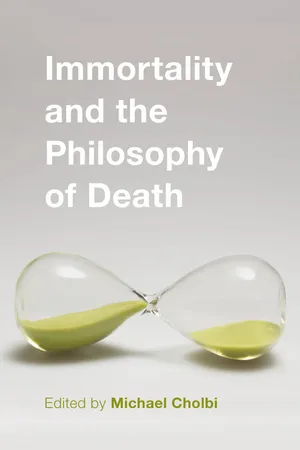
- 258 pages
- English
- ePUB (mobile friendly)
- Available on iOS & Android
eBook - ePub
Immortality and the Philosophy of Death
About this book
Information
Part I
IS DEATH BAD FOR THOSE THAT DIE?
Chapter 1
Victims
Christopher Belshaw
When is death bad for the one who dies? Not as often as you might think.1 It is typically bad for the likes of us—the people reading this—and for our friends, neighbors, colleagues, students. It is similarly typically bad for similar people elsewhere. But it isn’t bad for nonhuman animals or for a human zygote, or embryo, or fetus. Nor, more controversially, is it bad for neonates, or young babies. Nor, a little less controversially, is it bad for many in an end-of-life situation, for the brain dead, or someone in PVS, or with advanced Alzheimers. What more can be said about those for whom death is bad? Most of us are familiar with the term “person” used in a Lockean sense to pick out those beings that are rational, self-conscious, and have an understanding of time.2 While some have objections, often on grounds of its alleged ethical implications, most, I think, are content to so use the term. And I assume here that such usage is acceptable. So my claim can be put in terms of personhood. Death is often (but not always) bad for persons. It isn’t bad (ever) for non-persons. And now in explaining why this should be so there emerges a different, though related, account of death’s badness. Not only can persons, and they alone, have beliefs about times other than now, but they, and they alone, can have desires relating to those times, wishing that such and such had happened in the past, hoping that this and that will happen in the future. And they can hope that they themselves will survive into the future, and be able then to observe, or take part in, things happening then. Death is bad, I’ll say, only for those who want to live. And only persons can want this. The resulting claim—death is bad only for persons who want to live—alleges just a necessary condition of death’s badness. It is my major concern here. But I have also a lesser concern with something more ambitious. Death is bad, I’ll tentatively suggest, when and only when it cuts off a good life that some person wants to live.3
This is thus far only an outline of a view. And in all three parts, relating to death’s badness, to persons, and to desires, it needs some modification. I’ll proceed by anticipating and defending against some familiar objections. In so doing the view will be refined and clarified. There are three sorts of objections to be considered here. First, it will be said, death is bad much more often, in many more cases, than I claim. And it is bad for many non-persons. Second, the distribution of personhood is underestimated. Even if it is bad only for persons, death is more often bad than I allow. Third, even granting there is something seemingly correct about my view, it doesn’t withstand close scrutiny. Especially where desires are concerned, the devil is in the detail. As will emerge, these objections are in some ways connected, and the distinctions between them less than sharp.
1. DEATH’S BADNESS
Many people will object to my opening claim and hold that death is very often bad, and bad for more than the likes of us. And, in one sense, they are right. Consider trees. They can be in better or worse conditions, in good or bad health, alive or dead. When a tree would otherwise be in a good condition, then, I claim, disease or death is bad for it. It isn’t bad merely for gardeners, or nature lovers, or nesting birds. So although there are often reasons to do with consequences and side effects for thinking it bad that some tree dies, this isn’t the end of the matter. Set these aside. Death is bad for the tree.
Death is similarly bad for animals. When an animal would otherwise continue its life in a good condition, then death is bad for it. We might say, simply, that death is bad when it brings to an end a good life. Human animals are among the animals. So it is similarly bad for a human being to die when, had it not died, it would have lived a good life. Some related terms might be introduced here. When an intervention causes a deterioration in some living thing’s condition, we can say that this thing has been harmed. And there is no good reason not to include death among the interventions that harm.4 Plants and animals alike can be harmed by death. Some of this talk of a good condition or a good life might be put in terms of proper functioning, or flourishing, or well-being. When death is bad for some plant or animal, harms it, this is because, had it not died, it would have continued to function properly and to flourish. Its lifetime well-being would have increased. When, had it not died, it would have lived on in a poor condition, with no additions to overall well-being then, arguably, death is not bad. Arguably too, we can focus on the premature death: when death comes at the end of a natural lifespan then, again arguably, it is not bad.5
How bad is death? Even without an absolute scale we can make some relevant comparisons. Dying at thirty is, other things equal, worse for some individual than is dying at sixty, as more good life is thereby lost. Dying at three is worse still, and plausibly, dying at three months worse again. This is true whether we are considering a human being or a tortoise. And insofar as a premature death is bad for a tree, then death is worse earlier, for the sapling, than it is later, impacting on the mature specimen. Can we make comparisons across individuals? Other things equal, it is worse for young Jack to die than old Jill, whether these are pairs of people or parrots. Cross-species comparisons are more difficult. In a storm a middle-aged oak tree falls onto a middle-aged donkey. Both die. Which is worse?
None of this, however, has much bearing on an important question. Does it matter that things die? For some plant or animal death looms. Do we have reason to prevent (if we can) or regret (if we can’t) this death? Often, of course, we do. For consequences and side effects need, often, to be taken into account. Set these aside. My question is, do we have such reason, other things equal, just for the sake of victim, to prevent or regret this death? Why is this an important question? Those concerned with either the theory or practice of ethics want to know which lives to save, which killings to prevent. Many of us wonder how we should react to so-called natural disasters or environmental catastrophes in which millions of animals and plants are lost. We wonder, too, how we should deal with, react to, or assess the character of someone who brings about death. Our moral code might be left in parts vague, but we have no option but to devise and implement a criminal code that deals, fairly and appropriately, with a whole range of deaths. Merely noting that some lives have been ended ahead of time, and acknowledging that this is in some sense bad for the one who dies, doesn’t take us very far with this.6
Does it matter if some tree dies? Do we have reason to prevent or regret, for the sake of the tree, this death? Most of us think not. Side effects often matter. The tree itself doesn’t.
Trees and plants lack a psychology. They have a life, but nothing like a mind. There are, I claim, no reasons to regret or prevent, for the sake of the thing that dies, the death of some living thing that has, has had, and never will have any psychology. Some animals also lack a psychology. There is neither thinking nor feeling in the head of a wood louse, a head louse, or more obviously, in a headless clam or sponge.7 Nothing that happens to them should we regret, just for their sake. Other animals, and most of those we care about, do have a psychology. They can feel pleasure and pain. In many cases there are more complex mental states also. Some of these states, in some circumstances, will impact on our reasons to intervene in an animal’s life. So their obtaining matters. But which states matter, under what circumstances, and to what degree?
Plausibly, there is reason, other things equal, to prevent an animal, for its sake, from feeling pain. Many of the objections to hunting, factory farming, circuses, and zoos are sound. But as death, or being dead, in contrast to dying, doesn’t cause pain, there isn’t reason here to prevent or regret death in such an animal. Is there reason also to encourage or permit an animal to feel pleasure? A distinction needs to be made. If an animal is alive and conscious at some time, then there may be reason not only to decrease its pains but also to increase its pleasures at that time. We might say there is reason to care, in both respects, about its momentary well-being. Suppose this is so. It doesn’t follow from this that there is reason to sustain and extend its life, in order to increase its pleasures into a later time.
But is there reason to increase an animal’s pleasure at a time? Let’s assume that, as well as feeling, some animals are capable of thinking. So let’s assume there are some sorts of beliefs and desires that might be taken into account. Does our having reason to prevent or reduce pain depend on the animal’s desiring that pain be ended? Perhaps we can assume the reason persists, even if (and assuming the animal doesn’t actually want pain) the desire is absent. But pains and pleasure may differ here. It may be that there is no reason to increase an animal’s pleasure, at a time, unless it desires this increase. If there is a desire then there is reason. And otherwise not. We can be agnostic on this point—not implausibly there is reason anyway. But consider extending life. I want to suggest that there is no reason to keep an animal from death unless it actually wants to live on, and wants to enjoy not only present but future pleasure. And while we can assume there are some sorts of beliefs and desires that animals might entertain, those relating to past and future times may be beyond their grasp.
Imagine, then, a frog which believes right now that it isn’t very warm. And it desires right now to be warm. In such a case we do have reason, I think, for its sake, to warm it up, perhaps by moving it out of the shade. It is now enjoying the warmth of the sun. Unimpeded, this enjoyment will continue. Though death now would be bad for the frog, there isn’t, thus far, reason for any of us to prevent that death from occurring. The abrupt termination of pleasant sensations isn’t, for the frog, bad in the way that matters. Or so I claim. But imagine further that it desires warmth to continue into the future, say for the rest of...
Table of contents
- Cover-Page
- Halftitle
- PART I: IS DEATH BAD FOR THOSE THAT DIE?
- PART II: LIVING WITH DEATH
- PART III: THE VALUE OF AN IMMORTAL LIFE
- Index
- About the Contributors
Trusted by 375,005 students
Access to over 1.5 million titles for a fair monthly price.
Study more efficiently using our study tools.
Frequently asked questions
Yes, you can cancel anytime from the Subscription tab in your account settings on the Perlego website. Your subscription will stay active until the end of your current billing period. Learn how to cancel your subscription
No, books cannot be downloaded as external files, such as PDFs, for use outside of Perlego. However, you can download books within the Perlego app for offline reading on mobile or tablet. Learn how to download books offline
Perlego offers two plans: Essential and Complete
- Essential is ideal for learners and professionals who enjoy exploring a wide range of subjects. Access the Essential Library with 800,000+ trusted titles and best-sellers across business, personal growth, and the humanities. Includes unlimited reading time and Standard Read Aloud voice.
- Complete: Perfect for advanced learners and researchers needing full, unrestricted access. Unlock 1.5M+ books across hundreds of subjects, including academic and specialized titles. The Complete Plan also includes advanced features like Premium Read Aloud and Research Assistant.
We are an online textbook subscription service, where you can get access to an entire online library for less than the price of a single book per month. With over 1.5 million books across 990+ topics, we’ve got you covered! Learn about our mission
Look out for the read-aloud symbol on your next book to see if you can listen to it. The read-aloud tool reads text aloud for you, highlighting the text as it is being read. You can pause it, speed it up and slow it down. Learn more about Read Aloud
Yes! You can use the Perlego app on both iOS and Android devices to read anytime, anywhere — even offline. Perfect for commutes or when you’re on the go.
Please note we cannot support devices running on iOS 13 and Android 7 or earlier. Learn more about using the app
Please note we cannot support devices running on iOS 13 and Android 7 or earlier. Learn more about using the app
Yes, you can access Immortality and the Philosophy of Death by Michael Cholbi in PDF and/or ePUB format, as well as other popular books in Philosophy & Ethics & Moral Philosophy. We have over 1.5 million books available in our catalogue for you to explore.