Authenticity is much sought after; being described as inauthentic is an insult or an embarrassment. Being authentic suggests that a given behaviour or performance is reflective of a 'trueness' or 'genuineness' to one's identity. From a social science perspective there is sometimes scepticism expressed about the historical faithfulness of purported behaviours - such as when something is referred to as an 'invented' tradition. However, what can be overlooked in such criticisms is an array of sociological and existential dynamics that are at play when authenticity is striven for. Likewise able to be overlooked is where the location of that authenticity is ostensibly founded; sometimes the trueness of the behaviour is located in local traditions that reach back into time immemorial, sometimes in a universal human and shared sameness, and sometimes with regard to a global phenomenon.
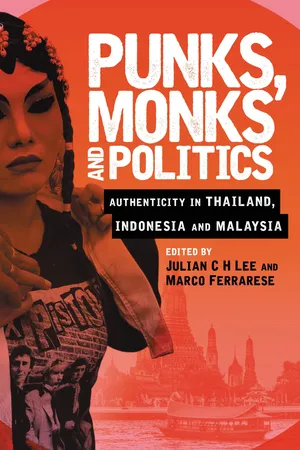
Punks, Monks and Politics explores the idea of authenticity as enacted in Thailand, Indonesia and Malaysia. The collective contributions reveal the sometimes contradictory ways in which the dynamics of authenticity – its pursuit, its deployment, its politics – play out in very different contexts. Whether authenticity inheres in the local or the global, amongst the majority or within a subculture, on the outside of or within people, or in the past or the present, authenticity is nevertheless valued.
eBook - ePub
Punks, Monks and Politics
Authenticity in Thailand, Indonesia and Malaysia
- 304 pages
- English
- ePUB (mobile friendly)
- Available on iOS & Android
eBook - ePub
Punks, Monks and Politics
Authenticity in Thailand, Indonesia and Malaysia
About this book
Information
Section 1
Malaysia
Chapter 1
Heavy Metal Nothingness
Alluring Foreignness and Authenticity Construction in Early 2010s Malaysian Metal
Marco Ferrarese
Music subcultures such as heavy metal and punk rock have greatly influenced many young people in Southeast Asia. The existence of a grassroots network of bands, venues, magazines and websites strengthened the idea that, even in the developing nations of Asia—and Southeast Asia in particular—where today nations such as Indonesia, Malaysia and Singapore have some of the biggest music scenes in the world (Wallach 2011), underground subcultures represent sites of social empowerment and anti-hegemonic resistance. What is still unclear, however, is the extent to which such ‘rebellion’ can be considered as an ‘authentic’ by-product of local agency. In other words, by embracing Anglocentric music subcultures, Southeast Asian youth employ foreign codes that are ‘authenticated’ and constructed on a ‘Western’ sense of resistance to the globalizing, commercial world we live in today. From this perspective, seeking to understand the ‘authenticity’ of Southeast Asian instances of heavy metal and punk subcultures, which are so embedded within an Anglocentric cultural framework, is a worthy endeavour.
What is clear is that metal music in Southeast Asia is a cultural code that local youth look to find for authentic identities in the rapidly changing, industrializing and globalizing societies they live in (Wallach 2008: 103). This is affirmed by previous studies on global metal (Wallach, Berger and Greene 2011)—the genre is a fixed code, an artistic expression bound by a set of globally recognized stylistic rules that authenticate its performance. Metal has a structure and a sound that makes it immediately recognizable and thus reproducible around the world, as described, for example, by a recent study of metal in Kenya (Knopke 2015). Based on Arjun Appadurai’s (1990) concept of mediascapes, ideas become globalized because of the global flows of their printed and screened media images. Accordingly, metal fans and musicians around the world have been influenced by the global metal cultural production that spread to their nations from the western epicentres as a consequence of what Deena Weinstein called ‘the globalization of metal’ (Weinstein 2011). However, such interpretations could suggest the subordination of the developing world’s metal scenes to a form of Western-influenced ‘metal colonialism’, thus suggesting their inability to create authentic metal music, and also highlighting their adherence to the features of a foreign music genre.
Such a conclusion, however, would be too simplistic. The concept of music ‘authenticity’, in fact, is not inherent in objects, but is negotiated and mutually agreed upon by the society or social group that observes such objects (Peterson 1997). In this regard, this chapter is concerned with demonstrating how in the early 2010s the Malaysian heavy metal music scene ‘authenticates’ forms of global metal, which in turn act as influential models that Malaysian metalheads use to construct their own sense of ‘metal authenticity’. Throughout my analysis, I show how members of this subculture in Malaysia authenticate their heavy metal identities by adhering to western-influenced metal clothing and style, valuing the possession of imported western subcultural capital, and considering the performance of Western heavy metal bands as superior to their own. In other words, I set out to demonstrate how Malaysian metalheads define metal ‘authenticity’ based on examples provided by an Anglocentric parent heavy metal culture. As a consequence, metal in Malaysia is perceived as a static form, and seems to be authenticated only when it is performed as close as possible to the foreign forms of metal that are globally recognized as ‘classic examples’.
My hypothesis is largely confirmed by previous studies of other Southeast Asian instances of western popular music subcultures. To begin with, Jeremy Wallach has concluded that the punks of Jakarta, Indonesia, are ‘loathe to embrace musical innovations, instead maintaining their stylistic allegiance to what they perceive as a classic punk sound’ (Wallach 2008: 103). Heather Maclachlan observed that by playing copy thachin, Burmese pop rock bands seek to reproduce a foreign art form that they perceive as ‘authentic’ only when it sounds as close as possible to the western original songs of reference (Maclachlan 2011: 71). Similarly, Ward Keeler saw very few differences distinguishing the performance of the rap scene in Burma from other rap scenes anywhere else in the world, because Burmese rappers ‘look outward, to the model of foreign rap, as they seek to take on for themselves an internationally validated style’ (Keeler 2009: 13). In the case of death metal, Emma Baulch (2003) has observed how Balinese death metal enthusiasts do not consider local death metal music as serious or authentic if it is sung in languages other than English, or if it incorporates local folk elements which are alien and not ‘authenticated’ by the American and British heavy metal classic traditions. Balinese death metal musicians, in fact, ‘gestured elsewhere’ (Baulch 2003) and constructed the authenticity of their subculture by looking at foreign forms of heavy metal, refraining from associating any core values of the music movement with any specific geographies. This choice is in line with the features of global heavy metal, which largely does not reflect a sense of territoriality or folkloric locality. And even in those scarce instances when it does, its recorded production ends up fitting the requirements of the Anglocentric global extreme metal marketplace by using texts and lyrics in English, metal’s prominent global language. Some examples are Brazilian death metal band Sepultura, which introduced localized elements in the song writing, lyrics and cover artwork of its largely successful album Roots released in 1996 (Harris 2000), or Israeli band Orphaned Land, which created an interesting mixture of progressive metal and Middle Eastern and Arabic-influenced sounds (Kahn-Harris 2007: 113), but invariably targeted the Anglocentric markets of global metal by using English lyrics.
UNDERSTANDING HEAVY METAL NOTHINGNESS
The discussion above might lead one to argue that global metal, exactly as any other form of globalized, commercially successful popular music, could represent an instance of what George Ritzer and Michael Ryan describe as the ‘globalization of nothing’, intended as ‘empty forms that are centrally conceived and controlled and relatively devoid of distinctive content’ (Ritzer and Ryan 2002: 51). Nothing, to the contrary of indigenously created forms rich in distinctive content which constitute something, is easier to export around the world because its lack of content is less likely to be rejected by some cultures and societies that could consider it as offensive. The shopping mall is one such example of empty structure which can be easily replicated all around the world, and filled with objects which are not characteristic of any particular culture (Ritzer and Ryan 2002: 52). Metal music, like a supermarket, could then be interpreted as an empty structure, a globalized music genre that, as such, remains faithful to its own authenticated standards.
Metal experts and scholars in the budding field of metal studies could object to this argument that metal is just an instance of simplistic, globalized nothing. Indeed metal music, besides its largely non-political and leisurely attitude (Phillipov 2012), retains strong visuals and messages that characterize the genre as opposing the norms of mainstream society. Furthermore, metal’s unorthodox themes and rebellious imagery have certainly unleashed censors and concerned parents, including in non-Western places such as in Turkey (Hecker 2012), Egypt, Iran, Morocco (LeVine 2008) and Malaysia (Azmyl 2009). This evidence would seem to partly contradict my argument that metal could be an easily exported, inoffensive nothingness which can adapt to any culture. However, I argue that the structure of metal, with its defiant characteristics, occult themes and music style, has clearly materialized in the exact same coded ways—as agreed by Weinstein (2011)—in both the developed and the developing world, wherever a metal scene has come into existence (Hecker 2012; Kahn-Harris 2002, 2007; Wallach, Berger, and Greene 2011). In other words, heavy metal never changes; it just reproduces its Anglocentric code-form regardless of the cultural and societal backbone in which it develops. In his landmark study Extreme Metal, even Keith Kahn-Harris observed how ‘[metal] musicians accrue mundane subcultural capital by developing existing styles. The majority of musicians and bands in the scene are not innovators, but refiners’ (Kahn-Harris 2007: 126). The Malaysian metalheads I observed and interviewed seemed bent on reproducing more than refining the metal genre. They adhered completely to globally ‘authenticated’ forms of metal, rather than interpreting them and refining them through their peculiar cultural differences. The same sense of their metal authenticity appeared to be authenticated by such reproduction, and greatly influenced by the foreign bands they observed. In the following sections, I will support my argument presenting several case studies I observed during a ten-month period of ethnographic fieldwork in West Malaysia.
EARLY 2010s MALAYSIAN METAL IN CONTEXT
The metal scene I encountered in West Malaysia at the beginning of my research in June 2013 lacked a physical centre and dedicated venues with regular metal shows. Concerts were organized occasionally at rehearsal studios, rented halls or more frequently in two established alternative spaces (Soundmaker Studio in Penang and Rumah Api in Kuala Lumpur) that hosted the sub-genres of metal as part of a wider gamut of extreme and alternative music styles such as hardcore punk and post rock. The metal scene was constituted by various bands scattered around the country, particularly in the capital Kuala Lumpur; the cities of George Town, Ipoh and Johor Bharu in West Malaysia; and Kuching, Kota Kinabalu and Sandakan in East Malaysia. Each local scene had at least one jamming studio where bands rehearsed and metalheads mingled, but only the biggest cities had dedicated venues. Among them, only the above-mentioned Soundmaker and Rumah Api could be considered as spaces where metal shows constituted the best part of the calendars. For the rest, the dearth of dedicated venues forced show organizers to rent public halls and other performance spaces in order to organize shows. However, because of the high costs and the small numbers of people in the scene, Malaysian bands tended to concentrate their performances either in Kuala Lumpur or Penang, where venues and a small but dedicated crowd existed. It is important to note how metal bands also suffered a common problem shared by other extreme music bands in Malaysia: the difficulty of getting paid to play. This is a common practice in the West, where venues usually hire performers to fill up their calendars, and therefore use bands as attractions, paying them at least the reimbursement for their expenses. In Malaysia, conversely, this was not the case. Burdened by the venues’ high rental fees, show organizers rarely offered any payment to local bands. Consequently, the development of a touring circuit was hampered, and the situation in turn helped concentrate the majority of metal performances to Kuala Lumpur, Penang and, to a lesser extent, Johor Bharu.
Dedicated metal press was also lacking. The Bahasa Malaysia-written and professionally printed metal and rock magazine Karisma ceased publications unofficially with the release of its twenty-sixth issue dated October/November 2012. It transformed into a Facebook page that until recently only published brief concert updates. ROTTW, another Malay language bookstall magazine, covered Malaysian metal but was regarded by most of my research informants as a publication ‘for teenagers and posers’.
Regardless of the dearth of press and dedicated spaces for live metal music, my fieldwork coincided with a period during which many international touring bands came to Malaysia, including big names of the global metal scene. Unlike the venues, these concerts were organized by different local promoters in rented clubs and halls that had no apparent relation with sites of metal consumption in Malaysia, and were simply chosen by virtue of their sound systems, capacity and location. In order to attract the widest possible number of fans, foreign bands usually played one single show in the capital city of Kuala Lumpur. Situated almost at the centre of West Malaysia and having an efficient transportation network, the capital functioned as the epicentre for foreign metal performance. Among others, I witnessed the arrival of affirmed American underground bands Disgorge and Kylesa, 1980s German thrashers Destruction, Lock Up and arena rock stars of the calibre of Metallica. I also witnessed the controversy surrounding the cancellation of American extreme metal band Lamb of God’s Kuala Lumpur show scheduled for 23 September 2013. The Jabatan Kemajuan Islam Malaysia (Jakim; Department of Islamic Development) prohibited the performance based on the claim that ‘the music the group performed was a mix of metal songs with the reading of verses from the Quran’.1 On the other hand, in nearby Jakarta, Indonesia, the contemporary launch of the first edition of other metal festivals like Hammersonic2 and Extreme Obscene gave Malaysians a chance to travel close to home and see internationally revered American and British extreme metal bands such as Dying Fetus, Hour of Penance, Cradle of Filth, Obituary, Cannibal Corpse and As I Lay Dying. Based on the descriptions provided by previous research into Malaysian metal (Wallach 2011) and my own research (Ferrarese 2012), the years 2013 and 2014 saw an exponential increase in the opportunities for Malaysian metalheads to see and interact with the Western bands they referenced to when constructing their sense of ‘metal authenticity’.
Even more importantly, these years also saw changes in global heavy metal touring trends, because Western bands on their way to touring Australia started to include tour stops in Southeast Asian nations such as Indonesia, Malaysia, Singapore and to a lesser extent the capital ...
Table of contents
- Cover-Page
- Halftitle
- Section 1: Malaysia
- Section 2: Indonesia
- Section 3: Thailand
- References
- Index
- About the Contributors
Trusted by 375,005 students
Access to over 1.5 million titles for a fair monthly price.
Study more efficiently using our study tools.
Frequently asked questions
Yes, you can cancel anytime from the Subscription tab in your account settings on the Perlego website. Your subscription will stay active until the end of your current billing period. Learn how to cancel your subscription
No, books cannot be downloaded as external files, such as PDFs, for use outside of Perlego. However, you can download books within the Perlego app for offline reading on mobile or tablet. Learn how to download books offline
Perlego offers two plans: Essential and Complete
- Essential is ideal for learners and professionals who enjoy exploring a wide range of subjects. Access the Essential Library with 800,000+ trusted titles and best-sellers across business, personal growth, and the humanities. Includes unlimited reading time and Standard Read Aloud voice.
- Complete: Perfect for advanced learners and researchers needing full, unrestricted access. Unlock 1.5M+ books across hundreds of subjects, including academic and specialized titles. The Complete Plan also includes advanced features like Premium Read Aloud and Research Assistant.
We are an online textbook subscription service, where you can get access to an entire online library for less than the price of a single book per month. With over 1.5 million books across 990+ topics, we’ve got you covered! Learn about our mission
Look out for the read-aloud symbol on your next book to see if you can listen to it. The read-aloud tool reads text aloud for you, highlighting the text as it is being read. You can pause it, speed it up and slow it down. Learn more about Read Aloud
Yes! You can use the Perlego app on both iOS and Android devices to read anytime, anywhere — even offline. Perfect for commutes or when you’re on the go.
Please note we cannot support devices running on iOS 13 and Android 7 or earlier. Learn more about using the app
Please note we cannot support devices running on iOS 13 and Android 7 or earlier. Learn more about using the app
Yes, you can access Punks, Monks and Politics by Julian C H Lee,Marco Ferrarese, Julian C H Lee, Marco Ferrarese in PDF and/or ePUB format, as well as other popular books in Social Sciences & Human Geography. We have over 1.5 million books available in our catalogue for you to explore.