In the course of Vladimir Putin's third presidential term, many of the doctrines and ideas associated with Eurasianism have moved to the center of public political discourses in Russia. Eurasianism, both Russian and non-Russian, is politically active —influential and contested— in debates about identity, popular culture or foreign policy narratives.
Deploying a variety of theoretical frameworks and perspectives, the essays in this volume work together to shed light on both Eurasianism's plasticity and contemporary weight, and examine how its tropes and discourses are appropriated, interpreted, modulated and deployed politically, by national groups, oppositional forces (left or right), prominent intellectuals, artists, and last but not least, government elites. In doing so, this collection addresses essential themes and questions currently shaping the Post-Soviet world and beyond.
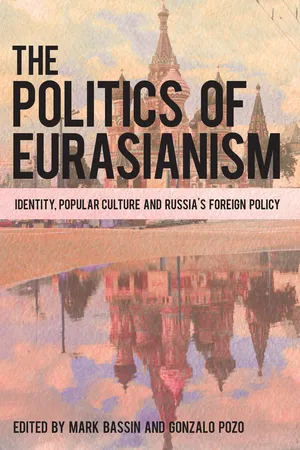
eBook - ePub
The Politics of Eurasianism
Identity, Popular Culture and Russia's Foreign Policy
- 384 pages
- English
- ePUB (mobile friendly)
- Available on iOS & Android
eBook - ePub
The Politics of Eurasianism
Identity, Popular Culture and Russia's Foreign Policy
About this book
Information
Part I
Eurasianism, Nationalism and Ideology
Chapter 1
Defining the “True” Nationalism
Russian Ethnic Nationalists versus Eurasianists
Igor Torbakov
When an empire ends, there are basically three main modes in which the post-imperial community can be reimagined: civic, ethnic and (neo) imperial. Russia’s case is no exception. The country’s liberals – clearly a “minority faith” – uphold the provisions of the 1993 Constitution that characterize Russia as a civic community of Russian citizens – rossiiane – enjoying equal rights throughout the entire territory of the country. For their part, Russian ethnic nationalists claim that the disintegration of the Soviet Union created – for the first time in Russian history – an opportunity to build a specifically russkii (Russian) nation, capitalizing on ethnic Russians’ numerical strength within the borders of the Russian Federation. By contrast, the impertsy (champions of empire) – a disparate group of thinkers that also includes the Eurasianists1 – contend that Russia’s current post-imperial condition is a mere prelude to the restoration of empire. They refer to the country’s long-standing tradition, arguing that throughout its entire history Russia has never been a nation state – either ethnic- or civic-centred – but has always been an empire. This chapter will explore how the issue of Russian identity is being contested in the debates involving Russian ethnic nationalists and Eurasianists focusing primarily on the ethnic nationalists’ critique of Eurasianism as well as on their efforts to craft a “true” Russian nationalism.
Russian Nationalism’s Perennial Dilemmas
Remarkably, the words “empire” and “nation” – essentially Western European concepts – came to be known in Russia simultaneously. They were introduced by learned churchmen (mostly of “Ukrainian” origin who drew heavily on Polish sources) between the end of the seventeenth century and the beginning of the eighteenth century, at a time when Russia had already evolved as an imperial polity. At first, these notions were used interchangeably as synonyms – as both basically meant a “sovereign state.” It took almost two centuries before “nation” started to be interpreted in Russia mainly as a political community – the locus of people’s sovereignty that is counterposed to the divine right of monarchs with its main attribute being political participation.2
In Russia, the political understanding of “nation” posed before the people who espoused such a conceptual approach – Russian ethnic nationalists – two fundamental questions. First, who is russkii? Who is included in and who is excluded from the narod (community of Russian people)? And second, how should the ethnic nationalists treat the imperial state? Is it their state in its entirety or not? These two questions remained unresolved throughout both the imperial and Soviet periods of Russian history, which resulted in what Ronald G. Suny famously called an “incomplete nation-building.”3 Not only were the ethnic nationalists unable to agree on how to define russkii, but they also found it difficult to identify with the imperial state, either tsarist or Soviet, because it tended to distance itself from Russian ethnic nationalism, seeking to preserve a delicate balance in a culturally diverse and multi-ethnic polity. To be sure, imperial bureaucrats could at times deploy Russian ethnonationalist imagery and highjack nationalist rhetoric (e.g. during the late imperial period and again during late Stalinism), but most of them were conscious of the supranational nature of the state they governed. “Since the time of Peter the Great and Catherine the Great there has been no such thing as Russia; there has been only the Russian Empire,” Sergei Witte, Russia’s prime minister in 1903–1906, wrote in his memoirs.4 The same applies in even greater measure to the Soviet Union whose very name excluded any reference to a particular ethnonational territory. True, the Soviet state did not become, as its founder Vladimir Lenin hoped, a worldwide proletarian commune but it definitely was not a Russian national homeland either. Among the fifteen Union republics of the Soviet federation the largest was called the “Russian” (Rossiiskaia) republic but the latter was also a federation whose many territorial units, noted Pavel Miliukov in his seminal 1925 essay on the “national question,” “were named after particular tribes (narodnosti) so that the map of Russian administrative territories resembled a historical-ethnographic map. A regular Russian learned about the existence in Russia of the ‘Mari’ people and the ‘Komi’ (Zyriane) people – names that scholars knew from [medieval] chronicles.”5
How did the situation change after the Soviet Union’s collapse? The 1993 Constitution characterizes post-Soviet Russia as the state of the “multinational people” – rossiiane. It inherited a legacy of Soviet federalism: a “territorialization of ethnicity” whereby a number of ethnic groups have their “national homelands” where they are recognized as “titular nations.” There is no official document that would explicitly call ethnic Russians a state-bearing people; instead the government promotes a civic (rossiiskaia) identity that encompasses the Russians along with many other rossiiskie ethnicities. Ethnic Russians do not have their specially designated “national homeland” within the Russian Federation. Furthermore, there is one complicating aspect which did not exist before 1991: millions of Russians have found themselves “stranded” outside post-Soviet Russia’s borders in what effectively is the post-imperial debris – the “newly independent states” that quickly transformed themselves into “nationalizing states.”6
Russia’s current “post-imperial condition” is deemed unsatisfactory by the two largest groups of Russian nationalists. While the impertsy (including the Eurasianists as their subspecies) regard the present-day Russian Federation as a polity that is not “imperial” enough, Russian ethnic nationalists argue that the time has come to rid Russia of the residual vestiges of empire and build at long last a truly national state – the Russian state (gosudarstvo russkikh) in which national minorities would live alongside the Russian “master of the house.” Debates between the two camps go back to the twilight of the Soviet era and the early 1990s: suffice it to mention the nationalist Russian historian Apollon Kuz’min’s sharp criticism of the Eurasianist concepts advanced by the maverick scholar Lev N. Gumilev (Kuz’min accused Gumilev of Russophobia and of the intent to sacrifice the interests of Russian people for the well-being of the Turco-Mongol world)7 or the heated polemic between the ethnonationalist writer Kseniia Mialo and Eurasianists.8 Yet these debates, argue the representatives of the new generation of Russian ethnic nationalists, are increasingly becoming pointless because history itself has resolved the empire–nation dilemma for the Russians. First, the empire – the Soviet Union – has disintegrated. Second, contemporary Russia simply lacks resources for legitimating imperial/supranational power – as both dynastic and “ideocratic” principles are missing. Finally, following the Soviet Union’s implosion, Russia has been profoundly reconfigured geographically: having shed its imperial dominions, Russia has shrunk down to what the late geopolitical thinker Vadim Tsymbursky called “its pre-imperial cultural and geographical core with solid and absolute Russian [ethnic] majority.”9 These developments have radically changed the correlation between “national” and “imperial” projects in Russian history. In the past, argues Mikhail Remizov, Russian nationalism has served as a kind of “reserve historical project” for Russia and the Russian people: it coyly manifested itself at some turning points of the country’s history but was in no pos...
Table of contents
- Cover-Page
- Halftitle
- Introduction
- Part I: Eurasianism, Nationalism and Ideology
- Part II: The Cultural Politics of Eurasianism
- Part III: “Project Eurasia” and Russia’s Foreign Policy
- Part IV: Eurasianism beyond Russia
- Bibliography
- Index
- About the Contributors
Trusted by 375,005 students
Access to over 1.5 million titles for a fair monthly price.
Study more efficiently using our study tools.
Frequently asked questions
Yes, you can cancel anytime from the Subscription tab in your account settings on the Perlego website. Your subscription will stay active until the end of your current billing period. Learn how to cancel your subscription
No, books cannot be downloaded as external files, such as PDFs, for use outside of Perlego. However, you can download books within the Perlego app for offline reading on mobile or tablet. Learn how to download books offline
Perlego offers two plans: Essential and Complete
- Essential is ideal for learners and professionals who enjoy exploring a wide range of subjects. Access the Essential Library with 800,000+ trusted titles and best-sellers across business, personal growth, and the humanities. Includes unlimited reading time and Standard Read Aloud voice.
- Complete: Perfect for advanced learners and researchers needing full, unrestricted access. Unlock 1.5M+ books across hundreds of subjects, including academic and specialized titles. The Complete Plan also includes advanced features like Premium Read Aloud and Research Assistant.
We are an online textbook subscription service, where you can get access to an entire online library for less than the price of a single book per month. With over 1.5 million books across 990+ topics, we’ve got you covered! Learn about our mission
Look out for the read-aloud symbol on your next book to see if you can listen to it. The read-aloud tool reads text aloud for you, highlighting the text as it is being read. You can pause it, speed it up and slow it down. Learn more about Read Aloud
Yes! You can use the Perlego app on both iOS and Android devices to read anytime, anywhere — even offline. Perfect for commutes or when you’re on the go.
Please note we cannot support devices running on iOS 13 and Android 7 or earlier. Learn more about using the app
Please note we cannot support devices running on iOS 13 and Android 7 or earlier. Learn more about using the app
Yes, you can access The Politics of Eurasianism by Mark Bassin,Gonzalo Pozo, Mark Bassin, Gonzalo Pozo in PDF and/or ePUB format, as well as other popular books in Politica e relazioni internazionali & Storia russa. We have over 1.5 million books available in our catalogue for you to explore.