African political writing of the mid-20th century seeks to critically engage with questions of identity, history, and the state for the purpose of national and human liberation.
This volume collects an array of essays that reflect on anticolonialism in Africa, broadly defined. Each contribution connects the historical period with the anticolonial present through a critical examination of what constitutes the anticolonial archive. The volume considers archive in a Derridean sense, as always in the process of being constructed such that the assessment of the African anticolonial archive is one that involves a contemporary process of curating. The essays in this volume, as well as the volume itself, enact different ways of curating material from this period.
The project reflects an approach to documents, arguments, and materials that can be considered "international relations" and "world politics," but in ways that that intentionally leaves them unhinged from these disciplinary meanings. While we examine many of the same questions that have been asked within area studies, African studies, and International Relations, we do so through an alternative archive. In doing so, we challenge the assumption that Africa is solely the domain of policy makers and area studies, and African peoples as the objects of data
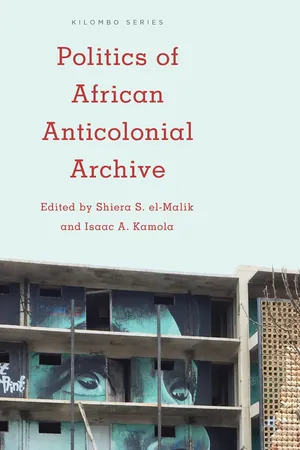
eBook - ePub
Politics of African Anticolonial Archive
- 224 pages
- English
- ePUB (mobile friendly)
- Available on iOS & Android
eBook - ePub
Politics of African Anticolonial Archive
About this book
Information
Chapter 1
Introduction
Politics of African Anticolonial Archive
Isaac A. Kamola and Shiera S. el-Malik
On 3 October 1984, Thomas Sankara – former guerrilla fighter and president of Burkina Faso – addressed a rally at the Harriet Tubman School in Harlem. Organized by the Patrice Lumumba Coalition, the rally took place on the eve of Sankara’s address to the United Nations General Assembly. However, prior to leaving for the UN, Sankara purportedly received a request from the Reagan administration for a copy of his speech, perhaps as part of a vetting process concerning whether to extend the new African president a White House invitation. When the Reagan administration suggested Sankara edit out criticisms of Western powers, Sankara ignored their request (Harsch 2014, 17). Effectively turning down a White House visit, Sankara instead planned to spend the days before the UN General Assembly in Atlanta at the invitation of Mayor Andrew Young – the renowned civil rights activist and first African American ambassador to the UN (Harsch 2014, 17). However, barred from making the trip to Atlanta, Sankara instead spent the days at various cultural and political events in Harlem. The previous day he inaugurated an exhibit on Burkina Faso art exhibition at the Third World Trade Centre, telling the crowd that ‘the fight we’re waging in Africa, principally in Burkina Faso, is the same fight you’re waging in Harlem. We feel that we in Africa must give our brother in Harlem all the support they need so that their fight too becomes known’ (Sankara 2007, 143–44). The following night, after a performance by ‘singers, dancers, and musicians’ demonstrating ‘what the revolutions should be’, and before a crowd of approximately five hundred people, Sankara drew further connections between Harlem and the struggles on the African continent, once again pronouncing that ‘our White House is in Black Harlem’ (Sankara 2007, 149). In this speech, he spoke of Harlem as the place that ‘will give the African soul its true dimension’, and declared that ‘our struggle is a call to build. … As Blacks, we want to teach others how to love each other’ and, in doing so, teach ‘the meaning of solidarity’ (Sankara 2007, 149–150). He demonstrated what this looks like with the story of his exchange with recently assassinated prime minister of Grenada, Maurice Bishop:
Last year I met Maurice Bishop. We had a lengthy discussion. We gave each other mutual advice. When I returned to my country, imperialism had me arrested. I thought about Maurice Bishop. Some time later I was freed from prison thanks to the mobilization of the population. Again, I thought about Maurice Bishop. I wrote him a letter. I never had the opportunity to send it to him. Once again, because of imperialism. So we have learned that from now on imperialism must be fought relentlessly. If we don’t want other Maurice Bishops to be assassinated tomorrow, we have to start mobilizing as of today. [Applause]
That’s why I want to show you I’m ready for imperialism. [Unbuckles belt and brandishes pistol in its holster. Cheers and prolonged applause.] (Sankara 2007, 150)
Today, this speech might seem remarkable – even unimaginable: a president of a small African country, clad in military fatigues, waving a firearm in New York City, and calling for African Americans to stand with him in a united fight against imperialism.
However, during the early 1980s this speech was anything but exceptional. In fact, it was part of a vibrant and powerful contemporaneous practice of thinking, speaking, acting, and world-making. This speech contained many themes of African anticolonial thought, including a critique of colonialism and imperialism, a vision of an alternative world not limited to Western capitalism or Soviet-style communism, an articulation of a politics premised on emancipation and liberation, as well as the existence of dense networks of collaboration and solidarity among different groups, parties, independent states, and organizations. In this tradition, Sankara’s speech was like many others in that it offered an alternative future cultivated by an international network of charismatic and national leaders, supported by mobilized populations, and held together by bonds of friendship, solidarity, and militancy. The language is poetic, yet strident. The publicness of the event was possible because of a dense network of institutions and coalitions: the United Nations brought people to New York, the Patrice Lumumba Coalition organized the event, a large crowd turned out for it, and the words, images, and memories created that night in Harlem were recorded, published, circulated, and archived.
In the decades that followed, however, many of the imaginaries and lived worlds articulated that night in Harlem fell under direct, and violent, counter-assault. The economic policies of the World Bank, International Monetary Fund (IMF), and other major financial institutions demanded that African countries slash their government funding and social services, sell off government enterprises, and ‘open’ their markets to foreign penetration. The Reagan administration funded covert wars in Nicaragua, El Salvador, Guatemala, as well as Joseph Savimbi’s brutal Union for the Total Independence of Angola, provided material support for apartheid South Africa, and launched airstrikes against Libya. Starting in 1984, Harlem and other centres of African American politics and culture were transformed by a CIA-sponsored crack epidemic, yet another devastating effect of the America’s covert and extralegal war against the Nicaraguan government. Social services and welfare programmes in the United States and around the world were slashed. The economies of many African countries stagnated.1 In October 1987, Sankara was killed in a coup that brought an autocrat willing to accommodate foreign interests – Blaise Compaoré – to power.
Today, thirty years later, it seems hard to remember, or even imagine, a world in which new economic and political realities still seemed possible. As the adage goes, we are now more able to imagine the end of the world than the end of capitalism (Jameson 2003). It seems hard to imagine a time when the world seemed more than a gaudy parade of conflict and military intervention, terrorism, civil war, neoliberal economic policies, ecological crises, graft and corruption, and free-market globalization as far as the eye can see. Like today’s world, the mid-twentieth century also had its share of profound political and economic crises. However, embedded within these crises – and existing parallel to them – were visions of the world otherwise: strong articulations of a world that had not yet come, a world defined by human liberation and freedom from want. Today, such talk often seems like the lofty, luxurious, and possibly deluded revelry of a long-lost era, of charismatic leaders and revolutionary possibilities – an anachronistic naiveté on the wrong side of history. This suspicion seems confirmed in the observation that contemporary inheritors of these anticolonial struggles – such as the revolutions of Tahrir Square and Zuccotti Park – seem so fragile in comparison, prone to collapse under their own weight.
It is in the spirit of Sankara in Harlem that this book turns towards african anticolonial archive.2 We read the intellectual work produced during this time – African anticolonial thought – not as a moment or collection of lost ideas, but rather as an archive that continues to circulate: another horizon for thinking the present. This horizon still very much exists and continues to shape the world around us. After all, African decolonization was one of the crowning achievements of the twentieth century, achieved despite the fiercest opposition by the United States, Britain, France, NATO, and ‘the West’. We suggest that reading the archive of this period remains necessary for understanding our present. The hopes, fears, memories, possibilities, texts, sounds, and images of this time constitute an African archive. They also constitute an inheritance for the entire world.
AFRICAN ANTICOLONIAL ARCHIVE
African political thinking of the mid-twentieth century is a vibrant body of work – often scholarly, polemical, and poetic. While the following chapters more clearly draw out the contours of the assemblage that we are naming ‘african anticolonial archive’, for now a preliminary sketch will do. At its most basic, the african anticolonial archive can be read as a body of work that diagnoses the logics of colonialism in Africa, and does so for the political purpose of fighting colonial rule within a particular historical conjuncture. On the one hand, this collection of texts includes books, articles, essays, speeches, letters, poems, and PhD dissertations that contemplate colonial rule in order to better develop forms of knowledge, politics, and strategies aimed at constructing an alternative. On the other hand, these texts exist in relationship to other practices of thinking, arguing, and working that embody and inform an anticolonial politics, including architectural spaces, song, conversations in courtyards, memories, and images. Unlike ‘postcolonial theory’, which self-consciously originated within a circle of subaltern scholars seeking an academic intervention within an academic field, we argue that african anticolonial archive must be located (to the degree it has a location) within the political fights against colonial rule during, and after, the period of decolonization. It was produced by a heterodox group of scholars, political leaders, peasants, teachers, journalists, and citizens engaged in the political struggles against colonial powers. As such, it critically engages questions of identity, history, and the state for the purpose of national and human liberation. Because the project of decolonizing African states had to constantly negotiate complex patterns rooted in the haphazard way their borders developed, African anticolonial thought is often concerned with thinking through ways of incorporating different peoples into a common project, united against a common colonial master. This work is fundamentally critical and philosophical. It is also intricately grounded in its condition of place. Or, more accurately, places – as its producers lived, worked, and participated in conversations with nodal points across Africa and other continents.
African anticolonial archive, then, does not exist as a single, coherent thing. It cannot be found neatly compiled within a set of document boxes housed within a specific institution. It is an archive that was created in circulation and continues to circulate today. While archives are always problematic objects – defined as much by their exclusions as their contents, and often compiled through horrible expressions of power and violence – we nonetheless find it useful to consider the possibility that there does exist, at least in practice (and even if fragmentary and contested), a phenomenon we can call ‘african anticolonial archive’. It is useful to hail the presence of archive because ‘the archive’ invokes a claim to foundational authority, demanding academic or scholarly attention. Scholars and students have long deferred to, engaged with, read, critiqued, and reread ‘the colonial archive’. We would say that the anticolonial archive is also deserving of such care. However, such engagement often takes place without an instituitonalized location, a finding key, or a reading room.
This book, therefore, is an act of engaging the political and universal significance of african anticolonial archive, while simultaneously curating an archive that does not necessarily exist as a single, self-evident thing. Our organizing question – What does it mean to ‘look back’ into archives, and african anticolonial archive in particular? – is inspired by Nigerian historian Yusufu Bala Usman’s argument that ‘looking back’ means being attentive to the power involved in constructing primary sources in the first place (Usman 2006, 2). ‘Looking back’, then, is neither a nostalgic nor a contemporary act of looking for a moment of authenticity but rather a relationship between a historical moment, its actors and locations, and the present historical moment. Looking back can also be understood as archiving – as archives in processes of production with no end.3 Drawing on such problematics, this book investigates the contours of what might be considered african anticolonial archive, namely the large and often forgotten body of work that formed the intellectual backbone of Africa’s many anticolonial struggles during the twentieth century. This archive is seldom conceptualized as coherent for reasons of historical amnesia, ambiguous record-keeping, racial and geopolitical marginalization, the political violence of the Cold War, and the fragmentation of material in different metropolitan, linguistic, and institutional contexts. A number of chapters in this book more carefully examine the various conceptual difficulties arising in efforts to locate a thing called african anticolonial archive.
Recognizing the historicity that gives rise to seemingly incoherent African anticolonial thinking, this book presents two lines of inquiry. First, it asks how – given these realities – might african anticolonial archive be curated within the present. Secondly, it does not read this archive as an engagement in a history of political theory or philosophy (‘African’, ‘global’, ‘comparative’, or otherwise) but rather as a means of speaking to contemporary political issues, including those of identity, sovereignty, inter-nationality, and globality. We read the past through the present and in doing so read the present as an archive. Looking back at (and, therefore, forward from) this body of work focuses our attention on the conditions under which this archive is written and asks to what important contemporary political struggles does this archive continue to speak. We ask: what are the embodied, spatial, temporal, and thematic boundaries of African anticolonialism?
NOTES ON CURATING AFRICAN ANTICOLONIAL ARCHIVE
The purpose of returning to african anticolonial archive is to examine what future possibilities still exist within its present. In the same way that one studies the colonial archive to map the power and violence of colonial rule, as well as its silences and possible resistances, anticolonial archive might be read as mapping the unfulfilled, utopic aspirations that existed within the recent past – and, therefore, possibly the present as well. This might be something akin to what Wilder calls ‘identifying and fashioning “historical constellations” as one way of writing a “history of the present”’ (Wilder 2015, 15). In this way, curating the anticolonial archive is not an attempt to fix a thing or to even provide its genealogy. Rather, like an artist commissioning, producing, collecting, and then installing an exhibit, we see this book as a sort of gallery space – maybe a distant relative, and pale academic equivalent, of the exhibit on Burkinabe art Sankara visited in Harlem.
For the reasons expressed above, ‘african anticolonial archive’ is not a collection that can be drawn upon – a standing reserve of information ready to be tapped – but rather something that requires curation. Curating an african anticolonial archive, in other words, is not a matter of retrieving from some pre-existing, already collected body of work, but rather the project of locating (and dislocating) texts, ideas, structures, music, images, and the like, and arranging them together in new ways. Martinon d...
Table of contents
- Cover-Page
- Halftitle
- 1 Introduction: Politics of African Anticolonial Archive
- 2 An Abbreviated Postcolonial Account of the Archives: Reconsidering the Unified Fields in the Human and Social Sciences
- 3 Curating and Politics: Searching for Coherency in African Anticolonial Archive
- 4 Comradeship, Committed, and Conscious: The Anticolonial Archive Speaks to Our Times
- 5 Realism without Abstraction: Amílcar Cabral and a Politics of the World
- 6 Inviting Marianne to Dance: Congolese Rumba Lingala as an Archive against Monument
- 7 Recollections of Past Events of British Colonial Rule in Northern Ghana, 1900–1956
- 8 The Skin and the Stool: Re-Crafting Histories of Belonging in Northern Ghana
- 9 ‘But for God’s Sake, Let’s Decolonize!’: Self-Determination and Sovereignty and/as the Limits of Anticolonial Archives
- 10 The Hip-Hop DJ as Black Archaeologist: Madlib’s Beat Konducta in Africa and the Politics of Memory
- 11 Archiving Thomas Sankara’s Presence: Metamorphoses of Memory and Revolution in Burkina Faso
- Afterword: Archives, Life, and Counter-Archives
- Index
- About the Contributors
Trusted by 375,005 students
Access to over 1.5 million titles for a fair monthly price.
Study more efficiently using our study tools.
Frequently asked questions
Yes, you can cancel anytime from the Subscription tab in your account settings on the Perlego website. Your subscription will stay active until the end of your current billing period. Learn how to cancel your subscription
No, books cannot be downloaded as external files, such as PDFs, for use outside of Perlego. However, you can download books within the Perlego app for offline reading on mobile or tablet. Learn how to download books offline
Perlego offers two plans: Essential and Complete
- Essential is ideal for learners and professionals who enjoy exploring a wide range of subjects. Access the Essential Library with 800,000+ trusted titles and best-sellers across business, personal growth, and the humanities. Includes unlimited reading time and Standard Read Aloud voice.
- Complete: Perfect for advanced learners and researchers needing full, unrestricted access. Unlock 1.5M+ books across hundreds of subjects, including academic and specialized titles. The Complete Plan also includes advanced features like Premium Read Aloud and Research Assistant.
We are an online textbook subscription service, where you can get access to an entire online library for less than the price of a single book per month. With over 1.5 million books across 990+ topics, we’ve got you covered! Learn about our mission
Look out for the read-aloud symbol on your next book to see if you can listen to it. The read-aloud tool reads text aloud for you, highlighting the text as it is being read. You can pause it, speed it up and slow it down. Learn more about Read Aloud
Yes! You can use the Perlego app on both iOS and Android devices to read anytime, anywhere — even offline. Perfect for commutes or when you’re on the go.
Please note we cannot support devices running on iOS 13 and Android 7 or earlier. Learn more about using the app
Please note we cannot support devices running on iOS 13 and Android 7 or earlier. Learn more about using the app
Yes, you can access Politics of African Anticolonial Archive by Shiera S. el-Malik,Isaac A. Kamola, Shiera S. el-Malik, Isaac A. Kamola in PDF and/or ePUB format, as well as other popular books in Politics & International Relations & African Politics. We have over 1.5 million books available in our catalogue for you to explore.