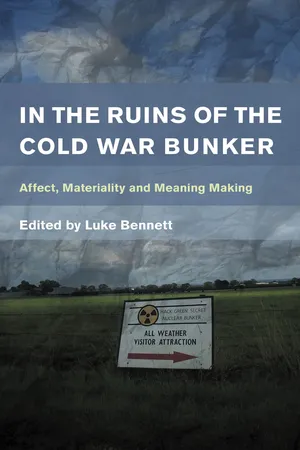
During the Cold War military and civil defence bunkers were an evocative materialisation of deadly military stand-off. They were also a symbol of a deeply affective, pervasive anxiety about the prospect of world-destroying nuclear war. But following the sudden fall of the Berlin Wall in 1989 these sites were swiftly abandoned, and exposed to both material and semantic ruination.
This volume investigates the uses and meanings now projected onto these seeming blank, derelict spaces. It explores how engagements with bunker ruins provide fertile ground for the study of improvised meaning making, place-attachment, hobby practices, social materiality and trauma studies. With its commentators ranging across the arts and humanities and the social sciences, this multi-disciplinary collection sets a concern with the phenomenological qualities of these places as contemporary ruins – and of their strange affective affordances – alongside scholarship examining how these places embody, and/or otherwise connect with their Cold War originations and purpose both materially and through memory and trauma.
Each contribution reflexively considers the process of engaging with these places – and whether via the archive or direct sensory immersion. In doing so the book broadens the bunker's contemporary signification and contributes to theoretically informed analysis of ruination, place attachment, meaning making, and material culture.
- 280 pages
- English
- ePUB (mobile friendly)
- Available on iOS & Android
eBook - ePub
About this book
Trusted by 375,005 students
Access to over 1.5 million titles for a fair monthly price.
Study more efficiently using our study tools.
Information
Part I
INTRODUCING THE BUNKER
Ruins, Hunters and Motives
Chapter 1
Approaching the Bunker
Exploring the Cold War through Its Ruins
At the top of the hill, scanning the flat fields and the coastline beyond, the boy looks out at the vista now opened up to him by his father’s insistent ascent. A tractor is ploughing the rich red earth, birds are circling and cars are drifting slowly along the winding country roads. Behind him the boy’s dog is rooting around in the undergrowth, and his father is scrutinizing a drab, weathered concrete cube sticking up out of the ground. Now bored, and with nothing better to do, the boy strolls over to take a look.
The structure is a metre high, and he sees some bits of rusty metal incorporated into its sides. On one face a grille looks to him like the multiple slits of a low-level mail box. So instinctively he stoops and pretends to insert his folded map into one of the slots.
His father takes a photograph of his son’s appropriation of this grille (see Figure 1.1), and momentarily their activities appear to coincide. But this appearance is deceptive: for the man and the boy are taking very different things from their encounter with the hilltop and its concrete and metal protrusion. For the boy this structure is a blank appropriation, a vague analogue for a familiar feature of his everyday acquaintance. For the father these are the redolent ruins of a Royal Observer Corps fallout monitoring post, one of 1,500 set up across the UK during the Cold War, and now lying abandoned since the network was decommissioned in 1991, following the sudden fall of the Berlin Wall.
Built in 1963, the now-weathered concrete ‘cube’ is the exterior of this monitoring post’s access hatch, inside which a ladder leads down into a small subterranean chamber. Here – in the event of a nuclear war – a team of three volunteers would have monitored drifting clouds of nuclear fallout as they passed across their local sector, feeding their observations through to a regional hub, where other bunker-dwellers would have attempted to piece together a national picture of the radioactive contamination of Britain and the locations of its associated nuclear blasts.

Figure 1.1. The Boy and the Bunker (2009, Luke Bennett).
Here, huddled within this hilltop refuge, 50 miles from Newcastle and industrial Tyneside, and 15 miles from RAF Boulmer and its radar command bunker, these observers would have witnessed the thermonuclear flashes of many strikes upon economic and military targets across the northeast of England. Then, confined to their bunker, and with their meagre rations running out, the crew would have awaited further instructions on what to do next, all the time thinking of their unsheltered families – families that they had left behind above ground, and who they probably would never see again.
MAKING SENSE OF AN ENCOUNTER
In the concrete of the bunkers, in the radio towers, the food stores, the dispersed centres of government [we] can read the paranoia of power. This evidence is written on the face of England.
(Laurie 1979, 9)
Writing amid the enhanced nuclear war anxieties of the early 1980s, Peter Laurie (like his contemporary, Duncan Campbell [1982]) tried to materialize the Cold War, by exposing its secret infrastructure: presencing it through the words and pictures of their investigative journalism. Both writers had found that the state’s preparations for Armageddon were hiding in plain sight across the UK – that the Cold War was physically there to see – for those who could learn how to look. Such acts of uncovering were seen to be a key tactic in campaigning against the nuclear state and its weaponry during the Cold War. Occasionally protestors would trace and target facilities like the ROC Post encountered earlier, gluing the locks or spraying anti-war graffiti upon its blank surfaces. However, most passers-by remained blissfully unaware of the importance of such hatches in hilltop fields or of the bunkers that lay beneath.
For the duration of the Cold War, from 1945 to 1991, ‘the world held its breath’ (Isaacs & Dowling 1998), but everyone also got on with their everyday lives. In most parts of the world the Cold War remained a ‘cruel peace’ (Inglis 1991), characterized by the pervasive background fear of a nuclear conflict between the United States (and its NATO allies) and the Soviet Union (and its Warsaw Pact allies). Admittedly, elsewhere in the world (Korea, Vietnam, Cuba, Angola, Mozambique, Afghanistan, Cambodia to name but a few Cold War conflict zones) the superpowers fuelled proxy wars, battling for regional influence and here people did die. But, despite these ‘hot wars’, the hallmark of the Cold War – what made it different – was (and is) its nuclear stand-off: the US and the USSR locked in an arms race to develop ever greater nuclear destructive capability, with the world taken closest to the brink of all-out war in the early 1960s (the Cuban Missile crisis) and again in the early 1980s with the Soviet invasion of Afghanistan and the arrival of U.S. Cruise Missiles in Western Europe. For 45 years this steady state of geopolitical and affective tension persisted, and it was a condition that seemed permanent. But then suddenly it was all over – and the once top-secret architecture that Laurie and his contemporaries had worked hard to unearth was now exposed through its redundancy.
The Cold War left marks upon both the landscape and popular consciousness, but as Jon Weiner’s (2012) travelogue of Cold War heritage sites has shown, those marks are becoming increasingly feint, and contemporary engagement with the remains of the Cold War is now characterized by a variety of styles and intensities, as echoed in the differential hilltop encounter described earlier. It is now 25 years since the Cold War ended, and a generation has grown up without the anxiety of a ‘wrong sun’ (Coupland 1994, 71) suddenly appearing in the sky. This book’s aim is to examine the variety of ways in which we now remember (or forget) the Cold War through its material traces, in the early 21st century, and to consider how our meaning making is changing, as the Cold War recedes into the ‘past’.
Rather than studying a cross-section the Cold War’s built environment (cf. Schofield et al. 2002; Cocroft & Thomas 2003; Schofield & Cocroft 2007) this book will focus upon one type of the Cold War’s material and cultural ruins: its bunkers, and through this focus will be able to present a sustained and interdisciplinary examination of contemporary engagements with this distinctive type of Cold War structure.
According to the Oxford English Dictionary, a bunker is ‘a reinforced underground shelter, typically for use in wartime’ (Stevenson 2010). Sharing some affinity with castles and strongholds, what sets the bunker somewhat apart is its focus on sheltering and the act of going underground. Many of the Cold War’s bunkers were completely subterranean, and certainly all sought to utilize the shielding properties of the ground, of rock and/or concrete. All were conceived as places of shelter against the Cold War’s anticipated armed assaults – and whether by nuclear or conventional weaponry. Engineered rather than designed, these were ‘non-architectural’ places, ‘a pure representation of function in poured concrete’ (Vanderbilt 2002, 36). They were intended to be unremarkable, and yet could not help but be distinctive through being unusual in shape, scale, location or purpose.
In its sustained analysis of the significance (and signification) of these structures in the early 21st century, this collection of 14 chapters will acknowledge that the bunker itself, as a brute physical form, is an important part of the story of any encounter with the Cold War’s cultural (and emotional) legacy. The bunker is more than a symbol – a metaphor of superpower stand-off – it is also a bulky, brute thing that assails the senses of any visitor and demands that they contort their bodies in order to navigate its rough surfaces and to probe its dank cavities. The contributors to this collection will show how the material properties of the bunker have shaped its subsequent life (and life span), and framed the strange, unsettling affective qualities of encounters with these relict places. This attentiveness to the bunker’s material-affective agency presents something of the vibrancy ascribed to matter by Jane Bennett (2010), but the human (and human agency) is not submerged in this collection’s attentiveness to materiality, for to dislocate the bunker from its human origins would be to lose something – rather than to gain it. The bunker was made by, and for, us. It was (and given that bunkers still get built – still is) testimony to the Cold War, and mankind’s death drive. That we feel strange within these spaces is to a large degree a conditioned response, but also somewhat atavistic. In this collection, therefore the bunker’s symbolic and material existence is given equal prominence – and their interdependency repeatedly encountered, explored and emphasized.
Bunkers are structures which are ‘known’ for both their brutal physical expression in concrete and their powerful dark resonance in language and imagery: as the site of ‘bunker mentality’ (Bennett 2011a). During the Cold War bunkers were exceptional spaces, in which extreme and exceptional things were enabled (Klinke 2015, 2016). They were fundamental, existential places: places of life and death, a conflation of womb and tomb (Beck 2011). The word ‘bunker’ therefore has powerful connotations: it exists in both the landscapes of the mind and those of the earth. It also straddles the realms of fact and fiction: for bunkers are places most of the time encountered more in fiction than reality, simultaneously figured in popular culture as a place of ultimate control and a place of abject defeat. Thus, in many ways ‘the bunker’ is a phenomenon for which we know more about the image than the reality, and yet the bunker’s ideational state and its materiality are co-productive: ideas shape the evolution of the bunker form, but the possibilities are limited by physical realities of the engineering properties and costs of their construction (Bennett 2011a). As Nadia Bartolini (2015) has emphasized, ultimately a bunker is just a chamber – it is what we (or others) do within it that makes these places matter; thus bunkers express and embody a ‘social materiality’ (Dale 2005), and our bunker hunting journey in this book needs to take us both to bunker places and to bunker ideas.
In the chapters that follow we will encounter a wide variety of places which fall within the OED’s broad definition of bunkers, ranging from the monolithic remains of the Nazi Atlantic Wall encountered in France during the Cold War, street corner pillboxes in Albania, defensive tunnels in Taiwan, fortified subways in the Netherlands, a modified mountaintop in Norway, adapted caves and a secret governmental complex in the US, ROC Posts and regional command bunkers in the UK and demolition charge stores in Germany. In doing so our contributors will take us to the frontiers at which the ‘everywhere war’ of the Cold War was most concentrated: ‘Cold War Europe’, ‘Nuclear America’ and ‘Asia’s Cold War Archipelago’ (Lowe & Joel 2013, 14), and beyond – for the Cold War’s reach (and its stationing of bunkers) was truly global.
But this book is only incidentally an account of the 20th-century origins, designs and geo-political histories of the Cold War’s bunkers and their dissemination (cf. Mallory & Ottar 1973; McCamley 2007; Osborne 2008). As part of the ‘Place, Memory, Affect’ series, this book investigates the ways in which the physical remains of now-abandoned Cold War bunkers become the totems and sites of memory, improvisation and engagement for a wide variety of disciplines, practices and visitors, and as such the book’s central concern is with practices of meaning making as they are applied to Cold War bunkers now, in the early 21st century. More particularly it is about how different groups of people valorize (or seek to ignore) the remains of these now-abandoned prosaic structures. In other words, to ask ‘why – and how – do some people ascribe significance to these now abandoned places?’. We will consider this a little further shortly, but must first digress to consider the question of whether we can properly call abandoned bunkers ‘ruins’.
ARE BUNKERS RUINS?
The past ten years have seen the revival of interest in ruins as subject of study and popular engagement (DeSilvey & Edensor 2013; Dillon 2011, 2014). But the ‘New Ruins’ (Martin 2014) that are the focal point of this Ruinenlust revival are the remnants of recently abandoned factories, shopping centres or military sites: thus Tim Edensor (2005) writes convincingly of aesthetic engagements with industrial ruins, Owen Hatherley (2011) takes us on a tour of The New Ruins of Britain wrought by neoliberalism – the recently failed schemes of malls, apartment blocks and civic architecture – and Julia Hell and Andreas Schönle (2010) gather 24 commentators to analyse the Ruins of Modernity, ranging across bombed buildings, colonial outposts and the relics of Modernist ambition. None of these works is strictly addressing a form of dereliction that counts as ‘ruin’ according to the principles of classical ruin aesthetics. And it is by this measure that Paul Hirst (2005) writes that abandoned bunkers should not be called ruins – for unlike castles they are not heroic structures which are softened or incorporated into nature by the passage of time. For Hirst, the simple fact of redundancy (that a bunker – like a mall, a factory or a municipal building – has been abandoned because it no longer has a use) doesn’t make it a ruin.
Exceptionally, Caitlin DeSilvey (2014) has been able to claim the abandoned bunker remains of the Orford Ness military testing range in Suffolk (UK) as ruins in a way that Hirst would accept, by showing how the National Trust (who took over the site in 1993) applied classical ruin aesthetics in order to decide the curatorial strategy for this place’s Cold War remains. The Trust, keen to balance the competing demands of nature conservation and the preservation of the Cold War heritage represented by the site’s bunkers, decided upon a policy of ‘palliative curation’ (DeSilvey 2014) in which processes of natural ruination were allowed to continue, the resulting ‘slow implosion’ of these structures seeing their ‘invasion by the benign forces of owls and gulls, roots and rust, wind and sea swell’ (80). Through this bunker ruination, ‘manufactured materials are slowing, losing their physical integrity, as they are actively enrolled in the process of becoming archaeological. The ragged seam between nature and culture unravels and, finally, dissolves’ (86). Thus, through the agency of the natural world acting upon the body of this iconic site’s abandoned military structures, a dynamic which accesses the classical ruin model is established: that a structure is falling back into a state of nature, the frailties of modernist confidence thereby unsettled, and revealed as hubris. For DeSilvey, the act of decay also reasserts the material existence and independence of the non-human, thus asserting a non-symbolic quality. Thus, the ruin does not just signify the ‘fall of man’ (and/or the finitude of all human projects). It also reminds us that the world is made up of a multitude of vibrant actors – animal, mineral and vegetal, acting out their processes in the extant realm of the material, rather than the culturally mediated realm of the semiotic. Although – of course – the ivy can creep its encroaching course only if the manager of the site decides – deliberatively – not to resist it.
Elsewhere Mette Haakonsen has suggested something approaching the picturesque for the landscapes formed by the Nazi bunkers of the Atlantic Wall (2009, 98), whereby ‘the bunkers enhance the inherent aesthetic qualities of landscape and weather…. The sand, the dunes, the lime grass and the sea, the sun, the wind and the rain – the beauty and the force of nature – appear more clearly when set in contrast to bunkers, and influence the senses and performance of the visitor’. Something then demonstrated in the-bunker-in-atmospheric-landscape photographs of Marc Wilson’s The Last Stand (2014) collection.
But these are exceptions – most bunkers (and particularly those pertaining to the Cold War era) are drab in appearance, suburban in location, mostly underground and not romantically offset by filigree and shadow. Therefore, we have the choice either of separating out the minority of compliantly ruinous structures and calling ...
Table of contents
- Figures and Table
- Acknowledgements
- PART I: INTRODUCING THE BUNKER: RUINS, HUNTERS AND MOTIVES
- PART II: LOOKING AT THE BUNKER: REPRESENTATION, IMAGE AND AFFECT
- PART III: EMBRACING THE BUNKER: IDENTITY, MATERIALITY AND MEMORY
- PART IV: DEALING WITH THE BUNKER: HUNTING, VISITING AND RE-MAKING
- PART V: CONCLUSION
- Index
- Contributors
Frequently asked questions
Yes, you can cancel anytime from the Subscription tab in your account settings on the Perlego website. Your subscription will stay active until the end of your current billing period. Learn how to cancel your subscription
No, books cannot be downloaded as external files, such as PDFs, for use outside of Perlego. However, you can download books within the Perlego app for offline reading on mobile or tablet. Learn how to download books offline
Perlego offers two plans: Essential and Complete
- Essential is ideal for learners and professionals who enjoy exploring a wide range of subjects. Access the Essential Library with 800,000+ trusted titles and best-sellers across business, personal growth, and the humanities. Includes unlimited reading time and Standard Read Aloud voice.
- Complete: Perfect for advanced learners and researchers needing full, unrestricted access. Unlock 1.5M+ books across hundreds of subjects, including academic and specialized titles. The Complete Plan also includes advanced features like Premium Read Aloud and Research Assistant.
We are an online textbook subscription service, where you can get access to an entire online library for less than the price of a single book per month. With over 1.5 million books across 990+ topics, we’ve got you covered! Learn about our mission
Look out for the read-aloud symbol on your next book to see if you can listen to it. The read-aloud tool reads text aloud for you, highlighting the text as it is being read. You can pause it, speed it up and slow it down. Learn more about Read Aloud
Yes! You can use the Perlego app on both iOS and Android devices to read anytime, anywhere — even offline. Perfect for commutes or when you’re on the go.
Please note we cannot support devices running on iOS 13 and Android 7 or earlier. Learn more about using the app
Please note we cannot support devices running on iOS 13 and Android 7 or earlier. Learn more about using the app
Yes, you can access In the Ruins of the Cold War Bunker by Luke Bennett in PDF and/or ePUB format, as well as other popular books in Architecture & Architecture General. We have over 1.5 million books available in our catalogue for you to explore.