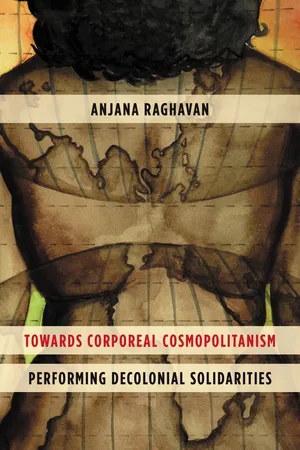
An articulation of any kind of global understanding of belonging, or ways of cosmopolitan life, requires a constant engagement with vulnerability, especially in a world that is so deeply wounded by subjugation, colonialisms and genocides. And yet discussion of the body, affect and corporeal politics from the margins are noticeably absent from contemporary liberal and Kantian models of cosmopolitan thought.
This book explores the ways in which existing narratives of cosmopolitanism are often organised around European and American discourses of human rights and universalism, which allow little room for the articulation of an affective, embodied and subaltern politics. It brings contemporary understandings of cosmopolitan solidarities into dialogue with the body, affect and the persistent spectre of colonial difference. Race, ethnicity, sexuality and gender are all extremely important to these articulations of cosmopolitan belongings, and we cannot really speak of communities without speaking of embodiment and emotion.
This text envisions new ways of articulating and conceptualising 'corporeal cosmopolitanism' which are neither restricted to a purely postcolonial paradigm, nor subjugated by European colonialism and modernity. It challenges the understanding of liberal cosmopolitan solidarities using decolonial, and feminist performances of solidarity as radical compassion, resistance, and love.
- 228 pages
- English
- ePUB (mobile friendly)
- Available on iOS & Android
eBook - ePub
About this book
Trusted by 375,005 students
Access to over 1.5 million titles for a fair monthly price.
Study more efficiently using our study tools.
Information
Chapter 1
Locating Corporeal Cosmopolitanism
Theoretical Vicissitudes
It is difficult to clarify a single purpose for chapter one, because I want it to do many things at once. I want this chapter to capture some sense of the exciting vastness and divergence in cosmopolitan scholarship and provide a glimpse of the worlds that are imagined within it. I want this chapter to bear witness and chronicle the contributions that contemporary articulations of cosmopolitanism make to the creation of solidarities and communities. I also want it to witness the silences, exclusions and abjections that are contained in these narratives of cosmopolitanism, as well as to explore “other” cosmopolitanisms which respond to these silences and violences. I am unlikely to fully succeed on all counts, but I hope that will not deter me from making a genuine effort. The literature that I explore in this chapter is not only selective but also limited by constraints of space and specificity. The attempt to open up a conversation about corporeal cosmopolitanism requires both space – physical, emotional and intellectual – and people with whom to have this conversation. In reading about and around contemporary cosmopolitan literature, there have been some ideas that have struck me as particularly challenging to, or cooperative of (those two things are not always at odds), a space for embodied and affective cosmopolitan articulations. I am trying to provide a contextual, though selective, review of literature, but also create a kind of patchwork quilt of ideas, conceptual frameworks, challenges and contradictions within which to place my own ideas, thoughts and questions about approaching the notion of corporeal cosmopolitanism. By and large, liberal narratives of cosmopolitanism, both more and less conventional varieties, operate on certain understandings of reason and rationality, often derived, in varying degrees, from Enlightenment conceptions of them. This raises a complex set of debates around the participants – that is, who is deemed capable of reason and rationality, and in a more extended sense, of autonomy, sovereignty and citizenship, and why certain people are excluded from these spaces. It also raises questions about the legitimacy of the realms of unreason and irrationality – emotions, bodies, art – all become illegitimate conceptual frameworks in “serious” political, social and economic spaces governed by particular discourses of reason and rationality. These discourses of reason and rationality that influence so much of liberal cosmopolitan thought, also have specific understandings of, and relationships to, the idea of generality and universal notions of solidarity and community. I offer the suggestion that a binaristic reduction of debates around universalism and particularism is not always productive, but particularly so when thinking about cosmopolitan notions of belonging. In my own work, I try to problematise certain understandings of universalism, and also explore the possibilities of different conceptions and imaginations that match the scale and largeness of universalistic frameworks but are perhaps not restricted and articulated in the same ways.
This chapter, therefore, tries to engage with these sets of questions and ideas in existing cosmopolitan literature – both liberal and decolonial. The questions around participation, and exclusion, particularly in political cosmopolitanisms, often seem to manifest themselves in debates around the ideas of nationhood, patriotism and political and affective significance of the nation state. As Sara Ahmed (2014) so evocatively points out, the nation is the bearer of both bodies and emotions. Exploring the nuances of the expression ‘soft touch’ (Ahmed 2014, 2) as applied to a nation, she points to the call for nations to be ‘harder’ and less emotional. It is interesting that these calls to harden often come from emotional places that are critical of the liberal nation state model, which, as we know, is more inclined to follow a dispassionate, “objective” discourse of reason. Several cosmopolitan scholars argue for and against the significance of the nation state, while many of them provide hybrid alternatives, arguing that patriotism and cosmopolitanism are not in direct conflict with one another. My focus here is not so much on the structural ramifications of nation and postnation; or polis and cosmos, but rather of the affective and embodied elements of the same. What are the emotional and bodily implications of nationhood, national identity and statelessness? I explore contemporary cosmopolitan scholarship, both liberal and decolonial, pro- and antination, not with the aim or concluding the debate, but to acknowledge and accept its diversity and depth. Perhaps what is most interesting about the liberal cosmopolitan articulations around patriotic or nation-related bonds, whether they be tolerant or dismissive of the same, is that these arguments all convene around some common understanding of “reason”, or a political similitude of some description. Basing the conception of such a large solidarity on a particular discourse of “reason”, which has been repeatedly used as a weapon of colonial and neo-liberal exploitation, is both dangerous, and deeply problematic. Although it is not really part of the journey of this work, decolonial efforts to dismantle European hegemony around the discourse of reason are constantly under way. However, liberal cosmopolitan narratives still largely rely upon a very particular derivative of European, Enlightenment-based reason discourse. This is really what corporeal cosmopolitanism, along with other radical and critical reimaginations of cosmopolitan solidarity, attempts to dismantle. I also focus my discussions of liberal cosmopolitan ideas around patriotism and nation bonds to illustrate the ways in which these Kantian, reason-based discourses are unable to engage with any “unreasonable” (read: emotional) dimensions of nation bonds. Any articulation of embodied or affective cosmopolitanism must be keenly aware of different levels and kinds of identifications that are deeply political and passionate, public and private, all at once. Ultimately, corporeal cosmopolitanism is looking for ways to scramble this impasse. It attempts to find ways in which a variety of solidarities, both large and small, can be connected in embodied and emotional relationalities. These may be situated in nations, sexualities, villages, performances, continents and artistic expressions. I therefore conclude chapter one by looking at some examples of radical and affective cosmopolitanisms, from different parts of, and times in, the world.
Cosmopolitan belonging can be experienced in both exile and welcome, in banishment from somewhere and adoption into elsewhere – the idea of home is always being challenged and expanded; home is everywhere and nowhere. Chapter one, therefore, is really about belonging and inhabitation; not just of spaces but also of nonspaces and margins, and of bodies, ideas and feelings. Cosmopolitan solidarities may be eked out in all kinds of extraordinary ways – there is no singular directive for how these understandings, exchanges and conversations take place. Through this chapter, I hope to map some of these diversities and try to show the differences and relationalities in existing cosmopolitanisms, their contributions and critiques, and how we may read them in order to understand the exclusion of affective and embodied dimensions in these cosmopolitanisms. I also discuss some possibilities of cosmopolitan narratives which challenge these exclusions of affect, embodiment and otherness in unique and wonderful ways, thus paving the way and making room for the articulation of corporeal cosmopolitanism.
KANTIAN RESONANCES
The powerful presence of Immanuel Kant lingers over significant portions of my work. However, it is often not Kant himself, but particular interpretations and received versions of his ideas that animate much contemporary writing on liberal cosmopolitanism, and consequently, this book. As such, it is useful to distinguish Kant’s cosmopolitanism from cosmopolitanisms that have been derived from, inspired or otherwise influenced by Kant’s original works. My own work challenges many of the premises of these liberal cosmopolitanisms and often argues for radically different premises and trajectories, but, it is also true that much of my work would not be necessary or possible without Kant and the cosmopolitanisms he inspired and influenced. They are my interlocutors, and we are engaged in relations of critique and love, of understanding and despair, of anger and compassion. I treat these relations and conversations as a constitutive part of corporeal cosmopolitanism, although our paths, and perhaps even ends, are very different. I therefore begin with some very brief ideas and concepts in Kant’s cosmopolitan vision, which, although very differently interpreted, are clearly reflected in contemporary liberal cosmopolitanisms – discussions of which form the major part of this chapter. I present a few key ideas that inform Kant’s vision of cosmopolitanism and connect to contemporary work on liberal cosmopolitanism, which comprises the rest of this chapter, rather than an analysis of Kant’s work.
Broadly, Kant indicated that every member of society has a right to freedom, common legislation and the legal equality that follows from the right to freedom (Kant 1917). He was vehemently opposed to an undifferentiated notion of popular rule and believed in the very necessary separation of legislative, judiciary and executive powers, causing him to describe democracy as ‘a form of despotism’ (Kant 2006, 76). For Kant, democracy consisted of an executive power that could make decisions against itself, if necessary, in the form of majority votes and decisions (Kant 2006, 76–77), and for this reason, he advocated a Republican system where executive and legislative powers were clearly separated. This laid several restrictions on subjects who willingly submitted to the rule of law – including the delegitimisation of revolt and rebellion against the state – but Kant’s conceptualisation of right was based on very clear moral actions, duties and a legal framework, which would ideally prevent the leaders of states from becoming tyrants, thereby negating the need for bloody rebellion (Kant 2006, 55–57). The idea of an unbounded, “wild” freedom was completely unsustainable to Kant’s vision of lasting peace and cosmopolitan solidarity. He had very specific guidelines around freedom and equality, and legislative equality of subjects within a state only applied to the structure of relationships. Thus, hereditary privilege, feudal privilege or any form of innate privilege was not acceptable to Kant, unless one was a woman or a person of colour, in which case they were not considered a subject of the state at all, but ‘protected compatriots’ (Kant 2006, 49). However, hierarchical relations of power were entirely permissible, because they did not breach the general law and constitutional right. This understanding of constitutional right and law, as observed previously, meant that resistance and rebellion against the head of the state are an active breach and violation of contract and law. Kant instead advocated resistance through the ‘freedom of the pen’ (Kant 2006, 57) and critical philosophy. This discomfort with, and fear of, unfettered resistance is, in so many unsavoury words, the fear of savagery, and I use that word as witness to the totality of colonial-imperial decimation. This fear of unfettered and untameable “wildness” (which, in many crucial ways, lies at the heart of resistance and liberation), is the large ball, attached to the end of the liberal cosmopolitan chain, and one which corporeal cosmopolitanism actively stands against.
Another key element in Kant’s conception of cosmopolitanism is the principle of hospitality and an international legal order. The Kantian right to hospitality refers to the right of any person to visit foreign territories without fear of death or hostility. The visitor may be denied entry according to the discretion of the state, but may not be harmed, unless he or she poses a significant threat to the state. The right to hospitality meant that Kant opposed colonial and imperialist actions by Europe as inhospitable, but his belief in the fundamental inferiority of non-Europeans, women and Others and his endorsement of hierarchical power relations (Kant 2006, 48–50) make this a slippery space. The familiar slippery space of Empire, where being a bad host is considered rude, but being a coloniser is the mark of progress. Hospitability, for Kant, is based on the principle of toleration among peoples and a mutual respect and recognition of one another as equals. However, much like with democratic membership, the real violence of exclusion lies in determining who might be considered worthy and capable of belonging to this hospitality club. Thus, hospitality, combined with the continuous refinements of reason, and critical thought, would eventually ensure the movement towards perpetual peace. Kant’s vision and path towards perpetual peace and cosmopolitanism are laid out in the greatest, most painstaking detail. His writing is dense and complex, and moves between a definite, enduring hope in humanity and an almost uncompromising certainty in the supremacy of reason. Kant offers a detailed programme of how to achieve a state of peace, accompanied by a deep, abiding fear that we will fail to do the right thing, as a species; a fear which is combated with a mixture of hope, reason, white superiority, and constitutional right. Kant’s vision of cosmopolitanism is invaluable in understanding liberal, modern political community and solidarity. His work continues to participate significantly in contemporary scholarship, both in contributory and critical capacities.
Kant’s work has been carefully and thoroughly critiqued by numerous scholars both within and outside Euromerican scholarship, with particular reference to those he considered capable of being moral agents: as mentioned previously, he excluded women, people of colour and children, among others. The Enlightenment understanding of and dependence on the supremacy of particular discourses of “reason”, “rationality”, and “objectivity” as gold standards are also widely critiqued ideas. While it is clear that we must understand the Kantian view within its specific context and history, and be aware of the profound implications that his right to hospitality continues to have upon our present understanding of cosmopolitanism, we must also be aware of its legacy. The legacy of cosmopolitanism is rooted in pre-Kantian Christian thought and ethics, as well as Kantian and post-Kantian interpretations of reason and rationality. This legacy has very particular implications for marginalised people including women, people of colour and queer peoples; as well as the material realities and experiences of embodiment and affect. For instance, Foucault (1978) explains that the Christian view of morality has very specific and exact positions vis-à-vis the body. In his work on sexuality (1985, 1986, 1988), Foucault clearly outlines the discourse around the body as propagated by the church, making it impossible to speak of, precisely by talking too much about it. This way of speaking about the body, cast it in a pathologised, medicalised light, which then paved the way for the Enlightenment and a reason-based approach to the body and affect. Thus, from the Christian view of the body as a repository of desire, and therefore sin, danger or “otherness”, we see the movement towards categorising bodies through the straitjacket of normalcy and the creation of archetypes – the female body, the insane body, the sexual body, the hysterical body and so on. Kant, along with other thinkers of the Enlightenment era, saw reason as the seat of moral power, as opposed to the church – an indisputably radical challenge for its time. However, from the point of view of the body, both reason as morality and particular forms of religious morality primarily focused on the mind and the spirit, respectively, thereby delegitimising and devaluing the body either by deeming it a machine – an instrument to be controlled by the mind – or a sin that must be absolved in order to attain paradise. The growth of liberal cosmopolitanisms, based on Enlightenment rationality, in cultural milieus deeply influenced and shaped by a religious morality that completely delegitimised the body and its associates – instincts, feelings, desires, and so on, as a site of knowledge or experience – poses a serious challenge in terms of creating new spaces for their reclamation.
A contemporary example of liberal, Kant-derived cosmopolitanism can be found in David Held’s work (2005, 10–27).1 I am not trying here to converse with Held’s cosmopolitanism in terms of negotiating a shared space, as Held’s cosmopolitan principles do not appear to have space for a dialogue about affect or embodiment. They do, however, point out some inherent forms of exclusions that close off such a cosmopolitanism to questions of affect and embodiment. Held follows the Enlightenment-appropriated concept of the world citizen and the Kantian concept of cosmopolitan right in framing his ideas on cosmopolitanism: ‘Cosmopolitan right meant the capacity to present oneself and be heard within and across political communities; it was the right to enter dialogue without artificial constraint and delimitation’ (Held 2005, 11). The call for the removal of ‘artificial constraint’ seems to overlook the existence of the very real constraints of historic violences and marginalisations which already preclude certain ‘political communities’ from equal status. This is one of the deep exclusions which characterises Euromerican liberal narratives of cosmopolitanism how they conceive “universal” equality. The idea that there is some kind of possibility for a “clean slate” from which we can all begin as equals requires some form of erasure and forgetting, neither of which I consider productive, or, indeed, possible. Corporeal cosmopolitanism is not only about remembering and articulating but also about holding the possibility of deep healing.
Using an interpretation of Kantian cosmopolitan belonging, Held elucidates eight principles that constitute his understanding of cosmopolitanism as follows (Held 2005, 12):
(1) Equal worth and dignity; (2) active agency; (3) personal responsibility and accountability; (4) consent; (5) collective decision-making about public matters through voting procedures; (6) inclusiveness and subsidiarity; (7) avoidance of serious harm; and (8) sustainability.
Broadly speaking, Held believes in a universal notion of human dignity, to which particularities must ultimately succumb. He also actively advocates the right to self-determination and autonomous choices, and accepting the consequences of those choices. In Held’s understanding, affirming Kant’s views, cosmopolitanism is governed by two ‘metaprinciples’ (19): ‘the metaprinciple of autonomy’ and ‘the metaprinciple of impartialist reasoning’ (19). He insists that these are not Western or European notions, but rather that they seek to ensure the freedom and equality of all people regardless of where they may be, and also to protect those who do not have access or structural means to achieve the first six cosmopolitan principles. The metaprinciple of impartialist reasoning ‘should be thought of as a heuristic device to test candidate principles of moral worth, democracy, and justice and their forms of justification’ (Held 2005, 22). It appears to be a slippery combination of insisting on a certain kind of universal, Euromerican-centric democratic membership and the consequent understandings of terms like equality, autonomy and, indeed, choice, while at the same time allowing for some kind of paternalistic protection for those who cannot achieve this version of perfectly reasonable and universally applicable cosmopolitanism.
As David Harvey candidly observes:
The use of ‘reasonably’ as well as the ‘assent’ inserted into the argument here is telling. It produces a powerful echo of Kant’s (and Burke’s) appeal to ‘mature individuals’ as the only acceptable participants in discussions. The elitism and potential class discrimination of this form of cosmopolitanism becomes clear. (Harvey 2009, 86)
Harvey also draws attention to a major lacuna in Heldian cosmopolitanism – that is, the assumption of a functioning, stable democracy in all major nation states that simply needs to be extended into all other realms of the political. Aside from the assumption itself being questionable, there is also the bigger question of this presumed democratic absolutism and whether it is in fact the choice of the world, along with a very particular, neo-liberal framing of human rights and the liberal discourse of autonomous choice. Held’s principles of inclusion and consent are extremely problematic because of their inability to address marginalised peoples (See also Mouffe, 2005). The notion of consent, for instance, is both fractured and fragile in several cultures and communities, particularly with reference to gender and sexuality. The assumption of consent as a constitutive principle in democratic societies makes Held’s principles both elitist and insensitive to gender, affect and corporeality. Held also writes about the ‘metaprinciple of autonomy’ where he argues:
If this notion is shared across cultures it is not because they have acquiesced to modern Western political discourse; it is, rather, that they have come to see that there are certain languages which protect and nurture the notion of equal status and worth, and others which have sought to ignore or suppress it. (Held [2005], 21)
On the face of it, as with many articulations of liberal cosmopolitanism, there is nothing objectionable, or even disagreeable about ideas of equality, freedom and the right to live without fear of violence. Held’s fundamental suggestions for a cosmopolitan society are not problematic in and of themselves; however, the ways in which these ideas are understood and approached reveal important exclusions and Eurocentric assumptions. The colonial hubris inherent in the ‘metaprinciple of autonomy’, for instance, cannot be ignored. The idea of certain languages or ways of thinking that protects and nurture equality, being set up against “barbaric tongues” that threaten it, is all too familiar. That it forms a core tenet of Held’s global cosmopolitanism is indicative of the erasure of colonial narratives of violenc...
Table of contents
- Acknowledgements
- Note from the Author
- Introduction: Incanting the Body into the Political
- 1 Locating Corporeal Cosmopolitanism: Theoretical Vicissitudes
- 2 The Anatomy of Abjection: Contextualising Exclusion, Corporeality and Emotions
- 3 Occluded Rainbows: Queerness and Cosmopolitan Solidarities in India
- 4 Are Dispossessed Bodies Human? Gender, Exile and Cosmopolitan Solidarities
- 5 Love in the Time of Corporeal Cosmopolitanism
- Bookends: Incanting the Political into the Body
- References
- Appendices
- Index
- About the Author
Frequently asked questions
Yes, you can cancel anytime from the Subscription tab in your account settings on the Perlego website. Your subscription will stay active until the end of your current billing period. Learn how to cancel your subscription
No, books cannot be downloaded as external files, such as PDFs, for use outside of Perlego. However, you can download books within the Perlego app for offline reading on mobile or tablet. Learn how to download books offline
Perlego offers two plans: Essential and Complete
- Essential is ideal for learners and professionals who enjoy exploring a wide range of subjects. Access the Essential Library with 800,000+ trusted titles and best-sellers across business, personal growth, and the humanities. Includes unlimited reading time and Standard Read Aloud voice.
- Complete: Perfect for advanced learners and researchers needing full, unrestricted access. Unlock 1.5M+ books across hundreds of subjects, including academic and specialized titles. The Complete Plan also includes advanced features like Premium Read Aloud and Research Assistant.
We are an online textbook subscription service, where you can get access to an entire online library for less than the price of a single book per month. With over 1.5 million books across 990+ topics, we’ve got you covered! Learn about our mission
Look out for the read-aloud symbol on your next book to see if you can listen to it. The read-aloud tool reads text aloud for you, highlighting the text as it is being read. You can pause it, speed it up and slow it down. Learn more about Read Aloud
Yes! You can use the Perlego app on both iOS and Android devices to read anytime, anywhere — even offline. Perfect for commutes or when you’re on the go.
Please note we cannot support devices running on iOS 13 and Android 7 or earlier. Learn more about using the app
Please note we cannot support devices running on iOS 13 and Android 7 or earlier. Learn more about using the app
Yes, you can access Towards Corporeal Cosmopolitanism by Anjana Raghavan in PDF and/or ePUB format, as well as other popular books in Philosophy & Political Philosophy. We have over 1.5 million books available in our catalogue for you to explore.