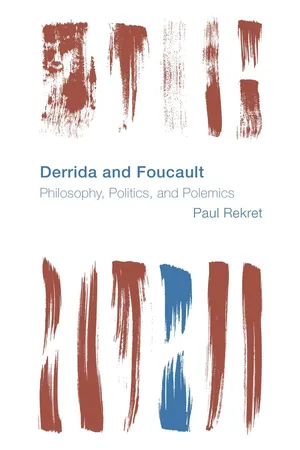
- 221 pages
- English
- ePUB (mobile friendly)
- Available on iOS & Android
eBook - ePub
About this book
Derrida and Foucault offers a major contribution to the interpretation of these two highly influential thinkers. By tracing the moments where Derrida and Foucault's arguments converge but also where they deviate, this book fundamentally recasts our understanding not only of these two philosophers, but of the political more broadly. Organised thematically around questions of epistemology, ethics, and politics, this is the only work to bring Derrida and Foucault's whole oeuvres into dialogue with one another. This book frames a dialogue not only between their works of the 1960s and 1970s but also their works that deal with political questions around liberalism, capitalism and democracy. This book offers the first substantial critical assessment of Derrida and Foucault's political work and also situates these crucial thinkers in contemporary debates in political theory.
Information
Chapter 1
Genealogy, Ontology, and Situated Thought
Among the central premises shared by the philosophers under consideration in this book rests the claim that thought’s point of departure can never find an absolute justification. As we will see in the following chapters, competing responses to this basic paradox will not cease to be the source of a succession of implicit and explicit polemics. Before doing so, however, it is imperative we further come to grips with this claim to finitude in the first place, at least in the form of some of its most powerful reverberations. It is with this in mind that we turn to the work of Friedrich Nietzsche and Martin Heidegger, to both situate thought within language, within history, and as socially mediated.
While for Nietzsche the subject, identity, and truth are preceded by an anterior field of relations between forces called the “will to power,” Heidegger posits the subject’s relation to the object or to others as emerging out of a primordial “being-in-the-world”; anterior to any determinate subject–object relation is the unconcealing of Being. Or, put otherwise, existence within a disclosed world is antecedent to any determinate relations within that world. Yet Nietzsche and Heidegger each fail to steadfastly commit to the limits to which they consign philosophy. That is, as we will see here, despite their discrete invocations of thought as situated, each nevertheless succumbs to a desire to legislate the political. In other words, each seeks to derive principles from out of his philosophy by which a social hierarchy would be justified and a new communal “health,” to use Nietzsche’s term, might be cultivated.
Not only do the implications of such a misjudgment ring as particularly nefarious given Nietzsche’s posthumous implication in, and Heidegger’s long-lasting enthusiasm for, Nazism. Likewise, it signals a question to which Derrida and Foucault will ceaselessly return and, indeed, will form the basis of their very public debate: how might a thought account for its existence upon a terrain which both precedes and exceeds it, without appropriating that terrain to itself, upon its own terms?
In the present chapter I seek to substantiate the terms of this inquiry by first outlining this question as it plays out in Nietzsche’s work, the Genealogy of Morals most of all. I then show how the tension that he builds between the epistemic and the ontological—between finite perspectives and the will to power—breaks down altogether when it comes to his well-known call for a system of social caste that would free the sovereign individual from the anonymity of collective social life. The question of the extent to which Nietzsche’s “grand politics” are merely coincidental to his philosophy has been the object of frequent debate, yet as we will see, in his own interpretation of Nietzsche, Heidegger will view a subject-centered metaphysics relating to the world as a resource for its consumption, as inherent to Nietzsche’s philosophy. But despite anchoring his thought in the question of Being to which existence finds itself “thrown” and so which it always experiences as an excess, Heidegger’s own account of finitude is nevertheless internally riven by its own (ultimately philosophically arbitrary) political hierarchies: authentic/inauthentic or proper/improper.
The permutations of Nietzsche and Heidegger’s ultimately unsuccessful confrontations with the affirmation of finitude set the stage, in the third and final part of this chapter, for a turn to Derrida and Foucault. Read through the lens of their engagements with Nietzsche and Heidegger, I hope to show in this chapter and throughout the rest of this work, that Derrida and Foucault’s work is equally animated in both cases by the attempt to propose a mode of thought that would renounce the desire to transcend its situated status.
NIETZSCHE, GENEALOGY, AND METAPHYSICS
At its core, Nietzsche’s genealogical method can be described as operating by placing moral systems within the prism of the “grander narrative” of a will to power. Using the frame of this narrative, Nietzsche provides an alternative account of the emergence of metaphysical systems and so demonstrates their essentially historical and contingent nature. As we will see, Nietzsche’s narrative of will to power occasions explanatory power, but it also leads him to come up against the paradox of the finite and situated nature of the enunciation of this narrative. To understand the paradox into which Nietzsche’s genealogy runs one must first confront the binary expression of the will to power upon which his philosophical edifice hinges.
This is evident in The Genealogy of Morals, a text whose argument revolves around Nietzsche’s distinction between two moral systems of differentiation; two systems of denoting actions and individuals deemed “good”—admirable and praiseworthy—and their consonant opposites.1 The text famously opens with an account of a moral system of “strong” masters characterized by a pre-reflexive expression and experience of power. Given these “noble” masters’ expressions of power never encountered any impediments, their self-assertions as “good” denoted their possession of a strength autonomous of any measure or external criteria.2 Conversely, weak “slaves” unable to assert their goals and desires directly were thus only consequently labelled as “bad.” Setting out from this originary nobility, the thrust of each of the three essays comprising the Genealogy lies in recounting, across three different intervals, the event of what Nietzsche calls the “slave revolt” in morals. This is the event whereby the noble or aristocratic distinction between good and bad is overturned through the emergence of a second system of differentiation. The latter, of course, amounts to the ethical system by which we are said to continue to live: slave morality.
The narrative turns of Nietzsche’s Genealogy are well known. It nonetheless bears highlighting how Nietzsche’s account is underlined by the irreducibility of struggle and violence to human existence, along with the philosophical work such a perspective does here. In the terms of Nietzsche’s argument, the erection of a system of moral values premised upon the slavish principles of Judeo-Christian monotheism provided not only the instruments for self-affirmation as a chosen people but also the construction of a metaphysical world that would allow the destruction of noble morality. By constituting a vision of the world that licensed and celebrated their own weakness, Nietzsche argues, the slaves simultaneously branded nobility as evil.3
This account of the emergence of a moral system couched in the slaves’ ressentiment against life along with their vengeance against the nobles is thus grounded upon a central genealogical supposition: metaphysical values arise from a field of struggle. Morality is, as he puts it, “the doctrine of the relations of supremacy.”4 Posited in these terms, Nietzsche’s interrogation of the “value of values” situates metaphysical postulations as violent exclusions and dominations while also insisting that any system of moral differentiation originates with social and political struggle.5
Yet the implications of such a view extend further. To claim that “this world is the will to power—and nothing besides!,” as Nietzsche famously does, implies that struggle and domination are inherent to every claim to truth.6 Such an assertion is underscored by an ontological vision of ephemerality and flux; a world composed of events, a “determination of degrees of relations of force.”7 Concordantly, the crime and error of Christian slave morality and indeed of all metaphysics is thus to have sought to fix, determine, and transcend this cosmological drama and so, to have “robbed of its innocence the whole purely chance character of events.”8 This is an offence for which slave morality is condemned: to have posited a transcendent world against which actions are measured and standards are developed to which all must conform.9 The central gesture of genealogy thus amounts to confronting the “will to truth” characteristic of slave morality with the perspectival and partial nature of its moral claims in order to cultivate a sense of their dubiousness.10
It’s important to note that Nietzsche’s genealogy hinges in part upon an understanding of humanity in vitalist terms whereby the subject, identity, or agent are but effects of a surface of relations between forces. This view of the multiplicity of forces continuous with life itself is called the “will to power” and it implies that the function of a custom or institution is only a marker of a will that has become master of something less powerful. On this account, all living creatures, humans included, are governed by a desire to express or discharge power.11 Moreover, from this perspective a still further insight follows: because humans are self-conscious creatures, our will to power is not expressed directly, but is mediated by particular perspectives through which we interpret and understand our power.
The ontology of will to power thus ostensibly offers the theorist a non-metaphysical interpretive and evaluative standard. In place of an epistemological assessment of ideas based on their correspondence to reality, it permits perspectives on the world to be evaluated in terms of the degree of enhanced potential of will to power that they allow us to experience.
Accordingly, slave morality is deemed destructive on the basis that its cardinal belief that the pain and suffering of existence is a punishment for sin represses will to power.12 Metaphysical ideals, Nietzsche argues, are “ideals which are all hostile to life, ideals that defame the world.”13 In other words, the value and meaning of life could be posited as transcendent and independent of life only on the basis of the negation of existence itself. At the core of metaphysics therefore lies a “will to truth”: truth provides for the absence of any meaning to suffering but it only does so by devaluing sensual life.
In sum, by first affirming a will to power behind all values and standards, Nietzsche sets the function of genealogy as tracing descent and origins in order to undermine universal pretensions.14 Moreover, the meta-question of the “value of values” that animates it is thus a moral one; the ethical ideal of truth emerging from herd morality is viewed as the source of every ideal.15 The will to truth, a “moral prejudice of all knowledge,” to use Michel Haar’s phrase, is based on a fundamental conviction: “that truth is more important than anything else, than every other intention.”16 The will to truth’s desire for unity and identity over difference and dynamism in turn attempts to justify and explain the suffering of existence.
The Paradox of Perspectivism
If Nietzsche’s genealogy works by inserting the phenomena he investigates within the terms of a “grander narrative” of the world as will to power, this in turn raises a question that will become increasingly central to our analysis: does theory here exceed or transgress the will to truth? Or, is it too subject to the same desire for truth? Any response to this question must begin by asserting that there...
Table of contents
- Preface
- Acknowledgments
- Introduction: Locating the Limits of Political Thought
- 1 Genealogy, Ontology, and Situated Thought
- 2 Cartesian Exclusions
- 3 The Aporia and the Problem
- 4 Economies of Violence
- 5 The Postponement of Politics
- Conclusion
- Bibliography
- Index
- About the Author
Trusted by 375,005 students
Access to over 1.5 million titles for a fair monthly price.
Study more efficiently using our study tools.
Frequently asked questions
Yes, you can cancel anytime from the Subscription tab in your account settings on the Perlego website. Your subscription will stay active until the end of your current billing period. Learn how to cancel your subscription
No, books cannot be downloaded as external files, such as PDFs, for use outside of Perlego. However, you can download books within the Perlego app for offline reading on mobile or tablet. Learn how to download books offline
Perlego offers two plans: Essential and Complete
- Essential is ideal for learners and professionals who enjoy exploring a wide range of subjects. Access the Essential Library with 800,000+ trusted titles and best-sellers across business, personal growth, and the humanities. Includes unlimited reading time and Standard Read Aloud voice.
- Complete: Perfect for advanced learners and researchers needing full, unrestricted access. Unlock 1.5M+ books across hundreds of subjects, including academic and specialized titles. The Complete Plan also includes advanced features like Premium Read Aloud and Research Assistant.
We are an online textbook subscription service, where you can get access to an entire online library for less than the price of a single book per month. With over 1.5 million books across 990+ topics, we’ve got you covered! Learn about our mission
Look out for the read-aloud symbol on your next book to see if you can listen to it. The read-aloud tool reads text aloud for you, highlighting the text as it is being read. You can pause it, speed it up and slow it down. Learn more about Read Aloud
Yes! You can use the Perlego app on both iOS and Android devices to read anytime, anywhere — even offline. Perfect for commutes or when you’re on the go.
Please note we cannot support devices running on iOS 13 and Android 7 or earlier. Learn more about using the app
Please note we cannot support devices running on iOS 13 and Android 7 or earlier. Learn more about using the app
Yes, you can access Derrida and Foucault by Paul Rekret in PDF and/or ePUB format, as well as other popular books in Philosophy & Philosophers. We have over 1.5 million books available in our catalogue for you to explore.