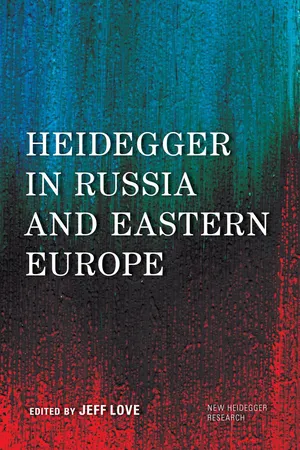
Heidegger's influence in the twentieth century probably outstrips that of any other philosopher, at least in the so-called Continental tradition. The 'revolution' Heidegger brought about with his compelling readings of the broader philosophical tradition transformed German philosophy and spread quickly to most of Europe, the United States and Japan. This volume examines Heidegger's influence in a region where his reception has had a remarkable and largely hidden history: Eastern Europe and Russia.
The book begins by addressing two important literary influences on Heidegger: Dostoevsky and Tolstoy. It goes on to examine Heidegger's philosophical influence, and features three crucial figures in the reception of Heidegger's thought in Eastern Europe and Russia: Vladimir Bibikhin, Krzysztof Michalski, and Jan Patocka. Finally the volume deals with an often vexed issue in current treatments of Heidegger: the importance of Heidegger's philosophy for politics. The book includes essays by an international team of contributors, including leading representatives of Heideggerian thought in Russia today. Heidegger's thought plays a key role in debates over Russian identity and the geopolitical role Russia has to play in the world. The volume surveys the complicated landscape of post-Soviet philosophy, and how the rise of widely differing appropriations of Heidegger exploit familiar fault lines in the Russian reception of Western thinkers that date back to the first stirrings of a distinctively Russian philosophical tradition.
- 392 pages
- English
- ePUB (mobile friendly)
- Available on iOS & Android
eBook - ePub
Heidegger in Russia and Eastern Europe
About this book
Information
Part I
HEIDEGGER AND RUSSIA: INFLUENCES
Chapter 1
Russia in the Age of Machenschaft
Michael Meng
It is possible to provide security against other things, but as far as death is concerned, we men all live in a city without walls.
—Epicurus
Russia and Germany belong together.
—Thomas Mann
With his own sons missing in Russia and with the Soviet Union in ruins after Hitler’s Vernichtungskrieg, Martin Heidegger wrote a dialogue set in a Russian prisoner of war camp. He dated it May 8, 1945. By that point, when Hitler’s war had finally ended, some 25 million Soviets had been killed, of whom some 3.3 million were POWs who had died largely of starvation in Nazi camps. The dialogue momentously speaks of “desolation” and “evil.” Not of the evil wrought by Hitler’s genocidal war but of a different kind of evil: that of the abandonment of Being by the regime of Machenschaft. The evil that concerns Heidegger is the devastation of the human by technology, or what Heidegger refers to as Machenschaft, before 1945. As the most complete manifestation of the Western metaphysical contempt for human finitude, Machenschaft threatens to destroy the “essence” of the human as ho thnētos, “as the mortal in distinction to the immortals, the gods.”1
But Heidegger, no pessimist, believes that where danger lies, there emerges also that which saves. For Russia, like Germany, might be able to unshackle the yoke of the Western metaphysical banishment of death that has been foisted upon it by Bolshevism. This is how the dialogue begins: “As we were marching to our workplace this morning, out of the rustling of the expansive forest I was suddenly overcome by something healing. Throughout the entire day I meditated wherein this something that heals could rest.”2
Wherein rests that which heals? It rests in the Russian forest, which carries one into the “open [ins Offene]” where one lets oneself be the being that one is, ho thnētos. In this “space” of the open, one embraces one’s mortality rather than fleeing from it into a determinate world of objects. Letting in the “healing” expanse of the open, of the Russian forest, one becomes free from the metaphysical contempt for indeterminacy and transience that now threatens to destroy Russentum as one of the last cultural traditions in the world that has a rooted attachment to the soil and to an appreciation of human fragility.3
With this admiration of Russia—of its forests, of its culture, of its respect for human vulnerability—Heidegger shows himself a master at creating metaphors and myths to advance his political revolution against metaphysics; otherwise one might be tempted to characterize him as nothing more than a romantic ethno-cultural nationalist who longs for returning to a “rooted” world freed from spiritless technology and Jewish cosmopolitanism, the peddler par excellence of Machenschaft.4 That Heidegger saw Russia and Germany as the “healing” powers that could save the world from the sickness of the Platonic-Jewish-Christian tradition can hardly be doubted in light of the recently published Black Notebooks. But Heidegger is no nostalgic romantic who longs for some lost past or some pure “natural” state. There can be no return to nature for him because there is no nature. “The ‘natural’ is always historical.”5
Hardly nostalgic, Heidegger is a revolutionary who looks to the future in calling for the end of philosophy and the preparation for “metapolitics” as the only way to save us from the nihilism of modern technology.6 His revolution seeks a total overcoming of the Western tradition that has estranged most of us from our essence as mortal beings for the past two millennia with a few exceptions: The Germans and the Russians still cultivate an awareness of death and, thus, it is they who can lay the groundwork for transitioning humanity to a new beginning beyond Machenschaft.7 In 1933 and 1934, Heidegger believed that Nazism could prepare the path for this transition. Though he quickly grew frustrated by the bureaucratic intransigence that his sweeping reforms for the German university faced, he never renounced the “inner truth and greatness” of Nazism as a movement that could confront the tyranny of Machenschaft, and he envisioned before and during the Nazi attack against the Soviet Union an alliance of Germany with Russia to combat the technological interpretation of Being.8 Heidegger prophesized that Germany and Russia could save Europe, if not the world, from the assertion of the modern technological era as the end of history and from its elimination of the human as an imperfect being-toward-death.
Heidegger as prophet? It seems so. But he is a prophet fully aware of himself as such. With considerable deftness and erudition, he recasts traditional concepts such as evil, estrangement, and salvation, employing the clichés of the Western tradition to overcome that exhausted tradition; he foretells the apocalyptic ending of time as dangerously self-destructive, not redemptive or healing in the least. Heidegger is, then, a prophet of the most ironic kind who warns about the ending of time. Specifically, Heidegger plays on three tropes in Western history: the Homeric attachment to soil, the metaphysical notion of “essence [Wesen],” and the Christian narrative of salvation. This trinity can be found in the basic narrative he tells about the modern era: Technology has estranged us from our essence as mortal beings, but a rooted community of people, the Germans in alliance with the Russians, can lead us out of this nihilistic evil. Let us hear from the herald himself:
Zerstörung ist der Vorbote eines
verborgenen Anfangs, Verwüstung aber
ist der Nachschlag des bereits entschiede-
nen Endes. Steht das Zeitalter schon
vor der Entscheidung zwischen Zerstörung
und Verwüstung? Aber wir wissen
den anderen Anfang, wissen ihn
fragend.9
This passage, poetic and prophetic, foreboding and hopeful, reflects a creative play on the Western salvific tradition. It invokes a sense of mystery and urgency as the world teeters between destruction and renewal. What shall we choose? Should we continue along the path of desolation or discover a hidden path to a new beginning? Whom shall we follow? Plato or Heidegger?
In what follows, I discuss in greater depth Heidegger’s political mythmaking in three central parts. The first part examines Heidegger’s claim that Machenschaft evades mortality, the second part looks at his portrayal of Russia as a salvific force that can free the West from the nihilism of Machenschaft, and the third part reveals the political implications of the ostensible “salvation” narrative that Heidegger creates—namely, that Heidegger’s critique of technology and his focus on death as one’s “ownmost” possibility brings him to reject the universalist and egalitarian tradition that he identifies as originating with Plato. He expresses this animus against egalitarianism in a lucid manner in his discussion of koinon as the basis of communism in Die Geschichte des Seyns.
Heidegger’s “salvation” from the metaphysical tradition involves embracing Dasein as the placeholder of the nothing, of affirming the “essence” of the human as having no essence. Death, as one’s ownmost possibility, can only be confronted as the possibility of my impossibility, not of anyone else’s. To claim differently, to claim human commonality through suffering, Heidegger suggests, is to avoid death as one’s ownmost possibility, and, in the case of communism, to legitimize the imposition of a tyrannical regime.
In viewing Russia as a country that, like Germany, still has a vitality and spirituality to it that “the West” no longer possesses, Heidegger stands in a long tradition of German admirers of Russia that stretches from Friedrich Nietzsche to Thomas Mann to Arthur Moeller van den Bruck; the latter, while less known, edited the German translation of Dostoevsky’s complete works and imagined a German-Russian fantasy against the West in The Third Empire (1923).10 But while Heidegger has predecessors, his prophetic call for freedom from the tyranny of Machenschaft through a German-Russian alliance has no rival in its astonishing challenge to many of the norms we cherish to this day.
***
Though Heidegger often insists that he does not oppose technology but merely a certain interpretation of it, one would be hard pressed to find an “authentic” approach to technology in his thought. Quite the contrary, Heidegger declares technology to be evil. This is a strong assertion and wittingly so. By saying “evil,” Heidegger seems quite obviously to be alluding to Augustine, that great thinker of evil in Western Christianity, who warns about absorbing oneself in things rather than worshiping God. So too does Heidegger exhort us not to mistake Being for a being, again and again, in various ways, including by employing the less-familiar word Seyn and the unusual locution of a crossed-out Seyn in his works during the 1930s. In so doing, he appeals to the Christian animus against materiality to gain adherents, as a prophet, yet in a subversive way so as to advance a wholly different kind of salvation—a salvation from the salvific tradition that hypostatizes Being in terms of beings, most obviously Christianity through its God.
The modern take on this hypostatization of Being is Machenschaft. The word means simply the “making or producing of things.” Machenschaft is “the accordance of everything with producibility.”11 Inherently imperialistic and hegemonic, Machenschaft threatens to regulate the relations of all beings to each other in a fixed and singular manner. Machenschaft discloses the Being of all entities in the world as equally exchangeable resources of measurement and exchange. Any other way of viewing things, ascetic, historical, or ...
Table of contents
- Cover-Page
- HalfTitle
- PART I: HEIDEGGER AND RUSSIA: INFLUENCES
- PART II: PHILOSOPHICAL TRACES
- PART III: POLITICAL CONTEXTS 223
- Index
- About the Contributors
Trusted by 375,005 students
Access to over 1.5 million titles for a fair monthly price.
Study more efficiently using our study tools.
Frequently asked questions
Yes, you can cancel anytime from the Subscription tab in your account settings on the Perlego website. Your subscription will stay active until the end of your current billing period. Learn how to cancel your subscription
No, books cannot be downloaded as external files, such as PDFs, for use outside of Perlego. However, you can download books within the Perlego app for offline reading on mobile or tablet. Learn how to download books offline
Perlego offers two plans: Essential and Complete
- Essential is ideal for learners and professionals who enjoy exploring a wide range of subjects. Access the Essential Library with 800,000+ trusted titles and best-sellers across business, personal growth, and the humanities. Includes unlimited reading time and Standard Read Aloud voice.
- Complete: Perfect for advanced learners and researchers needing full, unrestricted access. Unlock 1.5M+ books across hundreds of subjects, including academic and specialized titles. The Complete Plan also includes advanced features like Premium Read Aloud and Research Assistant.
We are an online textbook subscription service, where you can get access to an entire online library for less than the price of a single book per month. With over 1.5 million books across 990+ topics, we’ve got you covered! Learn about our mission
Look out for the read-aloud symbol on your next book to see if you can listen to it. The read-aloud tool reads text aloud for you, highlighting the text as it is being read. You can pause it, speed it up and slow it down. Learn more about Read Aloud
Yes! You can use the Perlego app on both iOS and Android devices to read anytime, anywhere — even offline. Perfect for commutes or when you’re on the go.
Please note we cannot support devices running on iOS 13 and Android 7 or earlier. Learn more about using the app
Please note we cannot support devices running on iOS 13 and Android 7 or earlier. Learn more about using the app
Yes, you can access Heidegger in Russia and Eastern Europe by Jeff Love in PDF and/or ePUB format, as well as other popular books in Philosophy & Phenomenology in Philosophy. We have over 1.5 million books available in our catalogue for you to explore.