- 272 pages
- English
- ePUB (mobile friendly)
- Available on iOS & Android
eBook - ePub
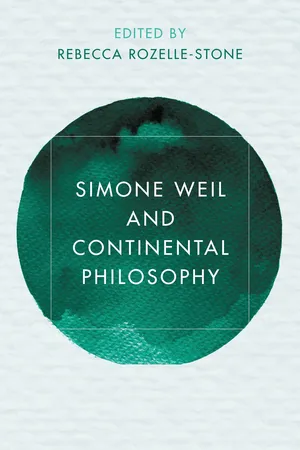
Simone Weil and Continental Philosophy
About this book
Simone Weil is an often-overlooked thinker whose insights could radically reshape contemporary discourses on religion, nature, art, ethics, work, politics, and education. This collection of essays situates Simone Weil's thought alongside prominent Continental thinkers and their philosophical concerns to show the ways in which she belongs to—but also stands outside—some of the major streams of 'Continental discourse', including phenomenology, ethics of embodied disposition and difference, and post-Marxian political thought. For the first time in a major work, intersections between the ideas of Weil and figures such as Nietzsche, Berdyaev, Foucault, Blanchot, Merleau-Ponty, Levinas, Chrétien, Agamben, Fanon, and Rancière are closely examined. The volume is authored by an international team of leading scholars in Weil studies and in contemporary Continental philosophy of religion more broadly. Simone Weil and Continental Philosophy is not only an unprecedented resource for Weil scholars who seek to read her in broader (and more current) philosophical terms, but also an important addition to the libraries of scholars and students of Continental philosophy and theology engaged in thinking about some of the most pressing questions of our time.
Trusted by 375,005 students
Access to over 1.5 million titles for a fair monthly price.
Study more efficiently using our study tools.
Information
Part I
TRANSCENDENTAL AND EMBODIED CROSSINGS
Chapter 1
Weil’s Boat
On Becoming and Being
A recurrent image of the human condition used in the writings of Simone Weil is that of a sailor in a boat:
The intelligence is powerless to get its bearings amid the innumerable eddies formed by wind and water on the high seas; but if we place in the midst of these swirling waters a boat whose sails and rudder are fixed in such and such a manner it is possible to draw up a list of the actions which they can cause it to undergo. (OL 88)
The rudder symbolizes both human reason and moral self-determination.1 Here, human will and intelligence seem to be alone sufficient to navigate through the flux: the will operates amid temporal change by setting its own orientation.2 Yet by Weil’s late work, the boat has capsized:
We are like shipwrecked persons clinging to logs upon the sea and tossed in an entirely passive manner by every movement of the waves. From the height of heaven God throws each one a rope. He who seizes the rope and does not let go, despite the pain and the fear, remains as much as the others subject to the buffeting of the waves; only for him these buffets combine with the tension of the cord to form a different mechanical whole. (ICG 194)
In Weil’s later work, the moral will has been replaced by consent, and work by attention. Humanism has been replaced by supernatural grace: the human being may only find a secure anchor in the sky. If the rudder symbolizes morality, the crucial question for understanding Weil is this: what does the rope symbolize? Is this a return from practical philosophy to metaphysics? Has the sailor been rescued from the sea of temporal becoming by grace from the sky of eternal being? Or, on the contrary, is the supernatural only encountered, grasped, and conceived in and through the temporal?3
The traditional philosophical distinction between being and becoming can be used to distinguish between two kinds of philosophy:4 there is a philosophy of being, a theoretical exercise that seeks to determine either the essence of things as in the metaphysical tradition, which derives from Plato and Aristotle, or the essence of reason as in the critical tradition, which derives from Descartes and Kant, or seeks simply to judge what is the case as in the analytic tradition, which derives from Frege and Russell; there is also a philosophy of becoming, which might take inspiration from the pre-Socratics but has emerged out of the Romantic historicization of reason by Schelling and Hegel. This “continental philosophy” takes many forms: it might concern itself with inwardness and existence, as in Kierkegaard and Sartre, or with material sensation and action, as in Feuerbach and Marx, or with phenomena and meaning, as in Husserl and Gadamer. Yet what is distinctive about this philosophy is that it is grounded no longer in a thought supposed pure, true, and implicitly divine, but in changeable life: it culminates in the radical postmetaphysical tradition. Substance, morality, and logic no longer offer a stable orientation amid the flux. Following Nietzsche’s proclamation of the innocence of becoming from judgment by being, Heidegger’s analysis of the temporality of being was extended into the diverse philosophies of difference found in Levinas, Derrida, Deleuze, Foucault, Irigaray, and many others.
If radical continental philosophy can be broadly characterized as a philosophy of becoming, then the received wisdom about Weil is that she takes a stand against the tide of becoming as an unrepentant Christian Platonist.5 Her rejection of progress in philosophy sets her against modernity with its cult of creation of the new.6 Whether one judges that she is essentially Christian, Platonic, Pythagorean, Stoic, Gnostic, or Manichaean, her main sources of inspiration are not often regarded as modern.7 Her distance from the Nietzschean tradition of naturalism seems more extreme: Weil appeals to supernatural inspiration as her source of truth. She is often regarded primarily as a religious thinker, and not a philosopher at all: for it is such private visions or inspirations that were excluded from the domain of reason by Hume and Kant because they are not universalizable.8 Consequently, the main emphasis of Weil scholarship lies in giving an account of her mystical doctrine, the “religious philosophy” that she revealed in the final three years of her life.9 Under this assumption, radical continental thought, with its preoccupation for extending the critique of reason to expose the pretensions, lacunae, and bids for power of modernist thought, could have little more than superficial contact with Weil.10
What places do being and becoming really hold in her thought? To investigate, first we will clarify the radical critique of philosophies of being, taking Nietzsche as a key representative, as well as clarify the critique of Nietzsche offered by Weil. The aim, here, is not to take sides but to expose the mutual contradiction. Next, I will summarize her philosophy of temporality to see if it offers any grounds for rapprochement. For, on the one hand, Weil has a critique of timeless, theoretical truth comparable to those of the philosophies of becoming; on the other hand, she also has a critique of the historicality of being and notions of historical progress (LPr 29). Weil resolves the contradiction through a change in level, a motion symbolized by her rope. For the specific relations between time and eternity, becoming and being, the natural and supernatural that she constructs in her notion of “grace” require an elevation of perspective beyond these simple oppositions.11
ASCETICISM AND FORCE: A MUTUAL CRITIQUE
The Nietzschean critique of Christian Platonism is well known. Nietzsche protested against an implicit conceptual idolatry that falsifies reality in conserving static concepts alone: “They kill, they stuff, when they worship, these conceptual idolaters—they become a mortal danger to everything when they worship. Death, change, age, as well as procreation and growth, are for them objections—refutations even. What is, does not become; what becomes, is not.”12 He claims that such concepts as the unconditioned, the good, the true, and the perfect lack a clearly defined sense: they are the most general, thinnest, and emptiest of concepts. Since one lacks access to these concepts, moral words such as justice, wisdom, holiness, and virtue are invoked to judge and condemn all that may be blamed for preventing human access to them, but this is merely revenge against the complex, subtle, nuanced, and self-contradicting ways of the human spirit.13 Morality itself, for Nietzsche, is antinature. The question of the value of morality is only raised when situated in relation to its value for life. “Why have morality at all when life, nature and history are ‘not moral’?”14 Morality is invoked against nature as a denial or refusal of natural desires and powers and yet morality must have been produced by life. Given this evaluation in relation to life, Nietzsche is able to assimilate all moralism to the supernatural as epitomized by Platonism:
One would have to be situated outside life, and on the other hand to know it as thoroughly as any, as many, as all who have experienced it, to be permitted to touch on the problem of the value of life at all: sufficient reason for understanding that this problem is for us an inaccessible problem. When we speak of values we do so under the inspiration and from the perspective of life: life itself evaluates through us when we establish values.15
Nietzsche condemns the pretension to imitate or participate in a position of transcendent judgment, outside of life; he diagnoses it as the product of a declining, debilitated life, seeking to survive by condemning others. Yet this conceptual move of assimilating morality to the supernatural is possible only as a correlate of assimilating the evaluative power of the mind to life itself: the mind is merely a product of the forces that operate through it.16 This devaluation of consciousness is achieved by elevating the immanent power of life itself. Life is understood as evaluative power, as will and will is understood by what it does, by force. Lacking the qualitative discrimination afforded by a moral view of life, life can only be understood in quantitative terms as will to power. For its reality is given by its action, and not by any appearance to consciousness; qualitative distinctions are now only to be made between active and reactive forces. Active forces go to the limit of what they can do, while reactive forces, upon which consciousness is based, express their moral vision of life by condemning the active powers of nature.17
Nietzsche, therefore, has offered a basis for the radical continental tradition to condemn the false consciousness or self-deception that appears in any appeal to the moral, the supernatural, or an ascetic ideal. For many, Weil’s life and thought would epitomize all that the Nietzscheans protest against. As a cure for self-despair, Nietzsche recommends the self-affirmation of life or amor fati:
My formula for greatness in a human being is amor fati: that one wants nothing to be other than it is, not in the future, not in the past, not in all eternity. Not merely to endure that which happens of necessity, still less to dissemble it—all idealism is untruthfulness in the face of necessity—but to love it.18
This would appear to be the self-affirmation of force by force, but it is a force that transforms itself by its own self-affirmation. Insofar as reality is composed of such active, self-affirmative forces, then it is composed of self-transformation, of becoming: what is real becomes; what simply is, is not real. This, in brief, is the Nietzschean perspective: its protest against philosophies of being is that they both lack content (appealing to vague, general concepts) and that they lack power, failing to express the self-transformative power of life.19
What is less well known is the conceptual underpinning of Weil’s critique of Nietzsche.20 Like Nietzsche, Weil begins her account of society with nature and plurality. In human life, nature makes itself felt through the compulsion of need, and there is an unlimited diversity of individuals together with their capacities for innovation. She adds to these the Darwinian notion of “conditions of existence”: only those behaviors that adapt to natural pressures and social competition survive. In other words, a force which goes too far, which does not operate within limits, will undermine its own conditions of existence. For human beings in society, these “conditions of existence” include specifically the organization of means of production and weapons, of methods of work and warfare. Some of these are of such complexity as to be the privilege of a few: Weil cites explicitly religious rites, arms, and money (OL 64). Through possessing these means, natural force is translated into human obedience, for continued existence relies on complex conditions of existence. Yet natural and social forces differ in kind. Natural force is entirely present; social force depends on threat and promise, on anticipation of the future. Weil then formulates her own theory of the will to power,21 but one which is exclusively concerned with social relations of privilege, obedience, and oppression, rather than with natural force:
The preservation of power is a vital necessity for the powerful, since it is their power which provides their sustenance; but they have to preserve it both against their rivals and against their inferiors, and these latter cannot do otherwise than try to rid themselves of dangerous masters; for, through a vicious circle, the master produces fear in the slave by the very fact that he is afraid of him, and vice versa; and the same is true between rival powers. (OL 65)
This situation of rivalry simply does not apply in the relations between humanity and nature: although humans feel the pressure of natural necessity, and nature offers resistance and obstacles to their efforts, even so, nature does not defend itself. Natural necessity is a struggle contained within real limits, and the resistance and obstacles it offers may be turned into means toward a goal: “The wind consents to guide to her destination the same ship which it would have sent off her course if sails and rudder had not properly been adjusted” (OL 66–67). By contrast, social rivalry is in principle unlimited (WA 194). The limit of power won over others would be their extermination, but to exterminate one’s slaves is to exterminate one’s own power; to exterminate one’s rivals is to exterminate one’s own prestige. Power is essentially unstable:
For, owing to the fact that there is never power, but only a race for power, and that there is no term, no...
Table of contents
- Introduction: Attending to the Outlaw
- PART I: TRANSCENDENTAL AND EMBODIED CROSSINGS
- PART II: ATTENTIVE ETHICS
- PART III: EMANCIPATORY POLITICS
- Bibliography
- Index
- About the Authors
Frequently asked questions
Yes, you can cancel anytime from the Subscription tab in your account settings on the Perlego website. Your subscription will stay active until the end of your current billing period. Learn how to cancel your subscription
No, books cannot be downloaded as external files, such as PDFs, for use outside of Perlego. However, you can download books within the Perlego app for offline reading on mobile or tablet. Learn how to download books offline
We are an online textbook subscription service, where you can get access to an entire online library for less than the price of a single book per month. With over 1.5 million books across 990+ topics, we’ve got you covered! Learn about our mission
Look out for the read-aloud symbol on your next book to see if you can listen to it. The read-aloud tool reads text aloud for you, highlighting the text as it is being read. You can pause it, speed it up and slow it down. Learn more about Read Aloud
Yes! You can use the Perlego app on both iOS and Android devices to read anytime, anywhere — even offline. Perfect for commutes or when you’re on the go.
Please note we cannot support devices running on iOS 13 and Android 7 or earlier. Learn more about using the app
Please note we cannot support devices running on iOS 13 and Android 7 or earlier. Learn more about using the app
Yes, you can access Simone Weil and Continental Philosophy by A. Rebecca Rozelle-Stone in PDF and/or ePUB format, as well as other popular books in Philosophy & Ethics & Moral Philosophy. We have over 1.5 million books available in our catalogue for you to explore.