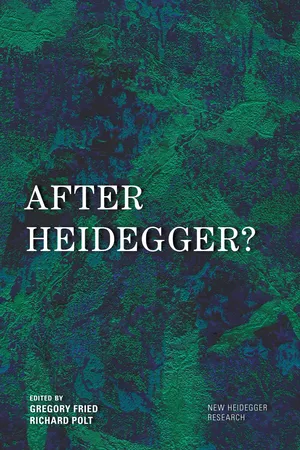
This unique volume collects more than 30 new essays by prominent scholars on what remains philosophically provocative in Heidegger's thought. His writings continue to invite analysis and application — ut, particularly in the light of his political affiliations, they must also be critiqued. Philosophy today takes place after Heidegger in that his views should not be accepted naively, and there are new issues that he did not address — but also in that we continue to think in the wake of important questions that he raised.
The contributors to this volume ask questions such as:
- What does it mean to think "after" Heidegger?
- What is valuable in his early work on finite existence, and in his early and late phenomenology?
- What is the root of his political errors? Are there still elements in his thought that can yield helpful political insights?
- Should we emulate his turn toward "releasement"?
- Can he help us understand the postmodern condition?
Readers will find thought-provoking echoes and points of contention among these engaging and lively essays.
- 392 pages
- English
- ePUB (mobile friendly)
- Available on iOS & Android
eBook - ePub
After Heidegger?
About this book
Trusted by 375,005 students
Access to over 1.5 million titles for a fair monthly price.
Study more efficiently using our study tools.
Information
Part I
Overviews
Chapter 1
Heidegger: Enduring Questions
I want to begin this short chapter by reaffirming the guiding assumption articulated by our two editors, that despite Heidegger’s deplorable political history, there is much, very much, philosophic work that remains to be done in response to his work. As I shall argue, the question of the relation between a philosopher’s political life (in the broadest sense of that phrase) and his or her philosophical writing is itself a philosophical issue, and certainly one not adequately addressed by rejecting Heidegger as a philosopher or relegating his work to the section of our libraries on the history of Nazism.
The editors have asked what are some of the most pressing and challenging issues for philosophy after—that is, in the philosophical wake of—Heidegger. I want to briefly discuss three issues: first, the centrality of the question as the core philosophical stance and speech act in Heidegger; second, and related, Heidegger’s development of the distinction between “calculative” and “meditative” thinking and his call to preserve meditative thinking under the threat of the total dominance of calculative thinking; and third, as mentioned earlier, the question of the relation between a philosopher’s thinking and the life lived, particularly if that philosophical thinking includes an affirmation of thinking as “beyond good and evil.” I turn first to the question of the question.
Book after book of Heidegger’s is titled as a question, and as if to underline the importance of this, Heidegger presses the limits of syntax to find alternative ways to formulate the question asked in his titles. Thus we find Die Frage nach dem Ding (The Question of the Thing), “Zur Seinsfrage” (On the Question of Being), Was heißt Denken? (What Is Called Thinking?), Was ist das, die Philosophie? (What Is Philosophy?), Was ist Metaphysik? (What Is Metaphysics?), among others. Even Sein und Zeit (Being and Time), though not titled as a question, makes it clear from the beginning that the whole purpose of this groundbreaking book is to raise the question of the meaning of Being. And of course, none of Heidegger’s texts ask the question of the title and then answer it in the book! The point of Heidegger’s thinking, that is, is not to “answer” this or that question but rather to deepen the question-worthiness of the issue at hand. One might say that the questions Heidegger asks call not for answers but for responses, where the difference would be that answers seek for a kind of closure on a given issue, whereas responses seek rather to open up that issue, to deepen our sensitivity to its nuances of meaning. In a world increasingly dominated by the kind of thinking that demands answers (more on this presently), Heidegger’s thought-path tries to keep alive a kind of thinking that attempts to dwell—and it will demand a dwelling—in what we might call the open of the question. That phrase hints at an even larger issue: for the call for questioning as the fundamental speech act of philosophy occurs as a response to an open, and an open which, if Heidegger is right, will ever remain open (even if always also partially hidden), not one that will be “closed” or “solved” by any future thinker. Throughout his career, Heidegger names this open with various provocative words: Being, event of appropriation (Ereignis), that-which-regions (das Gegnet), clearing (die Lichtung), and the Open. But for me, what remains “the same” through these various pathways is what Heidegger sees as the appropriate response to them, which remains, always, questioning. One might say that whereas for almost all of philosophy since Descartes, the fundamental philosophic speech act has been the assertion—the assertion of “truths,” of theories, of proofs, of conclusions, of refutations—Heidegger, by contrast, is trying to preserve for philosophy the fundamentality of that speech act which is questioning.
In this, it strikes me that there is a deep kinship with a thinker that Heidegger himself might be uncomfortable acknowledging as akin: the Platonic Socrates, and in particular, Socrates’s sustaining of aporia as his very stance of philosophy. In Plato’s Apology, at the very end of his life, Socrates characterizes his “human wisdom” precisely as his aporia, his recognition that he is not wise, a recognition whose appropriate response is always that of questioning. To be sure, in many dialogues, read superficially, Socrates seems to be seeking closure, to want a “definition” of courage, or friendship, or sophrosynē, or beauty, or knowledge itself. But we must note—and surely Plato wanted us to note this—that these attempted definitions, these apparent attempts at the closure of full knowledge, always fail. Do the dialogues therefore fail? Not at all! The dialogues succeed, succeed in opening up for us the question-worthiness of the issue at hand, help us to deepen our understanding of the call of the question concerning courage, or friendship, or knowledge. Socrates succeeds, moreover, not in reducing his interlocutors and us, Plato’s readers, to aporia, but in raising them up to the achievement of aporia. In this affirmation of aporia and its questioning, Heidegger will always be a Socratic. And in a world that increasingly demands answers, a world that increasingly understands questions as a kind of weakness to be overcome, Heidegger seeks to sustain for us a recognition of the power of the question and of the open that gives us the question. One task for philosophy after Heidegger, surely, is to continue cultivating this openness, to sustain the priority of the question for philosophy and for human living.
Second, and intimately related to this, is the preservation of what Heidegger calls in his “Memorial Address” to the citizens of Messkirch “meditative thinking,” or, in his “Conversation on a Country Path,” “releasement,” or sometimes simply “thinking.” The general point is this: Heidegger distinguishes between two basic kinds of thinking. The first is the one we use all the time in our “pragmatic” activities of life. In the “Memorial Address” he calls it “calculative thinking” (rechnendes Denken). It is characterized by being goal oriented, by its emphasis on order, system, and problem solving. Logic and mathematics are perhaps the paradigms of calculative thinking, though one gets the impression that almost all goal-oriented or problem-solving thinking counts as calculative. The second kind of thinking, “meditative” thinking, “releasement,” or just “thinking,” is quite different. Understandably, it is less precisely defined, since it is characterized not by logic, an urge to system, or a goal-oriented striving for closure on a given issue, but on an openness, yet not an openness to a specific, pre-calculated end. In the “Memorial Address” Heidegger calls this “openness to the mystery.” In the “Conversation on a Country Path” he speaks of it as “releasement” (Gelassenheit), a kind of “waiting” but not an “awaiting,” where the difference is that “awaiting” is an expectation of some specific happening, whereas “waiting” remains open to what may eventuate. It is in this openness that the kinship with questioning becomes clear. Both the questioning he espouses and the “releasement” he commends are characterized by a certain openness, not a predetermining of outcomes or even expecting certain outcomes. The English phrase “to hold open to question,” taken in its full sense, captures something of what Heidegger intends by this mode of thinking.
It must be emphasized that there is nothing in principle wrong with calculative thinking. To the contrary, it is imperative for “getting along” in the world, and the last thing that Heidegger would ask is that we do without it. The problem he sees is that particularly and increasingly in our epoch, calculative thinking threatens to become the only acceptable mode of thinking, indeed to be regarded as thinking itself. Meditative thinking, releasement, may be lost as a human possibility as the emphasis on technology, on calculation, on statistical analysis, takes over our lives more and more. The point of Heidegger’s drawing the distinction is to keep alive the very possibility of this other thinking, this thinking that, Heidegger seems to hold, in the end is what makes us human, for one fine day we shall learn that machines are much better than we are at calculative thinking.
I think that in this distinction Heidegger identifies a very important issue in the modern epoch. The dominance of technology, what might be regarded as the triumph of calculative thinking, is all around us. Even in the intellectual world in which we academics live, we see its dominance everywhere. We must all “document” our teaching ability through “measures” often called “learning assessment.” The legitimacy of traditional “liberal arts” education is being increasingly questioned precisely because its “practical” value is not obvious to all. In the “discipline” (itself a calculative word) of philosophy, the dominant understanding of philosophy today is called “analytic” philosophy, a movement whose explicit aim is to “solve philosophical problems.” Heidegger’s challenge in this regard is therefore ever more important and ever more difficult: how do we preserve that manifestly less “practical,” less goal-oriented, less closure-achieving thinking in an age where those very values are increasingly dominant? One “calculative” issue much discussed today has to do with the fact that machines—computers in particular—are increasingly capable of doing all the calculative thinking that we humans do, only more accurately and faster. Is Heidegger then perhaps right that it is this “other” thinking that would make and keep us human?
I turn to the third issue I want to address by noting that so far as I can see, not a thing I have discussed so far could be plausibly associated with a particular political standpoint, much less with the specific political standpoint which Heidegger himself took at least in the early 1930s, that of Nazism. Even less would questioning and meditative thinking have anything to do with anti-Semitism, a vice in which Heidegger also indulged. Yet questioning and this “released” mode of thinking are important and sustained themes in Heidegger’s thought-path. They both therefore stand as manifest refutations of any claim that Heidegger’s thinking is “through and through” Nazistic or anti-Semitic. Such a claim is nonsense.
Nevertheless, Heidegger was a Nazi, at least for a while, and an anti- Semite, and therefore the question must be raised: what are we to make of the fact that one of the greatest philosophers of the twentieth century was an enthusiastic advocate of what was surely the most diabolic political regime of that century? And we must also note that to ask this very question is to raise a philosophical issue.
As indicated earlier, the issue here should not be something like “Was Heidegger really a Nazi and anti-Semite, is his published thinking Nazistic and anti-Semitic, and therefore should we stop taking him seriously as a philosopher?” The answers to these questions are too easy: yes, he was, at least for a while, a Nazi and anti-Semite. No, his philosophic thinking is neither Nazistic nor anti-Semitic, at least not in any comprehensive sense. So, no, his work remains genuinely and profoundly philosophic and should continue to be taken seriously by serious philosophers. We can and should still wonder and be troubled by the few now notorious references to the “inner truth and greatness” of Nazism and the “Jewification” of culture, but doing so, I think, should not allow us to miss the genuinely philosophical issue at stake in this sorry situation.
The real issue for me has always been not “was Heidegger a Nazi or anti-Semite?” or “is his philosophy Nazistic or anti-Semitic?” both of which have been easily answered earlier, but rather this: why was there apparently nothing in his philosophy, nothing in his thinking, that enabled him, no, that demanded of him, to say “No!” to anything like the Nazis or anti-Semitism? To raise this question is to raise a most serious issue about the efficacy of Heidegger’s thought-project as a whole. But, as I shall argue, it raises that issue not just about Heidegger but about much of twentieth-century philosophy.
Considerations such as these lead me to suggest a different and in a way more demanding formulation of the question of Heidegger’s involvement with Nazism: was there anything in his philosophy that should have led Heidegger to reject National Socialism and its accompanying anti-Semitism, even though we know that it did not? And if not, what are we to make of a philosophic view that contains nothing within it that might call for the rejection of a political position as diabolical as Nazism?
I suggest that there is nothing in Heidegger’s thought that would have forbidden the affirmation of Nazism because from at least the time of Being and Time (1927), Heidegger claimed that all questions of ethics and politics were “ontic” questions of “everydayness,” whereas his thought, concerned always with the question of Being, was “ontological” and therefore prior to and independent of questions of ethics and politics. In Being and Time, developing the thesis that values are “ontic” and even “present-at-hand,” that is, treated as objective or quasi-objective “things” in the world, Heidegger argues that “these value characters themselves are rather just ontical characteristics of those entities which have the kind of Being possessed by things” (MR 132). Much later in the work, in the development of his notion of ontological “guilt,” and insisting that we must not think of guilt within the usual, “ontic” parameters of evil or good, he adds that “Just as the bonum and its privatio have the same ontological origin in the ontology of the present-at-hand, this ontology also applies to the idea of ‘value,’ which has been abstracted from these.”1
In a somewhat later work, the Letter on Humanism, Heidegger preserves the theme that the fundamental thinking of the sort that he pursues, the thinking of Being, is prior to and therefore independent of any thinking of values, that “here, as always, thinking in values is the greatest blasphemy imaginable against Being” (BW...
Table of contents
- Abbreviations
- Editors’ Introduction
- PART I: OVERVIEWS
- PART II: AFTER THE BLACK NOTEBOOKS
- PART III: POLITICS AND ETHICS
- PART IV: LIFE AND EXISTENCE
- PART V: PHENOMENOLOGY AND ONTOLOGY
- PART VI: THINKING WITH LATE HEIDEGGER
- PART VII: OPENINGS TO OTHERS
- Index
- About the Contributors
Frequently asked questions
Yes, you can cancel anytime from the Subscription tab in your account settings on the Perlego website. Your subscription will stay active until the end of your current billing period. Learn how to cancel your subscription
No, books cannot be downloaded as external files, such as PDFs, for use outside of Perlego. However, you can download books within the Perlego app for offline reading on mobile or tablet. Learn how to download books offline
Perlego offers two plans: Essential and Complete
- Essential is ideal for learners and professionals who enjoy exploring a wide range of subjects. Access the Essential Library with 800,000+ trusted titles and best-sellers across business, personal growth, and the humanities. Includes unlimited reading time and Standard Read Aloud voice.
- Complete: Perfect for advanced learners and researchers needing full, unrestricted access. Unlock 1.5M+ books across hundreds of subjects, including academic and specialized titles. The Complete Plan also includes advanced features like Premium Read Aloud and Research Assistant.
We are an online textbook subscription service, where you can get access to an entire online library for less than the price of a single book per month. With over 1.5 million books across 990+ topics, we’ve got you covered! Learn about our mission
Look out for the read-aloud symbol on your next book to see if you can listen to it. The read-aloud tool reads text aloud for you, highlighting the text as it is being read. You can pause it, speed it up and slow it down. Learn more about Read Aloud
Yes! You can use the Perlego app on both iOS and Android devices to read anytime, anywhere — even offline. Perfect for commutes or when you’re on the go.
Please note we cannot support devices running on iOS 13 and Android 7 or earlier. Learn more about using the app
Please note we cannot support devices running on iOS 13 and Android 7 or earlier. Learn more about using the app
Yes, you can access After Heidegger? by Gregory Fried,Richard Polt, Gregory Fried, Richard Polt in PDF and/or ePUB format, as well as other popular books in Philosophy & Phenomenology in Philosophy. We have over 1.5 million books available in our catalogue for you to explore.