The Moral Psychology of Anger is the first comprehensive study of the moral psychology of anger from a philosophical perspective. In light of the recent revival of interest in emotions in philosophy and the current social and political interest in anger, this collection provides an inclusive view of anger from a variety of philosophical perspectives. The authors explore the nature of anger, explain its resilience in our emotional lives and normative frameworks, and examine what inhibits and encourages thoughts, feelings, and expressions of anger. The volume also examines rage, anger's cousin, and examines in what ways rage is a moral emotion, what black rage is and how it is policed in our society; how berserker rage is limited and problematic for the contemporary military; and how defenders of anger respond to classical and contemporary arguments that expressing anger is always destructive and immoral.
This volume provides arguments for and against the value of anger in our ethical lives and in politics through a combination of empirical psychological and philosophical methods. This authors approach these questions and aims from a historical, phenomenological, empirical, feminist, political, and critical-theoretic perspective.
- 212 pages
- English
- ePUB (mobile friendly)
- Available on iOS & Android
eBook - ePub
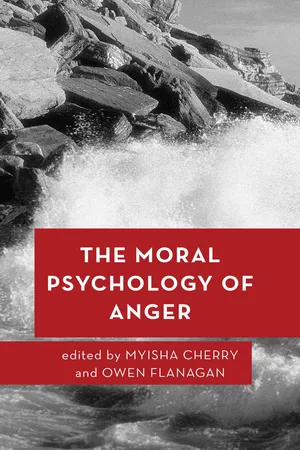
The Moral Psychology of Anger
About this book
Trusted by 375,005 students
Access to over 1.5 million titles for a fair monthly price.
Study more efficiently using our study tools.
Information
Chapter 1
Anger and Approbation
Anger is all too human. Contemporary psychology classifies anger as an emotion.1 It is thought that anger harkens back to our evolutionary fight-or-flight mechanism (Myers and Dewall 2015: 477). While fear engenders the visceral physiological response to perceived threat that prompts us to flee, anger denotes that visceral physiological response to perceived threat that prompts us to confront, to resist, and to counter. In philosophy (especially moral psychology), much work has been done to offer evaluative accounts of anger.2 Some argue that anger is always negative or destructive, something to be suppressed or eschewed. Others question whether we have an obligation—a moral duty—to get angry or indignant when met with undue injury.
In “Transitional Anger,” Martha Nussbaum argues that “garden-variety anger” is normatively irrational, politically unnecessary, and inevitably destructive (Nussbaum 2015: 54–56). Anger, on this account, is portrayed as a primitive vestige of bygone days, an impediment to the genuine pursuance of justice and the honoring of obligations. She argues that anger deserves reproach, unless the situation is momentous and anger is fleeting, quickly transitioning into compassionate hope focused on future welfare. Nussbaum’s thesis strikes me as wrong (I mean, incorrect) or, at least, callously overstated. I take issue with Nussbaum’s definition and portrayal of anger as essentially vindictive, which I believe leads her into conceptual contortions and ambivalence (regarding anger). In an attempt to bolster approbation for anger, I turn to Aristotle’s Nicomachean Ethics, where (even-tempered) anger is listed among the virtues.3 To develop this alternative conception of anger, I discuss the various roles anger plays in highlighting unnoticed wrongs and in galvanizing social agency among oppressed groups and those who suffer social injustice. Ultimately, a case is made for the approbation of anger (in relation to the right person(s), in the right amount, at the right time, with the right aim in view, and in the right way).
ANGER AS VESTIGIAL
For a definition of anger, Nussbaum turns to Aristotle’s Rhetoric (1378a31–33). Here we find: “Anger may be defined as a desire accompanied by pain, for a conspicuous revenge for a conspicuous slight at the hands of men who have no call to slight oneself or one’s friends” (Aristotle 1984: 2195). From this, Nussbaum infers (i) that anger (ὀργή) involves an injury, slighting, or down-ranking; (ii) that this injury is done to the self or people close to the self; (iii) that the injury is wrongfully or inappropriately done; (iv) that the injury is accompanied by pain; and (v) that it is linked to a desire for payback or retribution (Nussbaum 2015: 42). Anger, on this interpretation, expresses a desire for striking back or retaliation in many, if not all, cases. The suffering need not manifest as physically violent revenge or be meted out by the angry person, but the angry person wants the offender to suffer (47). Nussbaum frets over this retributive desire, finding it plainly irrational or misguided. She writes, “Doing something to the offender does not bring dead people back to life, heal a broken limb, or undo a sexual violation. So why do people somehow believe that it does?” (45).
Nussbaum lays out two paths of anger. The first is the path of status. The injury is taken as an unjust humiliation, slight, or down-ranking, reducing the event to a concern about the angry person’s rank or status. The angry person is portrayed as anxious and obsessively focused on protecting his or her honor. To right the injury, it is thought that the status of the angry person should be raised and the status of the offender lowered—a reversal of positions. This focus on status, according to Nussbaum, diverts attention away from the reality of the victim’s pain, the material theft, and the bodily wrong suffered. It reeks of infantile narcissism. This path places an overblown value on the relative status of the angry person, placing moral deliberation on dubious values. The path of status is thus normatively objectionable, committing what Nussbaum labels the “status error” (Nussbaum 2015: 51).
The second path is the path of payback. Here the angry person focuses on retaliation. The angry child bullied on the playground imagines the infliction of retaliatory pain and humiliation on the offending children. Those who have been sexually assaulted (and are angry about it) imagine various scenarios where the offenders suffer extensively—expelled, imprisoned, and raped. Angry-enslaved people imagine a future in which power is attained and their bondsmen are enslaved and brutalized (Nussbaum 2015: 55). The point is that the angry person on the path of payback imagines that the offender’s suffering would actually make things better and that it would somehow assuage the damages to bodily integrity, the egregious indignities, the grave losses, and so on. Nussbaum argues that this line of thought engages in magical thinking (51). Acts of retaliation do not right the cosmic balance; they do not produce justice. Again, “[payback] does not bring dead people back to life, heal a broken limb, or undo a sexual violation” (45). Sane, clear-eyed rational people will see that the imposition of retaliatory injury and suffering on an offender does not recompense for an unjust injury suffered (not in any sense that could be considered ameliorative or moral). Hence, the path of payback is normatively objectionable.
Garden-variety anger is thus normatively irrational—based on either defective (narcissistic) values or futile magical thinking. Anger is rendered “a central threat to decent human interactions” (Nussbaum 2015: 41). It is an irrational and destructive vestige of human prehistory, which forward-looking systems of justice have, to a great extent, made unnecessary (56).
TRANSITIONAL ANGER
Nussbaum has articulated an indictment of garden-variety anger. The paths of status and payback are normative irrationality. Anger is primitive, destructive, and no longer necessary for the pursuance of justice. Nussbaum’s paper ends with this sentiment. Yet there is one exception, one subspecies of anger that seems to escape Nussbaum’s reproach. There is a third path: the path of future welfare (Nussbaum 2015: 51). On this path, anger “quickly puts itself out of business” and transitions into concern for those actions that tend to augment the welfare of those parties whose interests are in question (cf. Bentham 1988: 2). (And, yes, she is referencing Bentham’s utilitarianism, here [Nussbaum 2015: 51].) Anger, in rational people, will quickly “laugh at itself” and go away. Anger is dispelled for saner thoughts, and residual concerns for punishment are enveloped in the larger goal of improving offenders and society (Nussbaum 2015: 51–52). Anger will then take on a new appearance; it will resemble something like “compassionate hope.” Nussbaum labels this healthy segue into forward-looking thoughts of welfare, this movement from anger to compassionate hope, “the transition” (52).
To explicate the transition, Nussbaum evokes Martin Luther King Jr., providing a brief analysis of the “I Have a Dream” speech. She points out that King begins with “an Aristotelian summons to anger,” citing the wrongful injuries of racist oppression and the nation’s failure to fulfill its implicit promises to equality (Nussbaum 2015: 52). But then King shifts course, and this is significant, according to Nussbaum. She writes:
Instead of demonizing white Americans, or portraying their behavior in terms apt to elicit murderous rage, he calmly compares them to people who have defaulted on a financial obligation: “America has given the Negro people a bad check, a check which has come back marked ‘insufficient funds.’ ” This begins the Transition: for it makes us think ahead in non-retributive ways: the question is not how whites can be humiliated, but how can this debt be paid, and in the financial metaphor the thought of humiliating the debtor is not likely to be central. (Nussbaum 2015: 52)
Although there may be initial pangs of anger, King makes the transition and “focuses on a future in which all may join together in pursuing justice and honoring obligations” (52). Anger, here, is not divisive, pitting blacks against whites. It is calm and nonthreatening. It calls for neither murderous rage nor the humiliation of white Americans.4 The process is unifying in its pursuit of freedom and justice—“everyone benefits” (52).
This anger that quickly transitions into compassionate hope is dubbed “transition anger” (Nussbaum 2015: 53). It captures the emotion “How outrageous! Something must be done about this” but lacks the drive toward payback and the inflicting of suffering on the offender. “[Transition-Anger] focuses on future welfare from the start” (Nussbaum 2015: 54). Nussbaum has thus isolated one exception, one borderline case, where anger receives approbation. Nevertheless, Nussbaum seems leery of giving transition anger full endorsement. Nussbaum’s article concludes with a rehearsal of the limited utility of anger, the threat of irrationality and destructiveness, and its anachronistic presence in contemporary systems of justice.
ANGER, COMPLICATED
Let us return to Nussbaum’s Aristotelian definition of anger (from the Rhetoric 1378a31–33). Her unpacking of this definition portrays anger as inherently retaliatory and seemingly vindictive. This takes anger well beyond a visceral physiological response to perceived threat that prompts one to confront or to resist. Nussbaum writes, “Anger involves, conceptually, a wish for things to go badly, somehow, for the offender in a way that is envisaged, somehow, however vaguely, as a payback for the offense” (Nussbaum 2015: 46). Yet transition anger does not contain a vindictive desire for payback or retribution. Nussbaum is, here, caught with an inconsistency, which draws her definition of anger into question. But instead of revising her initial definition of anger, Nussbaum pushes forward, introducing transition anger as “a major exception to [her] thesis that anger always involves, conceptually, a thought of payback” (53). Payback, then, is not a necessary feature or quality of transition anger. In other words, transition anger is anger that does not contain the quality (viz., vengefulness) that Nussbaum argues is inherent in anger simpliciter. Moreover, transition anger is anger that does not really resemble anger—it resembles compassionate hope more than anger. With furrowed brow, I am left somewhat bewildered.5 Why would Nussbaum go this route? It would seem to follow either (i) that transition anger is not really anger or (ii) that Nussbaum’s definition fails and should be abandoned. Nussbaum resists both of these options and in the process twists herself into needless conceptual contortions, which ultimately results in ambivalence toward transitional anger.
I would suggest a different starting point, a new definition that does not make retaliation an essential feature of anger. If we turn to the Nicomachean Ethics (1125b27ff.) we find another Aristotelian account of anger (ὀργή).6 In this text, Aristotle discusses the states relative to anger within a larger discussion of the virtues and their relative excesses and deficiencies. Aristotle designates “even temper” or “good temper” as a mean with respect to anger (πραότης δ᾽ ἐστὶ μεσότης περὶ ὀργάς) (Aristotle 2000: 73; NE 1125b25). Aristotle writes, “There is praise for someone who gets angry at the right things and with the right people, as well as in the right way, at the right time, and for the right length of time” (Aristotle 2000: 73). Here, even-tempered anger is understood as a virtue, as the mean (determined by reason) between two vices, one of excess and one of deficiency. People can fall into excess by getting angry with the wrong people, for the wrong reasons, to a greater degree, more quickly, and for a longer time than is appropriate (Aristotle 2000: 74). Irascible and vengeful people are representative of this vice of excess. People can also fall into deficiency by failing to get angry at the things at which they ought to get angry (Aristotle 2000: 73). Self-effacing and abject people are representative of this vice of deficiency.
In striking opposition to Nussbaum’s definition, even-tempered anger is not inherently destructive or deserving of disapprobation. Anger, in fact, receives approbation, when exhibited by virtuous moral exemplars. The even-tempered person is not carried away by his or her emotions. He or she is angry only in the way, at the things, and for the length of time that reason directs. Aristotle points out that, led by reason, “the even-tempered person is inclined not to revenge so much as to forgiveness” (Aristotle 2000: 73). That is, desire for payback is not taken as an inherent feature of even-tempered anger.7 Rather, an excessive focus on payback and the inflicting of humiliation and suffering on the offender can be classified as vice.
On this account, the even-tempered person must guard against being insufficiently angry, when he or she is unjustly injured. Aristotle suggests that it is odd (or inhuman) to not react to unjust injury; it is as if one has lost all feeling or lost all self-respect. He writes, “It is slavish to put up with being insulted or to overlook insults to those one is close to” (NE 1126a6–8). Thus, if you or someone close to you is sexually assaulted, lynched, or subjected to any variety of unjust injuries, you should (to some degree determined by reason) be angry; you should confront or resist this injustice. Anger, then, retains that visceral physiological response to perceived threat that prompts us to confront, to resist, and to counter.
A strain of this conception of anger qua virtue is discernable in María Lugones’s “Hard-to-Handle Anger” (Lugones 2003: 107). Lugones discloses that anger has been a problematic emotion for her. On the one hand, she recognizes that anger can play an integral role in both the resistance to injustice and the reorienting of self; on the other, she dislikes the internal turmoil and the corporeal imposition of uncontrolled or overwhelming anger (Lugones 2003: 106). She reports to have spent a great deal of her life trying, in an Aristotelian vein, to feel anger in accord with the mean (Lugones 2003: 107). This, of course, is a difficult task. As Aristotle puts it, “It is not easy to determine how, with whom, at what, and how long one should be angry, and the limits of acting rightly and missing the mark” (Aristotle 2000: 74). These things depend on the particular circumstances, and judgment lies in perception. Moreover, one must have a workable conception of the phronimoi (the wise ones) to gauge where the mean might lie.8 This is doubly difficult when one’s lived experience i...
Table of contents
- Introduction: The Moral Psychology of Anger
- 1 Anger and Approbation
- 2 Anger as a Political Emotion: A Phenomenological Perspective
- 3 Valuing Anger
- 4 The Errors and Limitations of Our “Anger-Evaluating” Ways
- 5 You Oughta Know: Defending Angry Blame
- 6 Anger and Patience
- 7 Anger and the Oppressed: Indo-Tibetan Buddhist Perspectives
- 8 The Reason to Be Angry Forever
- 9 The Berserker Rage
- Bibliography
- Index
- Notes on Contributors
Frequently asked questions
Yes, you can cancel anytime from the Subscription tab in your account settings on the Perlego website. Your subscription will stay active until the end of your current billing period. Learn how to cancel your subscription
No, books cannot be downloaded as external files, such as PDFs, for use outside of Perlego. However, you can download books within the Perlego app for offline reading on mobile or tablet. Learn how to download books offline
Perlego offers two plans: Essential and Complete
- Essential is ideal for learners and professionals who enjoy exploring a wide range of subjects. Access the Essential Library with 800,000+ trusted titles and best-sellers across business, personal growth, and the humanities. Includes unlimited reading time and Standard Read Aloud voice.
- Complete: Perfect for advanced learners and researchers needing full, unrestricted access. Unlock 1.5M+ books across hundreds of subjects, including academic and specialized titles. The Complete Plan also includes advanced features like Premium Read Aloud and Research Assistant.
We are an online textbook subscription service, where you can get access to an entire online library for less than the price of a single book per month. With over 1.5 million books across 990+ topics, we’ve got you covered! Learn about our mission
Look out for the read-aloud symbol on your next book to see if you can listen to it. The read-aloud tool reads text aloud for you, highlighting the text as it is being read. You can pause it, speed it up and slow it down. Learn more about Read Aloud
Yes! You can use the Perlego app on both iOS and Android devices to read anytime, anywhere — even offline. Perfect for commutes or when you’re on the go.
Please note we cannot support devices running on iOS 13 and Android 7 or earlier. Learn more about using the app
Please note we cannot support devices running on iOS 13 and Android 7 or earlier. Learn more about using the app
Yes, you can access The Moral Psychology of Anger by Myisha Cherry,Owen Flanagan, Myisha Cherry, Owen Flanagan in PDF and/or ePUB format, as well as other popular books in Philosophy & Ethics & Moral Philosophy. We have over 1.5 million books available in our catalogue for you to explore.