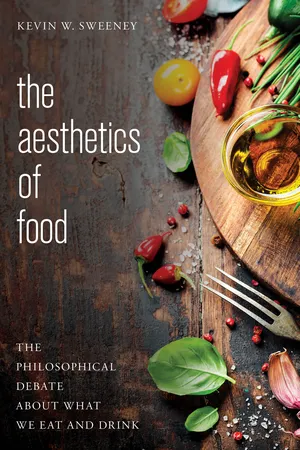
eBook - ePub
The Aesthetics of Food
The Philosophical Debate About What We Eat and Drink
- 212 pages
- English
- ePUB (mobile friendly)
- Available on iOS & Android
eBook - ePub
About this book
The Aesthetics of Food sets out the continuing philosophical debate about the aesthetic nature of food. The debate begins with Plato's claim that only objects of sight and hearing could be beautiful; consequently, food as something we smell and taste could not be beautiful. Plato's sceptical position has been both supported and opposed in one form or another throughout the ages. This book demonstrates how the current debate has evolved and critically assesses that debate, showing how it has been influenced by the changing nature of critical theory and changes in art historical paradigms (Expressionism, Modernism, and Post-modernism), as well as by recent advances in neuroscience. It also traces changes in our understanding of the sensory experience of food and drink, from viewing taste as a simple single sense to current views on its complex multi-sensory nature. Particular attention is paid to recent philosophical discussion about wine: whether an interest in a wine reflects only a subjective or personal preference or whether one can make objective judgments about the quality and merit of a wine. Finally, the book explores how the debate has been informed by changes in the cooking, presenting, and consuming of food, for example by the appearance of the restaurant in the early nineteenth century as well as the rise of celebrity chefs.
Trusted by 375,005 students
Access to over 1.5 million titles for a fair monthly price.
Study more efficiently using our study tools.
Information
Chapter One
The Aesthetics of Food
Cuisine and Taste
Food has been studied by anthropologists, sociologists, historians, and different cultural critics, all of whom have focused on increasing our understanding of the role that food plays in human affairs. Philosophers have also investigated and reflected on the nature and role of food in human life. If philosophy has traditionally been concerned with the true, the good, and the beautiful, food has been a subject of debate in each of these areas with philosophers asking: Is it true that food has played a significant role in the establishment of human nature? What moral issues arise in the selection of our diet? Are there things we should not eat, and what sort of diet is good for us? Can food be an object of genuine critical appreciation, and can it ever have a positive aesthetic value or be beautiful? This third area of philosophical inquiry is now commonly referred to as gustatory aesthetics or the aesthetics of food.
At least since antiquity, philosophers as well as a broad range of other thinkers have taken opposing positions on whether fine food or cuisine could be an object of a genuine critical or aesthetic appreciation.1 Was our enjoyment of fine food similar to the kind of appreciation we have with the arts and nature? Or, did our interest in what we consumed merely reflect an idiosyncratic preference driven by hunger? The thesis of this book is that the ongoing philosophical debate from antiquity to the present about the nature of food and its aesthetic value offers insight into and clarification about many of the issues dealing with our enjoyment and fascination with fine food. These debates especially reveal how the change over time in artistic styles and aesthetic paradigms has developed and refocused how we have come to think about and value cuisine.
Although it is now commonplace to refer to these debates as addressing the aesthetic issue of whether food could ever be an appropriate object of appreciation, the notion of the aesthetic is a fairly recent term in these debates. In earlier times, before the aesthetic became the favored conceptual term, other terms were used. The following four paragraphs present a sketch of some of the changes in the terms and concepts used in these debates. All of these terms and concepts will be discussed more fully in the following chapters.
Philosophers in ancient Greece and Rome used a single term, beauty or the beautiful, to refer to the highest value ascribable to an object of critical appreciation. In fifth century BCE, Plato asked whether food or drink could be beautiful. He concluded that only objects of sight and hearing could be beautiful and that food could not be beautiful because it was something that we smelled and tasted. In later years, Plato’s skeptical position about food being an object of serious critical appreciation has been supported in one form or another, but it has also been challenged, especially in recent years.
In the seventeenth and eighteenth centuries, a new term of critical approbation was introduced that, it was claimed, clarified the nature of genuine critical appreciation. Critical appreciation was referred to as an exercise of refined or critical taste. During this time, philosophers questioned the nature of the relationship of literal taste to critical taste. The latter notion often had nothing to do with what we orally ingest since we talk about, for example, someone’s taste in music. Yet, there was an acknowledgment that certain features of literal taste were common to critical taste, such as having a natural hedonic character and an immediacy of appreciative critical response.2 Although beauty as a term denoting high value still maintained considerable currency, the rise to prominence of critical taste allowed for the introduction of new terms distinguished from the beautiful that indicated positive value such as sublime and picturesque. Nevertheless, one of the problems with the notion of critical taste was that, if the metaphorical connection with literal taste were accepted, it was liable to render critical appreciation an individual or subjective matter.
In the late eighteenth and early nineteenth centuries, a new critical term was introduced, the aesthetic, which challenged the dominancy of taste as the major critical category, especially if one thought that critical taste was based on literal taste. One of the significant features of the aesthetic was that it did not require the immediacy of response that was claimed to be integral to literal and critical taste. In his Critique of Judgment, Kant distinguished what he took to be the immediate response that occurred in gustatory experience from the experience of genuine appreciation of the beautiful that took some time to develop. The early years of the nineteenth century saw a reappraisal of the nature of gustatory experience with the introduction of what was now called the study of gastronomy, the appreciation of fine food. With the rise of interest in cuisine, the views of Kant and others who dismissed food and wine as genuine objects of critical appreciation came to be challenged.
In succeeding years, the vocabulary of critical appraisal has continued to evolve. Although in the twentieth century some philosophers have dismissed the aesthetic as being no more than a mythic notion, the aesthetic has continued to maintain a general currency in discussing a variety of forms of critical appreciation. It is even used to characterize forms of appreciation that existed before the invention of the term in the eighteenth century. In light of this familiar and popular use of the term, aesthetic, discussion in future chapters will often make use of the term, even in discussing earlier eras when use of the term would, strictly speaking, have been anachronistic.
In addition to changes in the terms used for critical appreciation, there have been other changes that have influenced the debate about whether food and drink could be objects of genuine appreciative interest. Along with the rise to prominence of the notion of the aesthetic, the nineteenth century saw the beginning of a succession of new artistic styles and art historical paradigms. With the expanding interest in gastronomy, different artistic paradigms such as Expressionism, Modernism, and Postmodernism focused new attention on the creative process involved in the production of cuisine. In turn, the rise of an artistic avant-garde that introduced these new artistic styles opened the way for promoting and valuing the culinary achievements of creative chefs dedicated to introducing new breakthroughs in cuisine.
In addition to the influence of this succession of art historical paradigms, there were changes in the way that food was commonly prepared in the Western world and presented to the public. There were technological innovations in the kitchen such as the invention of cast-iron stoves with individual eyes that allowed for greater control over cooking temperatures.3 Such innovations in turn gave impetus to the creation of new dishes. Not only were there changes in the kitchen but there were also changes in the dining areas where the food was presented to diners. The beginning of the nineteenth century in Europe saw the rise of restaurants, public establishments where individuals or groups of diners could sit at their own table. There they could choose from a menu of different dishes and be successively served their selections. Since this form of service had been used in Czarist Russia, it came to be called service à la russe. Finally, there were changes in the way that gustatory experience was conceived and understood. The understanding of the sensory experience of ingesting and consuming food underwent a transformation from viewing gustatory experience as a simple single sensory event to viewing it as being a complex multisensory experience.
Ferran Adrià and Contemporary Cuisine
Consider an example from contemporary cuisine that frames within a philosophical context the types of changes indicative of our fascination with food in the twenty-first century. Recent decades have seen an expanding interest in all aspects of gastronomy and the pleasures of gustatory experience. There has been an eagerness to explore many regional culinary traditions reflective of different social classes. Vendors of street food started by immigrants have developed a following and been recognized by well-known food critics and mentioned in restaurant guides. So have pricey restaurants featuring celebrity chefs. These well-reviewed restaurants have become temples of gastronomy, flocked to by those who can afford them and are anxious to savor the latest styles and creations of chefs in the culinary pantheon.4
Accompanying this pursuit of gustatory creativity has been a curiosity to learn about the innovative technologies responsible for producing the exciting flavors of the new haute cuisine, flavors that in an earlier time might have been considered unusual (e.g., savory ice creams) or even garish. Given the current interest in this use of technology to revolutionize gastronomy, one might refer to the opening years of this century as the age of “molecular gastronomy.”5
“Molecular gastronomy” was a shortened form of a label first used in 1998 by two scientists interested in cuisine, Nicholas Kurti and Hervé This. They were looking for a name appropriate for a series of conferences they were sponsoring. Regularly held in Sicily over the following twelve years, the conferences were dedicated to exploring the science behind the creation of new flavors and to inventing new techniques for preparing innovative food. Hervé This has proposed the following general definition of “molecular gastronomy,” saying that it “deals with culinary transformations and the sensory phenomena associated with eating.”6 The conferences sparked a culinary movement that adopted the name of “molecular gastronomy.” On gaining prominence, the movement was championed by those who appreciated the avant-garde direction of this new form of cuisine, although the name itself was objected to by some who thought it did not reflect the true nature of the new cuisine. The movement also incited some controversy and was sharply criticized for challenging what were held to be established and well-founded standards of good cooking.
Many prominent chefs such as England’s Heston Blumenthal, Denmark’s René Redzepi, Spain’s Joan Roca, and Italy’s Massimo Bottura have been influenced by the movement.7 Perhaps the movement’s most celebrated chef and gustatory thinker, although he is said to loathe the label, “molecular gastronomy,” for not being descriptive of his cuisine, is Ferran Adrià. His restaurant, El Bulli, on the Catalan coast north of Barcelona, was given three stars by the Michelin Guide in 1997. From at least 2003 when a New York Times Magazine article turned Adrià into an international celebrity until the restaurant closed in 2011, El Bulli was frequently proposed as being the greatest innovative restaurant in the world.8
As a Catalan chef, Adrià has his roots both in the cooking of his native Catalonia and in traditional Spanish cooking; however, he has also been influenced by classic French haute cuisine and by nouvelle cuisine, the late twentieth-century lightening of that tradition. As his style has developed, Adrià has incorporated influences from Asia and elsewhere in the world. He has absorbed and reacted against all of these culinary styles, not to abandon them completely but to transform them in a revolutionary way so that food writers and critics have claimed that he has “reinvented food.” Adrià’s culinary methodology has been referred to as
culinary ‘deconstruction,’ which involves the breaking down of familiar dishes into their constituent parts, changing the physical identity of at least some of those parts, and then reassembling the pieces in new ways, so that the dishes take on different forms while retaining sensory connections with their models.9
“Deconstruction” is a term widely associated with the French philosopher Jacques Derrida’s antifoundationalist theory of lan...
Table of contents
- Cover
- Half Title
- Title Page
- Copyright Page
- Contents
- Chapter One The Aesthetics of Food: Cuisine and Taste
- Chapter Two Taste in Antiquity: Plato’s Rejection of Food
- Chapter Three Aristotelian and Roman Views on Taste
- Chapter Four Medieval and Renaissance Views on Food
- Chapter Five Critical Taste in the Enlightenment
- Chapter Six Kant and Brillat-Savarin on Taste
- Chapter Seven Creating and Tasting: Can Fine Food Be Fine Art?
- Chapter Eight Tasting Wine
- Chapter Nine The Philosophical Debate about the Aesthetics of Food
- Bibliography
- Index
Frequently asked questions
Yes, you can cancel anytime from the Subscription tab in your account settings on the Perlego website. Your subscription will stay active until the end of your current billing period. Learn how to cancel your subscription
No, books cannot be downloaded as external files, such as PDFs, for use outside of Perlego. However, you can download books within the Perlego app for offline reading on mobile or tablet. Learn how to download books offline
Perlego offers two plans: Essential and Complete
- Essential is ideal for learners and professionals who enjoy exploring a wide range of subjects. Access the Essential Library with 800,000+ trusted titles and best-sellers across business, personal growth, and the humanities. Includes unlimited reading time and Standard Read Aloud voice.
- Complete: Perfect for advanced learners and researchers needing full, unrestricted access. Unlock 1.5M+ books across hundreds of subjects, including academic and specialized titles. The Complete Plan also includes advanced features like Premium Read Aloud and Research Assistant.
We are an online textbook subscription service, where you can get access to an entire online library for less than the price of a single book per month. With over 1.5 million books across 990+ topics, we’ve got you covered! Learn about our mission
Look out for the read-aloud symbol on your next book to see if you can listen to it. The read-aloud tool reads text aloud for you, highlighting the text as it is being read. You can pause it, speed it up and slow it down. Learn more about Read Aloud
Yes! You can use the Perlego app on both iOS and Android devices to read anytime, anywhere — even offline. Perfect for commutes or when you’re on the go.
Please note we cannot support devices running on iOS 13 and Android 7 or earlier. Learn more about using the app
Please note we cannot support devices running on iOS 13 and Android 7 or earlier. Learn more about using the app
Yes, you can access The Aesthetics of Food by Kevin W. Sweeney in PDF and/or ePUB format, as well as other popular books in Social Sciences & Aesthetics in Philosophy. We have over 1.5 million books available in our catalogue for you to explore.