![]()
CHAPTER 1: YOU, THE AGILE MANAGER
| ‘Knowing others is intelligence; knowing yourself is true wisdom. Mastering others is strength; mastering yourself is true power.’ Laozi, ∼6th Century BCE |
Aim of this chapter: To make you think about your role as a manager. We investigate what makes a good manager, as well as examining your new, and changing, responsibilities under Agile Business Management. By the end, you should have the techniques you need to manage your staff, while empowering them to take direct responsibility and authority for their outcomes.
If you skipped the Introduction, Agile Business Management is a set of adaptive, lightweight, high productivity, and low waste business processes, designed to deliver regular outcomes for your Customers. As an Agile Manager, you need to understand, and embody, these concepts, and continuously develop, and encourage them, within your staff. Whilst it might be bad for the ego, you need to understand that you don’t deliver anything, your Teams do.
Your primary job as an Agile Manager is to encourage and empower your Teams, therefore the first question becomes, ‘How do you empower your Teams?’ At a superficial level, it requires a simple, organisational change, to give each Team Member sufficient personal responsibility, accountability and authority, to deliver the Customers’ Requirements. Whilst that may be sufficient for some staff, getting others to accept that accountability and authority can be difficult, and requires an attitude change, as well as the organisational change.
| Remember Agile value #1: We value individuals and interactions over processes and tools. |
In order to accept their new accountability and authority, your staff need the support of the organisation in three ways.
1 Firstly, they need to feel safe. Everyone makes mistakes, and one of the traditional roles of management is to buffer staff from these mistakes. In an empowered Team, where that buffer no longer exists, staff and management need to understand that while they must take every effort to avoid them, mistakes are inevitable, and, except in the most serious cases, acceptable. By putting in place self-correcting and transparent processes (see Chapter 4: Work, the Agile Way), Teams can proactively avoid mistakes, and learn from those that do occur.
2 Secondly, if you are expecting Teams to take authority, they must have all the information necessary to make appropriate decisions. Teams will generally already know the technical details, but, as a manager, you need to keep them aware of the context, the ‘why’ of the Requirements they are undertaking. By providing this context, your Teams will make more appropriate, strategic, and long-term decisions. This, in turn, will empower them to be personally accountable for those decisions.
3 Finally, staff need to be able to make decisions, confident that management will uphold them. The simplest mechanism for this is to allow staff to make decisions without approval, within agreed cost, time and scope tolerances. For example, a Team Member may take any decision within 10% of the allowed budget, such as outsourcing part of the work.
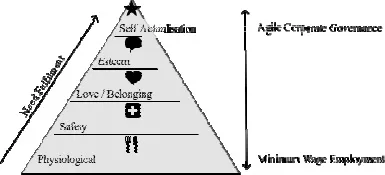
The point of this management approach is to engage staff at their level of need and motivation. Though it has its share of criticism, Maslow’s hierarchy of needs1 is a useful model of human psychological needs. Figure 4 shows the basic hierarchy, from basic physiological needs at the bottom of the pyramid, to abstract self-actualisation at the top of the pyramid. As people fulfil the requirements of each category of need, they begin to be motivated by the next level. Traditional employment exists towards the bottom of the pyramid (safety), so to fully engage and motivate your staff, requires you to meet higher, and more abstract, needs. Agile Business Management focuses on engaging staff at the level of ‘self-actualisation’, by emphasising creativity, problem solving and personal empowerment.
Figure 4: Maslow’s hierarchy of needs
| Remember Agile principle #5: Build projects [Teams] around motivated individuals. Give them the environment and support they need, and trust them to get the job done. |
Consider for a moment, your management style. Dr W Edwards Deming2 put forward two types of mistakes that you, as a manager, can make when dealing with ‘variation’ in process and outcomes. Interfering, or tampering, when everything is normal and within tolerance (common causes), which is indicative of micromanagement. Secondly, failing to intervene when a process is out of control (special causes), which is indicative of absenteeism. As an Agile Manager, or in fact any manager, you need to find the middle ground between these two extremes.
Micromanagers tend to be highly reactive to minor, expected, or manageable, issues without giving their Teams the authority to resolve them internally. If a process is under control, and within allowed tolerances, Team Members should have the authority to deliver, without management intervention. This assumes a robust monitoring and reporting process, to identify when management intervention becomes required.
This brings us to the other extreme, an absentee manager. A manager is ‘absentee’, even if they are physically in the office, if they do not monitor or engage with their Teams to ensure delivery. Without a manager to eliminate external, and sadly sometimes, internal impediments, it becomes nearly impossible to meet any schedules or budgets.
| Do not assume that a variation is due to special causes, when in fact it is due to common causes, or, more rarely, assume that a variation is due to common causes, when in fact it is due to special causes. |
These are the attributes of a bad manager; but what attributes would make you a successful Agile Manager? While that could be an entire book in itself, I would condense them into 11 core attributes:
1 You have excellent problem-solving and decision-making skills, and can validate the pros and cons of a decision, while dealing with uncertainty and ambiguity.
Benefit: You take advantage of change, while reducing management overhead for your Teams.
2 You have excellent facilitation, communication and social skills, capable of presenting, negotiating, resolving, engaging and persuading. A quick wit and good sense of humour helps with this.
Benefit: You build relationships with Customers and colleagues, and reduce misunderstanding and conflict.
3 You are creative and innovative, and can develop, or recognise, new and unique responses to problems.
Benefit: You improve outcomes for your Customers, and reduce costs for your business. Creative managers also tend to attract talented staff.
4 You have strength of character when dealing with stress. You maintain self-control, and keep emotions out of professional interactions and decision making.
Benefit: You make appropriate decisions, and build a professional environment where your staff are comfortable around you.
5 You are aware of your strengths and weaknesses, and how they apply to your role as a manager. Staff will respond well to self-confidence, but not to a large ego.
Benefit: You can play to your strengths, and pro-actively improve your weaknesses. You can also avoid situations where others could exploit your weaknesses.
6 You are self-motivated, without needing constant supervision from others, and take accountability for organisational outcomes.
Benefit: You build trust with your superiors and colleagues.
7 You have the appropriate professional and technical knowledge needed to engage with your staff and Customers. You do not need to know how to do their job, but enough to understand their work.
Benefit: Your staff and Customers respect your opinion, which helps to resolve issues quickly.
8 You understand the value of delegation or ‘getting things done through other people’. You trust your Team, and do not fear losing control.
Benefit: You will improve overall productivity, and promote personal development, by assigning work to the most appropriate people.
9 You manage your staff with honesty, fairness and integrity. You are willing to listen to, and seek input from, staff and are honest about performance, without being offensive or personal.
Benefit: Your staff feel trusted and empowered, leading to an environment where you can manage mistakes in an open and transparent manner.
10 You have flexible planning and time-management skills; visualising the short-, medium- and long-term requirements, while adapting to changing circumstances.
Benefit: You are in control of you, and your Team’s work, leading to an overall reduction of stress, and an increase in productivity.
11 You are aware of the organisational strategy and your role within it.
Organisational benefit...