Essential Time Management and Organisation
eBook - ePub

Essential Time Management and Organisation

A Pocket Guide

  1. 50 pages
  2. English
  3. ePUB (mobile friendly)
  4. Available on iOS & Android
eBook - ePub

Essential Time Management and Organisation

A Pocket Guide

About this book

Effective time-management techniques to revolutionise the way you work


Do you struggle to get everything done in the time you have available? Are you deluged with interruptions to your work flow? Do you find it difficult to prioritise your tasks and wish you were more organised?

Today's working environment moves at a very fast pace and, at times, it can be difficult to keep up. Expectations are high, and there are so many things competing for our attention. On top of the workload, we're interrupted by the phone ringing, e-mails landing in the inbox, people dropping in the office and, before we know it, the day has passed and we've only achieved half of what we intended to do.

If any of this sounds familiar, then this book is for you! Essential Time Management and Organisation will help you transform the way you work and regain control of your working day. This clear and concise guide offers tried and tested techniques for organising your time and achieving your goals.

Be more productive Drawing on current best practice and personal experience, Sarah Cook shows you how to:

  • accomplish more in the working day
  • reduce your stress levels by being more organised
  • get things done efficiently and effectively
  • enjoy a reputation as a highly-efficient member of the team.

Improve your working practices With the help of clear diagrams, checklists and models, this pocket guide will enable you to:

  • transform your methods of working
  • prioritise your tasks
  • follow the 4D model for dealing with e-mails
  • take full advantage of your most productive time of day
  • manage interruptions
  • eliminate timewasters
  • delegate effectively – including upwards!


Buy this pocket guidetake charge of your working day

Frequently asked questions

Yes, you can cancel anytime from the Subscription tab in your account settings on the Perlego website. Your subscription will stay active until the end of your current billing period. Learn how to cancel your subscription.
At the moment all of our mobile-responsive ePub books are available to download via the app. Most of our PDFs are also available to download and we're working on making the final remaining ones downloadable now. Learn more here.
Perlego offers two plans: Essential and Complete
  • Essential is ideal for learners and professionals who enjoy exploring a wide range of subjects. Access the Essential Library with 800,000+ trusted titles and best-sellers across business, personal growth, and the humanities. Includes unlimited reading time and Standard Read Aloud voice.
  • Complete: Perfect for advanced learners and researchers needing full, unrestricted access. Unlock 1.4M+ books across hundreds of subjects, including academic and specialized titles. The Complete Plan also includes advanced features like Premium Read Aloud and Research Assistant.
Both plans are available with monthly, semester, or annual billing cycles.
We are an online textbook subscription service, where you can get access to an entire online library for less than the price of a single book per month. With over 1 million books across 1000+ topics, we’ve got you covered! Learn more here.
Look out for the read-aloud symbol on your next book to see if you can listen to it. The read-aloud tool reads text aloud for you, highlighting the text as it is being read. You can pause it, speed it up and slow it down. Learn more here.
Yes! You can use the Perlego app on both iOS or Android devices to read anytime, anywhere — even offline. Perfect for commutes or when you’re on the go.
Please note we cannot support devices running on iOS 13 and Android 7 or earlier. Learn more about using the app.
Yes, you can access Essential Time Management and Organisation by Sarah Cook in PDF and/or ePUB format, as well as other popular books in Personal Development & Time Management. We have over one million books available in our catalogue for you to explore.
CHAPTER 1: HOW SUCCESSFUL ARE YOU AS A TIME MANAGER?
One thing that is immutable in this world is the number of hours we have in a day. The challenge for the business professional is to make the best use of the time that they spend at work, so that they are both efficient (doing things right) and effective (doing the right things).
I am sure we all go to work with good intentions, but many of us fail to achieve the key tasks of the day. Distractions, competing priorities and the sheer volume of work can all mean that projects slip, objectives and KPIs are not met and stress levels rise within the workplace.
So how do you ensure that you achieve your workload? How do you put in place a system to ensure better organisation and achievement of tasks?
Recognise where you are now
The first step in any improvement action is to recognise how effective you currently are as a time manager. How well organised are you?
Here is a simple self-assessment checklist that can help you do this. Score a ‘Yes’ if you generally do the following and a ‘No’ if you generally do not. Be honest with yourself!
image
Your score
To see how good you are at time management and organisation, look back at your answers.
For questions 1 to 5, award yourself 10 points for each ‘Yes’ and 1 point for each ‘No’.
For questions 6 to 10, award yourself 10 points for each ‘No’ and 1 point for each ‘Yes’.
Then total your scores.
Score 75–100: You are a good time manager.
You are an extremely well-organised professional who knows that good working habits save time and reduce stress.
Score 40–74: Your time management could be improved.
The way you organise your work may sometimes create problems for yourself and others. Greater time management and self-discipline would help you achieve more at work.
Score 39 or less: You are a poor time manager.
You are wasting an awful lot of time by failing to organise yourself and your work. As a result, you are probably not achieving your objectives and may feel that you are working under undue pressure and stress.
Improving your time management and organisation
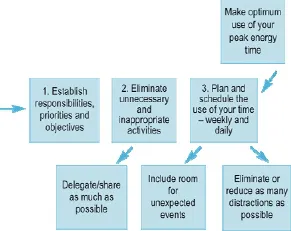
The following diagram outlines the process that you can adopt to make improvements in how effective and efficient you are at work:
image
Figure 1: The time management process
Effective time management involves three key steps:
  1. Establishing responsibilities, priorities and objectives.
  2. Eliminating unnecessary and inappropriate activities.
  3. Planning and scheduling the use of your time on a daily and monthly basis.
The chapters in this book will provide you with handy tips and advice to improve your time management and organisation, based on these three principles.
Your motivation to improve your time management
If you really want to improve the way you manage your time, you must be willing to change the way you work. Poor time management is invariably the result of bad habits. You won’t get anywhere unless you admit this to yourself. The reality is that habits are easier to make than they are to break. If you repeat a behaviour often enough, it becomes a habit. There is an old saying: ‘Bad habits are like a comfortable bed – easy to get into, but hard to get out of’.
If you are a poor time manager, you need to replace poor habits with better ones. Select an aspect of your time management that you feel motivated to change, and focus on this. It is reckoned that it takes at least a month to form new habits, so, in applying the techniques in this book, you will need to be determined and persevere.
Visualise the new, organised you. See it, hear it, feel it. Hear the compliments you will receive when you get things done. Feel how great it is to make this change.
You may find it useful to discuss with someone the changes you are going to make in the way you manage your time. This could be with a colleague, coach or close friend. Use them to help you review progress, to celebrate success and to keep you focused on your time management improvement goal.
CHAPTER 2: SETTING OBJECTIVES, GOALS AND PRIORITIES
Establishing goals
I imagine that you may have a goal in mind in reading this book: perhaps to improve your time management and effectiveness? At work, whatever our responsibilities, we have goals, objectives and targets that we have to meet. The place to start when improving your time management is to be clear about your key performance indicators. These are the criteria by which your performance will be measured. They outline what you have to achieve, how to achieve it and by when.
This chapter...
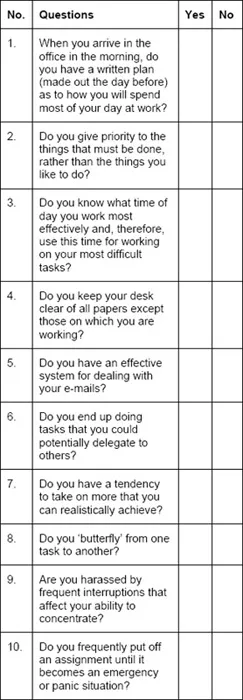
Table of contents

  1. Cover
  2. Title
  3. Copyright
  4. Contents
  5. Chapter 1: How Successful Are You As A Time Manager?
  6. Chapter 2: Setting Objectives, Goals And Priorities
  7. Chapter 3: Planning Your Time
  8. Chapter 4: Avoiding Timewasters
  9. Chapter 5: E-Mail Management
  10. Chapter 6: Delegation Techniques
  11. Chapter 7: Summary And Overview Of Time Management Tools And Techniques
  12. ITG Resources