![]()
CHAPTER 1: BACKGROUND
A new edition of Part 1
The new edition of Part 1 of ISO/IEC 20000 has been released (15th April 2011). The standard is now titled “Information technology – Service Management – Part 1: Service management system requirements”. It should be noted that a revised edition of Part 2 of the standard is not due for publication until approximately Q2 2012.
Why the need to change?
Edition 1 of the standard is now some six years old and quite simply, the world in which we live is continually changing. New thoughts regarding how service management should, or in the case of this part of the standard, how service management shall, operate have been reflected in Edition 2. During those six years, there have been new releases of best practice publications. Edition 2 of the standard has remained true to the spirit and intent of its forerunners, namely :
- the standard applies to IT Service Management. Do not try to extend it out into all of IT Governance, software maintenance, etc.
- the standard needs to be able to be certified alone or with ISO9000/ISO27001
- alignment with (not based on) ITIL® is key to a large part of the audience for this standard
- the standard should be minimal in its requirements for production of documents
- the standard needs to be applicable to both large and small service providers in the public and private sectors
- it must not be very prescriptive in how to implement the processes, it should stay at the level of what is to be achieved. This allows many best practice frameworks to be used to support ISO/IEC 20000 e.g. ITIL®, COBIT®, Business Process Framework (eTOM®), eSCM-SP® etc
- ensure that integration of processes is retained as a key principle
- information security process requirements are to remain as a consistent subset of ISO/IEC 27001 to ensure harmonisation
- retain the hierarchy of policy, process, procedure
- retain the need to demonstrate management commitment.
What are the key changes in Edition 2?
Edition 2 is a significant update on Edition 1. The key changes can be broadly categorised as :
- additional requirements – c.35%
- requirements with no fundamental change (being more explicit) – c.40%
- requirements that have not been changed – c.25%
The numbering and naming of chapters in the different sections is largely the same.
Principles of ISO/IEC 20000
ISO/IEC 20000 is based upon a number of fundamental principles that must permeate through the service management system.
Focus on a customer-driven approach, reflecting the agreed needs of the business and its customers in the underpinning management system throughout the full life cycle of the services.
Focus on end-to-end service management, ensuring that suppliers and subcontracted suppliers are aware of their scope of work, have key process touch-points defined, and have sufficient knowledge from the service provider to enable them to do their job in a seamless way.
Focus on integrated service management, developing and operating a coherent and holistic service management system that is effective in delivering the desired benefits to the customers, avoiding a ‘silo-based’ mentality (an approach where each function is focused independent of the others).
Focus on continual improvement, recognising that the business and service management environments are constantly changing, with new demands. Continual improvement will realign service provision and will, for example, increase the efficiency of the management system.
Focus on a customer-driven approach
Without customers, service providers would soon be out of business. The competition for customers is increasingly cut-throat, and service provision is much more of a commodity in these times. So how should a service provider differentiate itself? On cost, or time or quality? In reality, a combination of these factors contributes to the overall perception of the service provider.
From a cost point of view, the service provider typically finds it difficult to recoup the initial investment made during the early life of service provision. The ability to maximise the longevity of the customer relationship, and to cross-sell other services, based upon positive customer experiences and needs, is paramount. But how to do this?
ISO/IEC 20000 specifies a series of requirements for service providers in terms of understanding customer needs, agreeing a scope of work, delivering to that scope, and realigning when the customer needs change.
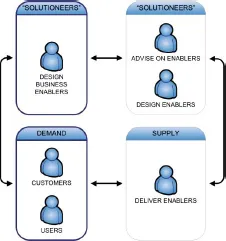
A supply-and-demand model could be used to assist in satisfying these requirements (see Figure 1). Initially, the demand side should, of course, be able to articulate its needs through the use of ‘solutioneers’ who are designing the business enablers, that is, the business services, business processes, financial models and marketing strategies. Their ‘solutioneer’ counterparts on the supply side would work closely with them, to advise on enablers to achieve the customer-critical success factors and to develop solution designs.
Once the supply-and-demand elements are designed and integrated, the delivery and operation of those services can be fulfilled.
Figure 1: Overview – supply and demand model
Using key performance indicators, cross-referenced to the customer-critical success factors, the delivery link can be maintained. This ensures that the supply side includes performance assessment from a customer perspective as well as an internal perspective. This approach enables an ongoing capability to assess the true value proposition to the customer.
In summary, service providers who align themselves to understanding how their service provision enables the customers to realise benefit will be in a stronger position to differentiate themselves in the market place.
Focus on end-to-end service management
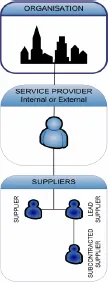
When customers entrust their service provision to a service provider, they expect that the service provider will accept overall accountability for the scope of work. This often includes the management of any suppliers, ensuring a seamless provision of service to the organisation. Figure 2 illustrates this relationship.
Figure 2: End-to-end relationship model
Service providers may be either internal (the organisation’s own staff) or external (a commercial managed service provider) or a combination of both facets. While the implications of service performance may differ between the two, the needs of the service provider are basically the same, in that they need to understand the direction of the organisation and the commitments made to them, and then ensure ongoing service delivery aligned to these needs.
It is the responsibility of the service provider to ensure that any outsourced activities are managed so that the commitments are achieved.
It is essential to ensure that the end-to-end relationship model is working well, as one weak link can cause major issues for the organisation. Vertical process integration should, therefore, be a major factor in the design of the management system to support the service life cycle. This will ensure that process touch-points between the service provider and their supply chain are clearly defined.
Timely and accurate information flowing through vertical integrati...