![]()
CHAPTER 1: CELEBRATE
As I welcome you to the world of IT project management, it’s time for you to celebrate. You have made the right choice by taking the initiative to pursue your career in the right direction. Your timing could not be more perfect: as the world slowly but surely comes out of recession, the IT industry is again gaining momentum. It is now impossible to find an industry that does not benefit from the power of IT. The IT industry has come a long way, and shows no signs of saturation.
As long as businesses want to be competitive, there will be no end to the IT industry.
With changing consumer demands, businesses need to continuously innovate new ways to attract them and remain competitive. IT allows companies to innovate and provide value for money. As existing businesses change their ways of working, the systems that support them need to change, too. This situation creates a demand for IT projects.
IT projects are responsible for delivering change to businesses. To start up, they should have a valid business case, a clear objective, and promise to provide value for money. The IT project managers managing the projects and are responsible for delivering to the business projects enabling change and better returns.
IT projects are unique, flexible and have valid business cases.
As an IT project manager, you will have many new things to learn and challenges to overcome. You will receive bricks and bouquets: you should always be prepared to expect the unexpected. Successful IT project managers will also be good leaders and mentors for their teams.
This book will give you a broad perspective on what IT project management is all about. It will give you a step-by-step guide to understanding all its aspects and provide useful tips to succeed in each of them.
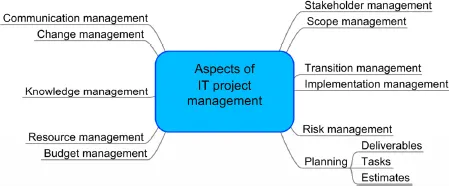
The following Mind Map is a brainstorm about the various aspects of IT project management.
Figure 1: Aspects of IT project management
IT project managers are like pilots to aeroplanes. They drive the change.
Useful tips
- You are an important part of your team. You are the leader. Act like a leader!
- Develop communication skills, including e-mail etiquette. E-mail will be your best pal in keeping things going forward – it will save you many times.
- Be confident and try to become familiar with all aspects of your project. For example, if the project is to deliver a hardware box to the group, learn a few things about the latest hardware trends.
- Develop your negotiation skills in order to convince people and get your work done.
- Be a Jack of all trades – sometimes you will work as an administrator, a technical consultant, a business analyst, an IT specialist, an implementation manager, a support analyst, or a business project manager. Flexibility is the key.
![]()
CHAPTER 2: KNOW YOUR ORGANISATION
Having become an IT project manager capable of bringing change to the business, you should now work to better understand your organisation. It is always better to have a view of the big picture and appreciate the change your project will bring to the business. By thinking like a customer, you will deliver a better project.
Have a big picture of the project.
For example, if you are doing an IT project for the stores division of a retail organisation, it is important for you to understand how a store works. You will need to understand what daily activities are involved at the store in order to understand how your project will change the life of an employee for good.
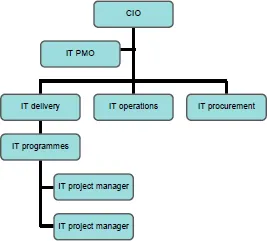
Next, you should try to understand the IT organisation of your company. How is it organised? Who leads the group? Who are the key decision makers? What is its vision? Usually, the IT organisation will be led by a chief executive officer (CEO), and will be organised into such groups as IT delivery, IT operations, IT infrastructure, and an IT project management office (PMO). Each group may have installed various subgroups to improve management efficiency. Most IT delivery teams are organised as IT programmes, each programme containing one or more related projects.
Figure 2: A typical IT organisation
I would encourage you to start your interaction with the IT PMO group to understand the organisation project maturity level, the IT project model, the documents to be prepared at each stage, the approvals to be sought at each stage, etc. In general, IT PMO groups exist to facilitate the induction and training of IT project managers in organisations.
Useful tips
- Align your goals with those of your IT organisation.
- Look into the top 10 projects in your organisation, and communicate with at least a few of the project managers concerned to get a better insight into how things work in your organisation.
- Look for the projects classified as red on the red, amber, green (RAG) scale, and learn, from the IT PMO, why they failed to deliver in the first instance. Doing this will help you make conscious decisions about how to avoid the same situations.
- Gain access to your IT organisation’s document repository and go through key documents concerning guidelines, policies, etc. These will be helpful at a later stage.
![]()
CHAPTER 3: KNOW YOUR PROJECT CAUSE
Now that you have been assigned to your project, it is important for you to understand why you are doing it. What is the project’s cause or business case? For example, the business case for making changes to banking computer systems might relate to changing financial regulations.
For the IT project to be valid and active until it goes live, it should have a valid business case until the very end. In the above example, if the government was to decide not to bring changes to the financial regulations, then the very reason for making changes to banking computer systems would no longer exist; the project could get cancelled at any stage. It is logical and valid to cancel a project if the business case no longer exists; the cost and resources allocated to that project can then be diverted to other projects.
Business cases should be viable, affordable and achievable.
You need, at every stage, to liaise with the business team or business project manager about the validity of the business case. Though this is not strictly your responsibility as the IT project manager, it is good to be in the know.
Useful tips
- Go through the feasibility study phase documents of the project. They will give you an insight into what the idea or business case was, what options were suggested, and why your project was approved for initiation.
- Go through the business benefits of the project to find details of the return of investment on it. Unless it is for a non-profit organisation, no one will invest money in a project without expecting any returns.
![]()
CHAPTER 4: KNOW YOUR PROJECT SCOPE
As the previous chapter examined your reasons for organising the project, we shall, in this chapter, discuss what you are going to deliver to achieve the business benefits.
The project scope is the agreement between you and the business team about what are you going to deliver. This is the basic foundation upon which you are going to build your project. If you get this agreement wrong, then no matter how good you are, or how good your tea...