![]()
INTRODUCTION TO SINAI
Highlights >>
Brief history >>
The Sinai peninsula has been the gateway between Africa and Asia since time immemorial, and a battleground for millennia. Prized for its strategic position and mineral wealth, Sinai is also revered by disparate cultures as the site of God’s revelation to Moses, the wanderings of Exodus and the flight of the Holy Family. As Burton Bernstein wrote, “It has been touched, in one way or another, by most of Western and Near Eastern history, both actual and mythic,” being the supposed route by which the Israelites reached the Promised Land and Islam entered North Africa, then a theatre for Crusader–Muslim and Arab–Israeli conflicts, and finally transformed into an internationally monitored demilitarized zone.
Though mostly wilderness, Sinai is both dramatic and beautiful. The interior of southern Sinai is an arid moonscape of jagged ranges harbouring Mount Sinai and St Catherine’s Monastery – pilgrims climb from the site of the Burning Bush to the summit where God delivered the Ten Commandments. Further north, the vast Wilderness of the Wanderings resembles a Jackson Pollock canvas streaked with colour. The Sinai is also home to a remarkably high number of plants and wildlife; over sixty percent of Egypt’s plant life thrives in this area, and 33 species are unique to it, including the world’s smallest butterfly, the Sinai Baton Blue. Hyenas, ibex and the rabbit-like hyrax also inhabit the region. Venture into this “desert” on a jeep or camel safari and you will also find remote springs and lush oases, providing insights into Bedouin culture.
Above all, the south has the lure of exquisite coral reefs and tropical fish in the Gulf of Aqaba, one of the finest diving and snorkelling grounds in the world. The beach resorts at Sharm el-Sheikh (which includes Na’ama Bay), Dahab and Nuweiba cater to every taste and budget. From Sharm el-Sheikh you can make expeditions to Egypt’s deepest reefs and most diverse aquatic life at Ras Mohammed, a mini-peninsula at the southern tip of Sinai, and the Tiran Strait, scattered with the wrecks of ships that have floundered on the reefs of this narrow passageway connecting the Red Sea to the Gulf of Aqaba. Northwest of here, the Gulf of Suez pales by comparison with its eastern counterpart, with no reefs and few sites to interest the general visitor – although it’s great for windsurfers and kiteboarders.
The differences between Sinai and mainland Egypt can induce culture shock. For those accustomed to the rest of the country, Sinai will seem amazingly uncrowded, laidback and hassle-free – especially for women. Even the customary salutation is different: “kif halak?” (“How is your health/situation?”) instead of “izzayak?”.
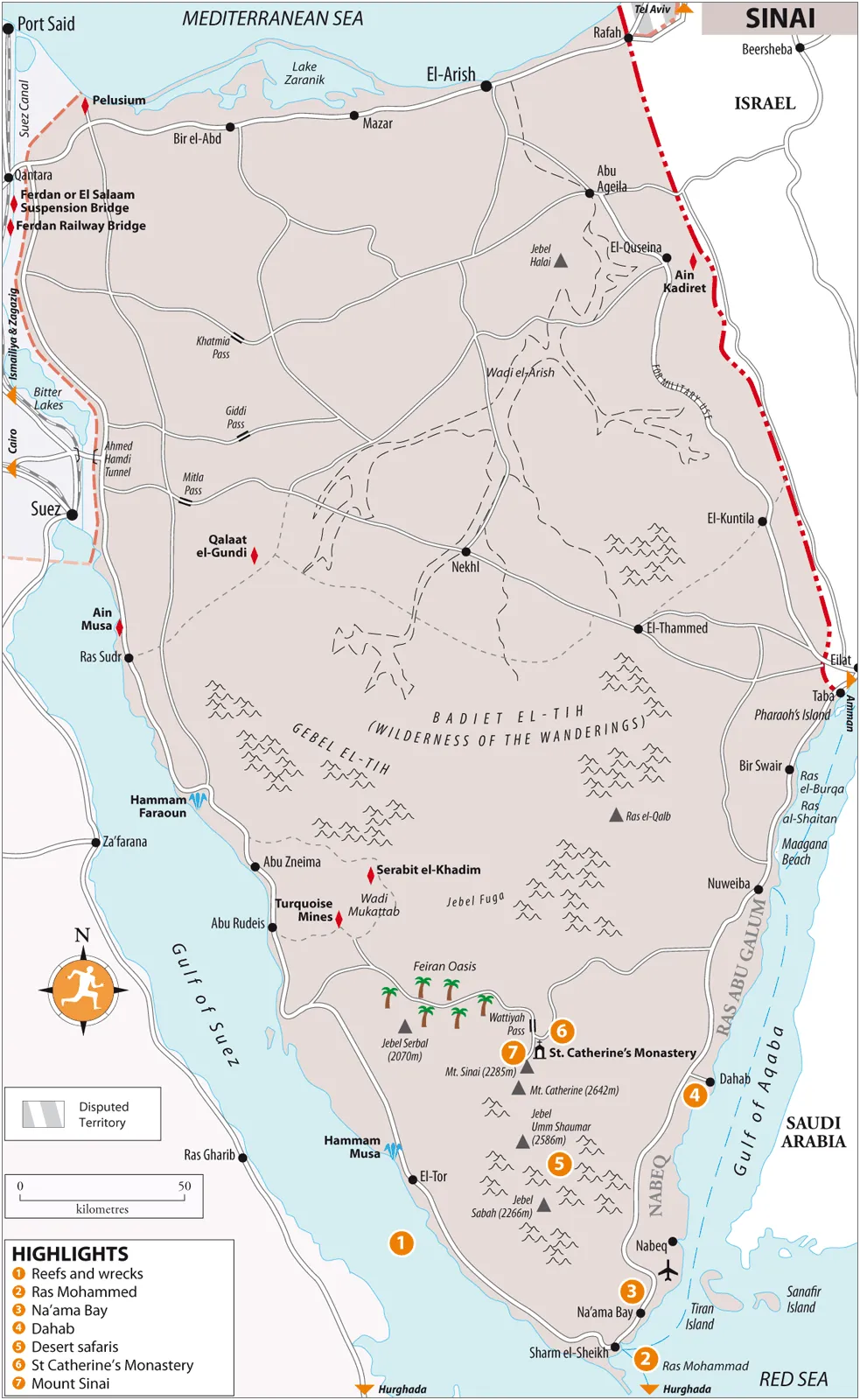
Highlights
1 Reefs and wrecks The Sinai has an excellent range of dive sites, including the Thistlegorm, a British ship sunk by German bombers in 1941.
2 Ras Mohammed Egypt’s first national park, at the southern tip of the Sinai peninsula, offers some world-class diving.
3 Na’ama Bay Egypt’s premier resort, whose buzzing bars and clubs teem with hedonists every night.
4 Dahab Chill out in Dahab, renowned for its diving, laidback beach cafés and backpacker vibe.
5 Desert safaris Explore the dramatic interior of the Sinai on a camel, horse or jeep safari with a Bedouin guide.
6 St Catherine’s Monastery Built by the Byzantine Empress Helena to commemorate the site of the burning bush at the foot of Mount Sinai.
7 Mount Sinai Climb the mountain where Moses received the Ten Commandments and see dawn break over the Sinai desert.
< Back to Introduction to Sinai
Brief history
Fifty million years ago the Arabian Plate began shearing away from the African landmass, tearing the Sinai peninsula from the mainland while the Red Sea inundated the gap. Bronze Age Semites from Mesopotamia were the first to exploit Sinai’s lodes of copper ore and turquoise, foreshadowing the peninsula’s colonization by the III Dynasty pharaohs, who enslaved its Semitic population. Pharaonic rule continued until the invasion of the Hyksos “Shepherd Kings”, whose occupation of northern Egypt lasted well over a century, till Ahmosis I finally destroyed their last bastion in Gaza. This was subsequently the route by which Tuthmosis III and Ramses II invaded Palestine and Syria.
The Exodus
Enshrined in the Old Testament and by centuries of tradition, the Exodus of the Israelites is a historical conundrum, as no archeological evidence of their journey through Sinai has been found – though excavations at Avaris in the Delta suggest this was the “City of Bondage” from which they fled. Thou...