With
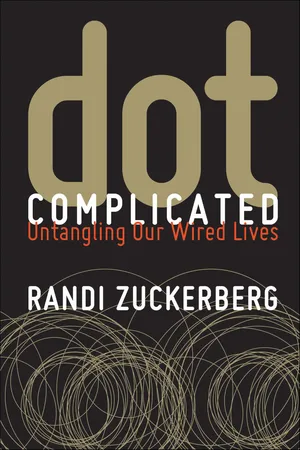
Dot Complicated: Untangling Our Wired Lives, new media pioneer Randi Zuckerberg offers an entertaining and essential guide to understanding how technology and social media influence and inform our lives online and off.
Zuckerberg has been on the frontline of the social media movement since Facebook's early days and her following six years as a marketing executive for the company. Her part memoir, part how-to manual addresses issues of privacy, online presence, networking, etiquette, and the future of social change.
- 256 pages
- English
- ePUB (mobile friendly)
- Available on iOS & Android
eBook - ePub
About this book
Information
chapter 1
FIRST AND LAST STEPS
There are moments in life when everything changes.
Sometimes these moments come out of nowhere, ambushing you. Sometimes they approach from a distance and arrive so slowly and expectedly that change is nothing to be surprised about.
And then, sometimes, the moment comes when you open your mouth and blurt your heart out at the most random and surprising opportunity. That’s how my life changed on April 20, 2011.
Sitting at my desk at work that morning, I had no idea this day would become one of the most important of my life and come to define my dreams, my career, and my views on technology and society in so many ways. But I already knew that it was going to be a very special day. Or at least a very strange one.
I had stopped by my desk for a quick breather. I don’t normally start the day tired. Most of the time, I’m a morning person—one of those terribly perky people who are always ready to roll, even before their morning coffee. But I was thirty-five weeks pregnant at this stage, and the baby felt like it weighed fifty pounds. At a short five feet two inches, I was officially all stomach and none too sprightly on my feet.
I’d also been at work for about eighty hours—and things were only just getting started. My desk was a mess of call sheets, floor plans, and the wreckage of discarded takeout meals. I slumped in my chair and took a moment to collect myself.
Suddenly, the mess began to buzz. I fumbled wildly beneath the papers for my phone. I tapped the keypad and pressed it against my ear.
“Randi!!!” boomed an enthusiastic voice. “It’s Ron!”
It was Ron Conway, the legendary Silicon Valley venture capitalist. He’s a good friend, and I have all the time in the world for Ron on any occasion. Well, almost any occasion. This time I wilted slightly in my chair. It was too early, and I was too tired for such a rousing greeting.
“Hello, Ron,” I said, forcing as much energy into my voice as I could, hoping I sounded less leaden than I felt. “What can I do for you?”
Ron paused for a moment. Then he spoke, as focused and earnest as he always is. “Listen, Randi. I need you to get M. C. Hammer in to see the president.”
For a moment, my brain struggled to process the sheer unlikelihood and absurdity of what I’d just heard. And then I began to smile. Suddenly I felt a lot less tired.
The president’s motorcade was on its way to Facebook. This was the day I’d been waiting for, the crescendo of my entire career to date.
The call had come in from the White House exactly two weeks earlier.
At Facebook, I was often contacted by people asking us to do events with them, sending movie scripts for our consideration, and pitching opportunities for our executives. Most of the time, these invitations weren’t exactly right for us, and I was used to politely declining several dozen a day.
Then, out of the blue, the White House communications office phoned. They had seen some of my “Facebook Live” broadcasts and were wondering, would Facebook be interested in hosting President Obama for a town hall event in two weeks?
It’s not every day that you get a call from the White House. So, even though I knew we would have to move mountains to pull this one off, even though all we had was an empty warehouse and a couple of cameras, I did the only sensible thing. I agreed on the spot.
Not only did the president want to come to Facebook to talk to our employees, he also wanted to answer questions submitted by people on the website as part of a “Facebook Live” event. The town hall would be streamed live, and people could tune in on Facebook to watch and ask questions. This was no idle PR stunt. The president was coming as part of his nationwide tour to make his case for a new economic policy—a strategy for cutting the deficit while maintaining investment in growth. For the president, it was a tough moment politically, and it wasn’t clear whether he would prevail over congressional Republicans.
For Facebook, this was a defining moment. The president had every distribution channel available to him to communicate to the country. But out of every website, every TV channel, every radio station at his disposal, he had chosen Facebook as the best way to speak directly to the nation.
Power, drama, technology—all the makings of an epic marketing moment for Facebook. Even as I digested the basic details of the event, my brain was already racing through the possibilities of what we could do—and what we needed to do—to host the president at Facebook in only two weeks.
We worked nonstop for thirteen days. It was a crazy, exhilarating, and terrifying whirlwind in which each day blended into the next, and my team and I lived from conference call to conference call, meeting to meeting, espresso shot to Red Bull can (or for my pregnant self, decaf coffee to herbal tea). We had to sort out logistics and security with the White House—not something to mess around with. We had to work out how to market the event so that people on Facebook would know when and how to tune in. We had to decide who would get to attend, how we could collect questions, and whether we should try to focus the conversation at all.
We had a moderator—my brother, Mark Zuckerberg, Facebook’s founder and CEO. But that’s all we had when I hung up the phone on day one. We didn’t even have a venue. There was only one space that we knew would fit the town hall. But it was nothing more than the big empty warehouse within our office complex. It had none of the furnishings or technical capacity to be a place where you’d host a presidential town hall.
We had to turn that warehouse into a fully functional studio and auditorium. We needed to find a crew to run the cameras. In fact, we needed cameras, lights, and audio. And we needed an Internet connection fast and stable enough to broadcast the president’s message live to the world.
By the fourteenth day, I’d been working almost nonstop for eighty hours, with only the occasional break for a quick nap or bite to eat. The chairs had been set up, the security team had done their final sweep, and the cameras had been tested, and then tested again. I finally went home on the morning of the event to get presentable for the president’s arrival. But this was no fancy-suit-and-slacks combo. This was Silicon Valley, and I was rocking my “on-camera Facebook signature look” of jeans with a custom-BeDazzled T-shirt, which displayed the Facebook logo in rhinestones.
And then it was straight back to work. My colleague Andrew Noyes, who had been instrumental in getting us to this day, met me at my house, just a few blocks from the Facebook office, to go over the plan for the day a final time and walk over to the event. I was glad for Andrew’s company. Even though I hadn’t slept in days, I was alert and energized, knowing how much was at stake.
Walking to the office, we saw multiple satellite trucks with antennas pointed to the sky, ready to send their signals far and wide. On the rooftops, the dark outlines of sniper rifles were barely visible. Everywhere there were security barricades, patrol cars, and lots of men clearly auditioning for parts in a Ray-Ban commercial. A police helicopter circled overhead, rotors thumping loudly.
I had stopped at my desk, simultaneously exhausted and energized, answering a few last-minute questions and staring out the window at the scene of managed chaos, when Ron called me.
“Listen, Randi. I need you to get M. C. Hammer in to see the president.”
I smiled at the request. “Hold on a moment, Ron.”
Pulling out the walkie-talkie attached at my waist, I radioed my colleagues at the ticket and credential area. “Malorie? Maureen? Come in. Can we arrange a seat for M. C. Hammer?”
A brief pause and then, “Roger that. We have secured a seat for M. C. Hammer.”
I turned back to my phone. “Sure thing, Ron! Hammer’s all set.”
And then I was off to manage a thousand other last-minute crises. It was Hammertime.
A few hours later, I sat in my seat in the audience. The audience was hushed, expectant. We were waiting for the president to enter. Out of the corner of my eye, I spotted M. C. Hammer snapping photos with his cell phone.
I was desperately nervous. This was the moment we had poured so many hours of work into. Expectations were unnervingly high. If it went well, the victory would be sweet. If it went badly—well, I didn’t want to think about that. There was too much on the line.
“So, when are you expecting?” whispered a voice.
Behind me sat a beaming Nancy Pelosi.
“Er, next month.”
Nancy launched into an enthusiastic story about her grandkids. I like Nancy and had interviewed her earlier for the live stream as a warm-up to the president. But I felt distracted and left the talking to her. I wanted the event to start. The waiting was killing me.
And then the president arrived. People stood and applauded. The novelty of a sitting U.S. president coming to address a crowd of Silicon Valley’s technorati was not lost on anyone.
Mark greeted the president, and they sat on two high stools, facing each other. The room grew quiet.
The president started. “Well, thank you so much, Facebook, for hosting this, first of all,” he said. “My name is Barack Obama, and I’m the guy who got Mark Zuckerberg to wear a jacket and tie.”
The room erupted. But I was doing everything I could just to stop myself from imploding. Against the odds, we’d done it, and it was going to be great. It had been an amazing journey to reach this moment.
Facebook was born in a dorm room. It grew up quickly, in unlikely circumstances, run first by a visionary team of students, and then with a growing crew of seasoned professionals attracted by a dream and an idea: that, by connecting people, we could give a voice to millions, transform the relationship between individuals and institutions, and help everyone get closer to the people who matter most to them. Every morning we would wake up and try to make the world more social, and we lived and breathed that mission every single day.
And now, incredibly, the president of the United States had come to Facebook to make the case for his agenda. For me, this was a pivotal career moment and one that was intensely personal. But there was also a much larger transformation taking place.
Mark was cool and collected. The president was forceful, charismatic, and energetic. There had been some doubt earlier in the day about whether he’d win the room. This was the low point of the president’s first term, and a lot of his natural supporters were feeling the blues. At the event, those fears quickly vanished.
But he did more than just win the room. He had a bigger goal and a larger audience. The president had come to speak to everyone on Facebook. Even as he joked with Mark and focused intently on the different questioners, his eyes kept returning to the cameras dotted around the room. That was where the debate over America’s economic strategy would be decided. In living rooms, offices, dorms, and coffee shops all across the country, people were tuning in to watch that town hall online. And he pulled no punches as he spoke to them.
“I know that some of you who might have been involved in the campaign or been energized back in 2008, you’re frustrated. . . . Just remember that we’ve been through tougher times before. We’ve always come out ascendant. We’ve always come out on top. If we come together, we can solve all these problems. But I can’t do it by myself.”
People cheered. So did I.
But I wasn’t just cheering for the president, as much as I agreed with him. I was cheering for those cameras—my cameras—that had just delivered the moment to the people outside this room. I was cheering for all my amazing colleagues who had worked with me to turn a dusty warehouse into a town hall fit for a president. I was cheering for the sheer audacity of what we had done: accepted an invite to run an event before we were even vaguely capable, and then made it possible through hard work and speedy improvisation.
Later, after the president and the crowds had long gone, I found out that it had been Facebook’s biggest ever live-streaming event. The numbers were off the charts.
The tiredness I had felt that morning was gone entirely. I felt invigorated, flushed with success. All of us at Facebook had done something great with technology. Of course, I always thought that the engineers and product designers at Facebook were transforming the world. But this was tangible, immediate. We had used Facebook’s enormous reach to enable a democratic experience for Americans and facilitate a political discussion for millions of people simultaneously.
That day the conversations at Facebook weren’t about the insular struggles of Silicon Valley, the latest in-jokes among the engineering team, or even the next set of product milestones, as important as they were. People were talking about big issues. Inside and outside Facebook, we had created a moment that touched people.
I had now been working for nearly ninety hours straight. The set of the town hall was already being dismantled, and my team had taken off for the day. It was time to go home.
I walked slowly through the streets of Palo Alto. I didn’t have my car. Driving was out of the question, because someone had closed all the streets.
The realization came slowly. Oh. Wait. That was me.
I was distracted, and as I walked, I felt incredibly restless. Today had ...
Table of contents
- Dedication
- Contents
- Introduction
- Chapter 1 - First and Last Steps
- Chapter 2 - The Diamond in the Rough
- Chapter 3 - It’s Complicated
- Chapter 4 - Self
- Chapter 5 - Friends
- Chapter 6 - Love
- Chapter 7 - Family
- Chapter 8 - Career
- Chapter 9 - Community
- Chapter 10 - Future
- Final Thoughts
- Acknowledgments
- About the Author
- Credits
- Copyright
- About the Publisher
Trusted by 375,005 students
Access to over 1.5 million titles for a fair monthly price.
Study more efficiently using our study tools.
Frequently asked questions
Yes, you can cancel anytime from the Subscription tab in your account settings on the Perlego website. Your subscription will stay active until the end of your current billing period. Learn how to cancel your subscription
No, books cannot be downloaded as external files, such as PDFs, for use outside of Perlego. However, you can download books within the Perlego app for offline reading on mobile or tablet. Learn how to download books offline
Perlego offers two plans: Essential and Complete
- Essential is ideal for learners and professionals who enjoy exploring a wide range of subjects. Access the Essential Library with 800,000+ trusted titles and best-sellers across business, personal growth, and the humanities. Includes unlimited reading time and Standard Read Aloud voice.
- Complete: Perfect for advanced learners and researchers needing full, unrestricted access. Unlock 1.5M+ books across hundreds of subjects, including academic and specialized titles. The Complete Plan also includes advanced features like Premium Read Aloud and Research Assistant.
We are an online textbook subscription service, where you can get access to an entire online library for less than the price of a single book per month. With over 1.5 million books across 990+ topics, we’ve got you covered! Learn about our mission
Look out for the read-aloud symbol on your next book to see if you can listen to it. The read-aloud tool reads text aloud for you, highlighting the text as it is being read. You can pause it, speed it up and slow it down. Learn more about Read Aloud
Yes! You can use the Perlego app on both iOS and Android devices to read anytime, anywhere — even offline. Perfect for commutes or when you’re on the go.
Please note we cannot support devices running on iOS 13 and Android 7 or earlier. Learn more about using the app
Please note we cannot support devices running on iOS 13 and Android 7 or earlier. Learn more about using the app
Yes, you can access Dot Complicated by Randi Zuckerberg in PDF and/or ePUB format, as well as other popular books in Negocios y empresa & Industria de medios y comunicaciones. We have over 1.5 million books available in our catalogue for you to explore.