In John Varvatos, the legendary designer reveals his perspective on how rock & roll music and style have influenced his own designs and fashion worldwide. Varvatos’s personally curated collection of more than 250 images are some of the most provocative ever shot by top rock photographers from the late 1960s to today, from the Rolling Stones to the Kings of Leon. The featured photographers are among the world’s finest, including Mick Rock, Bob Gruen, Elliott Landy, Danny Clinch, Lynn Goldsmith, and more. Also included are select images from Varvatos’s own advertising campaigns, featuring artists such as Slash, Iggy Pop, Scott Weiland, and Miles Kane. Varvatos’s captions and incisive commentary on the artist and his or her look accompany each image. Every chapter also contains numerous quotes from the musicians themselves, including Mick Jagger, Keith Richards, Iggy Pop, Jack White, Pete Townshend, Robert Plant, Steven Tyler, and Patti Smith. An extraordinary anthology of some of the finest images in rock & roll and the most influential rock looks in fashion and popular culture, this volume will delight music lovers, and fans of music photography, fashion, and fashion history.
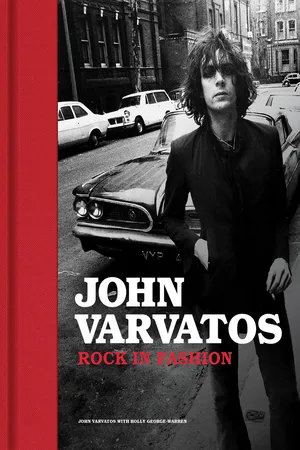
- 272 pages
- English
- ePUB (mobile friendly)
- Available on iOS & Android
eBook - ePub
About this book
Information
Subtopic
Fashion DesignSUIT YOURSELF
CHAPTER 10: IT’S ALL ABOUT TAILORING
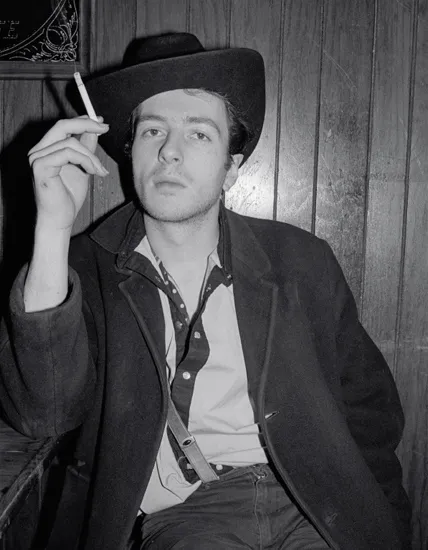
JOE STRUMMER—hobo chic. With his sport coat, hat, and two-tone shirt, Joe looks like a cross between Jean-Paul Belmondo in Breathless and an American outlaw. Photograph by Roberta Bayley.
Tailoring, for me, is the heart and soul of rock & roll fashion: the tailored topcoat, jacket, pant, and vest. When you consider music history, every important artist’s look was based on tailoring, be it Frank Sinatra, Elvis Presley, Ray Charles, Duke Ellington, or John Lee Hooker. The Chicago blues players wore a tailored suit: a jacket, a shirt, a tie, a vest, and trousers. Over time, wearing just the individual pieces has become more popular among musicians, rather than putting on the entire three-piece suit—except for traditionalists like Leonard Cohen and some young bands who’ve acquired a taste for tailoring, such as Franz Ferdinand, Interpol, and the Strokes.
I became interested in tailoring when I was young. As a kid, I never wanted to wear a suit, but then I saw cool-looking bands wearing them, and that totally changed my thinking. I loved the mods’ custom-made, three-button, Italian-styled suits with skinny lapels, short jackets, and narrow pants—perfect for riding a scooter or Vespa.
Dylan transformed his look in 1965, when he toured England and picked up his pegged pants, polka-dot shirts, and tailored jackets on Carnaby Street. Some British groups started going for longer jackets inspired by England’s Edwardian period, with a silhouette more like an hourglass, and King’s Road shops were a prime source for these. Granny Takes a Trip made crushedvelvet jackets and suits, giving us the rock & roll dandy. They also took a classic shape such as the two-button suit and created the garments in exotic fabrics. In the 1970s, Roxy Music’s front man and fashion plate, Bryan Ferry, wore eye-catching custom-made suits. Some of the design ideas from these halcyon days are still with us. Paul Smith said in the book Rock Fashion, “It was really the [London] shops of the times that led the bands and then the bands who make a particular look [like] the neat, modinspired look. . ..They all made the looks that the bands took on, and that led to acceptance by the mainstream. These shop owners and designers were the unsung heroes of fashion.”
Over the decades, the changes in tailoring styles, such as the width of the trouser leg, have affected other garments. For example, the bell-bottom jean came from the bell-bottom tailored garment, and both wide-leg and skinny jeans started as a suit style. Every season for my new collection, I begin with the tailoring. Whether it’s casual, funky, or chic and elegant, tailoring is at the root of every collection I design. In menswear, the tailoring is what differentiates one designer from another; along with cut, shape, and fit, it’s important how you make a statement with fabric. Changes in men’s tailoring tend to come as a gradual evolution: the lapel gets slightly wider or narrower; the pant gets a bit trimmer; the rise on a pant gets shorter or longer. In the last ten years, narrow pants and skinny jeans have become popular; a heavier guy feels slimmer in these, and a slimmer guy just feels kind of cool wearing them. With a tailored jacket, the shoulders can make you look stronger, tougher, or very sexy, depending on the cut.
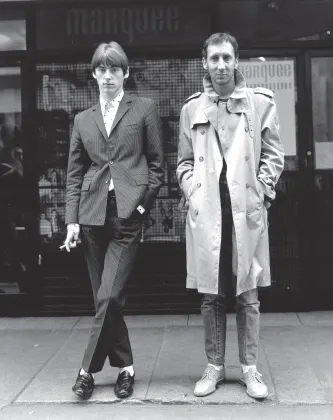
Paul & Pete: PAUL WELLER, whose band the Jam took its style cues from the Who’s mod period, with PETE TOWNSHEND.
Photograph by Janette Beckman.
“Mod had had a vast effect on the bands...rather than vice versa...Townshend has always gone to great lengths to explain the influence mod had on him. Small Faces, Rod Stewart, David Bowie, and Marc Bolan—all of them came out of the mod scene.”
—Paul Weller, from Cool Cats, 1982
Onstage, artists want fabrics that reflect light so they stay cool while they’re performing: they want lighter-weight clothes, textiles with sheen, fabrics they can move in and that aren’t going to cause them to sweat under hot lights.
But rock & roll fashion isn’t just about the stage. Fashion starts on the street, then artists grab it, make it their own, and take it to the stage. Of course, rock & roll fas...
Table of contents
- Dedication
- Introduction
- Band on the Run
- Hair
- Behind the Shades
- Wham Bam Thank You Ma’am
- Mad Hatters
- Scarf it Up
- Don’t Hang up My Rock & Roll Shoes
- Street-Walking Cheetahs
- Pattern Makers
- Suit Yourself
- Got the Blues
- Marching on
- Second Skin
- I am an Anarchist!
- Gypsies, Divas, and Tomboys
- Wearing the Message
- Acknowledgments
- Bibliography
- Photography Credits
- About the Author
- About the Coauthor
- Copyright
- About the Publisher
Trusted by 375,005 students
Access to over 1.5 million titles for a fair monthly price.
Study more efficiently using our study tools.
Frequently asked questions
Yes, you can cancel anytime from the Subscription tab in your account settings on the Perlego website. Your subscription will stay active until the end of your current billing period. Learn how to cancel your subscription
No, books cannot be downloaded as external files, such as PDFs, for use outside of Perlego. However, you can download books within the Perlego app for offline reading on mobile or tablet. Learn how to download books offline
Perlego offers two plans: Essential and Complete
- Essential is ideal for learners and professionals who enjoy exploring a wide range of subjects. Access the Essential Library with 800,000+ trusted titles and best-sellers across business, personal growth, and the humanities. Includes unlimited reading time and Standard Read Aloud voice.
- Complete: Perfect for advanced learners and researchers needing full, unrestricted access. Unlock 1.5M+ books across hundreds of subjects, including academic and specialized titles. The Complete Plan also includes advanced features like Premium Read Aloud and Research Assistant.
We are an online textbook subscription service, where you can get access to an entire online library for less than the price of a single book per month. With over 1.5 million books across 990+ topics, we’ve got you covered! Learn about our mission
Look out for the read-aloud symbol on your next book to see if you can listen to it. The read-aloud tool reads text aloud for you, highlighting the text as it is being read. You can pause it, speed it up and slow it down. Learn more about Read Aloud
Yes! You can use the Perlego app on both iOS and Android devices to read anytime, anywhere — even offline. Perfect for commutes or when you’re on the go.
Please note we cannot support devices running on iOS 13 and Android 7 or earlier. Learn more about using the app
Please note we cannot support devices running on iOS 13 and Android 7 or earlier. Learn more about using the app
Yes, you can access John Varvatos by John Varvatos,Holly George-Warren in PDF and/or ePUB format, as well as other popular books in Media & Performing Arts & Fashion Design. We have over 1.5 million books available in our catalogue for you to explore.