eBook - ePub
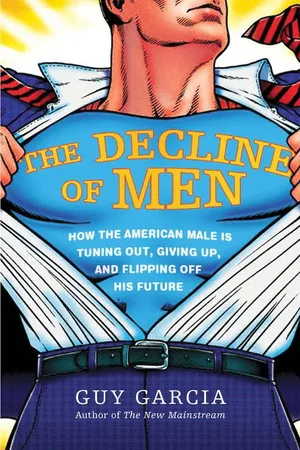
The Decline of Men
How the American Male Is Getting Axed, Giving Up, and Flipping Off His Future
- 320 pages
- English
- ePUB (mobile friendly)
- Available on iOS & Android
eBook - ePub
The Decline of Men
How the American Male Is Getting Axed, Giving Up, and Flipping Off His Future
Trusted by 375,005 students
Access to over 1.5 million titles for a fair monthly price.
Study more efficiently using our study tools.
Information
CHAPTER 1
Samson Shorn
The mood in the sumptuous ballroom at Cipriani Wall Street was exultant. An all-female jazz band had played during the reception, and the crowd of several hundred of New York’s movers and shakers at the “Women Who Make a Difference Gala,” hosted by the National Council for Research on Women, were tucking into their grilled lamb chops and sipping wine, all paid for by the evening’s sponsor, Goldman Sachs. Then it was time for Dina Dublon, a member of the board of directors at PepsiCo, to introduce one of the evening’s honorees: Steve Reinemund, PepsiCo’s chairman. His successor, an Indian-born woman named Indra Nooyi, had just delivered a glowing video testimonial, carried on giant screens throughout the room, and now it was time for Reinemund to get his award. In her introduction, Dublon noted that Reinemund, one of the most powerful and respected men in American business, was the first man to ever receive this award, adding that he was “part of our No Man Left Behind policy.” Reinemund graciously went along with the joke, saying that he was very glad not to be left behind. The mostly female audience laughed appreciatively.
The sad fact, however, is that men—as individuals, as a group, as a gender—are being left behind. Around the table, the suddenly pensive diners traded stories about men they knew who had lost their jobs or their marriages, or both, and were now basically idle, taking up golf or the piano, writing that novel, doing nothing. The women spoke about brothers, sons, nephews, and husbands. “It’s weird how everyone has a story like this,” remarked a female executive from a Fortune 100 company. “There’s definitely something going on.”
What’s going on is a seismic shift in the current status and future of American men that reaches from before the moment of conception until after their death. No one can say exactly when it began, but the change was well under way by the time noted genetics expert Jenny Graves was asked by a reporter from the Australian Broadcasting Corporation if men were heading for extinction.
“The future of the Y chromosome is certainly at risk,” said Graves, a professor of comparative genomics at the Australian National University. “We’ve been looking at the Y chromosome in lots of different animals, so we were able to tell where it came from and where it’s going…. The Y chromosome of course is what makes men men—if you’ve got a Y you’re male. But the Y chromosome’s actually derived from the X. It’s just a pale shadow of its once glorious past as an X chromosome.”
Some 300,000 years ago, when the Y chromosome was equal in length to the X chromosome, it had 1,400 genes on it. Today the Y contains a paltry 45.
The shrinking Y chrome has prompted Graves and other scientists to grimly suggest that the Y chromosome—the genetic code for the male gender—may be gone altogether in around 10 million years. Never mind that in 2003 a forty-person team of scientists led by David Page of the Whitehead Institute at the Massachusetts Institute of Technology reported that the Y chromosome actually has an elaborate backup system with as many as seventy-eight genes, and that it seems to have the ability to morph and grow and quite possibly survive. For researchers like Jenny Graves the demise of the male gene apparently can’t come soon enough. When asked to pinpoint how long it would take the Y chromosome to disappear, she replied: “Now, of course, it could be tomorrow. In fact, there could be…right now there could be a tribe of humans somewhere that have already lost their Y.”
Are Y guys about to become X men? Males may indeed be genetically hardwired to fail, but not for the reason that Professor Graves suggests.
The truth is that men may be doomed, not because of their genes, but because of their brains. Or, to be more precise, the innate biology of males may be increasingly at odds with the modern world that they inhabit. In fact, the very qualities that have helped men succeed for so many years may actually be a contributing factor to their current difficulties.
A growing body of scientific evidence attests that men are chemically predestined to share not only certain gender-specific physical traits but also a host of social, emotional, and behavioral attributes that are so different from those of women as to render them almost a separate species.
The classic male virtues—physical strength, aggression, self-sufficiency, resolve—that were so useful in agrarian and industrial societies, are increasingly out of date in a postmodern world where networking, cooperation, and communication are key. In other words, are men—or at least the traditional ideal of masculinity that has till now defined the American male—in danger of becoming obsolete? Are men at the beginning of a long, downhill slide to oblivion? And is it possible that the slippery slope begins to tilt against them even before they are born, and continues to skew the arc of their entire lives, through an undereducated childhood, an underemployed adulthood, and on to an unnecessarily premature death? As the ground beneath them rumbles and shifts, are men changing too little or too much? And how did they get into this mess in the first place?
THE CHICKEN OR THE EGG?
At the moment of conception, twenty-three chromosomes in the female’s egg are joined by the same number of chromosomes present in the male’s sperm. Forty-four of the chromosomes join up to form the blueprint for an individual’s physical characteristics—height, body type, eye and hair color, and so on. But the last two genes are different—they control gender. The mother’s egg contains a female, or X, chromosome. If the father’s contribution to the egg is another X, the baby will be female (XX). If the father contributes a Y chromosome, the baby will be male (XY). It is the Y chromosome that triggers the release of androgens that begin to shape the body and brain of the fetus into something we will recognize as a boy. Researchers now think that those hormones do much more than cause the development of physical attributes that we all recognize as male. Recent studies have shown that the same hormones that determine gender also have a decisive effect on the development and structure of the brain itself, which in turn shapes the different ways that men and women respond to each other and the world around them.
This new picture of how gender influences brain function and sensory development has profound implications for anyone trying to understand why men and women think and behave the way they do. So how are the brains of men and women different, and why should we care? The second part of that question continues to be a topic of heated social and ethical debate. The first part, while far from conclusive, has become considerably clearer thanks to advances in psychology and neuroscience that suggest our gender plays a bigger role in the way we behave, perceive, and feel than previously suspected.
Most people are aware that the brain is divided into two different parts, or lobes. The left side of the brain is the central processing station for verbal ability, numerical problems, and orderly, logical thought. The right side of the brain is the main engine for abstract ideas, visual perception, and emotions. Conventional wisdom has characterized the left side of the brain as more dispassionate and intellectual—the “male” side of the brain—and the right side as the more emotional and creative “female” lobe. Yet new research paints a considerably more complex picture.
Biologically speaking, all human beings begin as females.
All human embryos begin with a “female” brain. Then, about six weeks after conception, the Y chromosome triggers a flood of male hormones that transform the body and brain in ways that scientists are still trying to sort out. For example, a 1977 study by the Danish scientist Berte Pakkenberg found that men’s brains have around 4 billion more brain cells than a woman’s, yet females score on average about 3 percent higher in general intelligence tests than males. Females also have more gray matter in their frontal cortex, which gives them an advantage when it comes to processing several types of information or analyzing different kinds of situations at the same time. The corpus callosum, a bundle of fibrous nerve cells that straddles the brain’s left and right hemispheres, is thicker and more bulbous in women than in men. Beginning in early childhood, girls as a group are more coordinated than boys and are better at tasks that require fast and nuanced physical movement. Girls also tend to be more articulate and have better communication skills than boys. One reason may be that women process information over a greater area of their brains, allowing them to consider different variables in a more complex way than the opposite sex.
Boys, whose left brains generally grow faster than those of girls, excel at mathematical reasoning, crossword puzzles, and the arrangement of three-dimensional puzzles. Their tendency to process information on one side of their brains enhances their ability to compartmentalize feelings and thoughts and focus on a problem. In their interactions with other people and the physical world, males are, literally, more single-minded than females. Men are also, due to higher levels of testosterone, more likely to exhibit aggressive behavior, even when such behavior is frowned upon or contrary to their own self-interest. Testosterone has been linked to aggressive behavior in both sexes, but it is the much higher amounts of the hormone in males that seems to account for many of the traits historically associated with men.
“The biggest behavioral difference between men and women is the natural, innate aggression of men, which explains to a large degree their historical domination of the species,” assert Anne Moir and David Jessel in their book Brain Sex: The Real Difference Between Men and Women. “Men didn’t learn aggression as one of the tactics of the sex war. We do not teach our boy children to be aggressive—indeed, we try vainly to unteach it. Even researchers most hostile to the acknowledgement of sex differences agree that this is a male feature, and one that cannot be explained by social conditioning.”
To be sure, much of the evidence of what some call “brain gender” is grounded in conventional wisdom: boys are rambunctious and competitive, girls are sensitive and demure. It’s been noted that little boys will gravitate toward trucks and cars without encouragement, and, much to the mortification of their gun-control-favoring parents, will figure out how to make a weapon from Play-Doh or Legos.
But it’s equally obvious that not all men and women fit into traditional sexual stereotypes and that the very definitions of “male” and “female” behavior are increasingly overlapping and blurred. Are young men who date confident, older females acting like women, or just enlightened guys? Were the women who humiliated and abused prisoners at Abu Ghraib acting like men, or just being bad soldiers? Is sexual biology destiny, or are we shaped by our environment and social pressures to behave and conform to the cultural consensus of what it means to be a “woman” or a “man” at any given time? Are gender-bashing feminists out of touch with human nature, or is it the men-are-from-Mars, women-are-from-Venus camp that is in denial of the human ability to morph and evolve beyond our primitive impluses?
The scientific threads of the debate, like the brain itself, are more subtle and tangled than they might at first seem. Male and female brains differ not just in architecture but also in the ways they process information and stimuli.
Because a woman’s brain is better integrated than a man’s, she is more likely to consider all the implications of a decision or action, as opposed to focusing on an immediate or obvious goal.
Men and women also react differently to stress. When confronted by pressure or a crisis, an area in the brain called the amygdala triggers the release of adrenaline and cortisol, which helps us to remember and thus avoid danger. In women, estrogen causes the amygdala to release an extra dose of cortisol, which causes a larger field of neurons to be stimulated for a longer period of time. Another hormone, oxytocin, induces a woman to cultivate and protect alliances and relationships with other people who can help her protect herself and her loved ones; as a result, women are prone to experience stress more intensly than men and to remember it longer.
“Why would we evolve with different methods of coping with stress?” Marianne Legato asks in her book Why Men Never Remember and Women Never Forget. “From an evolutionary perspective, we have had different jobs. Viewed in that light, men’s poor memory for the emotions they had during events loaded with danger makes sense. Let’s say that the survival of our tribe depends on the hunting ability of men. A good emotional memory is hardly advantageous to them: if they remember exactly how cold it was on the last mammoth hunt, how tired they were during the chase, how frightened they were, and how much it hurt when they caught a tusk in the thigh, how enthusiastic are they going to be the next time?”
Indeed. But it’s doubtful they get much consideration for that when their spouse is lambasting them for forgetting to take out the trash.
Those who maintain that men and women are made instead of born got a powerful boost from research showing that experience not only had a profound effect on human behavior but actually changed the brain itself. By studying the way memory affects synapses in the brains of sea slugs and other creatures, Dr. Eric R. Kandel, a professor at Columbia University College of Physicians and Surgeons, revolutionized our understanding of how memory and learning affected the brain. Kandel, who was awarded the 2000 Nobel Prize in Physiology or Medicine for his work, showed that the process of remembering could alter the physical structure of the brain by strengthening and enlarging synapses that connect individual neurons. This revolutionary insight added a new wrinkle to the nature-or-nuture debate: if experience can change our brains, and if our brains in turn determine our perceptions, thoughts, and behaviors, then the potential for human beings to transform themselves is suddenly limitless.
For those who see the blurring and merging of the sexes as a positive and inevitable progression, the implication is obvious: under the right circumstances, men’s brains could, in theory at least, become physically more like a woman’s—and vice versa. For Legato and others, Kandel’s findings have opened the door to an unprecedented bio-merging of the sexes. “If practicing piano changes our brains so that we get better at those skills, might we not be able to change our brains as well by “practicing” the competencies of the other sex?” she asks. “We no longer have to wonder at the vast chasm that separates us: Let us instead take advantage of the brain’s natural plasticity and use it to become more alike.”
It’s a process that may already be under way. A study of more than 1,500 Massachusetts men, reported in the Journal of Clinical Endocrinology and Metabolism in 2007, found a population-wide decline in men’s testosterone levels over the past twenty years.
Testosterone levels have dropped 1.2 percent per year, or about 17 percent overall between 1987 and 2004.
In commentary accompanying the report, Shalender Bhasin, a physician at Boston Medical Center, observed that it would be unwise to dismiss the findings “as mere statistical aberrations because of the potential threat these trends—if confirmed—pose to the survival of the human race and other living residents of our planet.”
Is it any wonder then that many men feel skittish and out of sorts in an increasingly ambisexual world, their very sense of manhood imploding? There’s a TV commercial in which a dressed-for-success Neanderthal glimpses his own image in a museum exhibit; similarly, men find themselves snared in a kind of testosteronic time warp, damned if they do and damned if they don’t, caught between the desire to conform to a gentler, kinder masculinity and a competing urge to swing from the trees and bring home a fresh kill for dinner. At the very least, it’s got to be disconcerting for a fellow to hear that if he just tries a little harder, he can, neurologically speaking, become a woman, too.
“In sport and war, the big fear of men is to be feminized,” Dowd opines in Are Men Necessary? “In the workplace, the big fear of women is to be diabolized. So when a man kids a woman about being castrating, it is never more than half a joke. It’s discouraging. Can men and women ever meet in a place that’s not about sex? It’s enough to make a girl reach for a sharp object.”
Ouch!
Such is the sorry state of the modern man: with saber-toothed tigers and woolly mammoths in short supply, they wander the hostile savannahs of the twenty-first century, under attack in the lab and at the office, ...
Table of contents
- Cover
- Title Page
- Dedication
- Contents
- Epigraph
- Introduction
- Chapter 1
- Chapter 2
- Chapter 3
- Chapter 4
- Chapter 5
- Chapter 6
- Chapter 7
- Chapter 8
- Chapter 9
- Acknowledgments
- Searchable Terms
- About the Author
- Other Books by Guy Garcia
- Credits
- Copyright
- About the Publisher
Frequently asked questions
Yes, you can cancel anytime from the Subscription tab in your account settings on the Perlego website. Your subscription will stay active until the end of your current billing period. Learn how to cancel your subscription
No, books cannot be downloaded as external files, such as PDFs, for use outside of Perlego. However, you can download books within the Perlego app for offline reading on mobile or tablet. Learn how to download books offline
Perlego offers two plans: Essential and Complete
- Essential is ideal for learners and professionals who enjoy exploring a wide range of subjects. Access the Essential Library with 800,000+ trusted titles and best-sellers across business, personal growth, and the humanities. Includes unlimited reading time and Standard Read Aloud voice.
- Complete: Perfect for advanced learners and researchers needing full, unrestricted access. Unlock 1.5M+ books across hundreds of subjects, including academic and specialized titles. The Complete Plan also includes advanced features like Premium Read Aloud and Research Assistant.
We are an online textbook subscription service, where you can get access to an entire online library for less than the price of a single book per month. With over 1.5 million books across 990+ topics, we’ve got you covered! Learn about our mission
Look out for the read-aloud symbol on your next book to see if you can listen to it. The read-aloud tool reads text aloud for you, highlighting the text as it is being read. You can pause it, speed it up and slow it down. Learn more about Read Aloud
Yes! You can use the Perlego app on both iOS and Android devices to read anytime, anywhere — even offline. Perfect for commutes or when you’re on the go.
Please note we cannot support devices running on iOS 13 and Android 7 or earlier. Learn more about using the app
Please note we cannot support devices running on iOS 13 and Android 7 or earlier. Learn more about using the app
Yes, you can access The Decline of Men by Guy Garcia in PDF and/or ePUB format, as well as other popular books in Social Sciences & Social History. We have over 1.5 million books available in our catalogue for you to explore.