Chapter 1
The Great Tree of Life
THE “GREAT TREE OF LIFE” is how Charles Darwin described his metaphor for the origin of species.
“The affinities of all the beings of the same class have sometimes been represented by a great tree…The green and budding twigs may represent existing species; and those produced during each former year may represent the long succession of extinct species. At each period of growth all the growing twigs have tried to branch out on all sides, and to overtop and kill the surrounding twigs and branches, in the same manner as species and groups of species have tried to overmaster other species in the great battle for life.”
How do new branches arise? By divergence of existing branches. How do new species arise? By divergence of existing species.
When he was just twenty-eight years old, Charles Darwin jotted down his view of nature in his notebook: “If we choose to let conjecture run wild, then animals, our fellow brethren in pain, disease, suffering and famine—our slaves in the most laborious works, our companions in our amusements—they may partake of our origin in one common ancestor—we may be all melted together.”
Melted together, looking backward but spread apart and diverging, looking forward.
The Great Tree of Products and Services
In the “great tree of products and services,” how do new categories arise? By divergence of existing categories.
- First there was a branch called computer. Today that computer branch has diverged and now we have mainframe computers, midrange computers, network computers, personal computers, laptop computers, and handheld computers. The computer didn’t converge with another technology. It diverged.
- First there was a branch called television. Today that television branch has diverged and now we have analog and digital television. Regular and high-definition television. Standard (4/3) and wide-screen (16/9) formats. Television didn’t converge with another medium. It diverged.
- First there was a branch called radio. Today that radio branch has diverged and now we have portable radios, car radios, wearable radios, and clock radios. Radio didn’t converge with another medium. It diverged.
- First there was a branch called telephone. Today that telephone branch has diverged and now we have regular telephones, cordless telephones, headset phones, cellphones, and satellite phones. The telephone didn’t converge with another technology. It diverged.
Did you ever see a tree in which two branches converged to form a single branch? Perhaps, but this is highly unlikely in nature. It’s also highly unlikely in products and services.
Some Categories Live. Some Categories Die.
Darwin explains: “Of the many twigs which flourished when the tree was a mere bush, only two or three, now grown into great branches, yet survive and bear all the other branches; so with the species which lived during long-past geological periods, very few now have living and modified descendants. From the first growth of the tree, many a limb and branch has decayed and dropped off; and these lost branches of various sizes may represent those whole orders, families, and genera which have now no living representatives, and which are known to us only from having been found in a fossil state.”
A branch called typewriter, for example, diverged and formed multiple branches called manual typewriter, portable typewriter, and electric typewriter. Today the typewriter branch has decayed and is about to drop off, overshadowed by a nearby branch called personal computer.
The typewriter is a dinosaur. Today you find most typewriters, slide rules, and adding machines only in a fossil state. That is, in somebody’s basement or attic and possibly listed on eBay. (Ebay recently had 1,314 typewriters for sale.)
The sailing ship, the steam engine, and the horse and buggy have all followed similar paths.
The Great Tree of Brands
If you want to build a successful brand, you have to understand divergence. You have to look for opportunities to create new categories by divergence of existing categories. And then you have to become the first brand in this emerging new category.
In the “great tree of brands,” a successful brand is one that dominates an emerging branch and then becomes increasingly successful as the branch itself expands to block the sunlight from nearby branches.
Traditional marketing is not focused on creating new categories. Traditional marketing is focused on creating new customers. Traditional marketing involves finding out what consumers want and then giving them what they want, better and cheaper than the competition.
The high priest of a traditional-marketing company is the director of marketing research. To find out what consumers want, companies spend lavishly on research. In a recent year, American companies spent $6.2 billion on marketing research.
(If you’ve read some of our previous books, you know that we are big believers in public relations, yet PR is only a $4.2-billion business, a third less than marketing research.)
Are We Opposed to Marketing Research?
Yes and no. We’re opposed to market research when it attempts to predict the future. This happens when you ask consumers what they will do rather than what they have done.
We’re not opposed to market research that explores the past. Why consumers chose the brands they did, for example.
Consumers don’t know what they will do until they are actually given the opportunity to make a decision. Another way of looking at the situation is that categories don’t diverge until there is an available brand for consumers to purchase.
Today, four out of the five best-selling beer brands are light beers. Before the 1975 national launch of Lite beer, what good would it have done Miller Brewing to ask consumers if they would buy a watered-down beer? As a matter of fact, the 1967 launch of Gablinger’s should have answered that question with a resounding no.
Named after the Swiss chemist who developed the beer (Hersch Gablinger), the new light-beer product was launched with a massive advertising program. It was all for naught. Gablinger’s died a quick death.
The Role of the Name
Why was Lite successful and Gablinger’s not? One reason is the name. “Give me a Gablinger’s”? Sounds like you’re asking for a Polish sausage. If you are going to invent a new type of beer, make sure you have a nice German name like Adolph Coors or August Busch.
Names don’t matter, many managers believe; it’s the product that matters. With the right product at the right price, goes the thinking, we can win the battle of the marketplace.
Names do matter. Depending on the category, the name alone can represent the primary reason for the brand’s success.
A company might spend hundreds of millions of dollars to develop a new product and then give that new product a brand name that almost guarantees failure. Innovation alone is never enough.
Along with innovation, a company needs marketing to assure the brand’s eventual success and survival. The heart of a good marketing program is a great name.
If marketing research is a useless tool for predicting consumer behavior, how can a company figure out what might happen to a new brand in the marketplace?
The Role of Test Marketing
What about another component of traditional marketing, test marketing? Should a new product be tested in a regional or local market before a national introduction?
Test marketing has some benefits, but we believe the negatives far outweigh the benefits. Some of the negatives include:
WASTED TIME. You can’t afford to waste the time that test marketing takes, especially since the essence of branding is getting into the mind first.
TIPPING OFF THE COMPETITION. Test marketing will alert competitors and perhaps stimulate one or more of them to introduce similar products.
UNPROJECTABLE RESULTS. Test marketing for Enamelon toothpaste projected $50 million in annual sales nationally. Actual sales: $10 million.
One of the problems with test marketing is overstimulation of demand. To get enough tangible results to measure, you usually have to run a local marketing program that you can’t afford to run nationwide.
Most test marketing is not done to make a go/no-go decision. Most test marketing is done to measure the effectiveness of the brand’s advertising. And since you shouldn’t do much, if any, advertising in launching a brand, the value of test marketing is greatly reduced. (See chapter 16, “Launching the Brand.”)
Launching a new product the traditional way includes market research, test marketing, and a big advertising budget. We are opposed to all three of these activities.
If you want to improve your odds, you need to forget all you have learned about traditional marketing. You need a new theory of how to build a brand.
You need to learn the Darwinian principle of divergence.
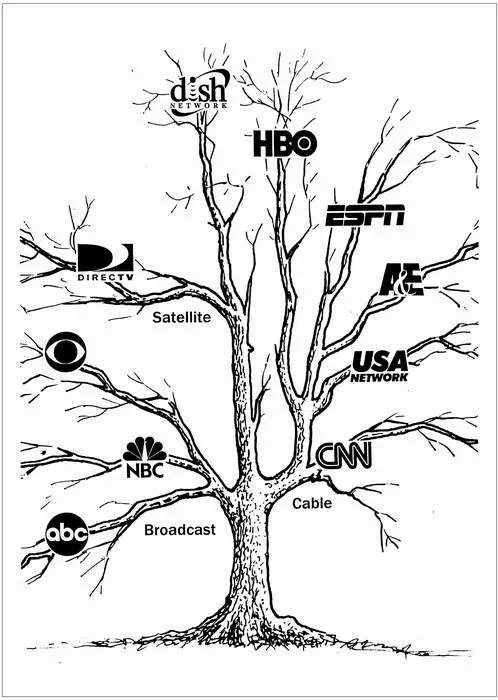
BROADCAST TELEVISION BRANCHED OUT INTO CABLE TV AND SATELLITE TV, CREATING MANY NEW BRANDING OPPORTUNITIES.
Chapter 2
Predicting the Future
CHARLES DARWIN WAS A VISIONARY. He could see effects that took place over millions of years even though these effects couldn’t be directly observed in the real world.
In The Origin of Species, Darwin describes how natural selection gradually increases the number of species that populate the earth:
“This gradual increase in number of the species of a group is strictly conformable with the theory, for the species of the same genus, and the genera of the same family, can increase only slowly and progressively; the process of modification and the production of a number of allied forms necessarily being a slow and gradual process,—one species first giving rise to two or three varieties, these being slowly converted into species, which in their turn produce by equally slow steps other varieties and species, and so on, like the branching of a great tree from a single stem, till the group becomes large.”
It’s easier for us. We can see the evolution of brands because the process is taking place right in front of our face. Everywhere you look, you see the same thing: categories are evolving and diverging.
In nature, changes in the environment create the conditions that cause species to diverge. In business, changes in technology and in the cultural environment create the conditions that cause categories to diverge.
The Television Tree
First there was broadcast television, which allowed the creation of three network TV brands: CBS, NBC, and ABC. Then cable television emerged and a proliferation of cable TV brands followed: HBO, ESPN, CNN, and many others. Then satellite television arrived on the scene, creating opportunities for DirecTV and the Dish Network.
Put yourself in the shoes of an executive of a company wanting to get into television just as cable TV was emerging. On the one hand, broadcast television, with three networks, was generating hundreds of millions of dollars in revenues. On the other hand, cable television had near-zero revenues and an uncertain future.
Where Does Opportunity Lie?
Are you better off trying to take a piece of an established market like network TV or are you better off trying to establish a new brand in an uncertain new category like cable TV?
Hindsight is twenty-twenty. Today the answer to the question is cable TV, but that wasn’t so obvious back in 1968 when the FCC first authorized pay-cable transmission.
- It wasn’t ABC, CBS, or NBC that started CNN, the first cable-television news network. It was billboard tycoon Ted Turner, who also put the first local TV station on a satellite creating “superstation” WTBS.
- It wasn’t ABC, CBS, or NBC that started ESPN, the first cable-television sports network. It was Scott Rasmussen and his father, Bill Rasmussen, who launched ESPN with a $9,000 cash advance on a credit card.
- It wasn’t ABC, CBS, or NBC that started HBO, the first premium cable television network. It was Charles Dolan, the man running Sterling Manhattan, a cable system controlled by Time Inc. (Dolan moved on to found Cablevision Systems, now the nation’s fifth-largest cable operator.)
Now part of Time Warner, HBO has become a massive moneymaker. In a recent year, for example, HBO was reported to have made more money than ABC, CBS, NBC, and Fox put together.
And so it goes. Big companies tend to see things the way they are. Entrepreneurs tend to see things the way they could be.
Improving Your Foresight
Forget hindsight. This book was written to improve your foresight. To show you that you don’t need to be a visionary to predict the future.
All categories will diverge. They always have and they always will. It’s this divergence that creates opportunities for new brands. What dir...