An "inside look at a major player in the saga of American enterprise" and its legendarily successful corporate culture (
Publishers Weekly).
IBM is one of the greatest sales and marketing organizations ever assembled. Established over a century ago, it now employs more than a quarter million people and generates $60 billion a year in revenue. Yet it operates more like a cottage industry than a huge multinational organization.
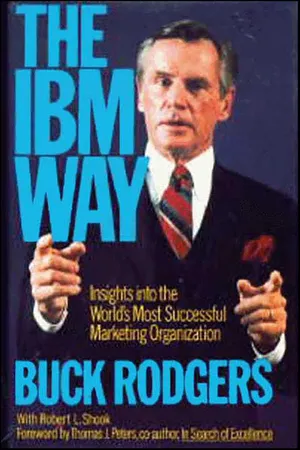
How does IBM do it? That's what even the most successful companies want to know. In this book, Buck Rodgers, a retired executive who personified "the IBM way," describes for the first time the reasons behind its extraordinary achievements. He has not written a company history, or an exposé, or a book on management theory. He has written a book about everything that makes IBM IBM, as only an insider could.
eBook - ePub
The IBM Way
Insights into the World's Most Successful Marketing Organization
- 256 pages
- English
- ePUB (mobile friendly)
- Available on iOS & Android
eBook - ePub
The IBM Way
Insights into the World's Most Successful Marketing Organization
About this book
Information
Subtopic
Business GeneralIndex
Business1
A BUSINESS AND ITS BELIEFS
The only sacred cow in an organization is its principles.
With more than 400,000 employees, annual sales that exceed $50 billion, and offices in almost every country in the world, IBM can be mind-boggling in its vastness, fascinating in its accomplishments. But to appreciate this business phenomenon, you must understand its corporate attitudes, feelings and behavior. Some people may have difficulty imagining that a corporation the size of IBM has humanistic characteristics, but it does. And I’m convinced that it’s these very human qualities that are responsible for IBM’s incredible success.
I don’t know how many companies have actually had a code of behavior articulated for them, but that’s what Thomas J. Watson, Sr., did for IBM when he founded it in 1914. Like any ambitious entrepreneur, he wanted his company to be financially successful, but he also wanted it to reflect some of his personal values. These values, which he put down on paper, became the foundation for his new company; and anyone who worked I for him thereafter knew exactly what Tom, Sr.’s, company was all about.
Watson’s tenets, which were reaffirmed by his son, Thomas Watson, Jr., in 1956, when he became IBM’s second CEO, are uncomplicated and can be easily understood by everyone From the CEO’s office to the mailroom. They are:
1. The individual must be respected.
2. The customer must be given the best possible service.
3. Excellence and superior performance must be pursued.
These commitments, which remain at the heart of the company’s operation, are so revered and encompassing that every action and policy is directly influenced by them. I think that anyone who studies the development of IBM will agree that Watson’s philosophy has more to do with the company’s success than do its technological innovations, marketing skills or financial resources. IBM doesn’t have a patent on corporate values, principles and philosophies. However, I don’t think any company can become great without them. Principles, though, can quickly become empty slogans. They’re like muscles that turn soft and weak if they’re not exercised regularly. To be important in a business environment, principles must first be clearly understood by everyone in management. They must be articulated to every employee, repeated so often that everyone understands just how seriously they are to be taken. IBM conscientiously drives home its philosophical messages at meetings, in internal publications and memos, at company gatherings and in private conversations. None of this would mean anything, of course, if IBM’s management did not demonstrate, by personal deeds and actions, what these beliefs mean. It requires diligence, but it works. Employees understand that not only the company’s success is dependent upon their faithful adherence to Tom Watson’s principles; but so is their personal success. And that means all of IBM’s employees. It takes time, but once your people believe you, every facet of your business is positively affected.
THE FIRST COMMITMENT
The individual must be respected. No one can be against this. At least, no one would admit to it.
After all, respecting the rights and dignity of the individual has been advocated by many cultures and religions throughout history. But while almost everybody agrees with the idea, seldom is it found in the doctrine of a business, let alone practiced. Of course, IBM isn’t the only company that advocates this, but not enough companies do.
Far too many employers abuse their employees. They may demean them by overtly outrageous actions or they may chip away at their self-esteem subtly and covertly; often, they look the other way while their supervisors and managers do the dirty work. Such behavior bothered Tom Watson, Sr., as it bothers some of us today. He couldn’t solve the problem universally, but he could do something about it in his own company. He truly wanted the people who worked for him to feel good about themselves and their work. No one could be paid enough money to be compensated for being made uncomfortable and unhappy by his supervisors.
Tom, Sr., was particularly intent on building the self-respect and self-confidence of his marketing reps. For years, when he was a salesman in the field, he may have suffered from low esteem. Those were the days of the “drummer,1‘ and selling was not a respected career—especially traveling salesman.
He said, “I want the IBM salesmen to be looked up to. Admired. I want their wives and children to be proud of them. I don’t want their mothers to feel that they have to apologize for them when asked what their sons are doing.’’
His early emphasis on human relations was not motivated by altruism alone, but as Tom Watson, Jr., put it, “by the simple belief that if we respected our people and helped them respect themselves, the company would certainly profit.’’
The Watsons understood that people, not money or things, are a company’s greatest asset. Ever since IBM’s earliest days, an ongoing campaign has stressed that each individual makes a difference. So that nobody feels like a number, the company tries to create a small-business atmosphere. Branch affices are kept small, and the company is pretty successful at maintaining a one-to-twelve manager-to-employee ratio. All managers understand the value of job satisfaction, and the need to motivate their people continually. Superior performances are rewarded by recognition, promotions and money. Compensation will be discussed fully in a later chapter, but I’ll say here that there are no automatic raises for IBMers, no cost-of-living increases—and it’s possible for a fairly new marketing rep to earn more than one who has been with the company for many years. Each person gets paid on the basis of what he produces, not on his longevity. Those who do exceptionally well are paid accordingly.
Since IBM opened its doors, the company has had a full-employment tradition. This is as true today, with nearly 400,000 employees, as it was when there were only hundreds of people in the company. An employee who produces always has an assignment, preferably a meaningful one. In nearly fifty years, no person employed on a regular basis has lost as much as one hour of working time because of a layoff. Like all businesses, IBM has had its share of difficult times. It has taken careful planning and commitment to maintain full employment. Perhaps the most dramatic way to help achieve this is through retraining, which often requires career changes and/ or relocation. For example, during the economically troubled years 1969-72, more than twelve thousand IBM employees moved from plants, labs and headquarters with light workloads to locations where they were needed. More than five thousand employees were retrained for new careers in sales, customer engineering, field administration and programming. Most ended up with comparable or better jobs.
Again, in 1975, during the severe recession, nearly 3,800 employees were placed in new positions to balance a workload. It cost a lot of money, but it was important. This doesn’t mean the company is benevolent and paternalistic to the degree that nobody has ever been terminated. People are dismissed for poor performance, usually early in their career. IBM couldn’t afford to spend so much to reward the good performers if it had to subsidize those who do not produce.
Productive people need challenging assignments. It’s vital for them to go home at night feeling that they did something worthwhile. And when they enjoy their work and know the company cares about them, they want to contribute to its growth.
IBM’s practice is to promote people from within. In all my years with the company, I recall only three executives— all in highly specialized fields—who were brought in from the outside. Everyone knows that if he works hard and aspires to a higher position, he will have an opportunity to advance. It’s frustrating and demoralizing for an ambitious person to work his tail off, striving for a certain job, only to have someone from the outside come in and get it. I know the argument that promoting only from within can lead to inbreeding, but I don’t accept it. The negative effect that bringing in outsiders has on morale far outweighs the hazards of inbreeding.
IBM has many programs to let a person know he or she can make a difference, and I’ll discuss a few of them later. But there is a host of little things that you might notice at IBM headquarters in Armonk, New York. For instance, there are no titles on any doors or desks, no bathrooms designed for “executive use only,” no reserved parking spaces, no executive dining room. All in all, it’s a very democratic environment, where everyone is treated with the same respect. Even IBM’s equal opportunity policy and affirmative action programs go far beyond government guidelines. In fact, the company’s minority population equals or exceeds the minority percentage mix of the U.S. population.
IBM strives to be a responsible corporate citizen. From a dollar perspective, the company’s 1984 contributions to social, cultural and educational programs exceeded $145 million. IBM’s attitude toward the individual extends far beyond company headquarters. Management treats everyone who works
at IBM with respect and, in turn, expects everyone to treat customers, suppliers and even the competition the same way. The company’s code of conduct states that no IBMer shall disparage any competitor; that selling must be done on the merits of products and services: sell strengths and never try to exploit someone else’s weaknesses. The code also advises not to boast about the company’s size, success or position in the industry; or about how much is spent on research and product development; or about how many systems engineers there are to work with customers. It’s all right to talk about the quality of IBM’s products or services, the resources and people that represent a commitment to the customer and the concept of excellence. It’s O.K. for a rep to tell the customer about an IBM educational facility that is staffed and equipped to give him the best possible service. That’s not boasting of bigness; it’s a fact and it’s relevant to the customer’s needs.
The Watsons believed that when one respects the individual one shows consideration for all people—in and out of the company. And that belief must be reinforced constantly by one’s actions.
The first time I met Tom Watson, Jr., I quickly learned that he practiced what he preached. I was new to the company and completing the final sales training program at the sales school in Poughkeepsie, New York. Although I was happy and excited about getting an opportunity to work for IBM, I was at the same time under considerable personal strain. My wife was pregnant and expecting to deliver at any moment. Though we had agreed that I must complete this initial phase of my training, no matter what, I was having second thoughts. I wanted to be with Helen, but I was afraid to ask for the time aff—especially since I didn’t know exactly when the baby would be born. It could be happening right now, it could be :omorrow or next week—or longer.
Watson spoke to the class, and when he was finished he moved around the room, chatting with the trainees. I was wondering if I had time to call home, when he approached me.
“How are things going? What’s happening?”
Well, he asked so I told him. I hadn’t got the words out of my mouth when he interrupted.
“What are you doing here? You should be home with your wife. Get on a plane and get back to Ohio immediately.”
Within the next few minutes, IBM’s CEO made arrangements for this trainee to get to Cleveland, and I was airborne that same afternoon.
In the lectures, I heard a lot about respect for the individual, but the message was made crystal clear when Watson demonstrated how he placed my family and personal worth above the business.
Among the flowers that were delivered to the hospital room after the arrival of my daughter was a beautiful arrangement from Tom Watson.
“Do we know him?” Helen asked.
In 1969, I wrote to the twenty-eight thousand people in my division:
Respect for the individual is not a platitude. It is a constant in IBM, the initial belief on which our business was founded. Its effectiveness depends entirely on the extent to which it is encouraged by every manager in this company, and practiced by every employee.
But respect for the individual can become a platitude, if it is not continually reemphasized and consciously made a part of our day-to-day business relationships.
The dramatic changes of our business increase rather than diminish our need to respect one another.
THE SECOND COMMITMENT
Customer Service. When Tom Watson, Sr., said that he wanted IBM to provide the best service in the world, he referred to service by any company, not just in his own industry. To accomplish this, he mandated that IBM would be a customer-oriented company. That is, every part of its operation would focus on the customers’ requirements. Every employee’s job description is somehow related to IBM’s goal of providing customers, prospects and vendors with the best possible service.
It’s a shame, but in America today when we get good service we are surprised by it. People don’t expect it, they don’t demand it, and they settle for a lot less than they should. When customers are first exposed to IBM’s brand of service, they are usually taken aback. But it’s easy to get used to the kind of treatment that makes you feel important. And every customer with every company should be made to feel that way.
To let the customer know how important he is, IBM tries to respond to, if not resolve, any complaint within twenty-four hours of its receipt. When a customer requests a service call, the response is even quicker—frequentiy within the hour. Similarly, IBM has introduced more efficient ways of providing service to its customers. IBM specialists are available via toll-free numbers to solve service and software problems over the phone. Lower-priced carry-in and mail-in service agreements have been added to give customers a wider range of choices. [n addition, IBM has established guidelines requiring that each new IBM product be superior in quality to the one it replaces, and to comparable products in the marketplace. IBM strives to provide its customers with superior products and service.
The quality of its service depends upon an organization’s training and educational capabilities. In this area, IBM believes that it has made the largest financial commitment of any company in the world. Its training and educational programs are unparalleled in business. The hours logged in the classroom are believed to exceed those spent in any major university. Each year, every IBM manager is given forty hours of training, and that extends down through the organization. Even customers are routinely invited to participate in a variety of classroom programs. In an industry where repeat business is essential for long-term growth, it is essential to make sure that the initial order is only the beginning. Outstanding service is what keeps bringing the customer back to do more business.
THE THIRD COMMITMENT
Watson’s third mandate is excellence—the pursuit of all tasks with the idea that they can be accomplished in a superior fashion. The constant goal is zero defects, in product and service. Though Watson of course knew that perfection is never possible, to aim for less would lower expectations and weaken his program. In its striving for the impossible, the company established certain satisfaction indexes so it could regularly sample the marketplace to establish the quality of its service. More about that later.
Excellence begins with the recruiting program. IBM believes that the best students selected from the nation’s best colleges may be the most responsive to the company’s intensive training program and the most highly motivated to do superior work. So a lot more is involved than simply attracting the outstanding young people. To achieve excellence, they need superior training and must feel compelled to succeed. At IBM, a highly competitive environment creates an atmosphere that nurtures excellence. Needless to say, a great deal of peer pressure exists. Nobody owns a job at D3M. With the intensity of competition and the continual emphasis on education, there’s no room for individual complacency. The insistence on peak performance sets a rigid pace. People begin to think that anything can be achieved—that anything is possible. That attitude generates excitement. You feel it in the air.
When an organization demands and gets excellence from its people, the excitement eventually becomes contagious. Its customers, too, become optimistic and enthusiastic, and think: “This is the kind of organization I want to do business with.”
THE ONLY SACRED COW
Tom Watson, Jr., said: “For any organization to survive and achieve success, there must be a sound set of principles on which it bases all of its policies and actions. But more important is its faithful adherence to those principles.” Does Watson’s credo hold up in times of change?
In business, everything about an organization’s operation is subject to change. Locations change. People change. Products change. (IBM originally manufactured butcher scales and ti...
Table of contents
- Cover
- Title Page
- Dedication
- Contents
- Foreword By Thomas J. Peters
- INTRODUCTION
- 1. A BUSINESS AND ITS BELIEFS
- 2. LEADEBSHIP
- 3. CBEATING A TOTALLY SALES-OBIENTED ENVIBONMENT
- 4. BUILDING A SUPERIOR MARKETING ORGANIZATION
- 5. FUTURE-ORIENTED MARKETING
- 6. SOLUTION-MINDED SELLING
- 7. BEING RESPONSIVE TO THE CUSTOMER
- 8. SERVICE, SERVICE, SERVICE … AND MORE SERVICE
- 9. MEASUREMENT AND COMPENSATION
- 10. THE ENTREPRENEURIAL SPIRIT
- Appendix: Excerpts from IBM’s “Business Conduct Guidelines’
- Index
- ACKNOWLEDGMENTS
- SPECIAL ACKNOWLEDGMENT
- SOME FINAL THOUGHTS
- Copyright
- About the Publisher
Trusted by 375,005 students
Access to over 1.5 million titles for a fair monthly price.
Study more efficiently using our study tools.
Frequently asked questions
Yes, you can cancel anytime from the Subscription tab in your account settings on the Perlego website. Your subscription will stay active until the end of your current billing period. Learn how to cancel your subscription
No, books cannot be downloaded as external files, such as PDFs, for use outside of Perlego. However, you can download books within the Perlego app for offline reading on mobile or tablet. Learn how to download books offline
We are an online textbook subscription service, where you can get access to an entire online library for less than the price of a single book per month. With over 1.5 million books across 990+ topics, we’ve got you covered! Learn about our mission
Look out for the read-aloud symbol on your next book to see if you can listen to it. The read-aloud tool reads text aloud for you, highlighting the text as it is being read. You can pause it, speed it up and slow it down. Learn more about Read Aloud
Yes! You can use the Perlego app on both iOS and Android devices to read anytime, anywhere — even offline. Perfect for commutes or when you’re on the go.
Please note we cannot support devices running on iOS 13 and Android 7 or earlier. Learn more about using the app
Please note we cannot support devices running on iOS 13 and Android 7 or earlier. Learn more about using the app
Yes, you can access The IBM Way by Buck Rodgers,Robert L. Shook in PDF and/or ePUB format, as well as other popular books in Business & Business General. We have over 1.5 million books available in our catalogue for you to explore.