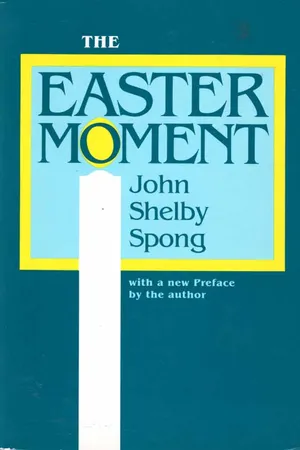
The Easter Moment tells the moving story of Spong's friendship with a young physician dying of cancer and how that relationship shed new light on the years of study the author has devoted to the great mystery of what actually happened on that long-ago Easter when the whole history of the human race was changed. Spong is willing to ask tough and searching questions and to come up with startling and significant answers to what happened after death that first fateful Easter, and what that means for thinking about life after death today.
- English
- ePUB (mobile friendly)
- Available on iOS & Android
eBook - ePub
The Easter Moment
About this book
Information
Topic
Theology & ReligionSubtopic
BiblesPart I
A Personal Witness
Chapter 1
An Autobiographical Word
Is it possible to believe that Easter is real? Can a child of the twentieth century with any integrity be a part of a community of faith that rests on the affirmation that one named Jesus of Nazareth some two thousand years ago did, in fact, break the power of death? Can it be asserted today with any credibility that there is life after death? Or are these but fond hopes and pious dreams that emotionally weak people create because they cannot tolerate the vision of nothingness that death seems to be?
I am a Christian. I do not believe it is possible to be a Christian without saying yes to Easter, yes to resurrection, and yes to life after death. I am also a person who has been shaped and formed by my generation. I am the product of the evangelical Bible Belt of the South in whose fundamentalist tradition no miracle of the Bible is too spectacular to be accepted on faith. But in my life that religious heritage has been challenged, eroded, and finally abandoned under pressure from the secular spirit of modern education, the scientific revolution, and the pervasive skepticism of my age. I constantly struggle to shape the form of those things I passionately believe so that I can meet head-on the doubt that my generation constantly engenders.
The result of this attempt on my part to bridge these two worlds is frequently that the defender of the faith types are not certain that I believe enough, while the modern, religiously emancipated types are quite certain that I am a naïve, old-fashioned believer who only pretends to be part of the twentieth century. I see myself, not surprisingly, as in neither camp. Rather, I believe I am one who is convinced of the truth of the Christian faith, but I am also convinced that this truth lies beyond the religious forms that we use in our attempt to convey that truth. I cannot literalize any of those forms, whether they be the Bible, the creeds, or the sacred traditions.
To illustrate this, let me state that I believe in the reality of God. That is the personal center of my deepest conviction. But I think every attempt to define what we mean by God is finally inadequate and must be seen as such by its adherents. (Some attempts are more inadequate than others.) I believe that in the life of Jesus of Nazareth God has uniquely and decisively entered human history, but I do not believe a definitive Christology has yet been formulated. Even the Chalcedonian formula1, which is the definitive Christological formula, says more about who the Christ is not than about who the Christ is. Chalcedon really set the parameters within which the Christological debate could be waged.
Finally, as this book will reveal, I believe that the Moment of Easter was real. I am convinced that Jesus tested the ultimate human barrier of death and penetrated it in a way that not only affects me but is decisivefor me. Yet, I am also certain that the words we use to describe that Moment are woefully inadequate vehicles to convey the wonder and the power to which they point. When analyzing the theological forms and the biblical narratives, I can be as skeptical as anyone. When I get past those forms and narratives and experience the reality to which they point, I can be as rhapsodic as any believer. This is a delicate but all-important distinction.
My life experience in the priesthood has convinced me that the church does not take seriously enough the doubts, fears, and questions of lay people. The church acts so often as if we are still in the thirteenth century, when only the priest was educated and all of the lay people were willing to believe on the authority of the church alone. In the thirteenth century the priest would tell the people what to believe, and they would respond by believing it. Many a clergyman today tries to play the same game. This may seem like a caricature, but it is accurate more times than I would like to believe.
The cumulative result is that the more educated the laity, the more the church has faded as a major factor in the intellectual life of Western civilization. The issues that theologians debate hardly cause a ripple in the secular city unless they relate to a current secular issue such as the women’s movement or the sexual revolution.
The churches that I have served as rector and the diocese that I now serve as bishop have been willing to be something different. They have opted for a searching, probing theological journey. They have encouraged doubt that delves beneath the surface, questions that cry out to be answered. They have beenplaces where the deepest scholarship that is Christian has interacted with scholarship from other disciplines in a relentless search for truth.
When the vocation to journey theologically into the exciting and insecure unknown is grasped by the church, the response has always been incredible. Belief that emerges at the end of an honest inquiry has an integrity that the old authoritarianism never possessed. But when one allows doubt or heresy to be articulated inside the community of faith, one must be prepared to listen to the threat levels of those who cannot deal with uncertainty. It will be loud and frequent.
I can give my personal testimony that for me the rewards of this kind of searching openness have been deeply enriching. I can honestly say that the more I probe the Christian story, the more deeply I believe it to be true. There have been for me moments of sheer ecstasy in my pilgrimage. Sight has faded into insight, and insight into new vision. Conviction has grown about things that are essential, while external things have fallen aside.
Nothing has ever captured my attention more deeply than the Moment of Easter. Death entered my life early. My grandfather died when I was three. I asked for an explanation, and my mother’s response was filled with her natural piety and literal images of heaven. It was not her intention, I am certain, but her explanation filled me with more fear than faith; for the God she sought to portray as a kind, heavenly Father came across as a capricious authority figure who snatched away little boys’ grandfathers out of his need for companionship. This experience merely heightened my sense that somehow this God must be placated and obeyed. Why this God should be loved I could not imagine.
When I was twelve my father died. So little was he involved in church that his funeral was held at home. I was not allowed to go. Somehow the experience was thought to be too difficult for me. Once again, my mother’s desire to protect me had exactly the opposite effect. My vision of death was filled with a fearful and negative mystery. My own feelings about my father’s death were never dealt with by anyone. Again, I got pious platitudes that begged above all not to be questioned, for they were offered with a kind of sentimentality that betrayed the embarrassment of phoniness. I had begun that inevitable process of adolescent rebellion, and my relationship with my father was far from satisfactory at that moment. His death only filled me with unresolved guilt and unanswered questions that I would deal with unconsciously in my behavior patterns and personality development for years. The fact that I made these things conscious in psychotherapy years later gave me insight but unfortunately not freedom from many of the debilitations and scars of that death experience.
My next confrontation with death did not come until shortly after ordination, when I began to realize existentially that a major portion of my newly chosen profession was to deal with death and dying. Despite some training in pastoral theology, it all seemed academic until the time came to plan my first funeral service. Then it became painfully obvious that I needed to be honest about what I believed and to act upon that belief with integrity. I could not parrot empty theological clichés or meaningless pious words. These empty gestures had never meant anything to me and I had no reason to think they would be meaningful to anyone else. I had to know what I believed, and I had to believe whatever I said. My life as a priest demanded that I search as deeply as I could into the meaning of life after death.
I was discovering the remarkable fact that for my pastoral ministry it was the Easter Moment that loomed as all-important. The critical moment in the entire Christian faith had now emerged as the critical moment in my own personal pastoral ministry. The realization of this fact meant that I had to devote my time to an exploration of that moment. I have done so for twenty-five years now. This book is the fruit of that study.
There were some high points in the pilgrimage. In 1957 when I was a young priest, I was invited to join the summer staff at Kanuga, the major Episcopal conference center in the South. Kanuga is located in the beautiful pine-covered mountains of western North Carolina. The keynote speaker for the adult conference that summer was the dean of the Theological Seminary of the University of the South at Sewanee, Tennessee, George M. Alexander, a man who was later to become the Bishop of Upper South Carolina and my good friend. At the last minute an emergency prevented Dean Alexander from attending, and I was asked to fill in as his substitute. The material I had already prepared for a small seminar at Kanuga became the major lectures at the conference. Each day that week, for the first time publicly, I shared my thoughts on the Resurrection.
The response was enormously encouraging. It was my first major lecture experience, and the response convinced me that the subject of resurrection and life after death touched chords deep in the psyche of every person. This encouraged me to dig deeper and deeper into this subject.
I began to search for books that would illumine thisarea of my life and faith. There were surprisingly few, enabling me to read every one I could find. More often than not they were not helpful. When written by believers, they tried to prove too much. When written by nonbelievers, they seemed content with too little. However, I poured my most creative energies into my study of the Resurrection.
In 1968 I took a mini-sabbatical from my parish duties in Lynchburg, Virginia, and went to Yale. There I worked in the Divinity School library exclusively on the subject of the Resurrection—probing, searching out leads, driving ever deeper into and beyond the scriptures. And there I first discovered the writings of Wolfhart Pannenberg, and at that moment his was the best voice I heard speaking on the subject. But that opinion did not last, for I came to find Pannenburg almost too literal, too historic. If Easter had been as he suggested, then there was no reason why all people did not acknowledge Jesus as risen and worship him as Lord. Since obviously they did not, why were they unconvinced?
While serving as rector of St. Paul’s Church in Richmond, two new books came to my attention and forced me to redo all of my resurrection material in the light of what I learned from them. These were Norman Perrin’s remarkable little book, The Resurrection Tradition in Matthew, Mark, and Luke, and Reginald Fuller’s brilliant work, The Formation of the Resurrection Narratives. Both books opened many doors for me, through which I walked quite eagerly. I did a new sermon series in Richmond during the Easter season of 1974 in which these fresh learnings were incorporated. Another step towards this book had been taken. It was still not enough.
The next step was my relationship with Dr. James Campbell, which I shall discuss in detail in the next chapter. Suffice it to say here that dealing with this man and his death forced me to filter everything I had learned intellectually into the reality of human experience. The circle was almost complete.
In 1976 I was elected bishop, and in the spring of 1977 I was asked to deliver a lecture series to the clergy of the Diocese of Newark on the subject of “The Resurrection.” I accepted and brought this lifetime of study to a new level of both intensity and preparation. Since that time I have led the clergy conferences in two other dioceses and conducted teaching missions in five congregations with lay people on this subject. I have also been blessed with another treasured book, Hans Küng’s On Being a Christian. This book has served to confirm and validate much of my pilgrimage. His insights into the Resurrection deepened and clarified my own. At least I felt ready to share my years of study on this subject.
My search will not end here. This book will be offered to the church at large, and in reaction I will learn more, and my thought may deepen or even change. But even if the way I understand or articulate the meaning of Easter changes, I do believe I have touched a reality and experienced a moment that will not change. In this volume I will seek to lead my reader to that reality beyond my words and my concepts.
I invite you to journey into that Easter Moment. I will be your guide as far as I can go.
Chapter 2
A Look through Death
This will be a personal volume, for beyond all my study it was the life and death of a person that brought this book together for me. His name was Jim Campbell. Because I knew Jim, I had a new way of looking at Jesus and new eyes to begin to see the meaning of resurrection. To share with my readers my understanding of the Easter Moment demands that I also share the story of Jim Campbell.
I have been a privileged man, privileged to know and to share life with a significant number of people. I mean nothing superficial by that statement, for to know another, to share life with another, is a profound, a rare, and an expanding experience. Most of us spend our lives erecting security systems that keep anyone from knowing our deepest thoughts, our innermost being. The mystery of our own personhood is for many, perhaps for most, locked forever in secret chambers and frequently hidden even from ourselves.
Our generation has witnessed an explosion of consciousness that probes the inner self. Depth psychologyexplores territory that few even a hundred years ago could have imagined. Yoga, meditation, group therapy, and even the use of hallucinogenic drugs find much of their appeal in their promise to introduce one to oneself. People have felt the need of these aids because without them few people can risk exposing themselves to another person. I suppose we all fear that if anyone gets to know us as well as we know ourselves, they might judge us as harshly as we judge ourselves. Self-negativity is an enormously powerful force at work in the human psyche.
But when you allow another to enter your life, to know your deepest self, to share that personal mystery, even to accept that darker side of your existence, it is a powerful, a moving, and a life-changing moment. We yearn for this depth of community with another even though we fear it.
The deepest joy of being an ordained minister for me has been those relationships where I was privileged to get beneath the protective barriers, to meet the real person who lives underneath those barriers, to experience a depth of life that I think is rare, to perceive a quality of life that few ever know. The rarest of all such relationships has come in my ministry to the dying. The one relationship that I treasure above all else and from which I learned the most about life and death and life beyond death was with Jim Campbell, a particular dying person. I can honestly say that I met this man more deeply than I have ever met another human being. He and his life illumined the subject of this book very specifically.
In the summer of 1975 I vacationed with my family on the exquisite Outer Banks of North Carolina. Returning to my parish the last of August, I wentthrough a list of routine notices entitled “while you were away,” which had been prepared for me by my administrative assistant. They were designed to bring to my attention quickly anything that I needed to know or that I needed to follow up. In the midst of the list I read “Jim Campbell went to the hospital to check some swelling in his feet. They think it is an allergic reaction to a fertilizer he has been using on his roses.” I called Jim at home to check. He repeated the remark about the allergy, but there was a tone about his voice that belied the confidence his words were trying to convey. I asked if I could come over that evening. He said, “Fine,” and at 8:00 P.M. I arrived at his house.
Jim Campbell was an anesthesiologist in Richmond, Virginia. He had been confirmed in my parish about a year before. His wife, Ruth, who was a pediatrician, had long been a member, as were their son, John, and their daughter, Elizabeth, who were eleven and eight years of age, respectively. Jim was forty-four, a man of many interests: music, literature, genealogy, and roses among them. He had a deceptive shyness about him that was winsome. He had countless friends.
Jim had been president of his medical school class at the Medical College of Virginia. He had not gone directly to medical school after college and consequently was a bit older than his classmates. This was a crucial fact in his life, for he met his wife, Ruth, while in medical school. She was one of his professors. They had done quite well, and both Jim and Ruth were well respected professionally. The arrival of their children required Ruth to curtail her practice, but Jim’s career soared. This was an attractive, successful family much admired, perhaps even envied, by those who knew them. My relationship with them at that moment wascordial, friendly, but rather superficial. I had, for example, never been in their house before that evening.
Ruth met me at the door and ushered me to an upstairs sitting room where Jim, clad in pajamas and a robe, was sitting. There was an anxiety in Ruth’s face that belied the cavalier quality of her words. She left Jim and me alone, and we had the first significant conversation of our lives. Jim was clinging to the possibility that his body was having a severe allergic reaction, but he said there were other more devastating possibilities, the worst of which was an unusual kind of leukemia. The blood work at the hospital had revealed rather strange data that did not fit into ...
Table of contents
- Cover
- Title Page
- Dedication
- Contents
- Foreword
- Preface to the Second Edition
- Part I A Personal Witness
- Part II The Effects of the Easter Moment
- Part III Exploring the Easter Moment
- Part IV Entering the Easter Moment
- Bibliography
- Index
- Copyright
- About the Publisher
- Notes
Trusted by 375,005 students
Access to over 1.5 million titles for a fair monthly price.
Study more efficiently using our study tools.
Frequently asked questions
Yes, you can cancel anytime from the Subscription tab in your account settings on the Perlego website. Your subscription will stay active until the end of your current billing period. Learn how to cancel your subscription
No, books cannot be downloaded as external files, such as PDFs, for use outside of Perlego. However, you can download books within the Perlego app for offline reading on mobile or tablet. Learn how to download books offline
Perlego offers two plans: Essential and Complete
- Essential is ideal for learners and professionals who enjoy exploring a wide range of subjects. Access the Essential Library with 800,000+ trusted titles and best-sellers across business, personal growth, and the humanities. Includes unlimited reading time and Standard Read Aloud voice.
- Complete: Perfect for advanced learners and researchers needing full, unrestricted access. Unlock 1.5M+ books across hundreds of subjects, including academic and specialized titles. The Complete Plan also includes advanced features like Premium Read Aloud and Research Assistant.
We are an online textbook subscription service, where you can get access to an entire online library for less than the price of a single book per month. With over 1.5 million books across 990+ topics, we’ve got you covered! Learn about our mission
Look out for the read-aloud symbol on your next book to see if you can listen to it. The read-aloud tool reads text aloud for you, highlighting the text as it is being read. You can pause it, speed it up and slow it down. Learn more about Read Aloud
Yes! You can use the Perlego app on both iOS and Android devices to read anytime, anywhere — even offline. Perfect for commutes or when you’re on the go.
Please note we cannot support devices running on iOS 13 and Android 7 or earlier. Learn more about using the app
Please note we cannot support devices running on iOS 13 and Android 7 or earlier. Learn more about using the app
Yes, you can access The Easter Moment by John Shelby Spong in PDF and/or ePUB format, as well as other popular books in Theology & Religion & Bibles. We have over 1.5 million books available in our catalogue for you to explore.