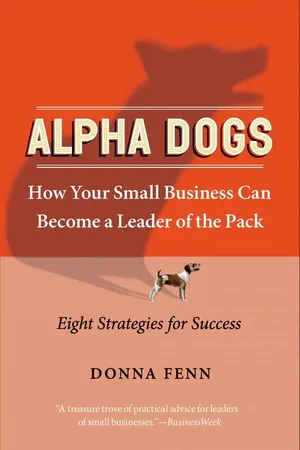
- 240 pages
- English
- ePUB (mobile friendly)
- Available on iOS & Android
eBook - ePub
Trusted by 375,005 students
Access to over 1.5 million titles for a fair monthly price.
Study more efficiently using our study tools.
Information
Topic
BetriebswirtschaftSubtopic
Business allgemein1 Lead the Pack
If you own one of the 5.7 million small businesses in the United States, or are tempted to take the leap of faith required to start one, there’s good news and bad news. Every year, 10% of small businesses—a half million or so—shut down for good; a quarter of all businesses never make it past their second year; 60% close after six years.
Today, small companies are up against an unprecedented set of challenges:
- Consumers are more educated, demanding, and fickle than ever before.
- Consolidation in nearly every imaginable industry is breeding behemoth competitors.
- Technology is enabling tiny competitors to look much bigger and allowing bigger competitors to forge more intimate relationships with customers—maybe your customers.
- Saturation of the marketplace by a growing number of products and services is making it even more difficult for small businesses to distinguish and differentiate themselves.
Under those circumstances, who in their right mind could expect to be a shining star in the vast entrepreneurial firmament?
You’d be surprised. According to the Global Entrepreneurship Monitor research program, established by Babson College and the London Business School, more than one in ten adult Americans is now starting or growing a new business; every year, more than 500,000 new start-up companies replace those that have gone under. In spite of the odds, it seems that entrepreneurs are relentlessly optimistic. The good news: they have every reason to be.
Even as small companies are facing new hurdles, they’re also being presented with a fresh set of opportunities. There’s never been a better or more exciting time to be a small business owner, or a more critical time to begin transforming your company into a leader of the pack. Here are seven reasons why:
1. Goliath Backlash. With 2004 revenues of $256.3 billion, Wal-Mart Stores, Inc., now accounts for more than 5% of total U.S. retail sales. But wherever you find one of their 3,600 stores, you’re also likely to find a heated community debate: the retailing colossus promises low prices and jobs (albeit low-wage ones) for local residents, but will it also threaten mom-and-pop businesses and turn downtown into a ghost town?
Some communities have even lobbied successfully to keep Wal-Mart out: in the spring of 2005, for example, small business owners, City Council members, and union officials in the Rego Park neighborhood of Queens, New York, were so vocal and persistent in their opposition to a proposed Wal-Mart (New York City’s first) that the developer scrapped the plan. Sprawl-Busters, a national organization founded by anti-Wal-Mart activist Al Norman in 1993, lists on its Web site 248 communities that have won battles against Wal-Mart and other big-box retailers. Of course, they are the exception, not the rule, but the very existence of such groups is telling.
The Wal-Marts, Home Depots, and Targets of the world are certainly here to stay for the foreseeable future, but their dominance and prevalence have caused a backlash among a growing number of consumers who are becoming tired of their predictability and conformity. And while these folks may not go as far as the activists who boycott the big boxes entirely, they are more and more likely to gravitate toward the more civilized and manageable local businesses that provide an antidote to the crowded aisles of superstores.
2. Proliferation of Small Business Alliances. All over the United States, local small businesses are responding to Goliath backlash by uniting to make themselves more powerful, visible, and attractive to consumers eager to support their local economies. Back in 1998, a Boulder, Colorado, bookstore owner named David Bolduc formed a local alliance of small businesses with community activists Jeff Milchen and Jennifer Rockne. Within two years, the Boulder Independent Business Alliance grew to more than 160 members, who publish a directory of locally owned businesses, form joint purchasing groups, distribute discount cards to the community, and offer one another valuable business advice.
The group attracted so much national attention that the founders also launched the American Independent Business Alliance (AMIBA) to provide advice and a template to other small business communities seeking to form similar alliances. “In our first two years, we had 120 inquiries,” says Rockne. “The idea really caught fire.” Since then, AMIBA has helped start twenty alliances that represent thousands of small businesses.
And in 2001, entrepreneurs Judy Wicks (founder of the White Dog Café in Philadelphia) and Laury Hammel (owner of Longfellow Clubs in the Boston area) formed another umbrella group for local alliances called the Business Alliance for Local Living Economies (BALLE). BALLE now has 19 member networks in the United States and Canada; its second annual conference, held in May 2004 in Philadelphia, attracted nearly 250 people from 25 states.
The proliferation of local alliances is great news for small business. Not only do their members pool resources and share best practices, but they often join together to brand themselves as local businesses.
3. Escalation of Consumer Rage. Consumers have never been as demanding as they are today. Whether we’re picking up dry cleaning, working with a contractor, choosing a phone service, or getting a haircut, our expectations for quality and service are higher than ever before. The marketplace is so flooded with products and services that we all can afford to be picky. And high-speed Internet access, satellite television, and advanced telecommunications allow us to gather and sort through reams of information to find exactly the right company to meet our needs. Moreover, we don’t hesitate to shift our loyalty if we’re disappointed.
In 2004, the Customer Care Alliance, an Alexandria, Virginia–based consortium of customer service firms, partnered with Arizona State University’s W. P. Carey School of Business to conduct the National Customer Rage Study. Of the 1,000 people who were surveyed about their customer service problems during the previous 12 months, 77% said their problem was caused by a large company; 73% reported being extremely or very upset; 85% shared their story with others; and 59% vowed never again to do business with the offending company.
Most striking: 56% of complainants felt they got nothing in return for their trouble, even though many of them merely wanted an explanation of the problem, assurance that it wouldn’t be repeated, an apology, or simply the opportunity to vent. “There’s a lot of hostility, passion, and rage associated with the services and products we use every day,” says Scott Broetzmann, president of Customer Care Measurement & Consulting and a co-founder of the Customer Care Alliance. “For small companies, it represents an opportunity to cannibalize the customer base of larger ones by providing a service experience that is higher touch.”
Independent pharmacies, for instance, seem to be doing just that. In October 2003, Consumer Reports magazine declared that “independent stores, which were edging toward extinction a few years ago, won top honors from Consumer Reports readers, besting the big chains by an eye-popping margin.” Approximately 85% of independent drugstore customers said they were very or completely satisfied, compared with just 58% of chain store customers. The independents offered more personal attention, knowledgeable and accessible pharmacists, and the ability to track down out-of-stock drugs faster than their chain competitors. And they did it all at prices that turned out to be equal to or lower than the chains’.
4. Impending Labor Shortage. Conventional wisdom says that when the 76 million baby boomers born between 1946 and 1964 begin retiring, they’ll leave behind five to ten million jobs that can’t be filled by the smaller succeeding generation. “Companies are going to be competing with one another for the best workers,” says Mike Chittenden, a spokesperson for Employment Policy Foundation, a Washington, DC, economic research organization. “We predict that between 2003 and 2013, there will be 30.3 million job openings for people with at least a two-year degree. But the number of people graduating from college during that same period is just 23.3 million.” It’s a potentially disastrous situation for employers.
Or is it an opportunity in disguise? In September 2003, the Gallup Organization’s Employee Engagement Index revealed that 54% of American workers were “not engaged” at their jobs, while 17% were “actively disengaged.” Human resources consulting firms like Challenger, Gray & Christmas and Towers Perrin have also reported high levels of dissatisfaction among U.S. employees. “Leaders cannot afford to ignore this wake-up call,” writes Jay Jamrog, executive director of the Human Resource Institute in St. Petersburg, Florida. “Up to now, workers have stayed put because there are not many choices. That will not be true for long. Scores of recent surveys all predict the same thing: Workers will head for the door as soon as the job market improves.”
So how is this good news? Because it represents an opportunity for small businesses to start implementing the kinds of workplace innovations that will make them employers of choice in the future—not just to retain current employees, but to attract top talent from companies that didn’t heed the wake-up call.
5. Experience vs. Transaction. Think about what makes consumers happier at an independent pharmacy than at, say, a CVS. Even though they’re probably getting the same product at a relatively similar price, the independent drugstore provides a fundamentally different experience. “The…offering of experiences occurs whenever a company intentionally uses services as the stage and goods as props to engage an individual,” write B. Joseph Pine II and James H. Gilmore in The Experience Economy: Work Is Theatre and Every Business a Stage. “While commodities are fungible, goods tangible, and services intangible, experiences are memorable.”
Anyone who has flown Virgin Atlantic or taken a child to create her own teddy bear at Build-A-Bear Workshop knows what they’re talking about. These companies create value for consumers by giving them experiences that linger in their memories long after the flight has landed or the bear has lost its sheen. By focusing on experience, on the emotional connection that a consumer makes with a product or service, you not only build long-lasting brand loyalty but differentiate yourself in a way that’s difficult, if not impossible, for your competitors to replicate.
6. High-Touch Technology. Amazon.com recommends books based on your past purchases, Netflix knows what kind of movies you like, and 1-800-FLOWERS reminds you that it’s time to send your mom flowers for her birthday. One-to-one marketing gurus Don Peppers and Martha Rogers saw this coming years ago, and introduced the concept in their 1993 book, The One to One Future: Building Relationships One Customer at a Time. Back then, the idea that companies would collect so much personal information on consumers made many of us a little uncomfortable. No more. Customers have come to expect businesses not only to cater to their every need, but to anticipate those needs. Technology, of course, is the great enabler, and the good news is that no matter what size your business is, you can find the resources to collect and use data that will help you get closer to your customers.
At Mitchells/Richards, high-end clothing stores in Westport and Greenwich, Connecticut, CEO and chairman Jack Mitchell keeps a detailed database of his company’s 115,000 customers. In an instant, his salespeople can access every purchase a client has ever made, not to mention the spouse’s birthday, golf handicap, and the name of the family dog. “Technology helps us grow the business and get closer to the customer,” says Mitchell. “There’s a bonding effect, and that’s why people come back to us.” That’s also how he helped transform a tiny family business into a $65 million company.
7. The Lust for Luxuries. Everyone is trading up. And why not? We’ve got more disposable income than ever before. According to 2003 U.S. Census Bureau figures, there are 26.1 million U.S. households with more than $75,000 in annual income and 15.1 million with more than $100,000. Of all income groups, the $100,000-and-over category saw the biggest increase over a 10-year period—up 42% from 10.6 million households in 1993. In Trading Up: The New American Luxury, authors Michael J. Silverstein and Neil Fiske argue persuasively that expanding incomes, as well as other social and business forces, have spawned a new category of goods they call “new luxuries.” Think Starbucks, Victoria’s Secret, and Panera Bread—brands that are premium when compared to others in their category, but not so wildly expensive that they’re beyond the reach of the average consumer. “More and more, the middle-market consumer is a person who selectively trades up to new and better products and services, trades down in others to pay for his or her premium purchases, and, in the process, drives innovation and growth in previously stale…markets,” write the authors.
The trend is great news for entrepreneurs who are creative and flexible enough to transform their mundane products and services into new luxury goods. Sound daunting? Just remember that it was done brilliantly with coffee and bras! And if you don’t do it, your more entrepreneurial competitors most likely will.
Entrepreneurs are in fierce competition with one another. Consider that 56% of the CEOs on Inc. magazine’s 2003 list of fastest-growing privately held companies said that the rivals they most feared were other small and midsize companies; 38% said their larger competitors made them most nervous. They know that as big companies gobble up more and more market share, the small companies that still comprise 50% of our economy are duking it out for the spoils. And it’s a no-holds-barred fight.
On Main Streets all across the country, you’ll find the same collection of businesses: delis, dry cleaners, florists, pizza and ice cream parlors, cycle shops, hair salons, hardware stores. Just outside of town, there’s likely to be a light manufacturer, a couple of motels, and a few car dealerships. Each business attracts its own loyal following, and the occasional customer who defects to a competitor down the street is, more often than not, replaced by a new customer who defected from someplace else. Everyone operates within his or her own comfort zone. Until, that is, someone transcends the perceived limits of small business and rises to Alpha Dog status. The company ratchets up its customer service delivery or comes up with a new spin on an old product. It might find a clever way to brand its business or to engage the community. And when it does, everything changes.
The new competitive landscape will ultimately compel you to reevaluate your business. Particularly in industries where the David vs. Goliath story is played out with dramatic intensity, it’s essential for small companies to find points of difference that are beyond the capabilities of their larger competitors. “Wal-Mart gives you the kick in the pants you need to get to the next level,” says Chris Zane, who owns a bike shop in Branford, Connecticut (see chapter 2). “And if you don’t want to get to the next level, you shouldn’t be in business.”
Sound harsh? Maybe, but to Zane and others like him, going to “the next level” isn’t just about finding a way to beat the big boys. It’s about looking at your own business through an entirely different lens. For Zane, the bikes he sold became almost secondary; the customer-service-driven manner in which he sold them became the differentiating factor that allowed him to beat out his local competitors and to survive the superstore onslaught. As a result, his business is more resilient, successful, and engaging than it ever would have been if circumstances had allowed him to remain in his comfort zone. He took himself out of the commodity game and adopted the strategy that is every successful entrepreneur’s secret weapon: don’t compete, differentiate.
And to do that effectively and meaningfully, companies must be strategic, not just reactionary. One of the most urgent and common utterances I’ve heard from entrepreneurs over the past several years is “we’ve got to professionalize our business.” In increasing numbers, very small companies are embracing “big company” management disciplines. They’re establishing quality programs, transforming their shop floors with lean manufacturing, setting up formal hiring and training regimens for employees, partnering with vendors, forging strategic alliances, and branding their products.
“Proprietors” are reinventing themselves as bona fide CEOs who are finally beginning to...
Table of contents
- Cover
- Title Page
- Dedication
- Contents
- Foreword
- Introduction
- Chapter 1
- Chapter 2
- Chapter 3
- Chapter 4
- Chapter 5
- Chapter 6
- Chapter 7
- Chapter 8
- Chapter 9
- Chapter 10
- Acknowledgments
- Sources
- Searchable Terms
- About the Author
- Praise
- Copyright
- About the Publisher
Frequently asked questions
Yes, you can cancel anytime from the Subscription tab in your account settings on the Perlego website. Your subscription will stay active until the end of your current billing period. Learn how to cancel your subscription
No, books cannot be downloaded as external files, such as PDFs, for use outside of Perlego. However, you can download books within the Perlego app for offline reading on mobile or tablet. Learn how to download books offline
Perlego offers two plans: Essential and Complete
- Essential is ideal for learners and professionals who enjoy exploring a wide range of subjects. Access the Essential Library with 800,000+ trusted titles and best-sellers across business, personal growth, and the humanities. Includes unlimited reading time and Standard Read Aloud voice.
- Complete: Perfect for advanced learners and researchers needing full, unrestricted access. Unlock 1.5M+ books across hundreds of subjects, including academic and specialized titles. The Complete Plan also includes advanced features like Premium Read Aloud and Research Assistant.
We are an online textbook subscription service, where you can get access to an entire online library for less than the price of a single book per month. With over 1.5 million books across 990+ topics, we’ve got you covered! Learn about our mission
Look out for the read-aloud symbol on your next book to see if you can listen to it. The read-aloud tool reads text aloud for you, highlighting the text as it is being read. You can pause it, speed it up and slow it down. Learn more about Read Aloud
Yes! You can use the Perlego app on both iOS and Android devices to read anytime, anywhere — even offline. Perfect for commutes or when you’re on the go.
Please note we cannot support devices running on iOS 13 and Android 7 or earlier. Learn more about using the app
Please note we cannot support devices running on iOS 13 and Android 7 or earlier. Learn more about using the app
Yes, you can access Alpha Dogs by Donna Fenn in PDF and/or ePUB format, as well as other popular books in Betriebswirtschaft & Business allgemein. We have over 1.5 million books available in our catalogue for you to explore.