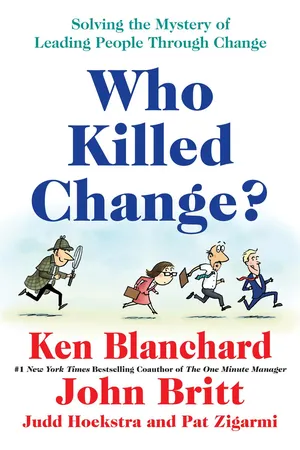
- 160 pages
- English
- ePUB (mobile friendly)
- Available on iOS & Android
eBook - ePub
Information
Suspect #1: Culture
AT nine o’clock the next morning Agent McNally, sitting in the same conference room where Change had been killed, read through his file. He looked up as Carolina Culture entered the room. He knew she’d be his first interview but he would never have recognized her. Culture was small and unassuming, neither attractive nor unattractive. She had no distinguishing features, and he thought that if he passed her on the street, he probably wouldn’t notice her.
“Good morning,” said McNally, trying to hide his surprise. “How are you today?”
“Very well,” Culture responded. “And you?” Her voice was smooth and low.
“Good, good. Thank you very much.” McNally was thinking, Why am I asking her how she is? I don’t ask people how they are. I ask them questions about the crime.
Her voice pulled him from his thoughts. “Did you have some questions for me?” she said.
“Yes, I do. Where were you yesterday morning?” he asked.
“I was here. I’m here most all the time.”
McNally did not interpret her comment as either whining or martyrdom. It came across as just matter-of-fact. “Did you visit any departments?” he asked.
“Oh, yes. I make my rounds. I’m in every department most every day.”
“Did anyone see you up here yesterday?”
“That’s an interesting question,” Culture replied. “People here are really busy. And let’s face it—my role isn’t exactly high profile. So I really can’t answer that. You’ll have to ask them.”
McNally found himself straining to hear her. “How would you describe your relationship with Change?” he inquired.
Culture did not hesitate. “Discreet,” she offered.
McNally prodded, “Can you help me with that?”
“Change’s role is designed to be high profile,” she replied. “He consulted me a few times but, in general, it was behind closed doors.”
McNally replied, “He consulted you? Were you able to help him?”
“I think so. It’s hard to say. It’s not my style to micromanage. Since he never discussed any problem with me twice, I assumed he was able to work through the challenges he was facing,” she said.
“Micromanage—does that mean Change reported to you?”
“Oh, no,” Culture said. McNally thought he noticed a hint of a smile. “No one reports to me. I’ve been around here longer than you would believe. My role has always been to define the beliefs that guide how we operate here. You could think of my role as a compass that points in a direction, but it’s not a map that details how to get from point A to point B.”
“So, what was it that Change consulted you about last?” McNally asked.
“VALUES!” Culture replied so loudly that McNally found himself backing up in his chair. She continued at a volume that was much too loud for the size of the room and their proximity to each other. “Change wanted to use our organizational values to leverage what he was trying to get accomplished. I tried to teach him that if your actions are consistent with your values, you have a better chance of success.”
“And those values are…?” McNally asked in a soft voice that was perhaps an unconscious attempt to normalize her previous intensity. It didn’t work. Culture launched into an even louder monologue that McNally could describe only as overly rehearsed.
“V is for Very Efficient. To reach our business goals, we must operate in a manner that is very efficient. We have to appropriately allocate resources and control our costs.
“A is for A Customer Focus. We have many customers and we have to provide each of them with the highest level of service.
“L is for Lots of Teamwork. We can achieve more by working as a team. At ACME we believe ‘no one of us is as smart as all of us!’
“U is for Understanding. At the core of understanding is listening. Each individual will bring a point of view to a situation or opportunity. By listening and understanding all points of view, we will make better decisions.
“E is for Excellence. Our products are our livelihood. Anything less than excellent is unacceptable.”
The contrast between his first impression of Culture and the strength of her presentation about ACME’s values was stark. But then McNally considered that strength and decibel level were not necessarily synonymous. He detected no passion in her delivery and sensed that the volume was a substitute for real feeling.
“The values you speak of come through loud and clear,” McNally said. “But I’m betting there’s a disconnect between those values and what’s actually going on here.”
Culture did not respond. McNally made a mental note that he had not seen Culture blink the whole time they had been talking.
“Would you mind responding to that?” McNally asked politely.
“Sure—but I didn’t perceive it to be a question,” she said, lowering her voice. “As I told you before, my job is to lay the groundwork and to point in a direction. I don’t control whether the individuals or teams live by our values.”
McNally wondered how well Culture knew Accountability. He knew that if Accountability were doing his job well, he would reinforce the behaviors that drive Culture. McNally had worked enough cases to know that there was always some gap between espoused values and the day-to-day behaviors of people in that organization. At this place, he suspected it was more of a wide gulf than a small gap. Surmising that Culture was not going to take any responsibility for the disparity, McNally changed tactics.
“Any idea who killed Change?” he asked.
“Not a clue,” Culture responded immediately.
“But surely,” McNally coaxed, “with your long history here and the long hours you put in and with your obvious influence on the organization, you must have some idea of who didn’t like Change—someone who wanted to get Change out of the way.”
“You flatter me, Agent McNally. Yes, I’ve been around a long time and I do work a lot of hours. I would like to think that I have had, and still have, some influence on this organization. But I still can’t tell you who killed Change.”
Again McNally found himself leaning forward, mesmerized by the honeyed tone of Culture’s voice.
There was a long pause. Then Culture asked, “Anything else?”
“No, I think that’s about it. Where can I find you if I have more questions?” he asked.
“Oh, I’ll be around,” she said.
Again McNally thought he caught a glimpse of a smile. He looked down to consult his notes to see who was next on the list. He looked up and began, “Thank you for your—”
But Culture was gone. He looked behind him and the door was closed. He had not heard it open or shut. With some embarrassment, he actually pulled his chair back and looked under the conference table. Nothing. No one was there.
That’s just downright eerie, he thought. Just downright eerie.
Suspect #2: Commitment
CHASE Commitment was the next to appear in the interrogation room. With an earnest face, Commitment smiled at Agent McNally, shook his hand and sat down.
McNally opened with “Thank you for meeting me. As you know, I am investigating Change’s death. Would you mind telling me a little about yourself?”
“My pleasure,” replied Commitment. “Certainly, like most people here, I wear several hats. My main focus, however, is to create buy-in for the Changes we employ here.” He stopped and eagerly looked at McNally.
“So tell me more. Can you tell me how you work with leadership here in regard to Change?”
“Happy to,” answered Commitment with a smile. “I’m not sure who you have interviewed so far and I wouldn’t want to ‘steal their thunder,’ as they say. I can tell you that I have learned a lot from the Changes we’ve had here over the years. The greatest lesson I’ve learned is that our employees have fairly predictable concerns when we introduce a new Change. If we don’t respond to those concerns, the success of Change drops dramatically. When Change is first introduced, everybody seems to need more information. They want to hear why they need Change. I work with Ernest Urgency on that. They also have personal concerns—who wouldn’t wonder if they’ll win or lose when someone announces a Change? Whether leadership likes it or not, employees don’t buy in to a Change until they understand how it might affect them. Don’t you see, Agent McNally, that if we get at these concerns and address them, we are more likely to gain employee support? Again, that’s my job.”
McNally felt Commitment’s passion. In fact, he could envision Commitment on stage behind a podium delivering a motivation speech, his audience in reverent attention.
Commitment continued, “We must be able to create a picture of the Change and help our people see what it will look like. I need Victoria Vision for that. And doesn’t it make sense that we should let some of our people be involved in the decision making about Change? I lean on Spence Sponsorship and Pecs for that.”
“Pecs?” McNally asked.
“You’ll meet him later, I’m sure. Everybody knows Pecs. Anyway, after Change has been here a while, our employees wonder whether or not Change can really be integrated. Perry Plan should be involved. Terry Trainer should be doing some training, and Isabella Incentive should provide the encouragement.”
Commitment stood up and began pacing, palms and eyes raised to the ceiling as if speaking to a higher authority. “Eventually, employees have concerns about whether everyone will be able to truly work together. It’s here that I need you more than ever, Peter Performance Management and Aidan Accountability.”
McNally found himself looking around to see if someone had entered the room. Nobody had.
Head and hands down now, Commitment walked back to his chair and sat down. McNally noticed that the suspect was sweating profusely. He grabbed a bottle of water and placed it in front of Commitment.
“Wow, as I was listening to you just now, I felt as though I was listening to a sermon,” McNally replied. “But despite all your passion, I couldn’t help thinking that your colleagues might not be totally on board with the lessons you have learned about Change.”
Commitment’s expression told McNally that he was having an internal debate as to how much information he wanted to share. Finally, Commitment said, “We’re a bit dysfunctional here.”
McNally used silence to urge Commitment to continue.
“It’s funny you said ‘sermon’ earlier,” Commitment continued at last, “because that pretty much sums up what I feel like I’m doing here—preaching. The congregation—made up of leaders and managers—comes every Sunday. They smile, nod, shake my hand and then go out and behave any way they want Monday through Saturday. Academically, they understand that people are much more likely to buy in to a Change when they are involved in the planning and have an opportunity to influence decisions. The leaders and managers are just not, may I say, committed to consistently applying the knowledge. And they fool themselves into thinking our employees don’t see what’s going on.”
Commitment looked exhausted. This was odd, considering that McNally had heard Commitment was typically full of energy and enthusiasm. “One more question,” McNally said. “Do you know who might have killed Change?”
“I truly don’t,” replied Commitment earnestly. “It’s hard for me to believe that people wouldn’t be committed to Change given what he was trying to do.”
Once again they shook hands, and Commitment left the room.
Reflections on Culture and Commitment
TAKING a break from the interviews, McNally steppe...
Table of contents
- Cover
- Title Page
- Dedication
- Contents
- Scene of the Crime
- Suspect #1:
- Suspect #2:
- Reflections on Culture and Commitment
- Suspect #3:
- Suspect #4:
- Suspect #5:
- Reflections on Sponsorship, Change Leadership Team and Communication
- Suspect #6:
- Suspect #7:
- Reflections on Urgency and Vision
- Suspect #8:
- Suspect #9:
- A Vision of Death
- Suspect #10:
- Suspect #11:
- Reflections on Plan, Budget, Trainer and Incentive
- Suspect #12:
- Suspect #13:
- Super Cops and Stakeholders
- The Autopsy Report
- Murderer Announced: Invitation Only
- Change Lives!
- Helping Change Thrive in Your Organization
- Services Available
- Leading People Through Change
- Social Networking
- Tools for Change
- Keynote Speakers
- About the Authors
- Also by Ken Blanchard
- Credits
- Copyright
- About the Publisher
Trusted by 375,005 students
Access to over 1.5 million titles for a fair monthly price.
Study more efficiently using our study tools.
Frequently asked questions
Yes, you can cancel anytime from the Subscription tab in your account settings on the Perlego website. Your subscription will stay active until the end of your current billing period. Learn how to cancel your subscription
No, books cannot be downloaded as external files, such as PDFs, for use outside of Perlego. However, you can download books within the Perlego app for offline reading on mobile or tablet. Learn how to download books offline
Perlego offers two plans: Essential and Complete
- Essential is ideal for learners and professionals who enjoy exploring a wide range of subjects. Access the Essential Library with 800,000+ trusted titles and best-sellers across business, personal growth, and the humanities. Includes unlimited reading time and Standard Read Aloud voice.
- Complete: Perfect for advanced learners and researchers needing full, unrestricted access. Unlock 1.5M+ books across hundreds of subjects, including academic and specialized titles. The Complete Plan also includes advanced features like Premium Read Aloud and Research Assistant.
We are an online textbook subscription service, where you can get access to an entire online library for less than the price of a single book per month. With over 1.5 million books across 990+ topics, we’ve got you covered! Learn about our mission
Look out for the read-aloud symbol on your next book to see if you can listen to it. The read-aloud tool reads text aloud for you, highlighting the text as it is being read. You can pause it, speed it up and slow it down. Learn more about Read Aloud
Yes! You can use the Perlego app on both iOS and Android devices to read anytime, anywhere — even offline. Perfect for commutes or when you’re on the go.
Please note we cannot support devices running on iOS 13 and Android 7 or earlier. Learn more about using the app
Please note we cannot support devices running on iOS 13 and Android 7 or earlier. Learn more about using the app
Yes, you can access Who Killed Change? by Ken Blanchard in PDF and/or ePUB format, as well as other popular books in Business & Business Development. We have over 1.5 million books available in our catalogue for you to explore.