"Fascinating and beautiful . . . if only chemistry had been like this at school." —Matt Ridley,
New York Times–bestselling author of
Genome, in
Prospect magazine
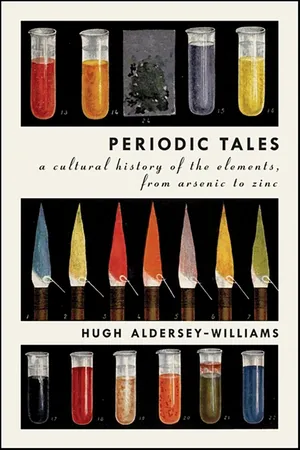
Like the alphabet, the calendar, or the zodiac, the periodic table of the chemical elements has a permanent place in our imagination. But aside from the handful of common ones (iron, carbon, copper, gold), the elements themselves remain wrapped in mystery. We do not know what most of them look like, how they exist in nature, how they got their names, or of what use they are to us.
Periodic Tales is
a dazzling tour through history and literature, science and art, in which you'll meet iron that rains from the heavens and neon as it lights its way to vice. You'll learn how lead can tell your future and why zinc may one day line your coffin. You'll discover what connects the bones in your body with the White House in Washington, and the glow of a streetlight with the salt on your dinner table. From the Los Angeles Times Book Prize finalist for
The Most Beautiful Molecule,
Periodic Tales reveals the true stories of these fascinating, mysterious building blocks of the universe.
"With a distinct British wit and a zest for science history, Aldersey-Williams turns his boyhood passion for the chemical elements into an insightful biography of the periodic table's denizens . . . Be prepared to laugh along." —
Discover
"A lucid, enjoyable collection . . . that, element by element, demystifies the iconic periodic table." —
Kirkus Reviews
"Aldersey-Williams's playful, hands-on approach to scientific exploration shines through the book." —
The Boston Globe
eBook - ePub
Periodic Tales
A Cultural History of the Elements, from Arsenic to Zinc
- 448 pages
- English
- ePUB (mobile friendly)
- Available on iOS & Android
eBook - ePub
About this book
Information
Topic
Physical SciencesSubtopic
Social HistoryPart One: Power
El Dorado
In 2008, the British Museum commissioned a life-size sculpture of the model Kate Moss. The artwork, called Siren, is made entirely of gold and is said to be the largest gold sculpture created since the days of ancient Egypt, though it’s impossible to check whether this is true. Siren was placed on show in the museum’s Nereid Gallery near a statue of a bathing Aphrodite. My immediate impression on seeing Kate Moss’s otherwise familiar image is how tiny she looks, accentuated by the fact that she is knotted in a particularly uncomfortable-looking yoga position, though this may be an optical illusion–we are unused, after all, to seeing so much of the shining metal at once. The gold, I am disappointed to find, is not polished to a high gloss but has a steely brushed finish, which elicits a high sparkle from the grains in the textured surface, not the burnished glow I had expected to see. There are signs of pitting in the casting, which a different goldsmith might have taken care of. The unique qualities of the metal that have made it precious to cultures since antiquity seem poorly served. Only the face is perfectly smooth, and is immediately reminiscent of the funerary mask of Tutenkhamun. The lifeless staring visage has the disturbing effect, entirely unexpected given the high public profile of its subject, of plucking the spectator out of time: this is no longer a rendering of the twenty-first-century celebrity, but a depersonalized, detemporalized figure whose sharp nose and pouting lips belong less to a living person than to a death mask or votive figure.
The price put on the statue was £1.5 million. It was the whim of the artist, Marc Quinn, that the work be fabricated from gold of equal mass to the model’s fifty-kilogramme body, so that in addition to appearing life-size, it could be said to represent her weight in gold, perhaps raising in the mind of the astute onlooker thoughts of ransom and slavery. In solid gold, I calculate, Kate would be shrunk to the size of a garden ornament. Quinn’s piece must therefore be hollow, which may also be an artistic comment of some kind. Although gold is the only declared material from which the work is made, I figure there must be some sort of armature to support the weight of the soft metal, which would otherwise slump out of shape. Afterwards, I look up the price of gold. Although Siren went on display during a period of global financial upheaval, when the price of gold had doubled, it was still only £15,000 a kilo, giving the artwork a scrap value, as it were, of £750,000. Presumably the rest of the £1.5 million is to cover labour.

I watch as people queue to take photographs of the golden Moss, either simply snapping her image or sometimes placing their partner in the shot next to her, making who knows what sort of comparison. I am curious to know what has drawn them to the sculpture. Which is more powerful: the cult of celebrity or the cult of gold? What is really the siren here? It is mainly men who have come to worship this modern Aphrodite. A few purport to admire the sculptural qualities of the work. Some are indeed drawn by the power of celebrity, but are fans of Quinn more than Moss. I ask the girlfriend of one temporarily distracted Polish man what she thinks of it. ‘It is beautiful,’ she concedes, as if to say otherwise would be unacceptable, ‘but it doesn’t belong here.’ Another woman photographing it with her phone is briskly dismissive: ‘I need some gold for my mobile–it’s wallpaper.’
More than any of the ancient elements, gold has been judged to possess a timeless allure. None of the elements discovered by modern science has challenged this supremacy. But what, if anything, is truly special about this metal?
Gold is characteristically yellow. In a flower, one might find this yellow attractive or not–beauty is a matter of taste, after all. But in gold, apparently, the unique combination of this colour with the lustre of metal leaves us no other option than to be drawn to it. Even the sociologist Thorstein Veblen, whom one might expect to maintain some professional caution in the matter, falls for the stuff. In a chapter on the ‘pecuniary canons of taste’ in his classic text The Theory of the Leisure Class (1899), he writes that gold has a ‘high degree of sensuous beauty’ as if that were an objective fact, and never mind the eye of the beholder.
There is then the fact that this colour and lustre endure, because gold resists corrosion by the air, by water and indeed by almost all chemical reagents. Pliny the Elder thinks it is this unique quality of endurance, and specifically not its colour, that explains our love of gold: ‘it is the only metal that loses nothing by contact with fire’, he observes. It is this endurance that gives gold its association with immortality, and so with royal lines and divinity. The Buddha is gilded as an indication of enlightenment and perfection, and the metal’s incorruptibility inspires a torrent of other ideals: the golden section, the golden mean, the golden rule.
Gold is special also because of its great density, its malleability and ductility–it can be beaten as thin as hair and ‘long enough to encircle a whole village’, as one West African proverb puts it. It is surely the case that gold’s heaviness, in particular, signifies value in the way that dense materials often do, regardless of their actual composition, because their relative weight transmits a sense of sheer quantity. Gold’s resistance to chemical attack–in other words its ability to retain its pure state–signifies value too, because we naturally place value in things that endure. It is these economically important secondary attributes of the element that give Veblen cause to comment on it at all. And it is this muddled equation between beauty and value that lies at the heart of our understanding of gold.
Though gold was known to the ancients, being the only metal typically found in the elemental state, it was too soft for making weapons and was perhaps not much used at first, even for ornamental purposes. Even where it is relatively abundant, such as in parts of Australia and New Zealand, aboriginal peoples have often ignored it. In Europe, Africa and Asia, however, the metal was generally highly prized and was soon taken up for jewellery and then for coin. The first coins were stamped out of electrum, a natural alloy of gold and silver, in Lydia in the seventh century BCE. Around 550 BCE King Croesus minted purer silver and gold coins, and from then on the yellow metal was man’s chosen element for the expression of great wealth. Backed by state authority, Croesus’ coinage boosted trade and banking. For gold to hold its greater value as coin against native electrum it had to be pure, and its purity had to be ascertainable by assay. With this, gold became subject to comparative testing and valuation as well as absolute worship.
Six hundred years later, Pliny is scathing about the corrupting effect of gold, which he wished ‘could be completely banished from life’. He damns equally those who wear it and those who trade with it: ‘The first person to put gold on his fingers committed the worst crime against human life.’ ‘The second crime against mankind was committed by the person who first struck a gold denarius.’ The difficulty lies not with the material itself, but with man’s transforming hands upon it. Natural gold may contain the light of the sun, but minted gold becomes a ‘symbol of perversion and the exaltation of unclean desire’. Sir Thomas More confirms this moral distinction in his Utopia, reserving its gold not for finery but for making chamberpots.
Harder heads have always understood that gold is the key to power. Had not the Pharaohs reigned for 3,000 years relying on their gold to contain the more ingenious Sumerians and Babylonians? Had not the Romans been driven to conquest by their envy of the gold possessed by the Gauls, the Carthaginians and the Greeks?
Such is the monetary value of gold that natural deposits tend to acquire an aura so dazzling that they soon become detached from any real geography. Ophir was the biblical source of Solomon’s gold. It is the port, probably in southern Arabia, from which sails the gold-laden quinquereme of Nineveh in John Masefield’s ‘Cargoes’. Strabo’s Geographica mentions gold mining on the African bank of the Red Sea, presumably one source of the Egyptians’ gold. But as the means expand so do the imaginative horizons. By the time of the Portuguese navigator Vasco da Gama, the best advice was that Ophir lay in southern Africa, roughly where Zimbabwe is today, or perhaps in the Philippines. Columbus thought Ophir was to be found on the island of Hispaniola. With the Spanish expeditions to the New World came new stories of fabulous gold and a new myth of El Dorado. El Dorado, literally ‘the golden man’, was said to be a tribal priest who was covered in gold for the performance of a sacred ritual, but in the imagination of Western explorers it became another unmapped place of riches, a new Ophir.
In March 1519, Hernando Cortés set out on such an expedition, sailing from Cuba with eleven ships and a force of 600 men to claim the mainland of Mexico and its treasure for the Spanish crown. After various skirmishes, Cortés reached the Aztec capital Tenochtitlan, where he and his men were ceremonially received by the emperor Montezuma II and showered with gifts of gold. By means of a subterfuge during the hospitality the Spanish managed to take Montezuma prisoner; before long the Aztec empire had fallen, and Spain was in control of most of Mexico. For all their victory, however, Cortés’s men found little gold besides the presents they had been given by their hosts. It was left to later settlers to develop the Mexican silver mines that would bankroll the Spanish empire.
Thirteen years later, Francisco Pizarro, after lengthy preparations including a voyage of reconnaissance down the Pacific coast to the northern fringe of the Inca empire and another back to Spain to obtain funding, set forth to Peru in search of Inca treasure. Once again betraying the hospitality they were shown (Pizarro had been coached by Cortés back in Spain), the conquistadores launched a surprise attack and captured the Inca ruler Atahualpa. As before, their plan was to control the territory by holding him as vassal ruler. But Atahualpa had another idea, a ransom calculated to appeal to the Spaniards: he bargained his freedom in exchange for a room, some six metres by five metres, that would be filled once with gold and twice with silver as high as a man could reach. This ‘ransom room’ still survives in Cajamarca, Peru. It is clear it cannot have been literally filled. Nevertheless, the Spaniards melted down some eleven tonnes of handsomely crafted gold artefacts for transport as bullion back to Spain. As the ships set sail, they reneged on the deal and put Atahualpa to death.
These were great windfalls. But where was El Dorado? The search went on. Pizarro’s half-brother Gonzalo set off inland from Quito in Ecuador in 1541, but found no city of gold, only a route to the Atlantic Ocean via the River Amazon. Other Spanish adventurers heard stories of the Muisca people of Colombia, who threw gold offerings into a mountaintop lake in order to appease the golden god supposed to live at the bottom of it. When they arrived, they rudely set about trying to drain the lake, but in 400 years only a few pieces of gold have been dredged up.
In 1596, Walter Ralegh sailed to Venezuela, coming away with little gold but his belief in El Dorado nevertheless intact. Accounts of these voyages gave Voltaire plenty of material with which to lampoon the rapacity of the Europeans in his picaresque novella of 1759, Candide. The naive hero Candide is expelled from his vapid and paradisiacal life in Westphalia to travel the world and witness its hardships, from the Thirty Years’ War to the Lisbon earthquake. He finds Eldorado with no trouble and, after being royally entertained, is sent on his way with gifts of fifty sheep laden with gold and jewels. At first, Candide and his companions are buoyed up by the vision of themselves as the ‘possessors of more treasures than Asia, Europe and Africa could gather’, but as they travel on, the sheep fall by the wayside in ones and twos, bogged down in swamps, or fallen from precipices, forcing Candide to acknowledge ‘how the riches of the world are perishable’.
Between 1520 and 1660, Spain imported 200 tonnes of gold, never finding it in one convenient hoard, but by expanding its mining activities throughout its territories in the New World. El Dorado was never a place; always an idea.
What these recurrent episodes have in common, apart from European greed and treachery, is the presumption that all parties are agreed that gold is the most valuable substance known to man. This was nothing like the case. The Aztecs and the Incas and other New World indigenous peoples made golden offerings to the gods but did not use the metal for money, so it had little tradeable value, and in some cases other metals were more desirable even for religious purposes.
The Taíno inhabitants of Hispaniola, Cuba and Puerto Rico, for example, assigned distinct roles to gold and silver, and also to a range of coloured alloys. These natives, treated as slaves by Columbus and his followers, found a friend in Bartolomé de Las Casas, the first Christian priest to be ordained in the New World. Las Casas was the author of a history of the Indies, a founder of utopian communities and a believer in liberation theology who thought Cortés a vulgar adventurer. He observed the Taíno customs and found that they did not prize gold for its weight or colour, or regard it as self-evidently valuable as the Spaniards did. The Taíno placed more importance on guanín, an alloy of copper, silver and gold. What pleased them about it was its reddish-purplish colour and most of all its peculiar smell, probably arising from a reaction between the copper and the grease of human fingering. Pure gold, by contrast, was yellow-white and odourless and unappealing. Both gold and guanín were associated with power, authority and the supernatural world, but guanín carried the greater symbolic charge. Unlike gold, which was found native, guanín had to be smelted. This made the alloy still more precious, especially since the technology was not available on Hispaniola and had to be imported from Colombia, which made it seem as if it came from another world. Gold could be dredged up from river-beds, but it seemed as if guanín could only be made in heaven.
Brass, an Old World alloy entirely unknown to pre-Columbian societies, had the same attractive qualities as guanín. Brought by the Spanish, it too was seen as coming from the remote heavens and given a local name likening its brightness to the sunny sky. How much did gold appreciate in value with each nautical mile on its eastward journey to Spain? And how much did humble brass gain as it sailed west? The image of Spanish ships ferrying the two yellow metals each way across the Atlantic with no other point than to feed two mutually uncomprehending societies’ taste in luxury is one to bring an ironic smile to the lips of any Veblen or Voltaire.
I feel it is time I got my hands on some gold, and arrange to meet Richard Herrington, an economic mineralogist at the Natural History Museum in London and an authority on the stuff. The floor of his office is strewn with variegated rocks, red ochre, glittering white, metallic black, each snug in its own box. I have to pick my way carefully just to take a seat. Herrington himself wears a lumberjack shirt as if he has just come in from the mountainside. ‘I love gold,’ he says simply. ‘I love finding it in the rock.’ He hands me a paperweight-sized piece of quartz with a dark yellow inclusion of gold the size of a fingernail. ‘Everybody understands gold. We’ve seen it in the credit crunch. It’s an alternative and trusted commodity. Even a popular paper will quote the gold price every day.’ The value of a diamond depends on its optical quality, that of a painting on everybody else’s opinion of the artist. But gold is always gold, pure and simple. ‘I can’t see it being replaced.’
Gold became a more democratic pursuit with the gold rushes of the nineteenth century. The American president James Polk inadvertently launched the first of these when he mentioned that gold had been found at Sutters Fort, California, in his annual statement to Congress in December 1848. By the end of 1849, the non-native-American population of the state had quadrupled to 115,000. In Australia not long after, the British crown attempted to assert its medieval prerogative over gold mines, but the gold rush was so frenzied, and the administration so inept, that it could not be enforced. Repeated over and over again in North America, Australia and elsewhere up until the early years of the twentieth century, the rush for gold, and the consequent increase in gold production, led economists, unable to see the metal as anything other than coin currency, to fear a wholesale collapse in the value of money itself.
One of the early American prospectors was Samuel Clemens, who only became the writer we now know as Mark Twain when he failed in his quest for gold. Clemens went west in 1861 to the Nevada Territory, where his brother was the governor. He tried his luck at several seams and wrote about his experience in his memoir, Roughing It. The memoir is peppered with the grandiloquent names given to the modest ledges and seams he acquired as stakes, but it also betrays Twain’s sheer distaste for the work, repeatedly blasting and sifting the ‘hard, rebellious quartz’ to obtain the tiniest specks of colour.
Twain had every reason to feel disheartened, for he may even have finished his spell as a prospector down on the deal. Having failed to find gold, he fetched up in Virginia City, Nevada, and took a job in an ore mill separating the precious metal from the dross. One means of doing this was by amalgamation, using mercury to dissolve the gold, which could then be recovered from the amalgam by heating. Unfortunately, Twain neglected to remove the gold ring he habitually wore, which he soon observed had crumbled to pieces under attack from the mercury.
The gold may now be gone, but evidence of the...
Table of contents
- Dedication
- Contents
- List of Illustrations
- Prologue
- Part One
- Part Two
- Part Three
- Part Four
- Part Five
- Epilogue
- Notes
- References and Select Bibliography
- Text Credits
- Searchable Terms
- Acknowledgements
- About the Author
- Other Books by Hugh Aldersey-Williams
- Credits
- Copyright
- About the Publisher
Trusted by 375,005 students
Access to over 1.5 million titles for a fair monthly price.
Study more efficiently using our study tools.
Frequently asked questions
Yes, you can cancel anytime from the Subscription tab in your account settings on the Perlego website. Your subscription will stay active until the end of your current billing period. Learn how to cancel your subscription
No, books cannot be downloaded as external files, such as PDFs, for use outside of Perlego. However, you can download books within the Perlego app for offline reading on mobile or tablet. Learn how to download books offline
Perlego offers two plans: Essential and Complete
- Essential is ideal for learners and professionals who enjoy exploring a wide range of subjects. Access the Essential Library with 800,000+ trusted titles and best-sellers across business, personal growth, and the humanities. Includes unlimited reading time and Standard Read Aloud voice.
- Complete: Perfect for advanced learners and researchers needing full, unrestricted access. Unlock 1.5M+ books across hundreds of subjects, including academic and specialized titles. The Complete Plan also includes advanced features like Premium Read Aloud and Research Assistant.
We are an online textbook subscription service, where you can get access to an entire online library for less than the price of a single book per month. With over 1.5 million books across 990+ topics, we’ve got you covered! Learn about our mission
Look out for the read-aloud symbol on your next book to see if you can listen to it. The read-aloud tool reads text aloud for you, highlighting the text as it is being read. You can pause it, speed it up and slow it down. Learn more about Read Aloud
Yes! You can use the Perlego app on both iOS and Android devices to read anytime, anywhere — even offline. Perfect for commutes or when you’re on the go.
Please note we cannot support devices running on iOS 13 and Android 7 or earlier. Learn more about using the app
Please note we cannot support devices running on iOS 13 and Android 7 or earlier. Learn more about using the app
Yes, you can access Periodic Tales by Hugh Aldersey-Williams in PDF and/or ePUB format, as well as other popular books in Physical Sciences & Social History. We have over 1.5 million books available in our catalogue for you to explore.