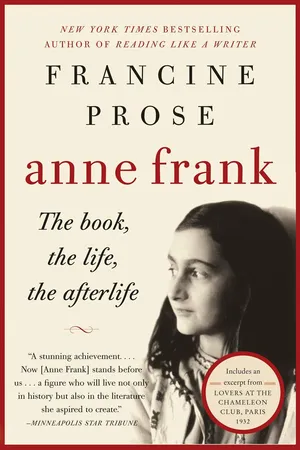
THE FIRST TIME I READ THE DIARY OF ANNE FRANK, I was younger than its author was when, at the age of thirteen, she began to write it. I can still picture myself sitting cross-legged on the floor of the bedroom in the house in which I grew up and reading until the daylight faded around me and I had to turn on the lamp. I lost track of my surroundings and felt as if I were entering the Amsterdam attic in which a Jewish girl and her family hid from the Nazis, and where, with the aid of their Dutch “helpers,” they survived for two years and a month, until they were betrayed to the authorities, arrested, and deported. I was enthralled by Anne’s vivid descriptions of her adored father, Otto; of her conflicts with her mother, Edith, and her sister, Margot; of her romance with Peter van Pels; and of her irritation with Hermann and Auguste van Pels and the dentist, Fritz Pfeffer, with whom the Franks shared the secret annex. I remember that when I finished the book, I went back to the first page and started again, and that I read and reread the diary until I was older than Anne Frank was when she died, at fifteen, in Bergen-Belsen.
In the summer of 2005, I read the diary once more. I had just begun making notes for a novel that, I knew, would be narrated in the voice of a thirteen-year-old girl. Having written a book suggesting that writers seek guidance from a close and thoughtful reading of the classics, I thought I should follow my own advice, and it occurred to me that the greatest book ever written about a thirteen-year-old girl was Anne Frank’s diary.
Like most of Anne Frank’s readers, I had viewed her book as the innocent and spontaneous outpourings of a teenager. But now, rereading it as an adult, I quickly became convinced that I was in the presence of a consciously crafted work of literature. I understood, as I could not have as a child, how much art is required to give the impression of artlessness, how much control is necessary in order to seem natural, how almost nothing is more difficult for a writer than to find a narrative voice as fresh and unaffected as Anne Frank’s. I appreciated, as I did not when I was a girl, her technical proficiency, the novelistic qualities of her diary, her ability to turn living people into characters, her observational powers, her eye for detail, her ear for dialogue and monologue, and the sense of pacing that guides her as she intersperses sections of reflection with dramatized scenes.
I kept pausing to marvel at the fact that one of the greatest books about the Nazi genocide should have been written by a girl between the ages of thirteen and fifteen—not a demographic we commonly associate with literary genius. How astonishing that a teenager could have written so intelligently and so movingly about a subject that continues to overwhelm the adult imagination. What makes it even more impressive is that this deceptively unassuming book focuses on a particular moment and on specific people, and at the same time speaks, in ways that seem timeless and universal, about adolescence and family life. It tells the truth about certain human beings’ ineradicable desire to exterminate the largest possible number of other human beings, even as it celebrates the will to survive and the determination to maintain one’s decency and dignity under the most dehumanizing circumstances.
Anne Frank thought of herself not merely as a girl who happened to be keeping a diary, but as a writer. According to Hanneli Goslar, a childhood friend, Anne’s passion for writing began when she was still in school. “Anne would sit in class between lessons and she would shield her diary and she would write and write. Everybody would ask her, “What are you writing?” And the answer always was, “It’s none of your business.” In April 1944, four months before the attic in which the Franks found refuge was raided by the Nazis, Anne Frank recorded her wish to become a writer. “If I haven’t any talent for writing books or newspaper articles, well, then I can always write for myself…. I want to go on living even after my death! And therefore I am grateful to God for giving me this gift, this possibility of developing myself and of writing, of expressing all that is in me!”
Much has been made of how differently we see Anne Frank after the so-called Definitive Edition of her diary, published in 1995, restored certain passages that Otto Frank had cut from the version that appeared in Holland in 1947 and in the United States in 1952. In fact, though the Definitive Edition is almost a third longer than the first published version of The Diary of a Young Girl, the sections that were reinstated—barbed comments about Edith Frank and the Van Pelses, and other entries revealing the extent of Anne’s curiosity about sexuality and about her body—don’t substantially change our perception of her.
On the other hand, there is a scene in Miep Gies’s memoir, Anne Frank Remembered, that actually does alter our image of Anne. Along with the other helpers, the employees of Opekta, Otto Frank’s spice and pectin business, Miep risked her life to keep eight Jews alive for two years and a month, an experience she describes in a book that sharpens and enhances our sense of what the hidden Jews and their Dutch rescuers endured. The scene begins when Miep accidentally interrupts Anne while she is at work on her diary.
The Anne whom Miep observed was another person: a writer, interrupted.
In his 1967 essay, “The Development of Anne Frank,” John Berryman asked “whether Anne Frank has had any serious readers, for I find no indication in anything written about her that anyone has taken her with real seriousness.” That is no longer completely true. In an incisive 1989 New Yorker essay, “Not Even a Nice Girl,” Judith Thurman remarked on the skill with which Anne Frank constructed her narrative. A small number of critics and historians have called attention to Anne’s precocious literary talent. In her introduction to the British edition of The Tales from the House Behind, a collection of Anne’s fiction and her autobiographical compositions, the British author G. B. Stern wrote, “One thing is certain, that Anne was a writer in embryo.” But is a “writer in embryo” the same as one who has emerged, at once newborn and mature?
The fact remains that Anne Frank has only rarely been given her due as a writer. With few exceptions, her diary has still never been taken seriously as literature, perhaps because it is a diary, or, more likely, because its author was a girl. Her book has been discussed as eyewitness testimony, as a war document, as a Holocaust narrative or not, as a book written during the time of war that is only tangentially about the war, and as a springboard for conversations about racism and intolerance. But it has hardly ever been viewed as a work of art.
Harold Bloom tells us why: “A child’s diary, even when she was so natural a writer, rarely could sustain literary criticism. Since this diary is emblematic of hundreds of thousands of murdered children, criticism is irrelevant. I myself have no qualifications except as a literary critic. One cannot write about Anne Frank’s Diary as if Shakespeare, or Philip Roth, is the subject.”
The Dutch novelist Harry Mulisch attributed the diary’s popularity to the fact that its young author died soon after writing it: “The work by this child is not simply not a work of art, but in a certain sense it is a work of art made by life itself: it is a found object. It was after all literally found among the debris on the floor after the eight characters departed….” Writing in the New Republic, Robert Alter, a critic and biblical scholar, agreed: “I do not mean to sound impervious to the poignancy of the Diary. Still, many diaries of Jews who perished have been published that reflect a complexity of adult perspective and, in some instances, of a direct grappling with the barbarity of Nazism; and these are absent from Anne Frank’s writing…. Anne may have been a bright and admirably introspective girl, but there is not much in her diary that is emotionally demanding, and her reflections on the world have the quality of banality that one would expect from a 14-year-old. What makes the Diary moving is the shadow cast back over it by the notice of the death at the end. Try to imagine (as Philip Roth did, for other reasons, in The Ghost Writer) an Anne Frank who survived Bergen-Belsen, and, let us say, settled in Cleveland, became a journalist, married and had two children. Would anyone care about her wartime diary except as an account of the material circumstances of hiding out from the Nazis in Amsterdam?”
At once admiring of Anne’s gifts and troubled by a sense of how they have been underestimated, I began to think it might be interesting and perhaps useful for students newly introduced to Anne’s diary and for readers who have grown accustomed to seeing it in a certain light to consider her work from a more literary perspective. What aspects of the book have helped to ensure its long and influential afterlife? Why has Anne Frank become such an iconic figure for so many readers, in so many countries? What is it about her voice that continues to engage and move her audience? How have the various interpretations and versions of her diary—the Broadway play, the Hollywood film, the schoolroom lessons, the newspaper articles that keep her in the public eye—influenced our idea of who she was and what she wrote?
The book I imagined would address those questions, mostly through a close reading of the diary. Such a book would explore the ways in which Anne’s diary found an enduring place in the culture and consciousness of the world. I would argue for Anne Frank’s talent as a writer. Regardless of her age and her gender, she managed to create something that transcended what she herself called “the unbosomings of a thirteen-year-old” and that should be awarded its place among the great memoirs and spiritual confessions, as well as among the most significant records of the era in which she lived.
That was the simple little book I envisioned. But little about the diary would turn out to be so simple.
I HAD always believed Anne Frank’s diary to be a printed version (lightly edited by her father) of the book with the checked cloth cover that she received on her thirteenth birthday in June 1942, and that she began to write in shortly before she and her family went into hiding. That was what I had assumed, especially after I, like the rest of Anne’s early readers, had been reassured by the brief epilogue to early editions of her book, in which we were informed that “apart from a very few passages, which are of little interest to the reader, the original text has been printed.”
I knew there had been controversies about the missing pages Otto Frank had omitted in the process of shaping the diary. More recently, I recalled, more withheld pages had surfaced, passages in which Anne speculated about the disappointments in her parents’ marriage. But I had thought that these questions had been answered, and most of the cuts restored, in the 1995 publication of the Definitive Edition, edited by Mirjam Pressler.
In fact, as I soon learned, Anne had filled the famous checked diary by the end of 1942; the entries in the red, gray, and tan cloth-covered book span the period from June 12, 1942, until December 5 of that year. Then a year—that is, a year of original, unrevised diary entries—is missing. The diary resumes in an exercise book with a black cover, which the Dutch helpers brought her. Begun on December 22, 1943, this continuation of the diary runs until April 17, 1944. A third exercise book begins on April 17, 1944; the final entry was written three days before its writer’s arrest on August 4.
Starting in the spring of 1944, Anne went back and rewrote her diary from the beginning. These revisions would cover 324 loose sheets of colored paper and fill in the one-year gap between the checked diary and the first black exercise book. She continued to update the diary even as she rewrote the earlier pages. Anne had wanted her book to be noticed, to be read, and she spent her last months of relative freedom desperately attempting to make sure that her wish might some day be granted.
ON March 29, 1944, the residents of the secret annex gathered around their contraband radio to listen to a broadcast of Dutch news from London. In the course of the program, Gerrit Bolkestein, the minister of education, art, and science in the exiled Dutch government, called for the establishment of a national archive to house the “ordinary documents”—diaries, letters, sermons, and so forth—written by Dutch citizens during the war. Such papers, the minister said, would help future generations understand what the people of Holland had suffered and overcome.
As they listened, the eight Jews in the annex focused on the young diarist in their midst. “Of course they all made a rush at my diary immediately.” Of course. Anne’s diary was a fact of communal life, like the potatoes they ate, the bathing arrangements they worked out, the alarming break-ins downstairs, and it inspired curiosity and consternation in the people she was writing about. As early as September 1942, Anne describes snapping her little book shut when Mrs. Van Pels comes into the room and asks to see the diary, in which Anne has just been writing about her, unflatteringly. A month later, during a moment of closeness—Margot and Anne have gotten into the same bed—Margot asks if she can read Anne’s diary, and Anne replies, “Yes—at least bits of it.”
For most of her stay in the annex, Anne’s diary had been her friend and her consolation. She wrote it for companionship, for the pleasure of writing, for a way to help fill the long hours during which she and the others were required to keep silent and nearly motionless while business was being transacted in the Opekta office downstairs. She wrote to help make sense of herself and the people around her. As Philip Roth notes in The Ghost Writer, the diary “...