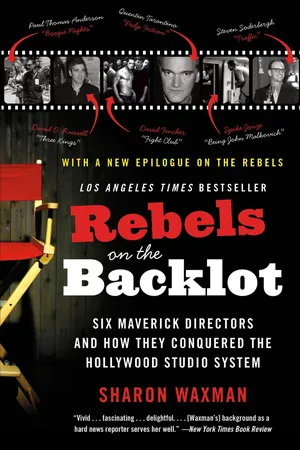
The 1990s saw a shock wave of dynamic new directing talent that took the Hollywood studio system by storm. At the forefront of that movement were six innovative and daring directors whose films pushed the boundaries of moviemaking and announced to the world that something exciting was happening in Hollywood. Sharon Waxman, editor and chief of The Wrap.com and for Hollywood reporter for the New York Times spent the decade covering these young filmmakers, and in Rebels on the Backlot she weaves together the lives and careers of Quentin Tarantino, Pulp Fiction; Steven Soderbergh, Traffic; David Fincher, Fight Club; Paul Thomas Anderson, Boogie Nights; David O. Russell, Three Kings; and Spike Jonze, Being John Malkovich.
eBook - ePub
Rebels on the Backlot
Six Maverick Directors and How They Conquered the Hollywood Studio System
- 464 pages
- English
- ePUB (mobile friendly)
- Available on iOS & Android
eBook - ePub
Rebels on the Backlot
Six Maverick Directors and How They Conquered the Hollywood Studio System
About this book
Information
Chapter 1
Quentin Tarantino Discovers Hollywood;
Steven Soderbergh Gets Noticed
1990–1992
Memorial Day in 1990 dawned bright and hot in Hollywood, even for a maker of horror films. Scott Spiegel, a screenwriter and the horror filmmaker in question, wanted to celebrate. He had some cash in his pocket from selling his first big screenplay, The Rookie, to Warner Brothers with Clint Eastwood attached to star. With his neighbor, actor D. W. Moffett, Spiegel threw a barbeque bash and invited to his backyard every starving actor, screenwriter, director, and movie wannabe he could think of, including some dedicated fans of his horror genre work.
Under leafy elm trees, behind a blue clapboard house on Mc-Cadden Place just off Sunset Boulevard, dozens of young wouldbes and could-bes in Hollywood gathered. Some of them would eventually make it. Director Sam Raimi was there along with actor/director Burr Steers and screenwriter Boaz Yakin. Others wouldn’t: One of the aspiring screenwriters present, Mark Carducei, would kill himself in 1997. The eighties still hung in the air; the cool guys had mullet haircuts and leather jackets; the hot women had long, permed hair fluffed out to there and bright red lipstick. While playing an electric keyboard, actor/screenwriter Ron Zwang belted out “Wild Thing” to a crowd slightly buzzed on beer and stuffed with Moffett’s burnt burgers and hot dogs. Inside the house a few people were slumped on a loveseat watching A Clockwork Orange.
One of the restless young men hanging around the yard was Quentin Tarantino, a twenty-seven-year-old screenwriter who’d spent the previous night on Spiegel’s couch. He loped around the backyard like a habitué of this crowd. He came from Manhattan Beach, an aspiring young screenwriter who only lately had started spending more time in Hollywood than in the working-class neighborhood down the coast.
Tarantino had reason to feel confident. After a decade of scraping by doing odd jobs, hanging with the other video geeks and movie dreamers at Video Archives, a video store in Manhattan Beach, Hollywood was beginning to show some interest. He had several scripts making the rounds, and a low-grade buzz had begun around his raw, clever screenplays: From Dusk Till Dawn, True Romance, Natural Born Killers. He was still penniless and unknown, but all of these scripts were on the verge of being sold. His moment was just off the horizon.
On this particular day, Tarantino was his blabbermouth self. He looked rumpled, of course, his striped blue shirt slightly untucked, his brown hair overgrown and stringy. As Spiegel wielded his video camera, Tarantino regaled film editor Bob Murawski with his latest insight on the latest movie he’d seen for the umpteenth time. When it came to film arcana, no one out-triviaed Quentin Tarantino.
“That movie—Motorcycle Gang—remember the goofy guy? His buddy? The goofy guy?” he asked, looming over his friend.
Murawski nodded.
“That’s Alfalfa!” Tarantino was psyched; he’d recognized one of the Our Gang actors in the B movie. “That’s Carl Switzer! I couldn’t believe it.”
Marowski was slightly less enthused. “That makes me glad I saw it,” he deadpanned.
Tarantino didn’t seem to notice. “It’s the same movie” (the same one as yet another B movie he’d seen, Dragstrip Girl.) “It’s the same lines. Yeah—I was reading about it last night.”
IN THE 1990S QUENTIN TARANTINO WOULD TURN OUT TO BE the biggest thing to hit the movie industry since the high-concept film. He became an image, an icon, and inspired a genre, if not an entire generation, of hyper-violent, loud, youthful, angry, funny (though none as funny as Tarantino) movies. His Pulp Fiction was the first “independent” film to crack $100 million at the box office, though technically it was made at a studio that had just been bought by the Walt Disney Company. Cinematically he spoke in an entirely new vernacular, and he threw down the gauntlet to fellow writer-directors as if to say Top this, assholes.
He also happened to come to prominence as the spinning, whizzing media machine began to be the central function of Hollywood rather than a mere by-product of its production line. In the 1990s the buzz machine, the sprawling, relentless entertainment media, became the very engine that made Hollywood run, a monstrous contraption that required constant feeding. And the Quentin Tarantino story was the perfect product to fill the cavernous maw.
The only thing is, a lot of the story wasn’t true.
THE MYTH THAT WORKED FOR THE LIKES OF ESQUIRE MAGAZINE and Entertainment Tonight went that Tarantino was a half-breed, white trash school dropout from rural Tennessee who went to work at a video store in Torrance, saw every movie known to mankind, and emerged, miraculously, a brilliant writer and director, a visionary autodidact with his finger on the pulse of his generation.
The reality is something far more subtle and complicated. Quentin Tarantino was not raised in poverty, nor in a white trash environment, nor as a hillbilly. He was from a broken home, but his mother was unusually intelligent and ambitious, and she did all she could to associate her son with the bourgeois values of the upper-middle class: education, travel, material success. Which Quentin chose to utterly reject.
After Quentin became a media star, his mother, Connie Zastoupil, was horrified to see a distorted view of his background spun into myth. After journalist Peter Biskind interviewed her for Premiere magazine, she was mortified by the first sentence that referred to Tarantino’s background as “half Cherokee, half hillbilly.” At the time, “I was the president of an accounting firm; my lawyer sent it to me,” she said in 2003. “You have no idea the humiliation that caused me. Nobody ever got beyond that one sentence.” She refused to talk to journalists for years after that.
CONNIE MCHUGH WAS BORN IN TENNESSEE, AND SHE DID indeed come from a middle-class, redneck background, half-Cherokee and half-Irish. But she was raised in Cleveland, Ohio. Her father, who was violent, owned a garage. Her mother, an alcoholic, was a housewife. From a young age she determined to get away from all of that. “I had a really bizarre childhood,” she explained. “I lied, schemed, and cheated to get out of that home.”
Ahead of her age group in school, Connie moved to California at age twelve to live with an aunt. She stayed for a year until her parents moved to Southgate, a small town in southern California, and made her move back with them.
When she was fourteen years old, Connie met would-be actor Tony Tarantino while horseback riding at the Buena Vista Stables, in Burbank. She looked older than her age and never told him she was fourteen. “Tony Tarantino fancied himself an actor. He had attended Pasadena Playhouse and taken classes there,” she said. “I married him to get away from that home. I had no desire to get married. I wasn’t really even into boys. I wasn’t sexually aware or precocious.” She got pregnant at fourteen but left Tarantino within four months. Connie has always told people that she got pregnant at sixteen, because “the minute a girl from the wrong kind of background gets into trouble, she’s trash. I had professional aspirations, class aspirations—I really wanted out. From the time I was a small child I knew there was something more in life for me; and education was going to be my way out of there.” Instead, she finished high school and moved back to Knoxville, Tennessee (her parents had left California and gone back to Tennessee), where she attended nursing school. Her mother cared for Quentin in the first two years, but Connie was in a hurry to get out of the south.
By age nineteen, she moved back to California “to get my life in order,” as she puts it. She got a job in a doctor’s office in Hacienda Heights, outside of Los Angeles, then met her second husband, Curt Zastoupil, at a local nightclub. He was twenty-five years old and worked as the pianist and guitarist in a family restaurant and bar. They married, and she sent for Quentin, aged three.
It was the 1960s, and Connie Zastoupil began to climb the corporate ladder. The doctor’s office where she worked became a partnership and eventually morphed into Cigna, the giant medical insurer. She quickly became a manager there and eventually rose to become the vice president of Cigna health plans in California.
“I was a little corporate geek wannabe,” she recalled. “When I was home with Quentin our life revolved around fun. We had hunting falcons, we fenced. We got kicked out of one apartment for our outrageous hobbies—fencing on a balcony. My husband was very eclectic; we had eclectic friends. We never left Quentin with a babysitter; if we went to an archery range, he’d come in the back of the car. We took him to every movie, regardless of whether it was appropriate, from the time he was three.”
Quentin spent a lot of time with Curt Zastoupil, who became his father for a time, and whose extended family became, permanently, his extended family. “Curt did love him,” said Connie. “He was his caretaker when I was working, because I worked days; he worked nights. Curt provided a steady stream of musicians, actors, poets—all the creative stream. I was the corporate drudge. I loved movies. We lived at the movie theater. Movies were a part of our lives. We went often and would do double, triple features.”
So Quentin Tarantino never lived in a trailer park. The closest he came to living a hillbilly life was at age eight, when his mother sent him to live in Knoxville, Tennessee, for a year when she was diagnosed—erroneously, it turned out—with Hodgkin’s lymphoma. Quentin lived with Connie’s alcoholic mother, who was verbally abusive and went off on drunken benders. It was also about that time that Connie divorced Curt Zastoupil. The divorce was devastating to Quentin, depriving him of the one stable male figure he’d known.
Beyond these turbulent moments in Quentin’s young life, he was a restless young man. As fate would have it, God handed the success-oriented, upwardly mobile Connie Zastoupil a downwardly mobile, academically averse child.
He was restless and had a short attention span. An early grade-school teacher wanted him to be put on Ritalin; Connie resisted, fearing the consequences of medicating her son. That teacher left a painful imprint on him, once telling him, “You’re so unlovable, I don’t understand how your mother can love you.” He told the story to his mother when he became a teenager, still a painful memory. But Quentin’s aversion to school never changed. He hated to go. He hated homework. School became, and always was, a place of discomfort for him.
From fourth grade he attended private school, Hawthorne Christian School, after his mother bought a sprawling house—thirty-five hundred square feet—in El Segundo, near Torrance, in the wake of the divorce. But things did not go better there. Quentin had sprouted into a tall kid and would get picked on for sticking out. His personal grooming was abominable, and he dressed like a slob. He didn’t want to be with upper-class kids and begged his mother to let him transfer back to public school, which she did in seventh grade. But by the ninth or tenth grade, he refused to go back to school at all.
“I knew you couldn’t force a teenager to go to school; he’d go on the streets and get into more trouble,” Connie explained. “And with Quentin I feared it would be worse than truancy. He’s a leader. He wouldn’t be passive. At least if I let him stay home, he’d be doing relatively harmless things, writing screenplays, watching TV. He’d be off the streets.”
So what Quentin did was watch TV and movies. All day. He was obsessively interested in movies, and he became a pop culture sponge. It was the sum total of his education. He began to write. His mother would come home from work and find Quentin’s scribbles on every available piece of paper, filling every yellow legal pad she brought from work. “He was sleeping all day, watching TV all night, and scribbling on paper. Pardon me if I didn’t recognize that as genius,” she admits. “I thought it was avoidance of responsibility and living in a dream world.”
The division between Quentin’s take on the world and his mother’s had become painfully obvious. She wanted to send him to Europe on vacation. He wouldn’t go. She wanted to buy him designer clothes. He insisted on dressing like a slob, in torn T-shirts; he wouldn’t bathe. Connie could never understand Quentin’s slacker attitude, and for a very long time didn’t take his interest in movies seriously.
“I’d get after Quentin about glamorizing poverty or the wrong side of the tracks, and he’d talk about Robert Blake not caring about the way he looked or dressed,” she recalled. “I was after Quentin about grooming, which was dismal. And his bedroom, and the attitude: It wasn’t important. Education wasn’t important. Nothing was important except movies. Hollywood. And at that time, although I was very entertainment-oriented, it drove me crazy.”
She went on: “To me it was a fantasy world he lived in. I knew he liked that stuff; he said he had ambitions to be an actor, but I thought that was an escape from reality. I’d say: ‘Whatever you do, I want you to get an education.’ I wouldn’t have cared, as long as he had [an] education. It was more than about livelihood to me: it was that ‘you must be educated.’ I wasn’t calm. He was picking at the fabric that was me and all the things I thought we needed to have to stay safe in this world I created.” In retrospect, Connie grew to become guilt-ridden at imposing her values on Quentin, to whom material success clearly did not matter, and doubting his precocious film talent.
She said: “In retrospect I wish I’d spent a whole lot more time at home. That was my baggage.”
But at the time, not insignificantly, she worried that her son would slide back into the world of poverty and ignorance that she’d escaped. “I was worried Quentin would be one of life’s dropouts who couldn’t function outside the home with Mom,” she said. Had Quentin not become a superstar—plenty of talented people don’t—that may well have been his fate.
BUT IT WASN’T. ONE SUMMER WHEN QUENTIN WAS FIFTEEN years old, Connie punished him for stealing a book from Kmart and getting caught by the police. Connie was mystified; she would have bought any book he wanted. Why did he steal? She confined him to the house for the entire summer. Softening, one day she let him out of the restriction, and Quentin asked to join a community theater group, which cost twenty dollars to join. “I gave it to him,” said Connie. “He came home and said he had the lead in their play.” The play was called Two and Two Make Sex, and it played at the Torrance Community Theater.
After that Quentin, who persisted for many years in his attempt to become an actor, was set on a path, heading to the James Best Theater acting classes in Burbank. His mother grew gradually less suspicious of his entertainment aspirations.
But later in life, Tarantino was unabashedly bitter toward his mother. They rarely spoke, and when Tarantino’s fortieth birthday passed in 2003, they were not in touch. Unlike some who succeeded in Hollywood, he did not buy her mink coats or a mansion. Something irreparable had broken between them. He blamed her for the instability of his youth; Connie married yet again, another union that didn’t last. In the years to come, Connie came to actively support Quentin’s ambitions. But it didn’t seem to help; Quentin was estranged from his mother during her third marriage and again in later years. In 2003 she wrote him a sixteen-page letter, begging him to come back to her, still hoping to reconcile. He didn’t write back. Connie Zastoupil never knew—and still doesn’t know—why her only son rejected her. It broke her heart.
TARANTINO LEFT MANY OTHER RELATIONSHIPS IN HIS wake as he made his way toward Hollywood. His early professional life follows a pattern of intense bonding with close friends and supporters, most of whom he jettisoned once he became successful.
In the early to mid-1980s Tarantino worked at the Video Archives store in Manhattan Beach, where he hooked up with a community of movie buff oddballs who became his closest friends. Video Archives was the kind of place that has almost disappeared in the world of the Blockbuster chain, a small, dark, quirky spot in a strip mall in Manhattan Beach that had on staff young movie geeks who watched videos all day and dreamed of making it in Hollywood. Its customers were a small clientele of faithful movie lovers. Tarantino started out as one of them, then eventually got hired and worked his way up to manager. He was perfect for the job, a slacker with a voracious film appetite and an encyclopedic memory to recall them on demand. The owner, Lance Lawson, sometimes let the staff sleep in the back room if they were broke. Tarantino would leave to write a script, or to dip a toe into Hollywood, but he always ...
Table of contents
- Dedication
- Contents
- Introduction
- Chapter 1 - Quentin Tarantino Discovers Hollywood; Steven Soderbergh Gets Noticed, 1990–1992
- Chapter 2 - Spanking and Flirting; Chewing on Pulp Fiction, 1992–1995
- Chapter 3 - Hard Times on Hard Eight; Flirting with the Indies; Schizopolis, The Experiment, 1994–1995
- Chapter 4 - New Line Hits a Bump in the Road; Paul Thomas Anderson Starts to Boogie; Steven Soderbergh Hits Traffic, 1996
- Chapter 5 - David Fincher Takes on Fight Club, 1996
- Chapter 6 - The Essence of Malkovich; Making Boogie Nights, 1996
- Chapter 7 - Pulling Punches on Fight Club; Pulling Strings for Malkovich; Magnolia Blooms, 1997
- Chapter 8 - Shooting the Real Malkovich; Warner Brothers Anoints Three Kings; Getting Traffic Out of a Jam, 1998
- Chapter 9 - Casting Three Kings—George Clooney Tries Harder; The Shoot—War Breaks Out, 1998
- Chapter 10 - 1999: A Banner Year; Fight Club Agonies, Fox Passes on Traffic
- Chapter 11 - Releasing John Malkovich; Testing Three Kings; Trimming Magnolia, 1999
- Chapter 12 - Fight Club Fallout; The Fruits of Violence, 1999
- Chapter 13 - Casting Harrison Ford; Movie Stars Rule; Making Traffic the Schizopolis Way, 2000
- Conclusion
- Notes
- Index
- Acknowledgments
- P.S.: Insights, Interviews & More …
- New, Updated Epilogue
- Praise for Rebels on the Backlot
- Copyright
- About the Publisher
Trusted by 375,005 students
Access to over 1.5 million titles for a fair monthly price.
Study more efficiently using our study tools.
Frequently asked questions
Yes, you can cancel anytime from the Subscription tab in your account settings on the Perlego website. Your subscription will stay active until the end of your current billing period. Learn how to cancel your subscription
No, books cannot be downloaded as external files, such as PDFs, for use outside of Perlego. However, you can download books within the Perlego app for offline reading on mobile or tablet. Learn how to download books offline
Perlego offers two plans: Essential and Complete
- Essential is ideal for learners and professionals who enjoy exploring a wide range of subjects. Access the Essential Library with 800,000+ trusted titles and best-sellers across business, personal growth, and the humanities. Includes unlimited reading time and Standard Read Aloud voice.
- Complete: Perfect for advanced learners and researchers needing full, unrestricted access. Unlock 1.5M+ books across hundreds of subjects, including academic and specialized titles. The Complete Plan also includes advanced features like Premium Read Aloud and Research Assistant.
We are an online textbook subscription service, where you can get access to an entire online library for less than the price of a single book per month. With over 1.5 million books across 990+ topics, we’ve got you covered! Learn about our mission
Look out for the read-aloud symbol on your next book to see if you can listen to it. The read-aloud tool reads text aloud for you, highlighting the text as it is being read. You can pause it, speed it up and slow it down. Learn more about Read Aloud
Yes! You can use the Perlego app on both iOS and Android devices to read anytime, anywhere — even offline. Perfect for commutes or when you’re on the go.
Please note we cannot support devices running on iOS 13 and Android 7 or earlier. Learn more about using the app
Please note we cannot support devices running on iOS 13 and Android 7 or earlier. Learn more about using the app
Yes, you can access Rebels on the Backlot by Sharon Waxman in PDF and/or ePUB format, as well as other popular books in Mezzi di comunicazione e arti performative & Film e video. We have over 1.5 million books available in our catalogue for you to explore.