Can an object go straight to your heart?
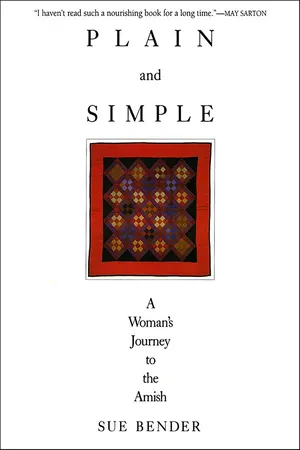
Twenty years ago I walked into Latham’s Men’s Store in Sag Harbor, New York, and saw old quilts used as a background for men’s tweeds. I had never seen quilts like that. Odd color combinations. Deep saturated solid colors: purple, mauve, green, brown, magenta, electric blue, red. Simple geometric forms: squares, diamonds, rectangles. A patina of use emanated from them. They spoke directly to me. They knew something. They went straight to my heart.
That was the beginning. Innocent enough.
“Who made these quilts?” I demanded.
“The Amish.”
I went back to Latham’s every day that summer, as if in a trance, not noticing it at first, just something I did in the midst of all the other things I was doing. Visiting the quilts became a practice, something like a spiritual practice, the one constant in days that were otherwise filled with the activities of summer.
I stared at the quilts. They seemed so silent: a “silence like thunder.” It was 1967, and I was thirty-three years old.
I had seen lots of old quilts before, made by non-Amish women. They drew on an unlimited palette: plaid, polka dots, calico, corduroy, velvet. Their patterns were endless: Geese in Flight, Log Cabin, Bear Paw, Fans, Pinwheel, School House, Broken Dishes, Old Maid’s Puzzle, Indian Hatchet, Crown of Thorns, and many more.
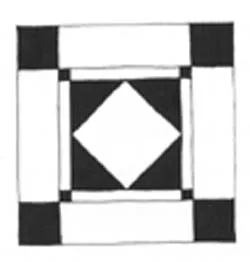
The Amish used the same few patterns over and over—no need to change the pattern, no need to make an individual statement.
The basic forms were tempered by tiny, intricate black quilting stitches. The patterns—tulips, feathers, wreaths, pineapples, and stars—softened and complemented the hard lines, and the contrast of simple pattern and complex stitchery gave the flat, austere surface an added dimension. I wondered if quilting was an acceptable way for a woman to express her passion?
I learned that the Amish used their old clothing to make the haunting colors in the quilts. Nothing was wasted; out of the scrap pile came those wondrous saturated colors. Like most deeply religious farm people, the Amish wore dark, solid-colored clothing, made from homespun material. But underneath, hidden from view, were brightly colored petticoats, blouses, and shirts.
Colors of such depth and warmth were combined in ways I had never seen before. At first the colors looked somber, but then—looking closely at a large field of brown—I discovered that it was really made up of small patches of many different shades and textures of color. Greys and shiny dark and dull light brown, dancing side by side, made the flat surface come alive. Lush greens lay beside vivid reds. An electric blue appeared as if from nowhere on the border.
The relationship of the individual parts to the whole, the proportion, the way the inner and outer borders reacted with each other was a balancing act between tension and harmony.
The quilts spoke to such a deep place inside me that I felt them reaching out, trying to tell me something, but my mind was thoroughly confused. How could pared-down and daring go together? How could a quilt be calm and intense at the same time? Can an object do that? Can an object know something?
How opposite my life was from an Amish quilt.
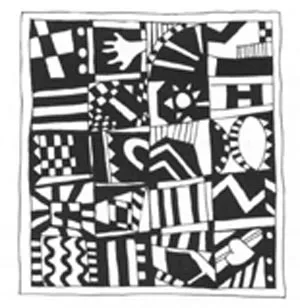
My life was like a CRAZY QUILT, a pattern I hated. Hundreds of scattered, unrelated, stimulating fragments, each going off in its own direction, creating a lot of frantic energy. There was no overall structure to hold the pieces together. The Crazy Quilt was a perfect metaphor for my life.
A tug-of-war was raging inside me.
In contrast to the muted colors of the Amish, I saw myself in extremes: a black-and-white person who made black-and-white ceramics and organized her life around a series of black-and-white judgments.
I divided my world into two lists. All the “creative” things—the things I valued, being an artist, thinking of myself as undisciplined and imaginative—were on one side, and the boring, everyday things—those deadly, ordinary chores that everyone has to do, the things I thought distracted me from living an artistic life—were on the other side.
I was an ex-New Yorker living most of the time in Berkeley, California; a wife and mother of two sons; an artist and a therapist with two graduate degrees, one from Harvard, one from Berkeley. That was my resume.
I valued accomplishments.
I valued being special.
I valued results.
The driven part didn’t question or examine these values. It took them as real, and believed it was following the carrot “success” wholeheartedly. Didn’t everyone believe in success? I never asked, “Success at what cost?”
A part of me is quiet. It knows about simplicity, about commitment, and the joy of doing what I do well. That part is the artist, the child—it is receptive and has infinite courage. But time and my busyness drowned the quiet voice.
In the world in which I grew up, more choices meant a better life.It was true for both my parents amnd my grandparents. I was brought up to believe that the more choices I had, the better.
Never having enough time, I wanted it all, a glutton for new experience. Excited, attracted, distracted, tempted in all directions, I thought I was lucky to have so many choices and I naively believed I could live them all.
A tyranny of lists engulfed me. The lists created the illusion that my life was full.
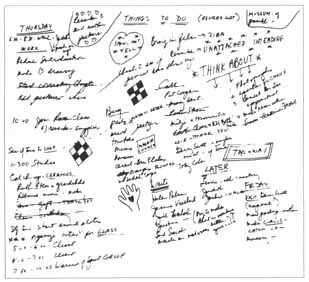
I would wake at five A.M. eager to begin. The first thing I did was to compose my Things to Do list. This gave me great pleasure, even though the list was nothing more than a superimposed heap of choices, representing all the things I enjoyed doing and all the things I had to do, crowding and bumping against each other. Any organized person would have said “This is ridiculous. It’s unrealistic. No one could accomplish so many things in one day.”
Sometimes I would stop in the middle of the day, when the scene on the page looked especially chaotic, and rewrite the list, never thinking to take anything off, but hoping the newly transformed neat rows would overcome my feeling of being overwhelmed. It was a balancing act on one foot—even when I was doing something I enjoyed, my mind jumped about, thinking of what was next on my list.
I never thought to stop and ask myself, “What really matters?” Instead, I gave everything equal weight. I had no way to select what was important and what was not. Things that were important didn’t get done, and others, quite unimportant, were completed and crossed off the list.
Accumulating choices was a way of not having to make a choice, but I didn’t know that at the time. To eliminate anything was a foreign concept. I felt deprived if I let go of any choices.
By evening, the list had become a battlefield of hieroglyphics; crossed-off areas, checks and circles, plus the many temptations added during the day. The circles were there to remind me of all the tasks that didn’t get done. Tomorrow’s list began with today’s leftovers.
I never questioned my frantic behavior. When I looked around, most of my friends were like me, scurrying around and complaining that they never had the time to do all the things they really wanted to do.
Only now, looking back, can I hear a child’s voice inside me calling “STOP, I want to get off. The merry-go-round is spinning faster and faster. Please make it stop.”
At the time I thought I was extremely lucky. But something was missing, and though I could not have said what that “something” was, I was always searching, believing there was something out there—and if only I could find it. That “if only” kept me trying to change. I took classes—trying to improve, hoping I’d be a better person. A friend laughed, “I’ll know you’ve changed when you stop trying to change.”
I didn’t know that my addiction to unrelenting activity produced a quiet desperation that permeated every cell of my being. In the world of “if only,” nothing I was doing would ever be enough.
Spinning frantically, I left myself out.
I had become an artist by chance.
In 1960, three months before the birth of my first child, I stopped teaching history at New Rochelle High School in New York and joined a clay class. The timing was perfect: I had planned to miss only three months of teaching before school began again in September. I never returned. In those few months, I fell in love with clay. Clay was soft and responsive. It had its own rhythm, its own heartbeat, a timing sensitive to moods and the atmosphere, just like a person. It didn’t make demands, but it did ask me to pay attention and to listen. I thought being receptive meant being “out of control,” so I had a lot of difficulty with that part of the relationship. On damp days, the clay took longer to harden. Impatient, I put the pieces in my kitchen oven, willing them to dry faster.
For all the abuse I gave the clay, I also had a natural connection with the material. Clay became part of me, not just something I did. But I never saw myself as just a potter. Refusing to make regular or practical forms, I felt I was something more, an artist. To me “regular” meant ordinary. I was determined to stand ou...