A fascinating look at life in the Middle Ages that focuses on eight extraordinary medieval men and women through realistically invented conversations between them and their counterparts.
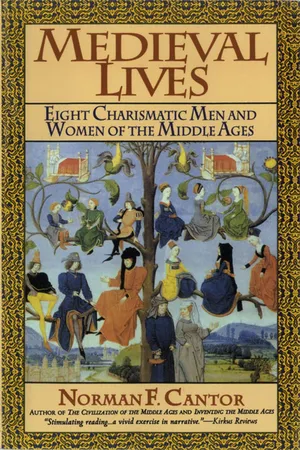
- 228 pages
- English
- ePUB (mobile friendly)
- Available on iOS & Android
eBook - ePub
About this book
Information
CHAPTER ONE
THE ADVENT OF THE MIDDLE AGES
HELENA AUGUSTA
“The old Jewish whore is coming down the road with the bishop of Caesarea and the rest of her entourage,” said Spero, the innkeeper, to Petra, the head of his assembled staff of six people. “They will be here very soon and they will be thirsty, hungry, tired, and dirty from the dusty road. They have been on the road from Caesarea since early this morning. Remember she wants to be treated like an empress and the Emperor Constantine expects us to treat his mother Helena as an Augusta, an empress. Remember there is good money for all of us if we please old Helena the Jewish bitch.”
It was late in the afternoon of a hot September day in the year 326, at a crossroads a mile east of the Palestinian coast halfway between Caesarea in the north and Jaffa in the south.
As the cloud of dust signaling that the Augusta’s party was approaching increased in size, Spero became more nervous and fussy. He turned to the stable boy and made sure there was enough hay for the horses in the Augusta’s entourage.
“Remember, Petra,” Spero said to the young woman whose special responsibility it was to supervise the dining room, “the meals must be not only well prepared but elegantly served and only our best vintages from the Golan Heights will do.”
Spero came from one of the Greek pagan families that the imperial government had settled in ancient Judea after Roman arms crushed the last Jewish revolt and the province’s name was changed to Palestine.
The Romans had treated the Jews generously and the imperial government’s reward for this generous treatment had been two fierce revolts within sixty years by the Jewish freedom fighters. After revolts were suppressed and the Jewish Temple destroyed, the Jews were expelled from Jerusalem and coastal plain where Caesarea was located and they were confined to the Galilee and the Golan Heights in the north of the country.
From the eastern Mediterranean the imperial government brought in Greek-speaking Gentile immigrants of various ethnic backgrounds to replace the exiled Jews. Fourth-century Palestine was still a rich agricultural land. It still as in biblical time provided bounteous crops. It was not yet desiccated by millennia of mining the soil, back to the time of the Canaanites, and perhaps a deterioration of the climate through a radical drop in rainfall that occurred under Arab rule.
After the Jews were expelled from southern Palestine, it became a quiet land. No more the clogging of the roads with families headed up to Jerusalem to pray and offer sacrifices at the Temple. No more rabbinical schools where bearded young men shook themselves while they studied, syllable by syllable, the sacred text of the Torah. No more the litigants assembled before rabbis, awaiting their judicial decisions. No more the crowds gathered around prophets declaiming the Word of God on hilltops and in market squares. No more the lineups at the ritual slaughterhouses awaiting precious supplies of kosher meat. Southern Palestine was a quiet land now, like Poland in the late 1940s after the Jews were dead.
The villa, the gymnasium, and the amphitheater were now the prominent features of the Palestinian landscape, signaling the triumph of Greek culture in the Holy Land. Paganism prevailed in the land of the prophets.
Like so many Greeks in Palestine, Spero hated the displaced Jews, just as the Israelis now detest the displaced Palestinians.
“Spero, why do you call Empress Helena a Jewish whore?” said Petra. “I know you don’t like the Emperor Constantine and his family because they are Christians and you have stayed passionately loyal to the old gods. I know that you are disappointed that for the first time a Christian has become emperor. But why do you call Helena a Jewish whore?”
Spero came originally from Alexandria in Egypt. He was a product of that mercantile middle class in the cities of the eastern Mediterranean upon whom both the economic and intellectual vitality of the Roman Empire heavily depended. He had attended the schools of Greek philosophy there, where traditional Graeco-Roman polytheism had been refined through the prism of Platonic philosophy and Middle Eastern mysticism. In Alexandria, Spero had also imbibed the intense anti-Semitism that had developed among the pagan intellectuals as the conflict endured between the Greek-speaking majority and the large Jewish minority in the Egyptian metropolis. Like so many scholars and intellectuals in the later Roman Empire, especially those who remained loyal to the old religion and did not join the Christian Church and become bishops and priests, Spero could not make a living as a scholar and philosopher. He had to find a trade. He migrated to Palestine, where the Roman government had welcomed pagan immigrants, and became an innkeeper.
Spero drew Petra aside, out of the earshot of the rest of his staff.
“Because that is how Helena started out—a half century ago in a small city in Bythinia, in Asia Minor, among the proletarian Jewish masses in those stinking cities there. She was a barmaid and a stable girl, and one day a Roman officer named Constantius took her as his concubine and Constantine our emperor was the product of that union of these two pathetically obscure people—the soldier and the barmaid—in a provincial town. But then Constantius showed his political mettle and rose in the ranks, and his Jewish barmaid concubine became an obstacle to his advancement. So he abandoned her and took a proper wife, and you know the end of the story—Constantius got to be the assistant emperor in the north, in Britain, and Constantine his son inherited his army and marched on Rome and gained the imperial purple.”
“Where was Helena all that time?” asked an intrigued, wide-eyed Petra.
“Who knows? Probably back in that town in Bythinia—today absurdly called Helenepolis—serving wine, cleaning the stables, and putting out for the soldiers. This is our great imperial family. May the gods preserve us.”
“But Constantine didn’t forget his momma, did he? That says something for the Christian emperor you don’t like,” said Petra.
“Yes, give Constantine credit for that, if raising whore mothers to the imperial purple is a good thing—Constantine deserves the credit,” said Spero.
The Augusta’s entourage turned off the main road and wound up the path to the inn. Four soldiers in heavy armor rode at the front, followed by the empress’ litter, its sides covered in heavy brocade and the monogram of Christ, Chi Rho, rising in a gold ornament from the top of the litter, which was carried by four huge swarthy slaves. Behind the litter rode the elegantly dressed bishop, Eusebius of Caesarea, the senior ecclesiastic of all Palestine, and chief court propagandist and confidant of the emperor. A dozen servants and six more soldiers on foot shuffled on behind the bishop.
When the Augusta’s litter reached the front of the inn, Spero and Petra and the rest of the staff were stiffly assembled to greet Helena and the bishop. Helena opened the side of the litter and looked cautiously at Spero and his group. With the help of a personal maidservant who had emerged from the crowd that had followed the empress and the bishop, Helena got out of the litter and stood erect and looked around. She was an old woman of seventy-six years, but still handsome, vigorous, and dignified. She had white hair, bright brown eyes, and a large Semitic nose. Spero prostrated himself facedown on the ground at Helena’s feet until she motioned to him to get up.
Spero rose and quickly dusted himself off.
“How great an honor it is that the Helena Augusta, mother of the most exalted Emperor Constantine, should stay at our humble inn, Supreme Majesty. We shall do everything to make you and his grace, the bishop of Caesarea, the famous theologian and historian Eusebius, and all your soldiers and servants in Your Excellency’s entourage welcome and comfortable for tonight.”
Helena ignored Spero and motioned to Petra.
“Young woman,” said Helena in a loud and firm voice. “I call upon you to help me. I am tired and thirsty from the trip to Caesarea. We have a long way to go before we reach our destination in Jerusalem. You can show me to my room.”
Petra led the way into the inn and upstairs to its best room. A silent Eusebius, a tall, thin figure with a dour face, a silver cross dangling from his neck, followed Spero to the room assigned to him.
Spero’s inn lay at the busiest crossroads in Palestine, where the road eastward to Jerusalem intersected with the coastal road between Caesarea and Jaffa. This intersection is still one of the busiest in Israel, the site today of lengthy traffic jams. The intersection lies about 20 miles south of Caesarea, the leading city in Roman Palestine at this time, while Jerusalem still lay devastated from the Jewish wars against Rome and the failure of the great Jewish rebellions against imperial power.
Caesarea on the Mediterranean was renowned for its beautiful villas and a splendid open-air theater. Today villas of prominent Israeli politicians and businessmen, including the private home of the current president of Israel, Ezer Weizman, are located in Caesarea. The amphitheater facing the sea has been restored by the Israelis and is heavily used in summer for concerts. Lifestyle in the Holy Land has not changed much since the time of Constantine—only the ethnicity of the master race.
Today at the crossroads where Spero’s inn was located there is a large gas station, within a wing of which is discreetly located one of the best (and cheapest) Arab restaurants in Israel.
After Helena had bathed with the aid of her personal maid, she dismissed the servant, and dressed only in a simple linen chemise laid down in the bed that Petra had prepared for her. Petra had gone down to the wine cellar while the empress was in her bath and now she held on a tray a beaker of white wine and a blue metal goblet, the best that this roadside inn had to offer.
“Your Majesty,” said Petra, “may I offer you some of our best white wine. It is from the Golan Heights in the far north, where we get all our wine, and the Jewish rabbi who personally supplies us from his vineyard on the cool mountains in the Golan made a delivery just this morning. It is a new cask we have tapped to make sure the wine would be at its best for you.”
Helena took the wine, drained the goblet in one swallow, motioned for a refill, and downed that too. Petra filled the goblet a third time. Helena set it on the table next to her bed. “Petra,” said the Augusta, “come and sit beside me on the bed. You are a pretty young woman. You remind me of the woman I once was long ago in Bythinia, when I too worked in an inn and capably served the guests as you are doing. I think you must be about the same age I was when I gave birth to my son Constantine. I was then twenty-four.”
“I am a little older than that, Your Highness,” said Petra.
“And what is your race, Petra? Tell me about yourself.”
“Your Majesty, I told Spero when I came to work here last year I was a Palestinian, but I cannot lie to you. I am Jewish. Jews are not supposed to live in this part of the country, I know, ever since the great revolts against Rome. The Jews were exiled from Jerusalem and from the coastal plain here and confined to Galilee and the Golan in the north. But some Jews have come back here quietly to seek employment among the Romans, Greeks, and Palestinians. And if we are quiet, no one bothers us, especially the women among us. The Jewish men cannot easily disguise their race because they pray so much and they are circumcised, but it is easy for an unmarried Jewish woman to pretend she is a Gentile and to get employment in an inn. I needed the work. There was little for me to do up north, except to get married to a pious man and produce many children. The atmosphere up there in the Galilee and Golan among the Jews is oppressive, with all those devout rabbis, who consider women inferior and imprison us in their rules and large families. So that is why I came down here and I told Spero I was a Palestinian. I hope, exalted Augusta, you will keep my little secret and not give me away.”
“Of course, I won’t,” said Helena. “I am a Jewish woman myself in origin, and I know how hard it is for a Jewish girl, and how oppressive the rabbis are. I told my son about how I suffered as a young vivacious woman who liked sex and drinking, how the rabbis persecuted me for this, and maybe that is why the Emperor Constantine hates the Jews so much. Constantine won’t even let the Church celebrate Easter at its proper time—at Passover. He and the bishops invented an alternative date. I thought that was funny.”
There was a warm feeling between the two Jewish women, separated by a half century in age, but with something in common—their careers as barmaids and their need to make their own way in the world, with little help from their original families and hostility from the rabbis because of their proclivity to sex and drink.
“Empress Augusta,” said Petra boldly, “I have heard so much about your many charities to the poor and the sick, how you free slaves and rescue convicts. But why at your age are your embarked on this tiresome journey to Jerusalem? Most of the old city still lies wasted, from the Jewish wars against Rome and the Romans’ savage destruction of the city, and you have three more days of travel from here, having already spent a day en route from Caesarea. And you know, it is a difficult journey, first having to cross the hot central plains of the country and then, in the last leg of the journey, having a long climb up a steep hill—Jerusalem is very high up.”
“I know that,” said Augusta. “It is indeed a difficult journey for someone of my advanced age. But I am in good health and it isn’t that I have to walk there or even go on horseback. In any case, I am compelled to go, both by my son the emperor and by my Christian God. I go there to do penance and make restitution for my family. Have you not heard of the tragedy that has struck the imperial family?”
“No, I have not,” said Petra.
“The secret has been well kept. Not many people know. The public is ignorant. To speak frankly, three months ago Constantine suddenly ordered the deaths of his eldest son, my beloved grandson, Crispus, a brilliant young man, and also the death of Constantine’s then current wife Fausta. The death sentences were carried out very quietly—Crispus died from poisoning, Fausta was killed in a steam bath, to make it look like an accident. The deaths were justified, but Constantine’s terrible anger is now stilled and he is remorseful for killing his favorite son and his son’s stepmother.”
“Why were these killings justified, Your Majesty?” said Petra cautiously.
“Crispus and Fausta were almost of the same age—Crispus was the son of a concubine, as you know Constantine was himself, and I was that concubine who was Constantine’s mother. Crispus and Fausta were found to have had a sexual relationship. By Roman law, Constantine was justified in ordering their deaths. Perhaps he was compelled to do so. But now he is remorseful, and to appease the Christian God that he now worships—as I do, because he insists I do so—he has gone on an orgy of church building all over the empire. He especially wants to honor Jesus Christ, to whom he prayed before his most crucial battles and always received Christ’s support. Constantine has already ordered the bishop of Jerusalem to make preparations for building a great church over Christ’s tomb, if it can be found. I am going to Jerusalem to find this tomb and to direct the building of the Church of the Holy Sepulchre over it. Constantine thinks that the building of this church in Jerusalem will cause Christ to forgive him for the deaths of Crispus and Fausta, if Christ puts any blame on the emperor.”
“I was in Jerusalem a year ago,” said Petra, “and the Temple Mount is in ruins and covered with debris. I hope you can find Jesus’ tomb.”
“I have no doubt that I will,” said Helena, “but that is not all. While I am in Jerusalem I will search for relics of the True Cross on which the Savior was crucified. I had a dream last month that I would find the True Cross and bring it back to Constantinople, to Constantine’s capital, where it will be the center of Christian worship and adoration. I have already once in my life been the instrument of God’s providence for changing the course of history. I was the mother of Constantine, the first Christian emperor. I do not know why God chose me for this divine purpose. But He did. Now I feel He has chosen me to find the Holy Sepulchre and the True Cross which will confirm millions in their faith and, I hope, bring millions more into the Church. All this for a poor Jewish girl in Bythinia, who became the lover and concubine of a minor officer in the Roman army there. Even th...
Table of contents
- Cover
- Title Page
- Dedication
- Contents
- Preface
- Acknowledgments
- Chapter One: The Advent of the Middle Ages: Helena Augusta
- Chapter Two: African Horizons: Augustine of Hippo
- Chapter Three: Northerners: Alcuin of York
- Chapter Four: Revolution: Humbert of Lorraine
- Chapter Five: The Form of Woman: Hildegard of Bingen
- Chapter Six: The Glory of It All: Eleanor of Aquitaine
- Chapter Seven: The Parting of the Ways: Robert Grosseteste
- Chapter Eight: The Winter of the Middle Ages: John Duke of Bedford
- Chapter Nine: Epilogue: Medieval People
- Select Bibliography
- Index
- Also by Norman F. Cantor
- Praise
- Copyright
- About the Publisher
Trusted by 375,005 students
Access to over 1.5 million titles for a fair monthly price.
Study more efficiently using our study tools.
Frequently asked questions
Yes, you can cancel anytime from the Subscription tab in your account settings on the Perlego website. Your subscription will stay active until the end of your current billing period. Learn how to cancel your subscription
No, books cannot be downloaded as external files, such as PDFs, for use outside of Perlego. However, you can download books within the Perlego app for offline reading on mobile or tablet. Learn how to download books offline
Perlego offers two plans: Essential and Complete
- Essential is ideal for learners and professionals who enjoy exploring a wide range of subjects. Access the Essential Library with 800,000+ trusted titles and best-sellers across business, personal growth, and the humanities. Includes unlimited reading time and Standard Read Aloud voice.
- Complete: Perfect for advanced learners and researchers needing full, unrestricted access. Unlock 1.5M+ books across hundreds of subjects, including academic and specialized titles. The Complete Plan also includes advanced features like Premium Read Aloud and Research Assistant.
We are an online textbook subscription service, where you can get access to an entire online library for less than the price of a single book per month. With over 1.5 million books across 990+ topics, we’ve got you covered! Learn about our mission
Look out for the read-aloud symbol on your next book to see if you can listen to it. The read-aloud tool reads text aloud for you, highlighting the text as it is being read. You can pause it, speed it up and slow it down. Learn more about Read Aloud
Yes! You can use the Perlego app on both iOS and Android devices to read anytime, anywhere — even offline. Perfect for commutes or when you’re on the go.
Please note we cannot support devices running on iOS 13 and Android 7 or earlier. Learn more about using the app
Please note we cannot support devices running on iOS 13 and Android 7 or earlier. Learn more about using the app
Yes, you can access Medieval Lives by Norman F. Cantor in PDF and/or ePUB format, as well as other popular books in History & History of Art. We have over 1.5 million books available in our catalogue for you to explore.