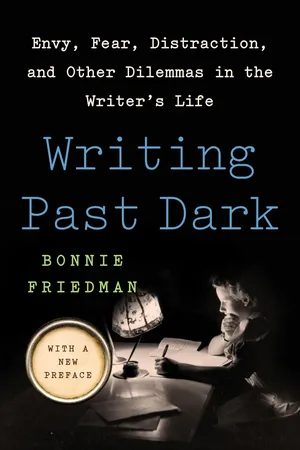
Writing Past Dark charts the emotional side of the writer's life. It is a writing companion to reach for when you feel lost and want to regain access to the memories, images, and the ideas inside you that are the fuel of strong writing. Combining personal narrative and other writers' experiences, Friedman explores a whole array of emotions and dilemmas writers face—envy, distraction, guilt, and writer's block—and shares the clues that can set you free. Supportive, intimate, and reflective, Writing Past Dark is a comfort and resource for all writers.
eBook - ePub
Writing Past Dark
Envy, Fear, Distraction and Other Dilemmas in the Writer's Life
- 148 pages
- English
- ePUB (mobile friendly)
- Available on iOS & Android
eBook - ePub
About this book
Information
Envy, the Writer’s Disease
IT USED TO BE LIKE A FEVER WITH ME, a compulsion, a madness: to go into a bookstore, head straight for the brand-new books, flip right to the back of the jacket and see if the author was young or old, my age or even—rats!—younger. Envy is a vocational hazard for most writers. It festers in one’s mind, distracting one from one’s own work, at its most virulent even capable of rousing the sufferer from sleep to brood over another’s triumph.
Envy is the green-eyed beast. It is a sickness; it is a hunger. It is the self consuming the self. It takes what was most beloved—reading books, writing them—and sours it, a quick drop of vinegar into the glass of sweet milk. Even friendships aren’t exempt. “That story of mine?” your friend says at lunch. “The New Yorker took it. I thought you knew.”
A finger has tapped your heart. You smile. This is your friend. Surely you feel happy for your friend. And yet a space opens between you. You can feel it there, wide enough for a cool breeze to blow across.
What is this thing that can take the best from us and yet remain unsatisfied? When I think of envy, I think of Pharaoh’s lean cows. They eat up the healthy ones—cannibals, those cows!—yet they remain as skinny as ever, so that, the Bible tells us, “when they had eaten them up, it could not be known that they had eaten them; but they were still ill favored, as at the beginning.” I’ve always felt sorry for those cows. We’re told they’re poor and lean-fleshed, emaciated and ugly. They feed, but cannot digest. They are unhealthy desire incarnate.
Another image of envy—this time not of my conjecturing, but called Envy by its author—comes from an anonymous late medieval poet:
Where Envy rokketh in the corner yond,
And sitteth dirk; and ye shall see anone
His lenë bodie, fading face and hond;
Him-self he fretteth, as I understond.
Envy sits in the corner, hidden, hiding, starved. His face and hand are fading, so thin is he, so insubstantial has he become from fretting himself. (“To fret” here meant to gnaw away at or to rub away. A medieval cookbook directed one to fret an apple through a sieve. “Fret” also refers, of course, to an agitation of the mind, a vexation.)
Envy frets himself. He is alone, his own victim. He is self-absorbed. He is self-propelled. It does not take two to envy. Somehow it takes only one.
Cynthia Ozick, that miracle word-spinner, speaks of envy in a generous interview published in Writers at Work: The Paris Review Interviews, Eighth Series. “Youth,” she says, “is for running around in the great world, not for sitting in a hollow cell, turning into an unnatural writing-beast. There one sits, reading and writing, month after month, year after year. There one sits, envying other young writers who have achieved a grain more than oneself. Without the rush and brush and crush of the world, one becomes hollowed out. The cavity fills with envy. A wasting disease that takes years and years to recover from.”
What is this thing that has us chewing at our own selves, grating ourselves against our own sharp sieve? It is the act of stepping back. It is the act of separating, and judging. It takes only one because the one becomes two. The self separates from the self. It points a finger and declares, “You are good” or “You are bad.” Either one, it doesn’t matter. The first statement usually flips over to become the second. And vice versa. Either way, the separated self is not doing the writing. Envious, the self is thinking about the writing, thinking about the self, rocking in its dark corner.
The self steps back and pretends to be the world. It says: “I too think that self is ugly. I too condemn it.” If you condemn it, you cannot be it. Thus the envious self protects itself from feeling puny. It identifies with the powerful, with the world that may condemn the self. It is not the inferior one—far from it! It will take that inferior one and punish it against that sieve. Envy fretteth him-self.
That sharp sieve may be a favorable review of someone else’s book. It may be the book in our hand, showing the author’s glowing face. What is she? Fifteen? There are a million sieves in the world, many in the shape of a book—that thing we loved most, transformed.
Even Shakespeare was tormented by this transformation: “When in disgrace with fortune and men’s eyes / . . . Desiring this man’s art, and that man’s scope.” Shakespeare desired another’s art? Dear Lord, whose? And doesn’t this prove that envy is one of the scorpions of the mind, often having little to do with the objective, external world? “With what I most enjoy contented least,” the poet says. “Yet in these thoughts myself almost despising.” For Shakespeare too, apparently, the source of pleasure could be transformed into a painful sieve. Even he could end up with a sense of almost self-loathing.
Perhaps an elemental sense of being neglected precedes the adult experience of recognition or neglect. I’m not saying that many people don’t have just cause to feel slighted, to feel jealous of another’s gifts. I’m suggesting that the sense of being deprived may preexist mature experience. So that as adults, we are often reminded of that earlier state. So that we are more attuned to repetitions of that same experience of hunger, and we may even transform neutral experiences into ones in which we can reconfirm our own earlier state. Perhaps some of us even go so far as to become deaf to positive experiences or to find some way to discredit them.
I had a friend at writing school who won many prizes and got enthusiastic letters from editors. But whenever I went to visit her, she said, “Look at this letter! Another rejection—I’m so depressed!” It’s true it was another rejection, but what about the wild praise that preceded the “Please send more work,” the great big dollops of heavy cream? I’d sit on the couch, sick at heart that the letter wasn’t mine, while my friend scanned my face. Did my misery really prove to her that her work was loved? Could she really nourish herself from my face? Strindberg writes about ego vampires, and I suppose my friend, in a way, was one. Still, I can’t believe the sustenance she derived from my unhappiness stayed with her. She showed the letter to the next person who visited, and the one after that. She ate, but starved. The no in the letter drowned out all the yes.
“I want to be a star,” this woman once told me, unabashed. We were walking through a heavy, swinging door, and I stopped a moment, stunned, before I pushed through. What awed me was not that she wanted to be a star—didn’t we all?—but that she’d say so, flat out. I thought if you had the gumption to say what you wanted, you’d probably have the nerve to get it. And I was, in fact, impressed by her desire. Most of us wanted the same thing, but we tried not to know it. Such grand wants exact a price. Better to content oneself with the small success.
“I am ashamed to confess this,” Cynthia Ozick says in her Paris Review interview. “It’s ungrateful and wrong. But I am one—how full of shame I feel as I confess this—who expected to achieve—can I dare get this out of my throat?—something like—impossible to say the words—Literary Fame by the age of twenty-five. By the age of twenty-seven I saw that Holy and Anointed Youth was over, and even then it was already too late.”
Too late! We will either be Thomas Mann or nobody. We will be F. Scott Fitzgerald or we ought not to exist at all. And some young writers actually do make it. Look, there’s Susan Minot, there’s David Leavitt and Michael Chabon. Names on the pages, photos in the magazines, as if to prove it can still be done, real achievement and fame in one fell swoop in the flush of what Ozick calls “Anointed Youth.”
In an episode of the old television comedy “Car 54, Where Are You?” Officer Gunther Toody tries to reassure his partner, Francis Muldoon, who is grieving because his father made police captain when he was years younger than Francis is now. “Don’t feel bad,” Gunther says. “People were younger back then.” I’ve believed that! People were younger back then. But then I open some journal or magazine and see that people are just as young today.
It’s desire that causes envy. Isn’t desire the villain here? Yet how to be an artist without desire? How far would you get? Without desire, could you send a story out again and again, after it’s been rejected? Without desire, could you sit back down at the desk after some friend has enlightened you so thoroughly about your poor little story that now its flaws loom like the gaping pores and massive nostrils of the Brobdingnagians? The piece appalls you, but you go on. You tape the rejection notice to the fridge and send the story out again. Desire spurs you and sustains you. And yet it does you in.
Melanie Klein, that controversial and pioneering post-Freudian, says that envy starts in infancy. In the essay “A Study of Envy and Gratitude,” she says, “The first object to be envied is the feeding breast, for the infant feels that it possesses everything that he desires and that it has an unlimited flow of milk and love which it keeps for its own gratification.” The baby is frustrated because he cannot gratify himself. It is the mother who has the power here, the mother who determines whether he feels hungry or sated, miserable or safe. Envy, Klein says, is “bound up with . . . projection.” The infant imagines that the breast, which inevitably frustrates him, which at some point or another is at least briefly absent, hoards its pleasures for itself. In response, the infant feels anger and greed. “Greed is an impetuous and insatiable craving,” Klein writes. “At the unconscious level, greed aims primarily at completely scooping out, sucking dry and devouring the breast . . . whereas envy not only aims at robbing in this way, but also at putting badness . . . into the mother . . . It is the nature of envy that it spoils the primal good object.” Enraged by his utter dependence, the infant tries to ruin what he most loved.
Projection is at the core of envy. As adults, we may project onto others—editors, other writers—a great awareness of what we imagine to be our own disempowerment. We may project onto others the possession of a perfect, delightful, hoarded life. We may project the power ultimately to judge our talent. We may project the power to decide if we should be happy or not, whether we should accept or reject our own work—even, perhaps, whether we should accept or reject our own selves.
Of course, if you’re going to give that much power away, you’re going to resent like hell whomever you give it to. Envy has projection at its core. One becomes two: you give away part of yourself, then feel lean and hungry, and you long for what you’ve given away. If praise comes, it satisfies only briefly. How could it be otherwise? The praise comes from outside you; the prize is given by a man or woman who is not you. You long for something—a sign, an unequivocal sign—that you are a good writer, that what you write is worthwhile. Signs come, sometimes many, sometimes few. But how can there be enough? Like Pharaoh’s cows, we eat and starve. What one longs to take into oneself is what one has given away: the power to say yes.
“I just sent my manuscript to an agent,” a friend once told me. “I hope he holds on to it for a long, long time. I really want to get some writing done, and know if he sends it back I’ll be too depressed to do anything. If he rejects it, I’ll be in a slump.” She gazed at me, miserable.
“Have you considered sending it to a second agent if it comes back?” I asked. The thought hadn’t occurred to her. She had this one man’s name—a stranger, someone whose tastes she didn’t know, simply a name on a page—and off she sent her fate.
“Why do we seek fame?” a student asks the spiritual teacher Krishnamurti, according to a book entitled Think on These Things.
“Have you ever thought about it?” he responds. “We want to be famous as a writer, as a poet, as a painter, as a politician, as a singer, or what you will. Why? Because we really don’t love what we are doing. If you loved to sing, or to paint, or to write poems—if you really loved it—you would not be concerned with whether you are famous or not . . . Our present education is rotten because it teaches us to love success and not what we are doing. The result has become more important than the action.
“You know,” he continues, “it is good to hide your brilliance under a bushel, to be anonymous, to love what you are doing and not to show off. It is good to be kind without a name. That does not make you famous, it does not cause your photograph to appear in the newspapers. Politicians do not come to your door. You are just a creative human being living anonymously, and in that there is richness and great beauty.”
Just one thing, saves me from envy: returning to my work. My desk is a quiet place. My hours there are like panes of clear glass. Empty, composed, they are ready to hold any image. I sit down and try to hear my characters. What is Louise saying today? What is happening with sweet, troubled Anna? Theirs is a separate world that I must write my way into. Theirs is a separate world that waits while I rush about, fixing meals, making beds, getting jealous and unjealous and maybe jealous again.
What do they care? When I am at my desk, when I’m receptive, they’ll speak. When I’m in the midst of their world, there is only them, and what they do and say and think. Anna is putting on weight, poor dear, and her mother is enforcing a diet. Louise is reading dirty magazines in the drugstore after school and is afraid that someone will find out. And Stuey is absorbed with his fish tank; he has firemouth cichlids, cardinal tetras, glass catfish with skeletons that you can see clear through their bodies. But the sound of the water pump is driving Martin mad! He gets up in the middle of the night. He grabs the fish tank with both hands and hoists it in his arms. But water—how could he forget how heavy water is? He lugs the thing three steps and then—and then I don’t exist. I am gone. What exists is only the writing. And when the writing goes well, its pleasure lasts the whole day. It is the writing that saves you, not your own self.
“One must avoid ambition in order to write,” Ozick says. “Otherwise something else is the goal: some kind of power beyond the power of language. And the power of language, it seems to me, is the only kind of power a writer is entitled to . . . [These days] I think only of what it is I want to write about, and then about the problems in the doing of it. I don’t think of anything else at all.”
Envy is a con man, a tugger at your sleeve, a knocker at your door. Let me in for just a moment, it says, for just one moment of your time. It claims to tell the truth; it craves attention. The more you listen to it, the more you believe what it says. The more thoroughly you believe, the more you think you must listen. You must get the info on who is out there, how young the competition is, where they’ve been reviewed, what they’ve won, and what that means about you. The antidote to envy is one’s own work. Always one’s own work. Not the thinking about it. Not the assessing of it. But the doing of it. The answers you want can come only from the work itself. It drives the spooks away.
Message from a Cloud of Flies: On Distraction
I SPENT THIS MORNING SMASHING FLIES. I meant to be writing my n...
Table of contents
- Cover
- Title Page
- Dedication
- Epigraph
- Contents
- Preface
- Why I Wrote This Book
- 1: Envy, the Writer’s Disease
- 2: Message from a Cloud of Flies: On Distraction
- 3: Your Mother’s Passions, Your Sister’s Woes: Writing About the Living
- 4: The Paraffin Density of Wax Wings: Writing School
- 5: The Wild Yellow Circling Beast: Writing from the Inside
- 6: The Story’s Body: How to Get the Meaning In
- 7: Anorexia of Language: Why We Can’t Write
- 8: Glittering Icons, Lush Orchards: On Success
- Acknowledgments
- About the Author
- Praise
- Copyright
- About the Publisher
Trusted by 375,005 students
Access to over 1.5 million titles for a fair monthly price.
Study more efficiently using our study tools.
Frequently asked questions
Yes, you can cancel anytime from the Subscription tab in your account settings on the Perlego website. Your subscription will stay active until the end of your current billing period. Learn how to cancel your subscription
No, books cannot be downloaded as external files, such as PDFs, for use outside of Perlego. However, you can download books within the Perlego app for offline reading on mobile or tablet. Learn how to download books offline
Perlego offers two plans: Essential and Complete
- Essential is ideal for learners and professionals who enjoy exploring a wide range of subjects. Access the Essential Library with 800,000+ trusted titles and best-sellers across business, personal growth, and the humanities. Includes unlimited reading time and Standard Read Aloud voice.
- Complete: Perfect for advanced learners and researchers needing full, unrestricted access. Unlock 1.5M+ books across hundreds of subjects, including academic and specialized titles. The Complete Plan also includes advanced features like Premium Read Aloud and Research Assistant.
We are an online textbook subscription service, where you can get access to an entire online library for less than the price of a single book per month. With over 1.5 million books across 990+ topics, we’ve got you covered! Learn about our mission
Look out for the read-aloud symbol on your next book to see if you can listen to it. The read-aloud tool reads text aloud for you, highlighting the text as it is being read. You can pause it, speed it up and slow it down. Learn more about Read Aloud
Yes! You can use the Perlego app on both iOS and Android devices to read anytime, anywhere — even offline. Perfect for commutes or when you’re on the go.
Please note we cannot support devices running on iOS 13 and Android 7 or earlier. Learn more about using the app
Please note we cannot support devices running on iOS 13 and Android 7 or earlier. Learn more about using the app
Yes, you can access Writing Past Dark by Bonnie Friedman in PDF and/or ePUB format, as well as other popular books in Literature & Journalist Biographies. We have over 1.5 million books available in our catalogue for you to explore.