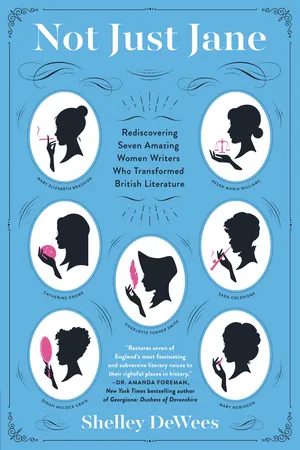
Not Just Jane
eBook - ePub

Not Just Jane

Rediscovering Seven Amazing Women Writers Who Transformed British Literature

  1. 336 pages
  2. English
  3. ePUB (mobile friendly)
  4. Available on iOS & Android
eBook - ePub

Not Just Jane

Rediscovering Seven Amazing Women Writers Who Transformed British Literature

About this book

"Not Just Jane restores seven of England's most fascinating and subversive literary voices to their rightful places in history. Shelley DeWees tells each woman writer's story with wit, passion, and an astute understanding of the society in which she lived and wrote."

—Dr. Amanda Foreman, New York Times bestselling author of Georgiana: Duchess of Devonshire

Jane Austen and the BrontĆ«s endure as British literature's leading ladies (and for good reason)—but were these reclusive parsons' daughters really the only writing women of their day? In a witty work of feminist literary history, this fascinating nonfiction debut explores the extraordinary lives and work of seven long-forgotten authoresses, and asks: Why did their considerable fame and influence, and a vibrant culture of female creativity, fade away? And what are we missing because of it?

You've likely read at least one Jane Austen novel (or at least seen a film one). Chances are you've also read Jane Eyre; if you were an exceptionally moody teenager, you might have even read Wuthering Heights. English majors might add George Eliot or Virginia Woolf to this list…but then the trail ends. Were there truly so few women writing anything of note during the dynamic Georgian and Victorian eras?

In Not Just Jane, Shelley DeWees weaves history, biography, and critical analysis into a rip-roaring narrative of the nation's fabulous, yet mostly forgotten, female literary heritage. As the country, and women's roles within it, evolved, so did the publishing industry, driving legions of ladies to pick up their pens. Focusing on the creative contributions and personal stories of seven astonishing women—among them pioneers of detective fiction and the modern fantasy novel—DeWees assembles a riveting, intimate, and ruthlessly unromanticized portrait of female life, and the literary landscape, during this era. In doing so, she comes closer to understanding how a society could forget so many of these women, who all enjoyed success and critical acclaim during their time, and realizes why, now more than ever, it's vital that we remember these foundational voices in women's history.

Rediscover Charlotte Turner Smith, Helen Maria Williams, Mary Robinson, Catherine Crowe, Sara Coleridge, Dinah Mulock Craik, and Mary Elizabeth Braddon.

Not Just Jane finally gives these trailblazing women writers their due, exploring:

  • Seven Forgotten Authoresses: Rediscover Charlotte Turner Smith, Helen Maria Williams, Mary Robinson, Catherine Crowe, Sara Coleridge, Dinah Mulock Craik, and Mary Elizabeth Braddon—bestsellers and pioneers in their time.
  • Literary History Reimagined: A rip-roaring narrative that blends biography, social history, and critical analysis to explore why a vibrant culture of female creativity faded from memory.
  • Genre-Defining Pioneers: Meet the astonishing women who pioneered detective fiction, the modern fantasy novel, and politically charged war journalism long before they were established genres.
  • Beyond Austen and the BrontĆ«s: An essential feminist history that asks what we've been missing by focusing only on a few famous names from 18th and 19th-century Britain.

Trusted byĀ 375,005 students

Access to over 1.5 million titles for a fair monthly price.

Study more efficiently using our study tools.

Information

Year
2016
Print ISBN
9780062394620
eBook ISBN
9780062394637

END NOTES

The pagination of this electronic edition does not match the edition from which it was made. To locate a specific passage, please use the search feature on your e-book reader.
INTRODUCTION
3.ā€œcarefully-fenced, highly cultivated gardenā€: Charlotte BrontĆ«, Letters of Charlotte BrontĆ«, ed. Margaret Smith (New York: Oxford University Press, 1995), 2:10.
8.ā€œgentle and kind obedienceā€: Francis Lye, The Single Married and the Married Happy, Being a Series of Wholesome Advice Designed to Promote the Discreet Union of the Sexes, and Their Mutual Happiness When United (Cheltenham: E. Matthews, 1828), 22, quoted in Hazel Jones, Jane Austen and Marriage (London: Continuum, 2009), 121.
8.ā€œexercise of the most splendid talentsā€: Elizabeth Gaskell, The Life of Charlotte BrontĆ« (New York: Harper, 1900), 357.
8.ā€œwhat but domestic misery can be expected?ā€: Thomas Gisborne, An Enquiry into the Duties of the Female Sex (London: Cadell, 1796), 256. Gisborne recommends that women use friendships only ā€œas instruments of comfort, of virtue, and of usefulness,ā€ which leaves no room for connections with any of those husband-hunting females who obsess over ā€œtinsel and glitter.ā€
9.ā€œchildren of a larger growthā€: Philip Stanhope, Earl of Chesterfield, Letters to His Son and Others (London: Dent, 1984), 66, quoted in Robert W. Uphaus, ā€œJane Austen and Female Reading,ā€ Studies in the Novel 19, no. 3 (1987): 340.
10.ā€œMy mind is worked upā€: Diary entry, Jan. 27, 1793, in English Diaries: A Review of English Diaries from the Sixteenth to the Twentieth Century (London: Methuen, 1923), 247. In 1797 Elizabeth’s husband divorced her on the grounds of adultery. Two days later, after the papers were finalized, she married her longtime lover, Lord Holland, and lived with him until his death in 1840. They had seven children together.
10.ā€œa life without external eventsā€: Hans Eichner, ā€œThe Eternal Feminine: An Aspect of Goethe’s Ethics,ā€ in Johann Wolfgang von Goethe, Faust, trans. Walter Arndt, ed. Cyrus Hamlin (New York: W. W. Norton, 1976), 620, quoted in Sandra M. Gilbert and Susan Gubar, The Madwoman in the Attic: The Woman Writer and the Nineteenth-Century Literary Imagination (New Haven, CT: Yale University Press, 1979), 22. Italics mine.
10.strict cosmetic and dietary practices: Gilbert and Gubar, Madwoman in the Attic, 25.
10.for anyone of intelligence it was intolerable: Eva Figes, Sex and Subterfuge: Women Writers to 1850 (New York: Persea, 1982), 9.
11.ā€œthe method’s origins are also tied to Franceā€: Thomas Hodgson, An Essay on the Origin and Progress of Stereotype Printing; Including a Description of the Various Processes (Newcastle: Hodgson, 1820), 77. Stereotyping was used during the French Revolution to issue a form of paper money, the assignat, but due to the shortcomings of the print method, most especially its ability to create like and imitative images rather than identical ones, the assignat was very readily counterfeited. Stereotype printing made great progress, then, in the hands of the French, as they worked to correct this problem by creating cleaner, better-cut plate molds and more efficient machinery.
12.more than twenty thousand titles: Edward Jacobs, ā€œCirculating Libraries,ā€ in David Scott Kastan, ed., Oxford Encyclopedia of British Literature (Oxford: Oxford University Press, 2006), 2:5.
13.ā€œThey tell us, we mistake our sexā€: Anne Finch, The Poems of Anne Countess of Winchilsea, ed. Myra Reynolds (Chicago: University of Chicago Press, 1903), 5. The original edition of Finch’s poetry was published in 1713.
21.Susan Hopley was the antecedent: Lucy Sussex, ā€œThe Detective Maidservant: Catherine Crowe’s Susan Hopley,ā€ in Silent Voices: Forgotten Novels by Victorian Women Writers, ed. Brenda Ayres (Westport, CT: Praeger, 2003).
21.singular attention to worldbuilding: Matthew David Surridge, ā€œWorlds Within Worlds: The First Heroic Fantasy, Part IV,ā€ Black Gate: Adventures in Fantasy Literature, 2010. http://www.blackgate.com/2010/09/19/worlds-within-worlds-the-first-heroic-fantasy-part-iv/.
22.ā€œmore widely readā€: ā€œMrs. Craik,ā€ Academy, Oct. 1887.
22.novel’s placement just behind Uncle Tom’s Cabin: Sally Mitchell, Dinah Mulock Craik (Boston: Twayne, 1983), 51.
24.ā€œa critic’s novelistā€: B. C. Southam, introduction, in B. C. Southam, ed., Jane Austen: The Critica...

Table of contents

  1. Dedication
  2. Contents
  3. Introduction
  4. One: Charlotte Turner Smith (1749–1806)
  5. Two: Helen Maria Williams (1759–1827)
  6. Three: Mary Robinson (1758–1800)
  7. Four: Catherine Crowe (c. 1800–1876)
  8. Five: Sara Coleridge (1802–1852)
  9. Six: Dinah Mulock Craik (1826–1887)
  10. Seven: Mary Elizabeth Braddon (1835–1915)
  11. Afterword
  12. Acknowledgments
  13. Note on Sources
  14. Bibliographies
  15. Notes
  16. About the Author
  17. Credits
  18. Copyright
  19. About the Publisher

Frequently asked questions

Yes, you can cancel anytime from the Subscription tab in your account settings on the Perlego website. Your subscription will stay active until the end of your current billing period. Learn how to cancel your subscription
No, books cannot be downloaded as external files, such as PDFs, for use outside of Perlego. However, you can download books within the Perlego app for offline reading on mobile or tablet. Learn how to download books offline
Perlego offers two plans: Essential and Complete
  • Essential is ideal for learners and professionals who enjoy exploring a wide range of subjects. Access the Essential Library with 800,000+ trusted titles and best-sellers across business, personal growth, and the humanities. Includes unlimited reading time and Standard Read Aloud voice.
  • Complete: Perfect for advanced learners and researchers needing full, unrestricted access. Unlock 1.5M+ books across hundreds of subjects, including academic and specialized titles. The Complete Plan also includes advanced features like Premium Read Aloud and Research Assistant.
Both plans are available with monthly, semester, or annual billing cycles.
We are an online textbook subscription service, where you can get access to an entire online library for less than the price of a single book per month. With over 1.5 million books across 990+ topics, we’ve got you covered! Learn about our mission
Look out for the read-aloud symbol on your next book to see if you can listen to it. The read-aloud tool reads text aloud for you, highlighting the text as it is being read. You can pause it, speed it up and slow it down. Learn more about Read Aloud
Yes! You can use the Perlego app on both iOS and Android devices to read anytime, anywhere — even offline. Perfect for commutes or when you’re on the go.
Please note we cannot support devices running on iOS 13 and Android 7 or earlier. Learn more about using the app
Yes, you can access Not Just Jane by Shelley DeWees in PDF and/or ePUB format, as well as other popular books in History & Education Biographies. We have over 1.5 million books available in our catalogue for you to explore.