- 224 pages
- English
- ePUB (mobile friendly)
- Available on iOS & Android
eBook - ePub
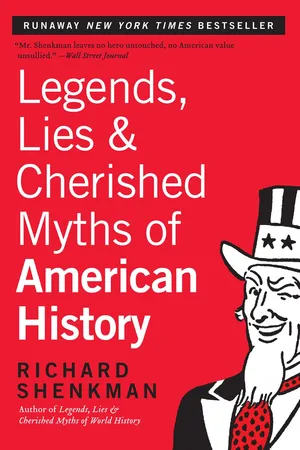
Legends, Lies & Cherished Myths of American History
Trusted by 375,005 students
Access to over 1.5 million titles for a fair monthly price.
Study more efficiently using our study tools.
Information
Notes
Discoverers and Inventors
1. WASHINGTON IRVING, The Life and Voyages of Christopher Columbus (1828; rpt. Twayne Publishers, 1981), pp. 47–53; SAMUEL ELIOT MORISON, Admiral of the Ocean Sea (1942), vol. I, p. 117; SAMUEL ELIOT MORISON, The European Discovery of America: The Northern Voyages (1971), p. 6; HARVEY EINBINDER, The Myth of the Britannica (1964), pp. 169–72.
2. MORISON, Admiral of the Ocean Sea, vol. 1, pp. 137–38.
3. MORISON, European Discovery of America: The Northern Voyages, ch. 3; Emily Morison Beck, ed., Sailor Historian: The Best of Samuel Eliot Morison (1977), pp. 17–18.
4. MORISON, Admiral of the Ocean Sea, vol. II, p. 271. S. E. ACKERMAN, Popular Fallacies (1924), pp. 603–06.
5. HOWARD ZINN, A People’s History of the United States (1980), pp. 1–8.
6. FREDERICK J. POHL, Amerigo Vespucci (1944), p. 63 ff., says Vespucci did invent a new astronomy based on the moon; so does DANIEL BOORSTIN, The Discoverers (1983), ch. 33; SAMUEL ELIOT MORISON disagrees in The European Discovery of America: The Southern Voyages (1974), ch. 12.
7. LOUIS SIMON, “Famous American Myths,” You’re Wrong About That (October 1938), p. 48, tells about “Amteric”; THOMAS JAY, The Encyclopedia of Fads and Fallacies (1958), p. 12, tells about Ameryke.
8. CHARLES E. NOWELL, “The Discovery of the Pacific: A Suggested Change of Approach,” Pacific Historical Review (February 1947), pp. 1–10.
9. BERGEN EVANS, The Spoor of Spooks (1954), pp. 57–58.
10. JEROME E. BROOKS, The Mighty Leaf: Tobacco Through the Centuries (1952), pp. 11, 46, 62–63.
11. HOWARD S. ABRAMSON, National Geographic: Behind America’s Lens on the World (1987), pp. 71–108.
12. PETER BAIDA, “Eli Whitney’s Other Talent,” American Heritage (May-June 1987), pp. 22–23.
13. DANIEL H. THOMAS, “Pre-Whitney Cotton Gins in French Louisiana,” Journal of Southern History (May 1965), pp. 135–48; THOMAS A. BAILEY, “Presidential Address,” Journal of American History (June 1968), p. 5ff.
14. BERNARD WEISBERGER, communication with the author; Bureau of the Census, A Century of Population Growth, from the First Censw of the United States to the Twelfth, 1790–1900 (1909), pp. 133–40.
15. ALEX GRONER, The American Heritage History of American Business and Industry (1972), pp. 87–88; ASHLEY MONTAGU and EDWARD DARLING, The Prevalence of Nonsense (1967), pp. 209–12.
16. DIXON WECTER, The Hero in America (1941), pp. 417–18.
17. You’re Wrong About That (March 1939), p. 58.
18. ROBERT LACEY, Ford: The Men and the Machine (1986), pp. 110–17, 284; DAVID HALBERSTAM, The Reckoning (1986), passim; JOHN KENNETH GALBRAITH, “Truly the Last Tycoons,” New York Review of Books (August 14, 1986), p. 17.
19. LEONARD MOSLEY, Lindbergh (1976), p. 73.
20. PETER WYDEN, Day One: Before Hiroshima and After (1984), pp. 20–27.
Founding Fathers
1. THOMAS A. BAILEY, The American Pageant (1971), p. 195.
2. JOHN BACH MCMASTER, “The Political Depravity of the Fathers,” Atlantic Monthly (May 1895), pp. 626–33; NATHAN MILLER, The Founding Finoglers (1976), pp. 116–34.
3. CHARLES A. BEARD, The Republic (1962), pp. 29–33.
4. JACK P. GREENE, in an interview quoted in JOHN A. GARRATY, Interpret ing American History (1970), vol. 1, p. 55.
5. HENRY STEELE COMMAGER, in an interview, ibid., vol. I, p. 103.
6. On Jefferson, see CHARLES B. HOSMER, Presence of the Past (1965), pp. 179–85; on Hamilton, Franklin, and Madison, see MICHAEL KAMMEN, A Season of Youtk (1978), pp. 42, 64, 69, 72; on Revere, see DIXON WECTER, The Hero in America (1941), p. 87; on Washington, see DANIEL BOORSTIN, The Americans: The National Experience (1965), pp. 337–39, and W. E. WOODWARD, George Washington (1928), pp. 11, 239, 311.
Jefferson may have become a member of the national pantheon before the 1920’s. At least Wecter thinks so. Wecter puts Jefferson’s apotheosis in 1858, when a three-volume biography listing his major accomplishments was published. In any case, Jefferson seems unquestionably to have become a full-fledged member of the elite club of demigods (to use Jefferson’s own term) by the 1930’s. By then Gutzon Borglum had put his fa...
Table of contents
- Dedication
- Contents
- Author’s Note
- Discoverers and Inventors
- Founding Fathers
- Presidents
- From Rags to Riches
- Sex
- The Family
- War
- Immigrants
- The Frontier
- From Slavery to Freedom
- Education
- Holidays
- Shrines
- Art
- The Good Old Days
- Folklore
- Famous Quotes
- Acknowledgments
- Notes
- Searchable Terms
- About the Author
- Copyright
- About the Publisher
Frequently asked questions
Yes, you can cancel anytime from the Subscription tab in your account settings on the Perlego website. Your subscription will stay active until the end of your current billing period. Learn how to cancel your subscription
No, books cannot be downloaded as external files, such as PDFs, for use outside of Perlego. However, you can download books within the Perlego app for offline reading on mobile or tablet. Learn how to download books offline
Perlego offers two plans: Essential and Complete
- Essential is ideal for learners and professionals who enjoy exploring a wide range of subjects. Access the Essential Library with 800,000+ trusted titles and best-sellers across business, personal growth, and the humanities. Includes unlimited reading time and Standard Read Aloud voice.
- Complete: Perfect for advanced learners and researchers needing full, unrestricted access. Unlock 1.5M+ books across hundreds of subjects, including academic and specialized titles. The Complete Plan also includes advanced features like Premium Read Aloud and Research Assistant.
We are an online textbook subscription service, where you can get access to an entire online library for less than the price of a single book per month. With over 1.5 million books across 990+ topics, we’ve got you covered! Learn about our mission
Look out for the read-aloud symbol on your next book to see if you can listen to it. The read-aloud tool reads text aloud for you, highlighting the text as it is being read. You can pause it, speed it up and slow it down. Learn more about Read Aloud
Yes! You can use the Perlego app on both iOS and Android devices to read anytime, anywhere — even offline. Perfect for commutes or when you’re on the go.
Please note we cannot support devices running on iOS 13 and Android 7 or earlier. Learn more about using the app
Please note we cannot support devices running on iOS 13 and Android 7 or earlier. Learn more about using the app
Yes, you can access Legends, Lies & Cherished Myths of American History by Richard Shenkman in PDF and/or ePUB format, as well as other popular books in History & Teaching History. We have over 1.5 million books available in our catalogue for you to explore.