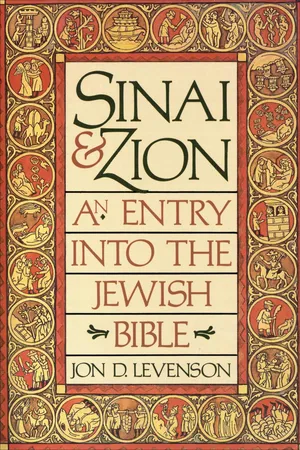
"The best introduction I know to the Jewish faith presented in the Hebrew Scripture." —Eugene B. Borowitz, Hebrew Union College-Jewish Institute of Religion
A treasury of religious thought and faith—places the symbolic world of the Bible in its original context.
"A challenging, exciting work in Jewish theology. Not to be missed." —Ruth Segal Bernards,
Sh'ma "A significant advance in Jewish-Christian understanding could be made if Christians would read
Sinai & Zion." —John Simpson,
Provident Book Finder "Beautifully written, theologically sensitive, and ecumenical." —Richard J. Clifford, S.J., Weston School of Theology "It is a book which has been longed for. It is also a very good book." —T. R. Hobbs,
Biblical Theology Bulletin "In this eminently readable work of biblical scholarship of the highest order, Levenson enables that Bible's many voices to speak for themselves and yet communicate a coherent religious vision." —Robert L. Cohn,
Journal of Religion
1. THE SINAITIC EXPERIENCE OR THE TRADITIONS ABOUT IT?
Whatever the experience of the people Israel on Mount Sinai was, it was so overwhelming that the texts about it seem to be groping for an adequate metaphor through which to convey the awesomeness of the event. For example, in the description in Exod 19:16–22, the first verse seems to describe a hurricane—thunder, lightning, a mysterious cloud. But v 18 presents an image more like that of a volcano—smoke and fire on the mountain, like the fire of a furnace. Both verses mention quaking, the quaking of the people before this momentous sight (v 16) and the quaking of the mountain itself (v 18), which is no more secure than the people against the descent of YHWH, the God of Israel. Fear pervades the spectacle, a fear that infects nature as much as humanity. At the same time, the sight exerts an eerie appeal, which tempts the people to “break through” to catch a glimpse (v 21), but to yield to this temptation is to risk YHWH’s displeasure. If they “break through” to him, he will “break out” against them (v 22). Even the priests, who have been singled out—or will be, as the received text has it, a few chapters later—to minister in the presence of God, must submit to special rites of sanctification if they are to survive the Sinaitic experience. In other words, we see here two contrasting movements. The first speaks of an intersection between the lives of God and of Israel. The two meet at Mount Sinai. Moses, the representative of Israel, ascends the mountain onto which YHWH has descended. The second movement, however, speaks of a barrier between God and Israel, which if transgressed, will turn the moment of destiny into one of disaster. Only Moses may ascend. Even the priests are in jeopardy until they have renewed their sanctity. It is as though God beckons with one hand and repels with the other. The twofold quality of the experience narrated in these verses has been explored by the theologian and historian of religion, Rudolf Otto. As is well known, Otto defined “the holy” by the words mysterium tremendum et fascinans, a Latin expression that admits of no good English equivalent, but which we can render as “a fearsome and fascinating mystery.”1 It is just such an ambivalent sense of mystery that pervades the account of the theophany, the apparition of God, that was believed to have occurred on Mount Sinai. The Sinaitic experience is here presented as simultaneously supremely relevant to human experience and distant from it and foreign to it. In its quality of indivisible charm and threat, it is eminently exotic, lying outside the boundaries of what is familiar.
What really happened on Mount Sinai? The honest historian must answer that we can say almost nothing in reply to this question. We do not know even the location of the mountain. Its identification with Jebel Musa, on which a Christian monastery stands today, is relatively recent and open to doubt.2 In fact, some streams of biblical tradition know the mountain by a different name, Horeb, and we cannot affirm with any confidence that the two sets of tradition, that of Sinai and that of Horeb, derive from the same event and were not welded together in the centuries of retelling the stories. In fact, the expression Mount Horeb occurs only once (Exod 33:6), although two passages speak of “Horeb, the mountain of God.”3 The other fourteen occurrences of “Horeb” mention no mountain at all. Instead, things tend to happen “at Horeb.” For example, the incident in which Moses struck the rock to produce water took place “at Horeb” (17:6), some time before Israel arrived at the Sinai Desert (19:1), where the awesome revelation was to take place. In short, although some passages speak of Horeb as the site at which YHWH spoke to Israel in the midst of fire (Deut 4:15) and proclaimed the terms of the covenant to them (e.g., v 10), we cannot assume that Horeb was always simply synonymous with Sinai.4 And even if we could make such an assumption, the presence of two names would suggest that we do not have a straightforward and continuous tradition linking us with the putative event, but, instead, a document whose complex literary history makes the recovery of the event well-nigh impossible. We know nothing about Sinai, but an immense amount about the traditions concerning Sinai. It is the consensus of those who approach these traditions empirically rather than dogmatically that their written form—which is the only way in which we can encounter them today—derives for the most part from periods hundreds of years after the event they purport to record.5 In Part 2, for example, we shall see that the Sinaitic experience was re-enacted in the Temple at Jerusalem, which was not built until hundreds of years later. Or is it the case that the Sinaitic experience, as portrayed in Exodus, is retrojected from, or at least colored by, the experience of YHWH’s theophany in the Temple? About such issues we can only speculate.
It is my contention, however, that the historical question about Sinai, as important as it is in some contexts, misses the point about the significance of this material in the religion of Israel. The Sinaitic experience is not narrated as if it occurred on the level of mere fact. In truth, unbiased historiography of the sort to which modern historians aspire did not exist in biblical times. Instead, biblical historians always enlisted history in the service of a transcendent and therefore metahistorical truth. It is that truth, conveyed to us through historical narrative, whether accurate historically or not, that interests the narrator, not the details, without which modern historians cannot work at all. What modern historian would tell the story of World War II without ever giving the name of the German Führer? Yet, the Torah, the first five books of the Hebrew Bible, never tells us the name of the king of Egypt—to the endless vexation of ancient historians—but refers to him by his royal title only, Pharaoh. Similarly, history in the modern sense is not the goal of the Sinai narratives: they present the Sinaitic experience as disclosing the essential, normative relationship of YHWH to his people Israel. Sinai was a kind of archetype, a mold into which new experiences could be fit, hundreds of years after the original event, if such there was. That mold served as a source of continuity which enabled new norms to be promulgated with the authority of the old and enabled social change to take place without rupturing the sense of tradition and the continuity of historic identity. For example, anyone who reads the whole Torah cannot avoid noticing that one sees law-codes separated by blocks of narrative. Soon after the giving of the Ten Commandments, we meet the “Book of the Covenant” (Exod 20:22–23:33); later we see another law-code in Leviticus 17–26, which concludes thus:
These are the laws, rules and instructions, which YHWH established between himself and the Israelites on Mount Sinai by the hand of Moses. (Lev 26:46)
One would think from this conclusion that the revelation of law was at last over. And yet individual blocks of law come in the very next chapter, in the book of Numbers, and another whole code, the longest in the Bible, will appear in Deuteronomy 12–26. This Deuteronomic code is most interesting in that it is proclaimed not at Sinai/Horeb, but on the plains of Moab, just before Israel is to dispossess the Canaanites; yet it, too, is presented in the mouth of Moses and as an outgrowth of the revelation of the Ten Commandments (chs. 4; 9–10). Modern scholars date these various codes to different periods in Israel’s history, all of them post-Mosaic. What their common ascription to Moses on Sinai suggests is that the Sinaitic “event” functioned as the prime pattern through which Israel could re-establish in every generation who she was, who she was meant to be. The experience of Sinai, whatever its historical basis, was perceived as so overwhelming, so charged with meaning, that Israel could not imagine that any truth or commandment from God could have been absent from Sinai.
2. YHWH’S HOME IN NO MAN’S LAND
Those who wish to speculate about the meaning of Sinai in the period of Israel’s first association with it will take special interest in those passages which mention the mountain and can be dated on independent, formal grounds to a very early period. Psalm 68 is a choice example, as linguistic, orthographic, and other criteria suggest to some scholars that it is one of the oldest pieces of Israelite poetry.6 Vv 8–9 and 16–19 are quite relevant to any discussion of the conception of Sinai that diverges from, and thus most likely predates, the conception in our Pentateuchal narrative sources. These verses, obscure as they are, clearly record a march of YHWH from Sinai, a military campaign in which the God of Israel and his retinue, divine, human, or something of each, set out across the desert. The point not to be overlooked is that YHWH’s home, the locus of this presence, is not a site inside the land of Israel, but rather Mount Sinai, which is separated from Israel’s home by forbidding wasteland. The mention of Sinai (vv 9, 18) clearly implies a connection between YHWH and that mountain much closer than what we would expect from the Pentateuchal narratives in which Mount Sinai seems to be no more than the place in which the revelation of law took place. Instead, in Psalm 68, YHWH is “the One of Sinai” (v 9), an epithet that provokes jealousy on the part of Mount Bashan, in the lands of the Trans-Jordanian branch of the tribe Manasseh. In spite of his ritual march to the land of Israel, YHWH’s favored abode is still Mount Sinai. “The One of Sinai” is the numen, the deity, of that mountain, the God of whom Sinai is characteristic. The same expression occurs in an identical context in the famous Song of Deborah (Judg 5:4–5). It is possible that “Sinai” in Ps 68:9, 18 and Judg 5:5 is a gentilic adjective related to the “Wilderness of Sin,” a desert probably in the Sinai peninsula (e.g., Exod 16:1). If so, the expression refers to a broader area than the mountain itself in its designation of the divine abode. On the other hand, there is an unmistakable play on Sinai in the account in Exod 3:1–6 of the burning bush (s
nê), which Moses encountered at Horeb. The marvel that attracts Moses’ attention here is a bush that burns and burns, but is never burnt up—the prototypical renewable source of energy. The document from which this narrative is drawn refers to the mountain of God not as Sinai, but as Horeb (v 1). Still, the closeness in sound of s
nê (“bush”) and Sînay (“Sinai”) cannot be coincidental. Perhaps the play on words here derives from the notion that the emblem of the Sinai deity was a tree of some sort; hence the popular association of Sînay and s
nê. In fact, a blessing on the tribe of Joseph identifies YHWH with “the one who dwells in the bush” (Deut 33:16). If “bush” is not a scribal error for “Sinai,” the tree here is not merely a device to attract attention, as one might think from Exodus 3, but is, rather, an outward manifestation of divine presence. YHWH is the numen of the bush. The conjunction in Exodus 3 of bush or tree (we do not know the precise meaning of s
nê) and fire is not surprising in light of later YHWHistic tradition. “YHWH your God,” thunders a Deuteronomistic homilist, “is a devouring fire, a jealous God” (Deut 4:24). In the encounter of Moses and the burning bush, two of YHWH’s emblems—tree and fire—clash, and neither overpowers the other. The two will appear again in tandem in the m
n
râ, the Tabernacle candelabrum which is actually a stylized tree, complete with “branches,” “almond-shaped cups,” “calyces,” and “petals” (Exod 25:31–39).7 This arborescent lampstand appears not only in the Tabernacle which served as Israel’s central sanctuary in the period of wandering in the wilderness, but also in the Temple that was to be built by Solomon in the early monarchical era (1 Kgs 7:49). The Temple at Jerusalem was lit by the fires of the burning tree.
What accounts for our inability to locate the site of the great mountain of Mosaic revelation with any certainty? The failure is not simply one of the modern science of topography. Rather, there is a mysterious extraterrestrial quality to the mountain in the most developed and least allusive biblical references to it. Sinai/Horeb seem(s) to exist in no man’s land. Moses’ first trip “to the mountain of God” occurs after he has fled Egypt. The mountain of God is not under Pharaoh’s control. It seems to be closer to Midian, a confederation of tribes living near what is today known as the Gulf of Eilat (or Gulf of Aqaba), the body of water that separates the Sinai from Arabia. Still, according to Exod 3:1, Horeb does not seem to lie within Midianite territory, since Moses must drive his Midianite father-in-law’s flocks into the wilderness to arrive at the sacred spot. Further proof of this follows from Num 10: 29–33, in which Jethro (also known as Hobab and Reuel) announces that he will return to his native land and not accompany Israel in her march from the Sinai into Canaan, the promised land. Mount Sinai may be near, but it is not within Jethro’s territory. Instead, “the mountain of God,” under whatever name and with whatever difference the names may indicate, is out of the domain of Egypt and out of the domain of the Midianites, an area associated, by contrast, with the impenetrable regions of the arid wilderness, where the authority of the state cannot reach. YHWH’s self-disclosure takes place in remote parts rather than within the established and settled cult of the city. Even his mode of manifestation reflects the uncontrollable and unpredictable character of the wilderness rather than the decorum one associates with a long-established, urban religion, rooted in familiar traditions. As Moses and Aaron put it to Pharaoh:
The God of the Hebrews has chanced upon us. Please let us go a journey of three days into the wilderness to offer sacrifices to YHWH our God, lest he strike us with plague or sword. (Exod 5:3)
In other words, the deity is like his worshippers: mobile, rootless and unpredictable. “I shall be where I shall be” (3:14)—nothing more definite can be said. This is a God who is free, unconfined by the boundaries that man erects. To man, especially to a political man in a civilization as urban and complex as that of Egypt, this request of the Hebrews must have seemed unspeakably primitive. And so Pharaoh, ruler of a great power, responds contemptuously to Moses and Aaron’s plea that the people be allowed to journey into the desert to appease their God, lest he afflict them:
Who is this “YHWH” that I should obey him and let Israel go? I do not recognize YHWH and I will not let Israel go! (Exod 5:2)
Artlessly, an opposition has been set up between service to YHWH and service to Phar...
Table of contents
Dedication
Contents
Preface
Table of Abbreviations
Introduction
PART I: SINAI, THE MOUNTAIN OF THE COVENANT
PART 2: ZION, THE MOUNTAIN OF THE TEMPLE
PART 3: THE MANIFOLD RELATIONSHIPS BETWEEN SINAI AND ZION
Searchable Terms 1
Searchable Terms 2
About the Author
Credits
Copyright
About the Publisher
Trusted by 375,005 students
Access to over 1.5 million titles for a fair monthly price.
Study more efficiently using our study tools.
Frequently asked questions
Yes, you can cancel anytime from the Subscription tab in your account settings on the Perlego website. Your subscription will stay active until the end of your current billing period. Learn how to cancel your subscription
No, books cannot be downloaded as external files, such as PDFs, for use outside of Perlego. However, you can download books within the Perlego app for offline reading on mobile or tablet. Learn how to download books offline
Perlego offers two plans: Essential and Complete
Essential is ideal for learners and professionals who enjoy exploring a wide range of subjects. Access the Essential Library with 800,000+ trusted titles and best-sellers across business, personal growth, and the humanities. Includes unlimited reading time and Standard Read Aloud voice.
Complete: Perfect for advanced learners and researchers needing full, unrestricted access. Unlock 1.5M+ books across hundreds of subjects, including academic and specialized titles. The Complete Plan also includes advanced features like Premium Read Aloud and Research Assistant.
Both plans are available with monthly, semester, or annual billing cycles.
We are an online textbook subscription service, where you can get access to an entire online library for less than the price of a single book per month. With over 1.5 million books across 990+ topics, we’ve got you covered! Learn about our mission
Look out for the read-aloud symbol on your next book to see if you can listen to it. The read-aloud tool reads text aloud for you, highlighting the text as it is being read. You can pause it, speed it up and slow it down. Learn more about Read Aloud
Yes! You can use the Perlego app on both iOS and Android devices to read anytime, anywhere — even offline. Perfect for commutes or when you’re on the go. Please note we cannot support devices running on iOS 13 and Android 7 or earlier. Learn more about using the app
Yes, you can access Sinai & Zion by Jon D. Levenson in PDF and/or ePUB format, as well as other popular books in Teología y religión & Crítica e interpretación bíblicas. We have over 1.5 million books available in our catalogue for you to explore.