This account of IBM's famed father-and-son CEOs and the family conflicts behind the scenes is "a revealing look at the making of corporate America" (
Publishers Weekly).
For an extraordinary fifty-seven-year period, one of the nation's largest and fastest-growing companies was run by two men who were flesh and blood. The chief executives of the International Business Machines Corporation from 1914 until 1971 were Thomas J. Watson, Sr. and Thomas J. Watson, Jr., and that great corporation bears the imprint of both men's ambitions and strengths—but it also bears the consequences of a family that was in near-constant conflict.
Sometimes wrong but never in doubt, both Watsons had clear and farsighted visions of what their company could become. They also had volcanic tempers. Their fights with each other combined with their commitment to leadership and excellence made IBM one of the most rewarding yet gut-clutching firms to work for in the history of American business.
Our expectations of professional behavior include leaving emotions and vulnerabilities at home each day. In the case of the Watsons, filial and sibling strife could not be excluded from the office. In closely studying the desires and frustrations of the Watson family, eminent historian Richard S. Tedlow has produced something more than a family portrait or a company history. He delves into the role of emotion in corporate life, and explores the interplay between the personalities of these two extraordinary men and the firm they created.
Both Watsons had deeply held beliefs about what a corporation is and should be. These ideas helped make "Big Blue" the bluest of blue-chip stocks during their long tenure. These very beliefs, however, also sowed the seeds for IBM's disasters in the late 1980s and early 1990s, when the company had lost sight of the original meaning behind many of the practices each man put into place. Tracing the family's idiosyncratic ability to cope with each other's weaknesses but not their strengths,
The Watson Dynasty is a "highly readable" portrait of a towering pioneer of the technology industry and the father and son who built it (
Library Journal).
"Crisp, engaging." —
Enterprise & Society
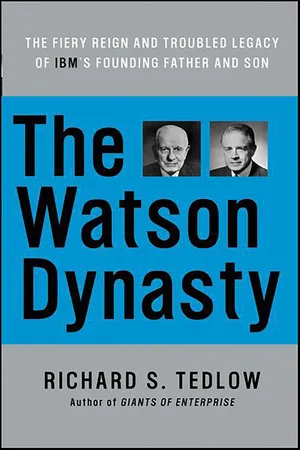
eBook - ePub
The Watson Dynasty
The Fiery Reign and Troubled Legacy of IBM's Founding Father and Son
- 352 pages
- English
- ePUB (mobile friendly)
- Available on iOS & Android
eBook - ePub
The Watson Dynasty
The Fiery Reign and Troubled Legacy of IBM's Founding Father and Son
About this book
Information
Topic
CommerceSubtopic
Biographies d'entreprisesCHAPTER 1
Defining Moments
The world’s fair in New York City at the end of the depression decade was a big deal. Planning began in 1935. The fairgrounds covered 1,216.5 acres in what had been a garbage dump in Queens. By opening day, April 30, 1939, the moonscape that had been Flushing Meadows was transformed, in the perhaps pardonable hyperbole of the guidebook, into a “stupendous, gigantic, super-magnificent…greatest show on earth.” Time magazine called it “the biggest, costliest, most ambitious undertaking ever attempted in the history of international exhibitions.”
Over sixty nations had pavilions and exhibits clustered around the “Court of Peace” on the fairgrounds. Every major country was represented save Germany. New York’s mayor, Fiorello H. La Guardia, had suggested in 1937 that a “Chamber of Horrors” be dedicated to Nazi Germany. The Nazis did not see the humor in the idea of the man they labeled “a dirty Talmud Jew,” lodged a protest with the State Department, and refused to participate in the festivities.
Dozens of corporations saw the fair, with its theme of “Building the World of Tomorrow,” as an ideal venue for institutional advertising and image making. This fair was to be more than merely a “showroom for the display of goods”; it was to be, according to historian Roland Marchand, a “World Stage upon which to dramatize the advantages of the American system of free enterprise.”
Foremost among the more than forty company exhibitors was the nation’s largest industrial corporation, General Motors. Still smarting from the disastrous sit-down strike in Flint in the winter of 1936–37, the result of which was the unionization of its plants and the creation of the United Automobile Workers, General Motors was anxious to turn the nation’s attention to its ambitions for the future. This it attempted to do through “Futurama,” a remarkable invitation to “share our world.” It was the hit of the fair, with more attendees and rave reviews than any other exhibit. Other companies spending large amounts of money to educate the public about their greatness included Ford, Chrysler, AT&T, General Electric, and Westinghouse.
Also making their presence known at the fair were the International Business Machines Corporation and its indomitable leader, Thomas J. Watson Sr.
Watson was sixty-five years old when the fair opened, an age when many businessmen think about retirement. But Watson had the energy of a man in his thirties, and we can confidently assert that thoughts of retirement never entered his mind. For years he had been telling his troops, “The IBM is not merely an organization of men; it is an institution that will go on forever.” He planned to accompany IBM on its journey—if not forever, then at least for a good many more years. And he had every intention of using the fair to tell the world that he and IBM—the two were inseparable in his mind—mattered.
On May 2, IBM held a huge meeting at the fair, with 2,200 employees in attendance. Watson told the listening throng that he wanted to keep the business session brief because the fair’s educational opportunities “are so much broader than anything we could hope to give you that we are going to give you as much time as possible to visit these things.” Nevertheless, there were eighteen speakers at the event.
May 2 was as nothing compared to Thursday, May 4—IBM Day at the world’s fair. May 4 was a busy day for Watson, but not a uniquely busy day. Indeed, one of the remarkable aspects of his long life was the number of days such as this which he arranged (and which those around him endured). Things were kicked off as Watson opened the fair for the day. He was accompanied by a mounted escort from Perylon Hall on the fairgrounds to the IBM exhibit at the Business Systems Building, where a precursor of a form of E-mail was displayed:
As a demonstration of the latest device out of the I.B.M. research laboratories, a letter of congratulation was flashed through the air from San Francisco to New York on an I.B.M. radio-type…. It was offered as the high-speed substitute for mail service in the world of tomorrow.
Not only technology but art had a place in IBM Day. The company had commissioned the IBM Symphony by Vittorio Giannini, and the work was performed at this event and was broadcast. In a burst of understatement, Fortune magazine described the symphony as “somewhat programmatic in nature.” The second movement contained a melodic reference to the most often sung of IBM’s many songs, “Ever Onward.”
Painting as well as music was part of IBM’s artistic contribution to the fair. Watson was described in the New York Times as taking “a bold and potentially constructive step” by displaying works from seventy-nine countries in his Gallery of Science and Art in a large hall in the Business Systems Building at the fair. “Far-flung” would be the best way to describe the countries represented. They included French Indochina, Libya, Luxembourg, and the USSR. “Our endeavor,” explained Watson,
has been to increase the interest of business in art and of artists in business…. This step by an industrial organization is in recognition of the part played by art in industry and its importance to industry in broadening the horizons of culture and influencing the needs and desires of the people of every country.
Whatever that might mean.
This collection traveled from one country to another after the fair. “To be sure,” sniffed the Times reporter, “representation by one painter alone [from each country] is inclined to provoke a smile and must have caused prodigious head-scratching.” Nevertheless, the plan was pronounced to “[work] well enough…upon the whole.” This project generated a good deal of publicity for Watson and for IBM.
Watson made speeches during IBM Day (“As a businessman, I think of world peace as a sales problem”—what intelligent response, one wonders, could be made to such an assertion?), received compliments, and unveiled a statue of Peter Stuyvesant, the last colonial Dutch governor of what was New Amsterdam and became New York, at the Dutch pavilion.
But the day was still young. The IBM contingent headed back to Manhattan for more festivities at the Waldorf-Astoria. Over two thousand guests saw Watson inducted into the Quarter Century Club (he had joined IBM in 1914). He was presented with the Order of the Southern Cross of Brazil by a representative of its government and with innumerable other gifts from IBM’s eleven thousand employees, among which was an oil portrait of himself. The evening concluded with a series of speeches, including one by Watson.
The world’s fair ran from April 30 to October 31 in 1939 and again the following year from May 11 to October 27. The fair’s second year took place in a context far different from its first. War was looming in the summer of 1939. It was reality in 1940. Some of the nations represented in the first year were gone by the second. The staff of the Polish pavilion did not go home after the fair closed in 1939. “Home was no longer on the map. They opened a Polish restaurant on Fifty-seventh Street…. Hitler destroyed Czechoslovakia even before its pavilion was complete.” The fair’s official theme was changed from “Building the World of Tomorrow” to “For Peace and Freedom.”
Even though the war clouds of 1939 were generating torrential rain by 1940, the fair was still a splendid stage to tell the world about the glories of the International Business Machines Corporation and its peerless, fearless leader. But how was Watson to top the previous year’s performance? That is the kind of question that never seemed to bother him.
For starters, this year IBM Day would be on the fair’s opening day. And Watson would not be lonely in Flushing Meadows. He decided to bring ten thousand guests to New York, including all of the company’s factory employees and sales and field-service men plus their wives, and put them up in Manhattan hotels for three days. He took out advertisements in the New York papers announcing “THEY ARE ALL COMING.” “Nobody,” observed Watson’s eldest son, “had seen anything like it since the troop movements of World War I.” Ten chartered trains would come from the factory and offices at Endicott, New York, in the “Valley of Opportunity” just north of the Pennsylvania border; one each would arrive from Rochester and from Washington, D.C.; and there would be “additional chartered Pullmans from all over.” The cost for this extravaganza was $1 million, more than 10 percent of profits that year.
Everything was set. All the arrangements had been made. And then something went seriously wrong. The headline in the New York Times was:
250 HURT IN CRASH OF TRAINS, JAMMED FOR OUTING AT FAIR
Two Specials Carrying I.B.M. Staff Collide at Port Jervis—Excessive Speed Blamed
35 Remain in Hospitals
The trains involved were two of the ten specially chartered from the Erie Railroad to transport employees from the factories and administrative offices at Endicott. When one of these stopped at Port Jervis, another, which had been traveling too fast, ran into it. Said one passenger, “It felt like—you know how they do when they start off. You got a jolt like when they start a freight train. A suitcase fell on my head.” Said another, “It felt as if we got an awfully hard bump. There was splitting and cracking and glass breaking. People were sitting on the floor. I don’t know how I ever got out of my seat.” She wound up sitting on the tracks waiting for first aid.
Word of the accident reached Watson in Manhattan at two o’clock on the morning of May 13. He hopped in a car with his oldest daughter, Jane, and headed for Port Jervis, about sixty-five miles northwest of New York City. Watson and Jane personally visited the injured in the hospitals. He mobilized IBM’s executives in the city. He arranged for more doctors and nurses to be dispatched to Port Jervis. He hustled up another train to take those able to travel the rest of the way to Manhattan. A fully staffed hospital was set up at one of the hotels at which the IBM contingent was staying. Watson got back to New York City and immediately ordered flowers for all of the families who had been involved in the accident. His executives woke florists up to be sure that these bouquets were delivered to the hotel rooms before breakfast.
This sixty-six-year-old man then betook himself to the fair, where he delivered a speech alongside Mayor La Guardia and other personages. Lily Pons and Lawrence Tibbett of the Metropolitan Opera sang accessible opera as well as more modern pieces to “thrill” a crowd of twenty thousand. IBM Day was declared by one and all to be a success.
What did it all mean?
Compared to some of the other companies which chose the fair as a platform, IBM was tiny. Sales of General Motors in 1940 were $1.8 billion, profits $196 million, and assets $1.5 billion. The corresponding numbers for IBM were $46 million, $9.4 million, and $83 million. AT&T’s assets were sixty-six times IBM’s. Peter Drucker, at the time a correspondent for some British newspapers, suggested a story on IBM because of the size of its pavilion. He “thought a story on so small a frog behaving like a big shot might be amusing. ‘Forget it,’ my editor wrote back. ‘We are not interested in a story on an unsuccessful company which as far as anyone can tell is never going to amount to much.’”
The editor was wrong, and the numbers did not matter. What mattered was the future. What mattered was the incident at Port Jervis. “Nobody ever forgot the way my father handled the Port Jervis wreck,” recalled his eldest son. It was yet more proof of Watson’s bulletproof leadership. What would have been a disaster for ninety-nine CEOs out of a hundred, he turned to advantage.
Doubtless “Ever Onward” was rendered with even greater gusto after Port Jervis:
There’s a thrill in store for all,
For we’re about to toast
The corporation in every land.
We’re here to cheer each pioneer
And also proudly boast
Of that “man of men,” our friend and guiding hand.
The name of T. J. Watson means a courage none can stem:
And we feel honored to be here to toast the “IBM.”
Or, as the “IBM School Song” put it:
With Mr. Watson leading,
To greater heights we’ll rise
And keep our IBM
Respected in all eyes.
CHAPTER 2
The Early Years of the “Man of Men”
Considering that Thomas J. Watson rose to the apex of the American business pyramid, it is surprising how little is known of his family’s background and of his own childhood, boyhood, and youth. We know a lot about where he wound up but not so much about how he began.
Watson’s grandfather, John, was from Clyde, Scotland. He and his two brothers emigrated to Castlederg, a small town in county Tyrone, Northern Ireland, to “engage in the linen business.” In the 1840s, the three brothers and their families joined the hundreds of thousands of Britons (Andrew Carnegie and his family among them) to cross the seas to the United States. The port of entry was New York City. One brother, Samuel, remained in Brooklyn. Another, Andrew, settled in Orange Town, New York. The third, John, moved to Hornby Township in Steuben County, not far from Orange Town, and just over five miles north of the New York–Pennsylvania border about halfway between the Hudson River and Lake Erie.
John and his wife had six children, four boys and two girls. Two of the boys, Andrew and Thomas, went into the lumber business. Andrew became a sawyer while Thomas, in the words of author William Rodgers, “with a wider range of interest and, apparently, a more encompassing outlook on his job, became something of an expert in judging the value of timber stands and in various phases of milling, curing, and selling lumber.” From about 1855 to 1870, he “worked and wandered” through timberlands from New York State to Ohio. He eventually returned to Steuben County to start his own lumber business, in which he was joined by brother Andrew.
The lumber industry had been a mainstay of the southern tier of New York State (i.e., the counties bordering Pennsylvania) since the 1790s, when settlers of European origin successfully broke the power of the Iroquois League during and after the Revolutionary War. Pioneers found in Steuben County a land rich in timber, with trees up to six feet in diameter and a hundred feet high. The county is drained by the Chemung River, which meets the Susquehanna in Pennsylvania. The Susquehanna flows south through Pennsylvania and Maryland and empties into the Chesapeake Bay (and eventually the Atlantic) at Baltimore.
The Erie Canal, linking Buffalo to Albany, was completed in 1825, changing the face of the state and the nation. By the mid-1830s, the Feeder Canal and the Chemung Canal had turned the commerce of Steuben County on its head. Commodities were moving north to the Erie Canal, east to Albany, and south down the Hudson to find the Atlantic at New York City, rather than down the Susquehanna to Baltimore. These canals were eventually superseded by the Erie Railroad, which for decades was the main artery linking the southern tier of New York counties with New York City and the Great Lakes. This is the same railroad on which the accident took place in 1940 while transporting IBM employees from Endicott (fifty-five miles east of the tiny town of Painted Post in Steuben County, which Watson considered his family’s first home) to the world’s fair.
Why did Thomas and Andrew Watson go into the lumber business? We do not know. The stands of giant trees were largely gone by the 1860s, cut down and uprooted, with the remaining stumps set on fire in what came to be known as the “Burned Over District” in western New York State. There is clear evidence that the lumber business in Steuben County had entered a long-term decline by the 1860s.
The industry of the future in Steuben County just after the Civil War was glassmaking. In 1868, a glassworks in Brooklyn was having a hard time because of labor troubles and difficulties in obtaining raw materials. The company was lured to the town of Corning with promises of easy access to coal and sand for glassmaking and also by a $50,000 subsidy. This was a small fortune for a town of four thousand citizens, but in the long run it proved an investment well ...
Table of contents
- Cover
- Title Page
- Dedication
- Epigraph
- Contents
- Prologue
- Chapter 1
- Chapter 2
- Chapter 3
- Chapter 4
- Chapter 5
- Chapter 6
- Chapter 7
- Chapter 8
- Chapter 9
- Chapter 10
- Chapter 11
- Chapter 12
- Chapter 13
- Chapter 14
- Chapter 15
- Chapter 16
- Chapter 17
- Chapter 18
- Chapter 19
- Chapter 20
- Chapter 21
- Chapter 22
- Chapter 23
- Chapter 24
- Chapter 25
- Chapter 26
- Epilogue
- Notes
- Bibliographical Essay
- Principal Sources by Chapter
- Acknowledgments
- Searchable Terms
- About the Author
- Other Books by Richard S. Tedlow
- Copyright
- About the Publisher
Trusted by 375,005 students
Access to over 1.5 million titles for a fair monthly price.
Study more efficiently using our study tools.
Frequently asked questions
Yes, you can cancel anytime from the Subscription tab in your account settings on the Perlego website. Your subscription will stay active until the end of your current billing period. Learn how to cancel your subscription
No, books cannot be downloaded as external files, such as PDFs, for use outside of Perlego. However, you can download books within the Perlego app for offline reading on mobile or tablet. Learn how to download books offline
Perlego offers two plans: Essential and Complete
- Essential is ideal for learners and professionals who enjoy exploring a wide range of subjects. Access the Essential Library with 800,000+ trusted titles and best-sellers across business, personal growth, and the humanities. Includes unlimited reading time and Standard Read Aloud voice.
- Complete: Perfect for advanced learners and researchers needing full, unrestricted access. Unlock 1.5M+ books across hundreds of subjects, including academic and specialized titles. The Complete Plan also includes advanced features like Premium Read Aloud and Research Assistant.
We are an online textbook subscription service, where you can get access to an entire online library for less than the price of a single book per month. With over 1.5 million books across 990+ topics, we’ve got you covered! Learn about our mission
Look out for the read-aloud symbol on your next book to see if you can listen to it. The read-aloud tool reads text aloud for you, highlighting the text as it is being read. You can pause it, speed it up and slow it down. Learn more about Read Aloud
Yes! You can use the Perlego app on both iOS and Android devices to read anytime, anywhere — even offline. Perfect for commutes or when you’re on the go.
Please note we cannot support devices running on iOS 13 and Android 7 or earlier. Learn more about using the app
Please note we cannot support devices running on iOS 13 and Android 7 or earlier. Learn more about using the app
Yes, you can access The Watson Dynasty by Richard S. Tedlow in PDF and/or ePUB format, as well as other popular books in Commerce & Biographies d'entreprises. We have over 1.5 million books available in our catalogue for you to explore.