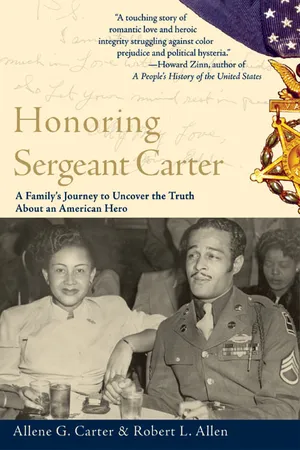
That my husband’s father was a war hero who played a pivotal role in the Rhineland campaign during World War II was never fully known to us until we got a call on May 2, 1996, a call that would change our lives. The caller, Gloria Long, asked to speak to Mildred Carter, Sergeant Carter’s widow. For several years Mildred had lived with her son, my husband, and our family. She suffered from Alzheimer’s disease. I explained to the caller that Mildred was not well, that I was her daughter-in-law, and that perhaps I could help her. Ms. Long said that she was a public relations liaison person with the Department of Veterans Affairs. She was calling to tell us that the White House was planning to award the Medal of Honor, the nation’s highest award for valor in combat, to several African-American soldiers who served in World War II. One of the recipients was to be Sergeant EdwardA. Carter Jr.
I was flabbergasted, and somewhat disbelieving. My mind was racing. I knew that my father-in-law, who died in 1963, was a soldier in the war. I had heard a little about his wartime service from my husband, Edward (whom we all knew as “Buddha,” a nickname given to him by his father because he was so chubby as a baby), and other family members, but this award was completely unexpected. Ms. Long said that plans were being made to present the awards at a ceremony at the White House, although the date hadn’t yet been set. Unfortunately, in 1973, a fire had destroyed the building in St. Louis that housed certain military records, including Sergeant Carter’s. Could the family help in reconstructing his tour of duty in the Army? The White House was going to prepare press releases, there would be articles in the press, and they needed information and pictures. I was stunned. Yes, I managed to say, we would help.
Mildred couldn’t follow the details, but she understood enough to know that Eddie was going to be honored. “Finally. He deserves it,” she kept saying. “He deserves it. He deserves it.” William, Buddha’s brother who lived in Washington state, was also excited, but his reaction was affected by a stroke from which he was recovering. Buddha, on the other hand, had always been withdrawn with regard to his father. Initially, I didn’t get a big response from him.
I later learned through Gloria Long that, in 1992, the Army had decided to commission a study to determine why no black soldiers were given the Medal of Honor during World War II. Black soldiers had won the medal in every other major American conflict, including the Civil War. Some 1.2 million black Americans served in the U.S. military during World War II, more than in any other war. A number of soldiers, including my father-in-law, won the Distinguished Service Cross, the second-highest award, but of the 294 Medals of Honor awarded, not one went to a black soldier. Some black veterans speculated that this was no accident. Pressured by the black press, civil rights groups, and veterans and their families, and facing the possibility of congressional action, the Army decided to look into the matter.
The study was undertaken by a team of scholars, including Daniel K. Gibran, then a professor at Shaw University in Raleigh, North Carolina. After fifteen months of investigation the team produced a 272-page report concluding that the racial climate and practice within the Army during World War II accounted for the lack of black Medal of Honor recipients. Specifically, the Army’s policies of segregation and exclusion of blacks from combat limited the opportunities for black soldiers to earn the Medal of Honor. In addition, the report said, racism in the Army undermined the effectiveness of black units in combat and may have prevented black soldiers from being nominated for the highest award. The report recommended that ten black soldiers, nine of whom had received the Distinguished Service Cross, be considered for the Medal of Honor. After reading the report, Secretary of the Army Togo West and the Army’s senior uniformed leadership agreed with its recommendation and initiated corrective action. It was decided that six of the Distinguished Service Cross recipients and a winner of a Silver Star, the third-highest award for valor, would be awarded the Medal of Honor. There was only one snag: Congress would need to waive the 1952 statutory time limit on granting the award to World War II veterans. Congress was expected to vote on the issue in September and the ceremony would be held sometime after that.
The spring of 1996 had been a deeply somber time for us. In March, Buddha’s brother William suffered a stroke and was hospitalized, unable to speak. In the same week, Iris, Mildred’s daughter by her first marriage, also had a stroke. It was a terrible double blow. Iris was on life support for a period of time, but her condition didn’t improve, so we finally had to make the decision to discontinue life support. Understandably, Mildred was very upset by the death of her daughter and her son’s illness. We were also worried about how William might take the news, so we made the arrangements for Iris’s funeral and buried her without telling him.
Given the sense of sadness and worry in our household, it was difficult to focus on Gloria Long’s request for information about Eddie. When I asked Buddha what he could tell me about his father, he was very vague. He didn’t seem to remember much, other than that he knew his father had won a medal during the war. Mildred was also vague about Eddie’s war experiences. Both of them seemed to feel that Eddie had been given a “bad time” by the Army, but I couldn’t get details. I couldn’t tell if they simply didn’t remember or didn’t want to say.
Any lingering doubts we had about the Army’s intentions were soon dispelled. On May 6, U.S. News & World Report published a long article on the government’s plan to belatedly award the Medal of Honor to seven black veterans of World War II. The article was written by Joe Galloway and included brief descriptions of each of the seven candidates, only one of whom, First Lieutenant Vernon J. Baker, was still living. The others were Sergeant Edward Carter Jr., First Lieutenant John R. Fox, Private First Class Willy F. James Jr., Staff Sergeant Ruben Rivers, First Lieutenant Charles L. Thomas, and Private George Watson. The article included accounts of what each man had done to deserve the medal. Although brief, the description of Sergeant Carter’s bravery was more than I knew before. I felt a surge of excitement as I finished the article. The reality of it all was beginning to sink in.
Over the next month William’s condition improved and he was released from the hospital. Feeling that my efforts to get information from Buddha and Mildred were getting nowhere, I proposed that we all go to Washington state to have a family discussion. William (known as “Redd” in the family) was now able to speak and was being cared for by his wife, Karen. I thought that by assembling everybody in the same room with a tape recorder I could get the background information the Veterans Affairs office needed. We made the trip in July, but it was not much help after all. Redd and Buddha had been too young to remember anything about Eddie’s military service. Neither did an old family friend, Gloria Arno, who was then living in Washington. She used to work with Mildred in Los Angeles but she didn’t meet the family until after Eddie was out of the military. Each of them had fragments of memories, but they argued and contradicted each other and I couldn’t be sure what to believe. Mil’s memory was fading; she couldn’t give me much. I began to feel that Mildred had somehow shielded the boys from something. It was when we returned to Los Angeles from this fruitless journey that I remembered Mildred’s trunk.
In 1992, as Mildred’s health started to deteriorate, Buddha and I decided to move her into our house. She had so much stuff—furniture, clothes, personal belongings—that we had to rent two storage spaces to contain it all. I remembered that there was one trunk in particular that she always wanted to keep track of. Although her memory was fading, she frequently asked me if I had the key to her trunk. Maybe there was something in the trunk that would help me with the information needed by the White House, I thought. Of course, Mildred no longer knew where the key was and she couldn’t or wouldn’t say what was in the trunk. This presented a dilemma. Should I force it open? Neither Buddha nor I wanted to violate Mildred’s privacy, but we were in a quandary. Everyone agreed that Eddie deserved the Medal of Honor, and we wanted to do what we could to ensure that he got full credit for his heroism.
When I pried the trunk open it was filled with dozens and dozens of letters—mostly letters from Eddie to Mildred. They included love letters, letters about plans they were making, letters about his experiences at various military bases and in the war. It was hard to put the letters down; they told a beautiful story of the love between Eddie and Mildred. Here were things I had never heard talked about in the family. There were also many photographs of Eddie in uniform, sometimes singly, sometimes with other soldiers. The pictures showed him in various locales, most of which I couldn’t identify. I found photos of Eddie and Mildred together and pictures of them with Buddha and Redd as children. There was also a collection of old newspaper clippings and articles. I was thoroughly entranced. That trunk was a treasure chest.
So much material was crammed in the trunk that I decided to organize it chronologically so that I could identify and follow the sequence of Eddie’s own account of his military experiences. I also wanted to reconstruct the rest of his story and find out why his success seemed clouded to his family.
I found references to Eddie having been raised by missionary parents in India and China, and having fought with both the Chinese Nationalist Army and the Spanish Loyalists. That he was recognized as a war hero when he returned from the service was quite evident: several articles published in the 1940s described his exploits in glowing terms. There were also some disturbing references. One undated article claimed that Eddie had been denied the right to reenlist, that he was barred by the Army in Fort Lewis, Washington. Apparently, the National Association for the Advancement of Colored People (NAACP) was urging the Army to allow him to reenlist. There was also a letter he wrote to Mildred in 1948 telling her not to worry about the CIC, that his record was clean and they had nothing to fear. I worried about what all this meant, especially when I learned that CIC had to do with the military Counterintelligence Corps. Was he under investigation? For what? Did it have something to do with his reenlistment problem? Whatever happened, could it reach through time and adversely affect his candidacy for the Medal of Honor?
To my relief, there was nothing in the Shaw University report to suggest that Sergeant Carter had any problems while he was in the service. Interestingly, the report mentioned a 1945 news item from the Omaha Star, a black newspaper, claiming that Sergeant Carter was originally recommended by his superior officers for a Medal of Honor but was denied it because of his race. According to the report, “It is possible that Carter’s award recommendation began as a Medal of Honor and was then changed to a Distinguished Service Cross. Research for this study, however, has found no evidence to support such a hypothesis.”
The report was going to be published as a book, under the title The Exclusion of Black Soldiers from the Medal of Honor in World War II, and Professor Gibran, one of the authors, called to ask if I could send him a photograph of Sergeant Carter to be used in the forthcoming book. We also talked briefly about their research in the National Archives and the Army personnel files that had been destroyed in the 1973 fire in St. Louis. It occurred to me that the National Archives might have more information on Eddie that would be useful in my research for Gloria Long and the White House, and helpful in putting my mind at ease. But a trip back east seemed a remote prospect.
In the meantime, I tried my hand at doing research closer to home. Joe Wilson, a military historian I had met, referred me to two important books: The Hellcats, about the Twelfth Armored Division’s activities during the war, and The Employment of Negro Troops, by Ulysses Lee. Both books contained mentions of Sergeant Carter (although his name is incorrect in The Hellcats). Lee’s book contained a one-paragraph description of the action at Speyer and Sergeant Carter’s role in it. The context of this account was a visit on April 19, 1945, to the Twelfth Armored Division by General Benjamin O. Davis, the top-ranking black officer in the Army.
In addition to these books, William told me that Mildred once had an issue of Ebony magazine that contained pictures and a big story about Eddie. I wrote to the offices of Ebony in Chicago and was able to get a copy of the January 1947 issue, which included an article about black soldiers who won medals for bravery. The article, “Where Are the Heroes?,” included two wonderful photographs of Eddie with Mildred and their young sons in Los Angeles after the war.
The tone of the article was critical. It pointedly stated that many black veterans, including those praised for heroism, returned to an America that continued to discriminate against them. It quoted Eddie as saying, “The war helped race relations by proving to America and the world that Negroes and whites could live, produce and fight a common enemy together…. The Negro gainedmuch from the war but there is room for improvement, a whole lot—about 99 percent.”
Congress had voted to set aside the statute of limitations on awarding the Medals of Honor to the seven soldiers. The ceremony was set for January 13, 1997. Time was pressing. In September 1996, I made arrangements to fly back east to visit the National Archives at College Park, Maryland.
Making a trip to the National Archives was not a simple thing. I had to arrange for some time off from work; I needed to make sure that Mildred’s and the rest of the family’s needs were taken care; and, of course, there was the expense involved. I worked as a supervisor of the 911 emergency dispatch center in Los Angeles County. With enough advance notice I could get a colleague to cover for me or arrange some vacation time. With some preplanning and meals cooked in advance, the family could survive for a few days without me. My husband was supportive. He wasn’t altogether sure why I needed to make this trip, but he knew I was doing it to help his father. We would somehow squeeze the money needed out of the budget.
That it fell to me to make the trip made sense in terms of family dynamics. When the initial call came from Gloria Long, I took it and dealt with it. I had to—Buddha and Mildred were too distraught over of William’s stroke and Iris’s death. The family was in crisis. If there was one thing I knew from my five years of experience as a 911 dispatcher and fourteen years as a supervisor, it was to remain calm and take things one step at a time. First, help Buddha and Mildred deal with their grief and worry. Then, gather information for the White House as best I could. Once I started the research, Buddha and Mildred, and later William, encouraged me to follow through, although with all of them there seemed to be a lingering reticence, an almost palpable uneasiness. They wanted Eddie to get the Medal of Honor, but they seemed apprehensive about where my research might lead. Mildred could no longer tell me what had happened. Buddha and Redd never really knew; they only knew the bad feelings that Eddie’s military experience had left in the family. The feelings were painful and they didn’t want to talk about them. Their inner conflict made it impossible for them to probe, to uncover what might be hidden in trunks or archives.
I was met at the National Archives by Kenneth Schles-singer, an archivist. I told him of the upcoming Medal of Honor event and explained that I was trying to get information for the family and for public dissemination. I wanted to see anything that might be helpful in understanding Sergeant Carter’s experiences and the general situation of black soldiers in the Army during the war and any problems they might have encountered there. Mr. Schlessinger directed me to the materials used by the Shaw University researchers and other important record groups. These included several sets of records and memos from Eddie’s unit, the Fifty-sixth Armored Infantry Battalion, that detailed the battalion’s movements in March 1945 at the time of the attack on the German town of Speyer. Sergeant Carter was not mentioned, but the maps, handwritten notes, and memos made the whole thing more real for me. Here were firsthand documents that recorded actions where Sergeant Carter was present. I leafed through the fading papers and tried to imagine what it was like for him. I realized that I could never know what he went through, but holding notes and messages that had been written while the fighting was actually going on made me feel close to Eddie.
I also found War Department press releases that praised the bravery and fighting spirit of black troops in the all-black Ninety-second Infantry Division in Europe, the Ninety-third in the Pacific, the 761st Tank Battalion, and the 332d Army Air Force Fighter Group—the famed Tuskegee Airmen—stationed in Italy. One press release applauded the hundreds of black troops originally assigned to service units who, like Eddie, had volunteered for combat duty as riflemen.
The other documents I found with Schlessinger’s help were more disturbing. For example, there was a series of reports assessing the use of Negro rifle platoons in the Army during the war. Although the reports generally concluded that the black infantry units, composed of volunteers, performed well in combat, almost all of the authors recommended against forming racially integrated fighting units. Instead they recommended continuation of the policy at that time of limited use of all-black units under white (or possibly black) officers within larger white combat units. In other words, black troops might be allowed into combat, but only in segregated units.
Evidence of discrimination against and mistreatment of black soldiers was plentiful in a file of letters and reports that had been sent to William M. Hastie, a respected black judge who was dean of the Howard University Law School. In 1940 he was appointed Civilian Aide on Negro Affairs by Secretary of War Henry Stimson. Among other things, Hastie tracked racial incidents in the military. The material in the fi...