The way in which each human infant is transformed into the finished adult, into the complicated individual version of his city and his century is one of the most fascinating studies open to the curious minded. Whether one wishes to trace the devious paths by which the unformed baby which was oneself developed personality, to prophesy the future of some child still in pinafores, to direct a school, or to philosophise about the future of the United States—the same problem is continually in the foreground of thought. How much of the child’s equipment does it bring with it at birth? How much of its development follows regular laws? How much or how little and in what ways is it dependent upon early training, upon the personality of its parents, its teachers, its playmates, the age into which it is born? Is the framework of human nature so rigid that it will break if submitted to too severe tests? To what limits will it flexibly accommodate itself? Is it possible to rewrite the conflict between youth and age so that it is less acute or more fertile of good results? Such questions are implicit in almost every social decision—in the mother’s decision to feed the baby with a spoon rather than force it to drink from a hated bottle, in the appropriation of a million dollars to build a new manual training high school, in the propaganda plans of the Anti-Saloon League or of the Communist party. Yet it is a subject about which we know little, towards which we are just developing methods of approach.
But when human history took the turn which is symbolised in the story of the confusion of tongues and the dispersion of peoples after the Tower of Babel, the student of human nature was guaranteed one kind of laboratory. In all parts of the world, in the densest jungle and on the small islands of the sea, groups of people, differing in language and customs from their neighbours, were working out experiments in what could be done with human nature. The restless fancy of many men was drawing in diverse ways upon their historical backgrounds, inventing new tools, new forms of government, new and different phrasings of the problem of good and evil, new views of man’s place in the universe. By one people the possibilities of rank with all its attendant artificialities and conventions were being tested, by a second the social consequences of large scale human sacrifice, while a third tested the results of a loose unpatterned democracy. While one people tried out the limits of ceremonial licentiousness, another exacted season-long or year-long continence from all its members. Where one people made their dead their gods, another chose to ignore the dead and rely instead upon a philosophy of life which viewed man as grass that grows up in the morning and is cut down forever at nightfall.
Within the generous lines laid down by the early patterns of thought and behaviour which seem to form our common human inheritance, countless generations of men have experimented with the possibilities of the human spirit. It only remained for those of inquiring mind, alive to the value of these hoary experiments, to read the answers written down in the ways of life of different peoples. Unfortunately we have been prodigal and blind in our use of these priceless records. We have permitted the only account of an experiment which it has taken thousands of years to make and which we are powerless to repeat, to be obliterated by firearms, or alcohol, evangelism or tuberculosis. One primitive people after another has vanished and left no trace.
If a long line of devoted biologists had been breeding guinea pigs or fruit flies for a hundred years and recording the results, and some careless vandal burnt the painstaking record and killed the survivors, we would cry out in anger at the loss to science. Yet, when history, without any such set purpose, has presented us with the results of not a hundred years’ experiment on guinea pigs, but a thousand years’ experiment on human beings, we permit the records to be extinguished without a protest.
Although most of these fragile cultures which owed their perpetuation not to written records but to the memories of a few hundred human beings are lost to us, a few remain. Isolated on small Pacific islands, in dense African jungles or Asiatic wastes, it is still possible to find untouched societies which have chosen solutions of life’s problems different from our own, which can give us precious evidence on the malleability of human nature.
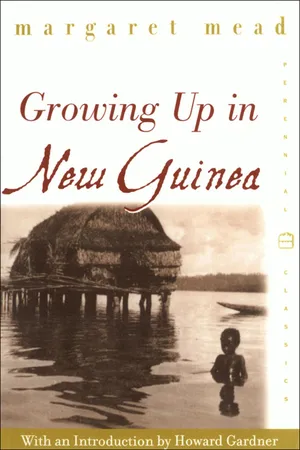
Such an untouched people are the brown sea-dwelling Manus of the Admiralty Islands, north of New Guinea.* In their vaulted, thatched houses set on stilts in the olive green waters of the wide lagoon, their lives are lived very much as they have been lived for unknown centuries. No missionary has come to teach them an unknown faith, no trader has torn their lands from them and reduced them to penury. Those white men’s diseases which have reached them have been few enough in number to be fitted into their own theory of disease as a punishment for evil done. They buy iron and cloth and beads from the distant traders; they have learned to smoke the white man’s tobacco, to use his money, to take an occasional dispute into the District Officer’s Court. Since 1912 war has been practically abolished, an enforced reformation welcome to a trading, voyaging people. Their young men go away to work for two or three years in the plantations of the white man, but come back little changed to their own villages. It is essentially a primitive society without written records, without economic dependence upon white culture, preserving its own canons, its own way of life.
The manner in which human babies born into these water-dwelling communities, gradually absorb the traditions, the prohibitions, the values of their elders and become in turn the active perpetuators of Manus culture is a record rich in its implications for education. Our own society is so complex, so elaborate, that the most serious student can, at best, only hope to examine a part of the educational process. While he concentrates upon the method in which a child solves one set of problems, he must of necessity neglect the others. But in a simple society, without division of labour, without written records, without a large population, the whole tradition is narrowed down to the memory capacities of a few individuals. With the aid of writing and an analytic point of view, it is possible for the investigator to master in a few months most of the tradition which it takes the native years to learn.
From this vantage point of a thorough knowledge of the cultural background, it is then possible to study the educational process, to suggest solutions to educational problems which we would never be willing to study by experimentation upon our own children. But Manus has made the experiment for us; we have only to read the answer.
I made this study of Manus education to prove no thesis, to support no preconceived theories. Many of the results came as a surprise to me.* This description of the way a simple people, dwelling in the shallow lagoons of a distant south sea island, prepare their children for life, is presented to the reader as a picture of human education in miniature. Its relevance to modern educational interest is first just that it is such a simplified record in which all the elements can be readily grasped and understood, where a complex process which we are accustomed to think of as written upon too large a canvas to be taken in at a glance, can be seen as through a painter’s diminishing glass. Furthermore in Manus certain tendencies in discipline or accorded license, certain parental attitudes, can be seen carried to more drastic lengths than has yet occurred within our own society. And finally these Manus people are interesting to us because the aims and methods of Manus society, although primitive, are not unlike the aims and methods which may be found in our own immediate history.
We shall see how remarkably successful the Manus people are in instilling into the smallest child a respect for property; how equally remarkable is the physical adjustment which very young children are taught to make. The firm discipline combined with the unflagging solicitude which lie back of these two conspicuous Manus triumphs, contradict equally the theory that a child should be protected and sheltered and the theory that he should be thrown into the waters of experience to “sink or swim.” The Manus world, slight frameworks of narrow boards above the changing tides of the lagoon, is too precarious a place for costly mistakes. The successful fashion in which each baby is efficiently adapted to its dangerous way of life is relevant to the problems which parents here must face as our mode of life becomes increasingly charged with possibilities of accident.
Perhaps equally illuminating are the Manus mistakes, for their efficiency in training dexterous little athletes and imbuing them with a thorough respect for property is counterbalanced by their failure in other forms of discipline. The children are allowed to give their emotions free play; they are taught to bridle neither their tongues nor their tempers. They are taught no respect for their parents; they are given no pride in their tradition. The absence of any training which fits them to accept graciously the burden of their tradition, to assume proudly the rôle of adults, is conspicuous. They are permitted to frolic in their ideal playground without responsibilities and without according either thanks or honour to those whose unremitting labour makes their long years of play possible.
Those who believe that all children are naturally creative, inherently imaginative, that they need only be given freedom to evolve rich and charming ways of life for themselves, will find in the behaviour of Manus children no confirmation of their faith. Here are all the children of a community, freed from all labour, given only the most rudimentary schooling by a society which concerns itself only with physical proficiency, respect for property and the observance of a few tabus. They are healthy children; a fifty per cent infant death rate accomplishes that. Only the most fit survive. They are intelligent children; there are only three or four dull children among them. They have perfect bodily co-ordination; their senses are sharp, their perceptions are quick and accurate. The parent and child relationship is such that feelings of inferiority and insecurity hardly exist. And this group of children are allowed to play all day long, but, alas for the theorists, their play is like that of young puppies or kittens. Unaided by the rich hints for play which children of other societies take from the admired adult traditions, they have a dull, uninteresting child life, romping good humouredly until they are tired, then lying inert and breathless until rested sufficiently to romp again.
The family picture in Manus is also strange and revealing, with the father taking the principal rôle, the father the tender solicitous indulgent guardian, while the mother takes second place in the child’s affection. Accustomed as we are to the family in which the father is the stern and distant dictator, the mother the child’s advocate and protector, it is provocative to find a society in which father and mother have exchanged parts. The psychiatrists have laboured the difficulties under which a male child grows up if his father plays patriarch and his mother madonna. Manus illustrates the creative part which a loving tender father may play in shaping positively his son’s personality. It suggests that the solution of the family complex may lie not in the parents assuming no rôles, as some enthusiasts suggest, but in their playing different ones.
Besides these special points in Manus educational practice, there is also a curious analogy between Manus society and America. Like America, Manus has not yet turned from the primary business of making a living to the less immediate interest of the conduct of life as an art. As in America, work is respected and industry and economic success is the measure of the man. The dreamer who turns aside from fishing and trading and so makes a poor showing at the next feast, is despised as a weakling. Artists they have none, but like Americans, they, richer than their neighbours, buy their neighbours’ handiwork. To the arts of leisure, conversation, story telling, music and dancing, friendship and love making, they give scant recognition. Conversation is purposeful, story telling is abbreviated and very slightly stylised, singing is for moments of boredom, dancing is to celebrate financial arrangements, friendship is for trade, and love making, in any elaborate sense, is practically unknown. The ideal Manus man has no leisure; he is ever up and about his business turning five strings of shell money into ten.
With this emphasis upon work, upon the accumulation of more and more property, the cementing of firmer trade alliances, the building of bigger canoes and bigger houses, goes a congruent attitude towards morality. As they admire industry, so do they esteem probity in business dealings. Their hatred of debt, their uneasiness beneath undischarged economic obligations is painful. Diplomacy and tact are but slightly valued; obstreperous truthfulness is the greater virtue. The double standard permitted very cruel prostitution in earlier days; the most rigorous demands are still made upon the virtue of Manus women. Finally their religion is genuinely ethical; it is a spiritualistic cult of the recently dead ancestors who supervise jealously their descendants’ economic and sexual lives, blessing those who abstain from sin and who labour to grow wealthy, visiting sickness and misfortune on violators of the sexual code and on those who neglect to invest the family capital wisely. In many ways, the Manus ideal is very similar to our historical Puritan ideal, demanding from men industry, prudence, thrift and abstinence from worldly pleasures, with the promise that God will prosper the virtuous man.
In this stern workaday world of the adult, the children are not asked to play any part. Instead they are given years of unhampered freedom by parents whom they often bully and despise for their munificence. We often present our children with this same picture. We who live in a society where it is the children who wear the silk while the mothers labour in calico, may find something of interest in the development of these primitive young people in a world that is so often like a weird caricature of our own, a world whose currency is shells and dogs’ teeth, which makes its investments in marriages instead of corporations and conducts its overseas trade in outrigger canoes, but where property, morality and security for the next generation are the main concerns of its inhabitants.
This account is the result of six months’ concentrated and uninterrupted field work. From a thatched house on piles, built in the centre of the Manus village of Peri, I learned the native language, the children’s games, the intricacies of social organisation, economic custom and religious belief and practice which formed the social framework within which the child grows up. In my large living room, on the wide verandahs, on the tiny islet adjoining the houses, in the surrounding lagoon, the children played all day and I watched them, now from the midst of a play group, now from behind the concealment of the thatched walls. I rode in their canoes, attended their feasts, watched in the house of mourning and sat severely still while the mediums conversed with the spirits of the dead. I observed the children when no grown-up people were present, and I watched their behaviour towards their parents. Within a social setting which I learned to know intimately enough not to offend against the hundreds of name tabus, I watched the Manus baby, the Manus child, the Manus adolescent, in an attempt to understand the way in which each of these was becoming a Manus adult.