![]()
1
THE WILD INDIAN
“I was the terror of the neighborhood.”
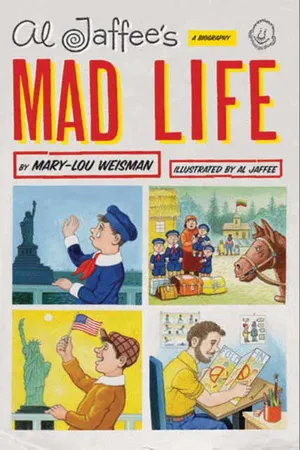
AL REMEMBERS the day his childhood ended. He, his mother, and his three younger brothers had just disembarked from the boat that had taken them on a long ocean voyage. The journey had started when he said an angry, tearful good-bye to his father in Savannah and had ended in this big, scary place with the funny name—Hamburg. Was there a place, he wondered, called Hot Dog?
The Hamburg railroad depot was the biggest place he had ever seen. He was like Jonah in the belly of the whale, a hellish, frightening belly of soot, screeching metal, pumping wheels, and sulfurous coal smoke. Huge, dark engines crouched on the tracks, hissing and panting steam. A wilderness of rails ran out of the station until they were lost from view. If they followed one of these tracks far enough, Al wondered, would they lead to this place they were going called Lithuania?
Al had seen trains before, but never so many all at once. His father had always been with him in the train station in Savannah when they went together on Sundays to the Isle of Hope, an amusement park outside of the city. Al could remember standing with him on the platform. He could almost feel his father’s hands resting firmly on his shoulders, holding him safely in place, away from the tracks, while Al, thrillingly terrified, leaned against his father’s knees and covered his ears against the thundering onslaught.
Where was his mother? Harry, his five-year-old brother, was running on the tracks. Bernard, two and a half years old, was waddling off in another direction. David, the baby, was screaming in his carriage. Standing on the platform, holding tightly to the handle of the carriage, Al didn’t know what to do. Should he leave David and run after his brothers? Should he try to push the carriage through the crowd? Adults, exhausted and confused, labored under bundles tied with string, lugged satchels, leather valises, and cardboard trunks, trying to find their place on platforms so long they seemed to lead to nowhere. None of these adults was his mother. He was paralyzed with fear.
“Mama!” he yelled. “Where are you?
“Mama!” he cried. “Come back!”
“It was chaos,” Al remembers. “It is a moment that is as clear to me today as it was then. I realized that I must not rely on this woman for my survival. I must not. Either we are all going to get killed, or those of us who stay alert are going to survive, because she doesn’t know what she’s doing. I realized that she was irresponsible. That I knew better than she did. I knew I could not put my life in her hands. I knew I was on my own.” Suspended between two worlds, he understood that this was no time to look down. Al was six years old.
The year was 1927. At a time when Jews all over Europe were trying to get to the United States, Mildred Gordon Jaffee, homesick for zarasai, the Lithuanian shtetl from which she’d emigrated, decided to leave Savannah and take her four American-born children back to an increasingly anti-Semitic Lithuania.
Mildred Jaffee told her husband, Morris, who had also emigrated from zarasai, that she was going for a brief visit to relatives, but she had probably never intended to return.
DOCUMENTS ARE INCONSISTENT about Morris’s age when he first immigrated to New York’s Lower East Side in 1905. He might have been as young as fifteen or as old as seventeen. He might have left Zarasai, as did many others, to keep from being conscripted into the czar’s army. (Lithuania would not become independent of Russia until 1918.) A 1910 census lists his profession as a tailor. It is unlikely that Morris had plans at the time to send for Mildred Gordon, whose age, also listed variously in different documents, would identify her as anywhere from three to seven years his junior. They might have known each other in zarasai, but their romance probably began in New York.
Morris Jaffee hit New York running. Al doesn’t know what kind of work his father did in New York, but he was smart, well educated, buoyant, confident, and ambitious. Already fluent in Hebrew, Russian, and Yiddish, he enrolled in night school and quickly became proficient in English. Although Jaffee was a small, frail man—no more than five feet four inches—his appetite for the challenges of the New World was immense. In a New York minute, he exchanged his black woolen cap for a dapper straw boater and set out to make this glitzy, noisy, crowded new world his own. He cheered for the Giants. He walked across the Brooklyn Bridge for the sheer joy of it. He had left a world lit only by kerosene, and now—he could hardly believe it—he stood basking in the lights of the Great White Way. Whenever he could afford it, he’d slip into the nickelodeon or the movies. His favorites were the Keystone Kops and Charlie Chaplin.
Mildred Gordon boarded the Czar in Libau, Russia’s largest emigration harbor, and arrived in New York on December 9, 1913. According to the ship’s manifest, which lists her name as “Michlia Gordon, daughter of Chaim Gordon,” she was a twenty-year-old, five-foot-tall “Hebrew,” a “tailores” with dark hair and eyes. She had twenty-two dollars in her pocket, the equivalent of almost five hundred dollars today. She listed her American destination as 305 Jackson Street, in the heart of the Lower East Side and the home of her cousin Morris Gordon.
Mildred’s entry into New York City’s Lower East Side was much more tentative than Morris’s. She lived among her relatives, who, with the exception of her sister Frieda, one year her senior, consisted of great-aunts and second or third cousins from the provinces of zarasai and Vilnius (Vilna in Russian, Vilne in Yiddish). Lithuania, as such, did not exist under the Russian regime.
However tenuous their relationships, they faced the stigma of marginality together. They shared a common language, Yiddish, and a common need to find lodgings, learn English, and make a living. Mildred went to night school and easily developed a fluency in English. She read and wrote beautifully. She took out books from the library. She loved the new language so much that in later years, when Al would make a grammatical error, she would slap him across the face. Frieda, who was an expert seamstress, probably secured apprentice work for her “tailores” sister. They stuck together in the vast, strange city, creating a tiny replica of shtetl life in which Mildred Gordon must have felt safe. She might even have been happy. The relatives with whom she lived described her as cheerful, a clever mimic, and full of fun.
Mildred was eager to marry Morris, but her plans were frustrated when, in 1917, Morris was drafted into the army and sent to Yaphank, Long Island, for training, and then on to Europe. Morris persuaded Mildred to wait and see if he returned. He almost didn’t. He was captured and held under near-starvation conditions in a prisoner-of-war camp in Germany.
Morris Jaffee abhorred violence so much so that he didn’t even like to join in conversations with other men about the fighters Max Schmeling or Joe Louis. He was interested in politics and social issues. He was a liberal, a New Dealer. “My father was proud when the governor of New York was Herbert Lehman, but he was just as condemnatory of Jewish crooks. ‘We’re going to get hell for these guys,’ he’d say.” He would show Al his uniforms and medals. He would let him wear his kepi, but he refused to satisfy his son’s little-boy lust for blood and guts. “When I asked him, ‘What did you do in the war, Daddy? Did you shoot Germans? Did you kill lots of Germans?’ he would answer, ‘No, no, no. I was out shooting lions.’ ”
After his army discharge, Morris and Mildred married on June 19, 1919, in the Bronx and moved to an apartment on Bathgate Avenue. Their marriage certificate lists her name as a more Americanized “Milly.” At about this time, Morris passed the civil service exam to qualify as a postal worker. Shortly thereafter, he learned through the Jewish grapevine that wound its way from Savannah to New York City that a Mr. Blumenthal had sent word north that he was looking for an “honest, young, Jewish man, preferably married,” to run his Savannah pawnshop. It was common in those days to recruit young Jewish men from New York because southern Jewish businessmen didn’t trust gentiles or Negroes as employees. Morris applied for the job and was hired. Morris and Mildred moved to Savannah, where, a year later, on March 13, 1921, Al (né Abraham) was born. Morris rented a house at 120 West Taylor Street, in a pleasant, if modest, part of town. Morris was such a success at the pawnshop that he was soon given the job of general manager of S. Blumenthal and Son, one of Savannah’s leading department stores.
Al remembers his father as having two personae, with accents to match. “It was the most amazing thing. In New York, he spoke English with a New York accent and not a trace of Yiddish. Once in Savannah, he spoke English with a southern accent. He quickly became a member of the Shriners and the Masons. He couldn’t wait to do the American thing.
“My father was a dandy. He walked around like he was on top of the world, and he was. Everybody bowed and scraped to him. He felt like a million bucks. My father was very, very eager to join the twentieth century. My mother was very happy being drawn back into the nineteenth. She was suspicious of modernity. She feared that eating salted butter could make her family sick. She knew that in zarasai when butter was spoiled, merchants added salt to cover up the rancid taste. My mother was hopelessly attached to the Old World.”
Mildred Jaffee—scrupulously religious—never got used to life in Savannah. Immigrating to New York City turned out to have been the easy part. Leaving the cocoon of the Lower East Side and moving to Savannah may have contributed to Mildred Gordon’s undoing.
Although most people think of Charleston as the most “Jewish” of southern colonial cities, Savannah was just a few years behind, having established a synagogue, Mickve Israel, in 1735. By the time Mildred got to Savannah, Mickve Israel had become a Reformed temple, so “goyish” that Mildred wouldn’t be caught dead there. The so-called Orthodox synagogue, B’nai B’rith—with its Moorish architecture and stained-glass rose windows, no less—bore no resemblance to her wooden shul in zarasai. She attended but found little comfort or sociability there.
It didn’t matter that she had traded the dirt streets, the outhouses, the lack of running water, and the long, freezing winters for a middle-class life in a white clapboard house on a pleasant, tree-lined street in Georgia. What mattered was that the Negro maid kept mixing up her milchig (dairy) and fleishig (meat) dishes. What mattered was that she missed the ghettoized Jewish life she had known in zarasai and on the Lower East Side.
Al’s mother had a lot of rules about what she would and would not tolerate. Morris, who was making good money, wanted to take driving lessons and buy a car, but Mildred wouldn’t hear of it.
“Perhaps my mother had a genuine fear that my father would not know how to handle this newfangled machine and that he would kill us all. Automobile accidents were frequent in the 1920s. Nobody knew what traffic was. My mother trusted horses and wagons, not Model T Fords. Horses had enough sense not to bump into one another. Maybe that’s what it was.”
Mildred Jaffee could never come to terms with the fact that her husband’s job at Blumenthal’s department store required that he work on the Sabbath. Her fear of trayf* kept her and her family from accepting any dinner invitations, including those from her husband’s boss, Mr. Blumenthal, even though the Blumenthals themselves kept kosher. Al can’t remember any social life, either inside or outside of their home. “If my mother would have given and attended parties, my parents could have become part of the southern Jewish semi-aristocracy, and I’d be the scion of a very nice family in Savannah by now.” As scrupulous as Al’s mother was about certain religious practices, Al doesn’t think she qualified as an Orthodox Jew. She didn’t shave her head, but Litvak women did not always shave their heads. Sheitels† were expensive, and many women might have preferred to wear a scarf. In other respects Mildred was clearly a nonconformist. “If she was totally religious, we would have had to wear yarmulkes when we ate, and we didn’t; we only wore them in shul. She walked long distances on the Sabbath, when only short distances were permitted. In all matters religious and secular, my mother did as she pleased.”
That her husband loathed the very rabbis that Mildred Jaffee revered had to have been the greatest source of conflict in the Jaffee household. Al’s father would go into protracted and frequent rants against them. “They get free room and board. They’re supported in luxury. They’re a bunch of monkeys and freeloaders. I have no respect for any of these thieves.”
“For all my mother’s religious beliefs,” Al remembers, “we were all born in a Catholic hospital, Saint Something or Other. My father says the nuns so respected her wishes that they covered up the crucifixes in her room and helped her to light candles on Friday night.
“Our travels were no less eccentric. On the steamship to Hamburg, she demanded of the captain, ‘Stop this boat, it’s sundown.’ There she was, with a lace doily on her head, trying to light the Sabbath candles in a dinky stateroom on a ship that was rolling from side to side in the middle of the Atlantic. It was madness.”
THE MADNESS ONLY INCREASED on the next leg of their journey, the train trip from Hamburg to Berlin and then from Berlin to Memel. Fifteen minutes before the train was to arrive in Berlin, where they were to connect with the train to Memel, the conductor passed by Mildred Jaffee and her brood to encourage her to get them ready to leave the train.
“Shh, I have sleeping children,” Al remembers his mother saying. “Do you expect me to wake up my children because of your timetable? When my children wake up, we’ll get off the train.”
“I was apoplectic. I pled with her. ‘Mom, you gotta get off,’ but she let my brothers sleep until the train stopped. Then she turned to the conductor and told him that he couldn’t start the train until she dressed her children and got them off. The conductor was going crazy. I didn’t know whether to get off the train or to wait with her. My mother insisted on her way. She was very strong. She was never terrified. She terrified others. She had no sense of embarrassment about demanding what she wanted.”
In addition to the many pieces of luggage that traveling with four small children required, Mildred Jaffee brought with her on this difficult and long journey four small Torahs* and a cardboard satchel filled with jars of homemade jam. En route from Berlin to Memel...