"A superb analysis of American paranoia . . . a terrific, measured, objective study of one of American culture's most loaded topics." —
Publishers Weekly (starred review)
Jesse Walker's
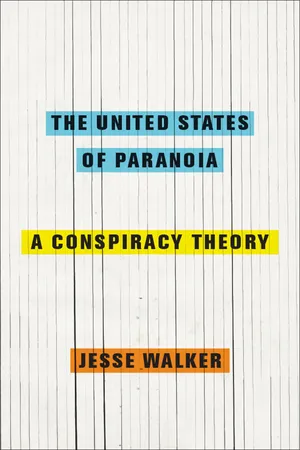
The United States of Paranoia presents a comprehensive history of conspiracy theories in American culture and politics, from the colonial era to the War on Terror.
The fear of intrigue and subversion doesn't exist only on the fringes of society, but has always been part of our national identity. When such tales takes hold, Walker argues, they reflect the anxieties and experiences of the people who believe them, even if they say nothing true about the objects of the theories themselves.
With intensive research and a deadpan sense of humor, Jesse Walker's
The United States of Paranoia combines the rigor of real history with the punch of pulp fiction.
This edition includes primary-source documentation in the form of archival photographs, cartoons, and film stills selected by the author.
"Oddly entertaining . . . Walker quickly demolishes [Richard Hofstadter's
The Paranoid Style in American Politics]. It's all too rare to come upon a writer willing to attack the sacred cows of the right and left with equal amounts of intelligence and flair." —
Los Angeles Times
"Free-floating fear and half-baked ideas about what's really going on have been a more significant part of American history than is generally accepted, according to Jesse Walker's thorough, meticulously researched book."
—
Vice
"A remarkably comprehensive, wide-ranging look at the way American culture, politics, religion, and social structure have been affected by conspiracy stories." —
Booklist
- 464 pages
- English
- ePUB (mobile friendly)
- Available on iOS & Android
eBook - ePub
About this book
Information

1
THE PARANOID STYLE IS AMERICAN POLITICS
If men define situations as real, they are real in their consequences.
—William and Dorothy Thomas1
On January 30, 1835, as Andrew Jackson exited a congressman’s funeral, an assassin drew a weapon and pointed it at the president. The pistol misfired. The gunman pulled a second weapon from his cloak. Though loaded, it too failed to fire. The cane-wielding Jackson and several bystanders subdued the would-be killer, an unemployed housepainter named Richard Lawrence. Lawrence later informed interrogators that he was King Richard III, that Jackson had killed his father, and that with Jackson dead “money would be more plenty.”2 He was judged insane and committed to an asylum, where he died three decades later. Lawrence was a lone nut.
Or at least that was the official story. It wasn’t long before two witnesses filed affidavits claiming to have seen Lawrence at the home of the Mississippi senator George Poindexter shortly before the attack. Poindexter was a noisy opponent of the Jackson administration, and pro-Jackson newspapers accused the senator of plotting the president’s murder. So did Jackson’s allies in Congress, who quickly convened an investigation. Jackson himself told bystanders after the assault that the shooter had “been hired by that damned rascal Poindexter to assassinate me.”3
Some of Jackson’s critics countered by suggesting that the president had staged the assault to gain public support, and that this explained why both weapons had failed. And many Jacksonians pointed their finger at John Calhoun, the South Carolina senator and former vice president, arguing that if he had not been directly involved in the assassination attempt, he had at the very least incited it with a speech denouncing Jackson as an American Caesar.4
When the Republican writer John Smith Dye described the crime twenty-nine years later, he saw an even more devilish plot at work. Calhoun might not have been directly involved in the assault, Dye conceded: “Whether this man was induced to attempt to murder the President by listening to his defamer making speeches in the Senate . . . or whether he was secretly hired to assassinate him, God alone can determine.” 5 But Dye believed that Calhoun had been a part of a larger force, the Slave Power, that would have benefited if Jackson had been put in the ground. And the Slave Power, Dye informed his readers, was more than willing to kill a powerful man to get its way.
In 1841, for example, President William Henry Harrison told Calhoun he wasn’t sure he was willing to annex Texas, which southerners wanted to add to the union as a slave state. Harrison promptly died. Officially the cause of death was pneumonia, but Dye was sure that arsenic was to blame. Nine years later, Dye continued, President Zachary Taylor opposed the Slave Power’s agenda in Cuba and the Southwest, and so he was killed by the same poison. And when President-elect James Buchanan prepared to make some appointments of which the slaveocrats disapproved, Dye declared, he narrowly survived one of the most elaborate assassination plots ever conceived.
On February 23, 1857, according to Dye, southern agents poisoned all the bowls containing lump sugar at the National Hotel in Washington, D.C. Southerners, he explained, drink coffee; coffee drinkers use pulverized sugar; so the southern diners would be spared and the tea-drinking northern diners, including Buchanan, would be wiped out. The future president barely survived the illness that followed. “Intimidated by the attempted assassination,” Dye wrote, Buchanan “became more than ever the tool of the slave power.”6
There is little evidence for Dye’s explosive charges. You can make a case that Harrison’s doctors did more to hurt than to help the ailing president, but no more than conjecture supports the idea that anyone deliberately killed him.7 Coroners debunked the belief that Zachary Taylor had been poisoned when his body was exhumed in 1991. And Buchanan was not even present in Washington on February 23, 1857, though dysentery did break out at the hotel when Buchanan stayed there a month earlier and again when he returned for his inauguration. Today the outbreaks are usually attributed to a sewage backup that contaminated the inn’s food and water, but at the time several stories circulated blaming poisoners for the illnesses, with the suspects ranging from a Chinese cabal to a band of homicidal abolitionists. Inconveniently for Dye’s tea-and-coffee thesis, the dead included a southern congressman, John Quitman of Mississippi.
But when Dye’s book The Adder’s Den was published in 1864, the country was at war with the South, and when a new edition appeared two years later, under the title History of the Plots and Crimes of the Great Conspiracy to Overthrow Liberty in America, the nation was still reeling from the assassination of Abraham Lincoln.8 In that atmosphere, a book that feels like a 1970s conspiracy movie set in the antebellum era received a respectful notice in The New York Times and was excerpted in the Chicago Tribune;9 Republican papers praised it in Philadelphia, Harrisburg, Trenton, and New York City, and in Pennsylvania even the Democratic Easton Express proclaimed it “the most powerful book of this century.”10

Richard Lawrence attempts to kill Andrew Jackson, National Archives
Nor did Dye invent his theories from nothing: He drew on rumors that had been floating through Whig and Republican circles for years. After Lincoln was elected—well before Dye’s book appeared—several supporters of the incoming president sent letters warning him to watch out for the plotters who had killed two of his predecessors. “General Harrison livd but a Short time after he was Installd in office,” one concerned citizen pointed out, and “General Taylor livd but a short time after he took his seat. . . . You Sir be careful at the Kings table what meat and drink you take.”11 Another letter informed Lincoln that “I have often heard it stated by Physicians, that it was an undoubted fact, that our two last Whig Presidents, Gen’s Harrison & Taylor, came to their sudden and lamentable ends, by subtle poisons, administered in their food at the White House.”12
After Lincoln died, at least two prominent ministers—George Duffield of Detroit and William Goodwin of Connecticut—worked the supposed murders of Harrison and Taylor into their sermons. Reverend Henry Ward Beecher not only invoked their alleged assassinations in an article for The New York Ledger but added the antisecessionist Democrat Stephen Douglas to the list of victims, writing that he had been killed because his position in the party “made him one of the most efficient champions against the Rebellion.”13 During the effort to impeach Lincoln’s southern successor, President Andrew Johnson, Representative James Mitchell Ashley of Ohio brought up the same old accusations, declaring that Harrison, Taylor, and Buchanan had been “poisoned for the express purpose of putting the vice presidents in the presidential office.”14
And in May 1868, an extraordinary article in the New-York Tribune managed to out-Dye Dye, accusing a Democratic conspiracy of engineering the city’s malaria outbreaks. After commenting that Zachary Taylor “fell under the malarious vapors of Washington and died” because he was prone to “acting honestly and straightforward,” the Tribune writer claimed that Washington in subsequent years “was free of malaria—that is, for Democrats; but when the new Republican party began to gain strength, and it was possible that they might become the ruling power in Congress, the water of Washington suddenly grew dangerous, the hotels (particularly the National) became pest-houses, and dozens of heretics from the Democratic faith grew sick almost unto death.” The contagions continued until Lincoln put “the walls and springs of the Capital” under “the care of loyal soldiers,” ending the outbreaks. But after Lincoln was deposed, the pattern returned: Right before the vote to impeach Johnson, “we had a return of that bad water, and two or three Senators—Republicans, mind you—are prostrated with sudden illness. What does it mean? Why does it happen that whenever the current sets against the Master Demon of Slavery (and never at any other time), we find the air, and the water, and the whisky of Washington full of poison?”15
The assassination theorists weren’t the only Americans worried about conspiracies of slaveholders. Dye didn’t coin the phrase “Slave Power.” The term was common currency in the North, where it was used to describe the political influence of the planter elite. This was not in itself a conspiracy theory, but it often adopted a conspiratorial coloring. In the words of the historian Russel B. Nye, the Slave Power had an alleged agenda to extend slavery “to the territories and free states (possibly to whites)” and “to destroy civil liberties, control the policies of the Federal government, and complete the formation of a nationwide ruling aristocracy based on a slave economy.”16 Lincoln himself believed that he could “clearly see” a “powerful plot to make slavery universal and perpetual,”17 and in his famous House Divided speech he engaged freely in conspiratorial speculation.18
Senator Henry Wilson, later to serve as Ulysses S. Grant’s vice president, put the idea bluntly: “Slavery organized conspiracies in the Cabinet, conspiracies in Congress, conspiracies in the States, conspiracies in the Army, conspiracies in the Navy, conspiracies everywhere for the overthrow of the Government and the disruption of the Republic.”19 Meanwhile, southerners had elaborate conspiracy theories of their own, blaming slave revolts, both real and imagined, on the machinations of rebellion-stoking abolitionists, treacherous land pirates, and other outside agitators.
It was a paranoid time. In America, it is always a paranoid time.
Pundits tend to write off political paranoia as a feature of the fringe, a disorder that occasionally flares up until the sober center can put out the flames. They’re wrong. The fear of conspiracies has been a potent force across the political spectrum, from the colonial era to the present, in the establishment as well as at the extremes. Conspiracy theories played major roles in conflicts from the Indian wars of the seventeenth century to the labor battles of the Gilded Age, from the Civil War to the Cold War, from the American Revolution to the War on Terror. They have flourished not just in times of great division but in eras of relative comity. They have been popular not just with dissenters and nonconformists but with individuals and institutions at the center of power. They are not simply a colorful historical byway. They are at the country’s core.
Unfortunately, much of the public perception of political paranoia seems frozen in 1964, when the historian Richard Hofstadter published “The Paranoid Style in American Politics.”20 Hofstadter set out to describe a “style of mind” marked by “heated exaggeration, suspiciousness, and conspiratorial fantasy,” detecting it in movements ranging from the anti-Masonic and anti-Catholic crusades of the nineteenth century to the “popular left-wing press” and “contemporary right wing” of his time. A flawed but fascinating essay, “The Paranoid Style” is still quoted frequently today. Half a century of scholarship has built on, rebutted, or otherwise amended Hofstadter’s ideas, but that work rarely gets the attention that “The Paranoid Style” does.
That’s too bad. The essay does contain some real insights, and if nothing else it can remind readers that conspiracy theories are not a recent invention. But it also declares that political paranoia is “the preferred style only of minority movements”—and, just to marginalize that minority some more, that it has “a greater affinity for bad causes than good.” 21 In an earlier version of his article,22 Hofstadter went further, claiming that the paranoid style usually affects only a “modest minority of the population,” even if, under certain circumstances, it “can more readily be built into mass movements or political parties.”
Hofstadter did not provide numbers to back up those conclusions. We do have some data on the popularity of well-known conspiracy theories, though, and the results do not support his sweeping claims. In 2006, a nationwide Scripps Howard survey indicated that 36 percent of the people polled—a minority but hardly a modest one—believed it “very” or “somewhat” likely that U.S. leaders had either allowed 9/11 to happen or actively plotted the attacks.23 Theories about JFK’s assassination aren’t a minority taste at all: Forty years after John F. Kennedy was shot, an ABC News poll showed 70 percent of the country believing a conspiracy was behind the president’s death. (In 1983, the number of believers was an even higher 80 percent.)24 A 1996 Gallup Poll had 71 percent of the country thinking that the government is hiding something about UFOs.25
To be sure, there is more to Hofstadter’s paranoid style than a mere belief in a conspiracy theory. And there’s a risk of reading too much into those answers: You can believe the government has covered up information related to UFOs without believing it’s hiding alien bodies in New Mexico. ...
Table of contents
- Dedication
- Epigraph
- Contents
- Part I: Primal Myths
- Part II: Modern Fear
- Epilogue: The Monster at the End of This Book
- Acknowledgments
- Notes
- Index
- About the Author
- Credits
- Copyright
- About the Publisher
Trusted by 375,005 students
Access to over 1.5 million titles for a fair monthly price.
Study more efficiently using our study tools.
Frequently asked questions
Yes, you can cancel anytime from the Subscription tab in your account settings on the Perlego website. Your subscription will stay active until the end of your current billing period. Learn how to cancel your subscription
No, books cannot be downloaded as external files, such as PDFs, for use outside of Perlego. However, you can download books within the Perlego app for offline reading on mobile or tablet. Learn how to download books offline
Perlego offers two plans: Essential and Complete
- Essential is ideal for learners and professionals who enjoy exploring a wide range of subjects. Access the Essential Library with 800,000+ trusted titles and best-sellers across business, personal growth, and the humanities. Includes unlimited reading time and Standard Read Aloud voice.
- Complete: Perfect for advanced learners and researchers needing full, unrestricted access. Unlock 1.5M+ books across hundreds of subjects, including academic and specialized titles. The Complete Plan also includes advanced features like Premium Read Aloud and Research Assistant.
We are an online textbook subscription service, where you can get access to an entire online library for less than the price of a single book per month. With over 1.5 million books across 990+ topics, we’ve got you covered! Learn about our mission
Look out for the read-aloud symbol on your next book to see if you can listen to it. The read-aloud tool reads text aloud for you, highlighting the text as it is being read. You can pause it, speed it up and slow it down. Learn more about Read Aloud
Yes! You can use the Perlego app on both iOS and Android devices to read anytime, anywhere — even offline. Perfect for commutes or when you’re on the go.
Please note we cannot support devices running on iOS 13 and Android 7 or earlier. Learn more about using the app
Please note we cannot support devices running on iOS 13 and Android 7 or earlier. Learn more about using the app
Yes, you can access The United States of Paranoia by Jesse Walker in PDF and/or ePUB format, as well as other popular books in Social Sciences & North American History. We have over 1.5 million books available in our catalogue for you to explore.