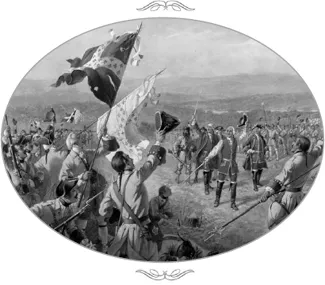
By the spring of 1757 the war in North America—both undeclared and declared—had been going very well for the French. Despite being outnumbered twenty to one in inhabitants, they continued to hold a vast territory, now more securely protected by a cordon of forts and Indian allies than ever before. This was a striking contrast to 1749, when Céloron, on his visit to the Ohio country, had found the French presence lacking.
In 1754, the French had seized the forks of the Ohio and sent young George Washington packing back to Virginia. In 1755, save for the loss of forts Beauséjour and Gaspereau in Nova Scotia, they had managed to block advances along all of Braddock’s roads. In 1756, they had not only solidified their perimeter defenses from Fort Duquesne to forts Niagara, Frontenac, Saint Frédéric, and Carillon, but also swept the British from Oswego and from a toehold on the Great Lakes. Meanwhile, the Indian allies of the French had played havoc all along the British frontier north of the Carolinas. With another round of reinforcements in hand and the fortress of Louisbourg still secure, why shouldn’t 1757 be another banner year for the fleur-de-lis? The answer to that question lay much more in Europe than in North America.1
In England, George II had finally resigned himself to William Pitt’s role in his government, although George still grumbled about Pitt’s apparent lack of interest in the king’s prized possession, Hanover. George and his favored son, the duke of Cumberland, remained transfixed by Hanover’s defense among the shifting boundaries of Europe. Pitt, however, painted on a much broader canvas, and it quickly became apparent that this canvas encompassed the world. He had little or no patience with generals and admirals or, for that matter, monarchs, who were content to debate ad infinitum the pros and cons of the push of a single pawn on the global chessboard. Rather, Pitt saw the big picture and demanded bold moves. In truth, the king was right: Pitt cared not a bit for Hanover, but he clearly recognized its strategic importance to keeping France occupied on the continent while he pursued global ambitions.2
France took the bait, for a variety of reasons. First of all, the very idea that France might become a great maritime power with a global reach seems to have run counter to its national psyche. England was an island, inexorably tied to the seas around it. France was the crossroads of western Europe, inexorably tied to the lands around it. French armies had held its borders and secured its domain since the days of Charlemagne. Why France could not be a power on both land and sea seems to have been lost on its national consciousness.
Second, the French military establishment, championed by the minister of war, Antoine-René de Voyer d’Argenson, was resolutely determined that the army, not the navy, should be given all priorities and opportunities in any military operations. The French army simply could not imagine circumstances in which it would play second fiddle to the navy. Even the successes of de la Motte’s resupply of Canada in 1755 and Galissonière’s victory off Minorca in 1756 were viewed as tactical support of the army and did not awaken the French to the importance of sea power as a major strategic weapon.
Finally, there was the marquise de Pompadour. Her alliance with Maria Theresa of Austria had turned France’s gaze once again to the battlefields of Europe. Rather than emphasize its navy and concentrate its strength against England, its worldwide rival, France chose instead to throw the bulk of its resources into a European land war. After 1757, Louis XV’s chessboard was much smaller than William Pitt’s, and Louis’s overseas colonies, particularly New France, would be neglected. In the words of Frances Parkman, “Louis XV and Pompadour sent a hundred thousand men to fight the battles of Austria, and could spare but twelve hundred to reinforce New France.”3
With so much glory waiting on the battlefields of Europe, it was no wonder that France’s rising military leaders did not fall over each other clamoring for a command in the backwoods of Canada. Louis-Joseph de Montcalm-Gozon, marquis de Montcalm de Saint-Véran, ended up there because he was a good soldier following orders—nothing more. Montcalm was born on February 29, 1712, at the château of Candiac near Nîmes in the south of France. He acquired an early taste for books and received a strict education in Latin, Greek, and history. He joined the French army as an ensign at the age of fifteen, and two years later his father bought him a captaincy. When his father died in 1735, Montcalm was left with an estate that he cherished but that was saddled with debt. Consequently, Montcalm had little choice but to continue his military service. Along the way, he found time to marry and to father ten children.
By 1743, Montcalm had fought in Bohemia and been made colonel of the regiment of Auxerrois. (French regiments were generally named after the province where they were raised, whereas British regiments after 1751 were generally numbered.) More fighting followed in Italy; and in 1746, at the battle of Piacenza on the banks of the Po River, Montcalm twice rallied his troops back from the brink of disaster. In so doing, the marquis received no less than five saber wounds, including two to the head. Clearly, he was not lacking in personal courage. Captured in this engagement, Montcalm was soon paroled to France, where he was made a brigadier. After another year of warfare, the Treaty of Aix-la-Chapelle gave him an interlude in his fields at Candiac.
In the summer of 1755, the minister of war, Voyer d’Argenson, hinted that Montcalm might be headed for North America, but nothing came of the matter until Voyer d’Argenson looked around for a replacement for the fallen Dieskau after the battle of Lake George. Writing to Montcalm on January 25, 1756, Voyer d’Argenson was all flattery and noted his “greatest pleasure” in announcing that “the King has chosen you to command his troops in North America, and will honor you on your departure with the rank of major-general.” Setting out for Paris from his beloved château at Candiac, Montcalm wrote to his mother from Lyons that he had read a pleasant account of Quebec, but “shall always be glad to come home.”4
Montcalm sailed from Brest on April 3, 1756, with three ships of the line outfitted as transports. On board were two battalions of 600 men each—the 1,200 men Louis XV and the marquise de Pompadour had deigned to spare for the sake of New France. His subordinates were François-Gaston, chevalier de Lévis, named as brigadier; and François-Charles, chevalier de Bourlamaque, named as colonel. Louis-Antoine de Bougainville was to serve as his principal aide-de-camp. After a storm-tossed crossing of the Atlantic, the little fleet anchored in the Saint Lawrence River roughly thirty miles below Quebec, stopped from proceeding farther by heavy spring ice.
Within weeks of his arrival, Montcalm faced two issues that were to weigh heavily on his tenure in North America. The first was his meeting in Montreal with the governor general of New France, Pierre de Rigaud, marquis de Vaudreuil. Born in Canada, Vaudreuil was passionate about its cause, but somewhat indecisive and incompetent in his actions to pursue it. As was the long-established custom, Vaudreuil reported to the minister of marine, while Montcalm reported to the minister of war. Ostensibly, Montcalm was in charge of military matters, while Vaudreuil saw to civilian and administrative ones. But Vaudreuil was less than pleased by Montcalm’s arrival; and the fact that he himself had aspired to both the civilian and the military commands only added to a smoldering distrust between the two men.
The other issue facing Montcalm was the role of France’s Indian allies. At Montreal, Montcalm got a quick indoctrination into the intricacies of maintaining their alliances. “One needs the patience of an angel to get on with them,” Montcalm wrote to his mother shortly after arriving. “They make war with astounding cruelty, sparing neither men, women, nor children, and take off your scalp very neatly—an operation which generally kills you.” Montcalm was to see those tactics firsthand after his capture of the forts at Oswego the following summer, and doubtless they were on his mind as he plotted his strategy for 1757.5
But if Montcalm in Canada was feeling a little like the tail of the French dog, the British colonies had yet to feel any warmth from William Pitt’s global strategy. In fact, in the spring of 1757, they were feeling quite neglected, and in this they weren’t alone among their fellow Englishmen. The London Evening Post published a woodcut entitled “Without,” depicting the mood in London in the uncertain months between Pitt’s first dismissal and his coalition with Newcastle. England, according to this drawing, was feeling “without” about everything from “manufacturers without trade, to colonies without protection, parading fleets without fighting, great armies without use, the common people without money, and the poor without bread.”6
Given this situation, what were the British colonists to do? They could wallow in the loss of Oswego and wait for Montcalm to renew his attack via avenues from Niagara, Frontenac, and Carillon; or they could launch yet another assault against Canada despite the failures of three years running. To many, those failures proved a point. A jab here or there, or pruning a branch or two off Canada’s tree, wasn’t going to get the job done. This time, the thrust had to be for the jugular.
Go for Quebec, the New York Gazette urged its readers as early as December 6, 1756. Given the logistics of attacking Fort Duquesne or Fort Saint Frédéric, Quebec was no more difficult, the newspaper asserted, and “nothing is more certain than that when the head is lopped off, the inferior members will fall of course; why then is not this effectual step attempted?”7 Why indeed, but who was to lead it and from where?
In the British chain of command, only one thing was clear. By the end of 1756, William Shirley had become the scapegoat for the fall of Oswego. Not only that, but his successor, the earl of Loudoun, had charged Shirley with near treason. Shirley, Loudoun claimed, had been “raising armies to support himself” by enriching his friends through “lavishing the public treasure” and otherwise impressing people that he was “the only man entrusted in American affairs, by the King or his servants.”8
Given Shirley’s long record of service in North America, it was a low and unjustified blow, but Shirley was summoned home to England to account nonetheless. Loudoun, whom Shirley was to describe as “a pen and ink man whose greatest energies were put forth in getting ready to begin,” now had to do just that.9
While Lord Loudoun would soon have plenty of his own detractors, he received high marks for his efforts during the fall of 1756 to impose order on the chaotic logistics of the colonial war machine—just the sort of “pen and ink” work at which he excelled. Essentially, this meant improving the stockpiles of clothing, equipment, and provisions for regulars and provincials alike. This required not only the goods themselves, but also a steady and reliable means of moving them from the centralized storehouses at New York, Albany, and Halifax to the principal forts and troops in the field.
Loudoun made progress in this regard, but then ran afoul of provincial governors and their assemblies by instituting an embargo prohibiting all trade between the individual colonies unless it was of a military nature. This was supposed to centralize control over the flow of goods and eliminate the opportunists who were trading with Canada despite the war. About all that it did, however, was to crowd the docks from Boston to Charleston with spoiling produce. By the time that Loudoun realized that the measure was fruitless and lifted the embargo, it had accomplished nothing save harming American commerce. (This was a lesson that Thomas Jefferson would have done well to remember before imposing a far lengthier and far more destructive embargo on the American economy before the War of 1812.)
Given the disaster at Oswego and the impasse around Lake George, Loudoun heartily agreed with the New York Gazette and was convinced that the only way to win North America from the French was to strike a blow at its jugular—the Saint Lawrence—and seize Quebec. The question was, by land or by sea? “By fighting across the land,” Loudoun wrote to the duke of Argyle, “the troops must be exposed to a thousand accidents … and if we have all the success we can hope, we can get no further next campaign than to Lake Champlain.” Loudoun’s choice was clearly by sea. “By going to Quebec,” Loudoun concluded, “success makes us master of everything.”10
William Pitt certainly didn’t disagree with that sentiment, but he did have a different idea about how to attain the goal. England would strike for Quebec, all right, but Pitt refused to do so while his flank was threatened by the fortress of Louisbourg, which, it will be remembered, the English had seized once before—thanks in no small measure to the leadership of William Shirley. Consequently, on February 4, 1757, Pitt dispatched orders to Loudoun to seize Louisbourg before sailing on to Quebec.
But in the winter of 1757, Pitt was in his first tentative ministry and still groping for political power. He needed consensus and was not without critics. The duke of Cumberland in particular favo...