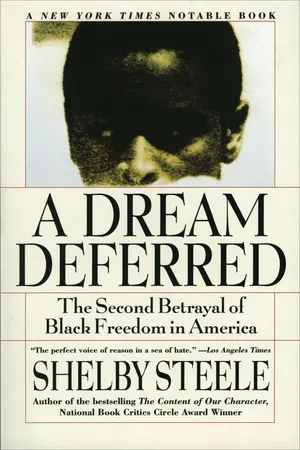
Award-winning author Shelby Steele's essay collection
A Dream Deferred reveals the untold story behind the polarized racial politics in America today.
A
New York Times Notable Book
Through thought-provoking insights, National Book Critics Circle Award Winner Shelby Steele argues that a second betrayal of black freedom in the United States—the first one being segregation—emerged from the civil rights era when the country was overtaken by a powerful impulse to redeem itself from racial shame. According to Steele, 1960s liberalism had as its first and all-consuming goal the expiation of American guilt rather than the careful development of true equality between the races.
In four densely argued essays, Steele takes on the familiar questions of affirmative action, multiculturalism, diversity, Afro-centrism, group preferences, victimization—and what he deems to be the atavistic powers of race, ethnicity, and gender, the original causes of oppression.
A Dream Deferred is an honest, courageous look at the perplexing dilemma of race and democracy in the United States—and what we might do to resolve it.
"Steele has given eloquent voice to painful truths that are almost always left unspoken in the nation's circumscribed public discourse on race." —
New York Times
"Steele's skill compares with that of James Baldwin, Richard Wright, or Frederick Douglass." —
Chicago Tribune
"Sweeping in its formulations . . . Perceptive . . . Steele is a clever critic." —
Los Angeles Times Book Review
"Deeply engaging public-policy criticism." —
Booklist
- 208 pages
- English
- ePUB (mobile friendly)
- Available on iOS & Android
eBook - ePub
About this book
Information
THE LONELINESS OF THE
“BLACK CONSERVATIVE”
1.
I felt a familiar anger rise when the editor asked me over the phone to write about “the loneliness of a black conservative.” Unless this was to be one of those serendipitous matchups of writer and subject where the charm is in the incongruence, the request all but stated that I was an obvious choice to map out this new territory of American loneliness. But the anger I felt was immediately diffused by an equally familiar sense of fatalism. There was no point in arguing. To be called a black conservative is, in fact, to be one, or at least to pay the price for being one. Besides, my life has been varied enough that I can now lay reasonable claim to many black identities, black conservative among them. As for loneliness, it is no doubt a risk that trails every effort to define one’s beliefs. Most people could empty half of any room simply by saying what they truly believe. If, somehow, you come by the black conservative imprimatur, you will likely empty a lot more than half the room before you say what you believe.
I realized, finally, that I was a black conservative when I found myself standing on stages being shamed in public. I had written a book that said, among many other things, that black American leaders were practicing a politics that drew the group into a victim-focused racial identity that, in turn, stifled black advancement more than racism itself did. For reasons that I will discuss shortly, this was heresy in many quarters. And, as I traveled around from one little Puritan village (read “university”) to another, a common scene would unfold.
Whenever my talk was finished, though sometimes before, a virtual militia of angry black students would rush to the microphones and begin to scream. At first I thought of them as Mau Maus, but decided this was unfair to the real Mau Maus, who, though ruthless terrorists, had helped bring independence to Kenya in the 1950s. My confronters were not freedom fighters; they were Carrie Nation-like enforcers, racial bluenoses, who lived in terror of certain words. Repression was their game, not liberation, and they said as much. “You can’t say that in front of the white man.” “Your words will be used against us.” “Why did you write this book?” “You should only print that in a black magazine.” Their outrage brought to light an ironic and unnoticed transformation in the nature of black American anger from the sixties to the nineties: a shift in focus from protest to suppression, from blowing the lid off to tightening it down. And, short of terrorism, shame is the best instrument of repression.
Of course most black students did not behave in this way. But the very decency of the majority, black and white, often made the shaming of the minority more effective. So I learned what it was like to stand before a crowd in which a coterie of one’s enemies had the license to shame, while a mixture of decorum and fear silenced the decent people who might have come to one’s aid. I was as vulnerable to the decency as to the shaming, since together they amounted to shame. And it is never fun to be called “an opportunist,” “a house slave,” and so on while university presidents sit in the front row and avert their eyes. But this really is the point: The goal of shaming was never to win an argument with me; it was to make a display of shame that would make others afraid for themselves, that would cause eyes to avert. I was more the vehicle than the object, and what I did was almost irrelevant. Shame’s victory was in the averted eyes, the cowering of decency.
Today a public “black conservative” will surely meet a stunning amount of animus, demonization, misunderstanding, and flat-out, undifferentiated contempt. And there is a kind of licensing process involved here in which the black leadership—normally protective even of people like Marion Berry and O. J. Simpson—licenses blacks and whites to have contempt for the black conservative. It is a part of the group’s manipulation of shame to let certain of its members languish outside the perimeter of group protection where even politically correct whites (who normally repress criticism of blacks) can show contempt for them.
Not long ago I heard a white female professional at a racially mixed dinner table call Clarence Thomas an incompetent beneficiary of affirmative action—the same woman whom I had heard on another occasion sneer at the idea that affirmative action stigmatized women and minorities as incompetent. Feminists who happily vote for Bill Clinton are free to loathe Clarence Thomas. In a sense Thomas Sowell, Walter Williams, Ward Connerly, Stanley Crouch, myself, and many, many others represent a new class of “unprotected” blacks. By my lights there is something a little avant-garde in this. But, as with any avant-garde, the greater freedom is paid for in a greater exposure to contempt and shame.
The Czech writer Milan Kundera—a man whose experience under the hegemony of the Communist Party taught him much about the shaming power of groups over the individual—says that shame transforms a person “from a subject to an object,” causes them to lose their “status as individuals.” And to suffer this fate means that the group—at least symbolically—has determined to annihilate you. Of course we have no gulags in black America, but black group authority—like any group authority—defines itself as much by who it annihilates as by who it celebrates. Thus it not only defines group, it also defines grouplessness. And here, on this negative terrain, where his or her exclusion sharpens the group identity, the black conservative lingers as a kind of antithesis.
But is this loneliness? I’m not sure.
The problem for the black conservative is more his separation from the authority of his racial group than from the actual group. He stands outside a group authority so sharply defined and monolithic that it routinely delivers more than 90 percent of the black vote to whatever Democrat runs for president. The black conservative (who for convenience I will sometimes abbreviate down to “BC”) may console himself with the idea that he is on the side of truth, but even truth is cold comfort against group authority (which very often has no special regard for truth). White supremacy focused white America’s group authority for three centuries before truth could even begin to catch up. Group authority is just as likely to be an expression of collective ignorance as of truth; but it is always, in a given era, more powerful than truth.
This authority is very often based on a strategic explanation of a group’s fate, a narrative that explains why the group is in a given situation and therefore why it is justified in pursuing a certain kind of power. This explanation is all-important because it establishes the group as a collective being with a history, a present, and a future—a life, as it were, that entitles it to all the considerations of sovereignty. In the schools of every nation, children hear the story of their country’s struggle for sovereignty. But for a minority group like American blacks, whom history has left with a deep sense of vulnerability, shame becomes a primary means of reinforcing the group’s story. Shame provides the muscle to keep individuals in line with group authority.
And shame does this muscling by making conformity to the group explanation the measure of one’s love for the group. Thus nonconformity is a failure of love, a betrayal. And this is the most constant charge against the black conservative—that he does not love his own people—an unpardonable sin that justifies his symbolic annihilation. Because the capacity to love makes us human, it is precisely the charge that a person is without love that transforms him “from subject to object” and causes him to lose his “status as individual(s).” So nonconformity not only points to a failure of love but also to a kind of inhumanity.
All of this is made worse by the fact that black Americans have been a despised minority surrounded by indifference and open hatred. An individual’s failure of group love is a far greater infraction among blacks because it virtually allies that individual with the enemy all around. An Uncle Tom is someone whose failure to love his own people makes him an accessory to their oppression. So group love (in one form or another) is a preoccupation in black life because of the protective function it serves, because we want to use the matter of love as a weapon of shame, and thus as an enforcer of conformity. Love adds the seriousness and risk to nonconformity.
If this gives black America the means to enforce its group authority—and its explanation of its fate—it also plagues us with a repressive, one-party politics. Because of historic vulnerability and the resulting insistence on conformity around a single strategic explanation of group fate, black America has not yet achieved a two-party politics. Thus black conservatives do not yet comprise a loyal opposition; they are, instead, classic dissenters. This differentiates them from white conservatives, who work out of a two-party group. In his dissent from a one-party-one-explanation group politics, the BC lives the life of a dissenter, a life too conspicuously gambled on belief, a life openly subversive to his own group and often impractical for himself—a life at odds.
What, in fact, is a black conservative?
Well, he is not necessarily a Republican, or free-market libertarian, or religious fundamentalist, pro-lifer, trickle-down economist, or neocon. I have met blacks in all these categories who are not considered conservatives.
The liberal-conservative axis is a bit different for blacks than for Americans generally. Under his American identity a black Republican is conservative, but under his racial identity he may be quite liberal. Many black Republicans, for example, are intense supporters of preferential affirmative action and thus liberal in terms of their group identity. (Colin Powell is a case in point, as is Arthur Fletcher, a black Republican who helped President Nixon introduce America’s first racial preference in the famous “Philadelphia Plan.”) But the “new” black conservatives—the ones who have recently become so controversial—may even be liberal by their American identity but are definitely conservative by the terms of their group identity. It is their dissent from the explanation of black group authority that brings them the “black conservative” imprimatur. Without this dissent we may have a black Republican but not a “black conservative,” as the term has come to be used.
And what is this explanation? In a word it is victimization. Not only is victimization made to explain the hard fate of blacks in American history, but it is also asked to explain the current inequalities between blacks and whites and the difficulties blacks have in overcoming them. Certainly no explanation of black difficulties would be remotely accurate were it to ignore racial victimization. On the other hand, victimization does not in fact explain the entire fate of blacks in America, nor does it entirely explain their difficulties today. It was also imagination, courage, the exercise of free will, and a very definite genius that enabled blacks not only to survive victimization but also to create a great literature, utterly transform Western music, help shape the American language, expand and deepen the world’s concept of democracy, influence popular culture around the globe, and so on. No people with this kind of talent, ingenuity, and self-inventiveness would allow victimization so singularly to explain their fate unless it had become a primary source of power. And this is precisely what happened after the sixties. Victimization became so rich a vein of black power—even if it was only the power to “extract” reforms (with their illusion of deliverance) from the larger society—that it was allowed not only to explain black fate but to explain it totally.
A black woman journalist I met recently for lunch said: “I don’t think we can tell the story of our victimization enough.” We were talking about an article she was writing. She was young, Ivy League-educated, and, sitting across from me in the patio restaurant, she might have been an advertisement for any number of blessings—good health, good upbringing, good fortune. Politely we argued about how much victimization blacks were still subjected to. I said it was number three or four on the list of things that held blacks back. She said it was number one. And here we had arrived at one of the most telling impasses two black Americans can reach. Her number one ranking aligned her with the explanation of black fate on which black group authority rests. For her, victimization was not a fact of black life, it was the fact. It was a totalism—an ultratruth that not only supersedes but that makes a taboo of all other truths. My lower ranking of racism as a barrier violated this taboo, put me at odds with black group authority, and made me, alas, a “black conservative.”
Very simply, then, a black conservative is a black who dissents from the victimization explanation of black fate when it is offered as a totalism—when it is made the main theme of group identity and the raison d’être of a group politics.
The young journalist was a liberal and in harmony with black group authority because of a predetermined willingness, even commitment, to seeing two things: that black difficulty in America was the result of ongoing racial victimization and that white America was responsible for bringing change. The only time she transgressed her natural politeness was when she smugly said, “Well, obviously we have a different time schedule as to when white people ought to be let off the hook.” Certainly even a BC would not want to let white people off the hook. And yet, as time marches on, I can’t help but feel that a far greater danger for blacks is the belief that doing so makes a difference. What is clear is that a group politics devoted to keeping whites on the hook also requires that victimization be a totalism in black life—that it define group identity, become a part of the self-image of individual blacks, and keep in play a permanently contentious relationship with whites.
I said to her that when victimization is treated as a totalism, it keeps us from understanding the true nature of our suffering. It leads us to believe that all suffering is victimization and that all relief comes from the guilty good-heartedness of others. But people can suffer from bad ideas, from ignorance, fear, a poor assessment of reality, and from a politics that commits them to the idea of themselves as victims, among other things. When black group authority covers up these other causes of suffering just so whites will feel more responsible—and stay on the hook—then that authority actually encourages helplessness in its own people so that they might be helped by whites. It tries to make black weakness profitable by selling it as the white man’s burden.
“But isn’t it really about power? And if victimization brings power, it’s the power that counts.” She surprised me. I hadn’t realized she was even listening. “I mean, you could say that whites got power by killing the Indians and enslaving the blacks. That’s worse than using your history of victimization to get power. People get power all sorts of ways.”
We were outside the restaurant now and she was hurrying to cover the few blocks to her rented car to make her next appointment. Working to keep pace, I suddenly felt a familiar doubt. Let’s call it the black conservative doubt—the feeling that one is talking into a void, that one might be right, might even have a compelling piece of truth, but that it is a truth unattached to any necessity, a truth with no means of enforcing itself. Often people don’t listen as much for the truth as for the necessity that will hold them accountable to the truth. Failing to hear any such necessity, they can conclude that the truth itself has no relevance.
The great problem for the BC is that the necessity of his or her truth is hidden so that it seems irrelevant, academic. What keeps it hidden is the symbiosis between whites and blacks by which they agree to let victimization totally explain black difficulty. Whites agree to stay on this hook for an illusion of redemption, and blacks agree to keep them there for an illusion of power. I can say that these investments are illusions, that whites have no real redemption and that blacks have no real power, but then what do I have? That’s really what the young journalist was saying to me as we walked to her car. Government, corporate America, universities, foundations—they were all in the business of seeing blacks as victims, of trading an illusion of power for an illusion of redemption. Everybody was practiced in these negotiations, so the fact that they encouraged helplessness in blacks, kept them mired in a victim-focused identity, gave them a disinvestment in success and an investment in failure…well. The BC is at odds with a very cozy and very functional symbiosis, and there is always something to be said for function. He may believe that there are bodies under the floorboards, but until that truth is more widely understood, there is not much necessity in what he says.
I was not surprised when we turned a corner and came upon the journalist’s rental car. It was a huge, white Lincoln Towncar with plush leather upholstery, and it sat so regally on the street that the smaller cars around it seemed to compose its court. I thought she might apologize for it, as people often do with their ostentations, but she said only that she had a “good” expense account. After quickly shaking my hand good-bye, she swung open the driver’s door and all but plunged in. In a moment the white boat was floating down the street.
2.
After the sixties, when American politics became openly accountable to the legacy of racial victimization, the acceptance or rejection of victimization as a totalism came to imply either a liberal or conservative politics. In response to the sixties American liberalism realigned itself around victimization not as a fact or as an ongoing problem but as a totalistic explanation of black difficulty. Conservatism during this period belatedly admitted to the fact of black victimization but never accepted it as a totalism. To a profound degree this relation to the totalism of victimization came to demarcate social liberalism and conservatism after the sixties. And to this day the liberal looks at black difficulties—high crime rates, weak academic performance, illegitimacy rates, and so on—and presumes them to be the result of victimizing forces beyond the control of blacks. The conservative does not deny this as a possibility but refuses to presume it. This refusal has become a contemporary mark of social c...
Table of contents
- Cover
- Title Page
- Dedication
- Epigraph
- CONTENTS
- PREFACE
- THE LONELINESS OF THE “BLACK CONSERVATIVE”
- WRESTLING WITH STIGMA
- LIBERAL BIAS AND THE ZONE OF DECENCY
- THE NEW SOVEREIGNTY
- About the Author
- ALSO BY SHELBY STEELE
- Copyright
- About the Publisher
Trusted by 375,005 students
Access to over 1.5 million titles for a fair monthly price.
Study more efficiently using our study tools.
Frequently asked questions
Yes, you can cancel anytime from the Subscription tab in your account settings on the Perlego website. Your subscription will stay active until the end of your current billing period. Learn how to cancel your subscription
No, books cannot be downloaded as external files, such as PDFs, for use outside of Perlego. However, you can download books within the Perlego app for offline reading on mobile or tablet. Learn how to download books offline
Perlego offers two plans: Essential and Complete
- Essential is ideal for learners and professionals who enjoy exploring a wide range of subjects. Access the Essential Library with 800,000+ trusted titles and best-sellers across business, personal growth, and the humanities. Includes unlimited reading time and Standard Read Aloud voice.
- Complete: Perfect for advanced learners and researchers needing full, unrestricted access. Unlock 1.5M+ books across hundreds of subjects, including academic and specialized titles. The Complete Plan also includes advanced features like Premium Read Aloud and Research Assistant.
We are an online textbook subscription service, where you can get access to an entire online library for less than the price of a single book per month. With over 1.5 million books across 990+ topics, we’ve got you covered! Learn about our mission
Look out for the read-aloud symbol on your next book to see if you can listen to it. The read-aloud tool reads text aloud for you, highlighting the text as it is being read. You can pause it, speed it up and slow it down. Learn more about Read Aloud
Yes! You can use the Perlego app on both iOS and Android devices to read anytime, anywhere — even offline. Perfect for commutes or when you’re on the go.
Please note we cannot support devices running on iOS 13 and Android 7 or earlier. Learn more about using the app
Please note we cannot support devices running on iOS 13 and Android 7 or earlier. Learn more about using the app
Yes, you can access A Dream Deferred by Shelby Steele in PDF and/or ePUB format, as well as other popular books in Social Sciences & Civil Rights in Politics. We have over 1.5 million books available in our catalogue for you to explore.